
Business Partnership Statistics: The Data Behind Success and Failure
Table of Contents
Business partnerships are often described as essential to growth, but the data tells a more complicated story. Around 70% of strategic partnerships fail to live up to what was agreed at the outset. The reasons vary: misaligned goals, unequal commitment, poor governance, or simply insufficient planning before the handshake.
Yet the case for partnerships remains strong. The same data that documents the failure rate also shows that businesses that get partnerships right see measurable gains in revenue, market reach, and speed of innovation. The question is not whether to pursue partnerships, but how to structure them so they belong to the 30% that work.
This article compiles the core statistics on business partnerships: what drives their success, what causes them to fail, and what the rise of partner ecosystems means for SMEs planning their growth strategy.
Three things the data consistently shows:
- Preparation before the partnership matters more than effort during it. Most failures are traceable to decisions made (or not made) before the agreement was signed.
- Partner quality outweighs partner quantity. A single well-chosen alliance typically delivers more than several poorly matched ones.
- Digital partnerships and ecosystems are growing faster than traditional bilateral agreements. Businesses that structure their partnerships with this in mind are better placed for the next decade.
Why Business Partnerships Drive Growth
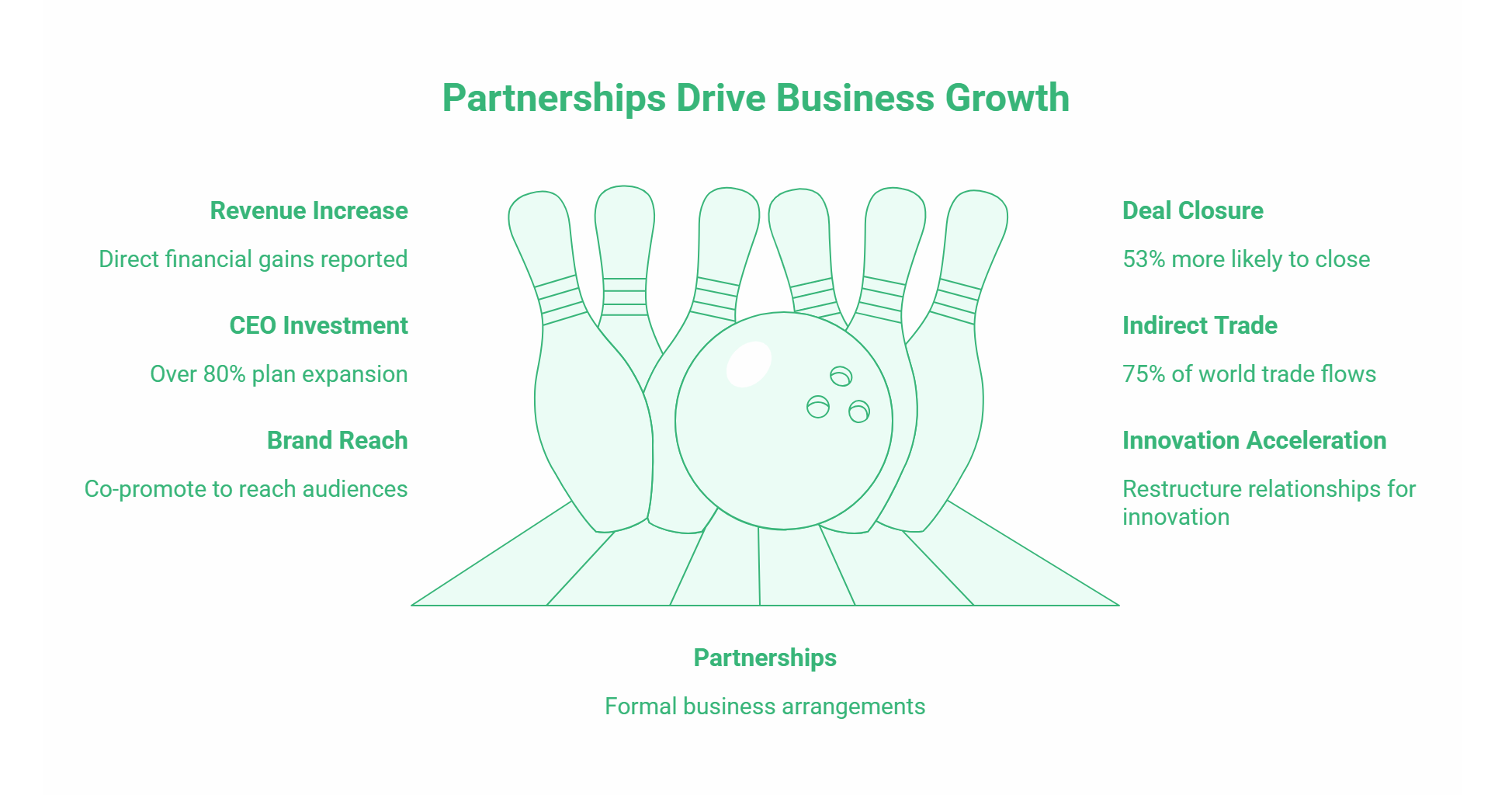
The growth case for partnerships is well-supported by data. Roughly half of businesses that pursued formal partnership arrangements reported direct revenue increases as a result, making partnerships one of the more consistent growth levers available to companies of any size.
The mechanism is straightforward: a partnership extends your reach into markets, customer segments, or distribution channels that would take significantly longer and cost significantly more to build independently. This is particularly relevant for SMEs, where the internal resources to open new markets organically are limited.
The Deal Closure Effect
One of the more striking statistics in partnership research is the deal closure rate. Partnerships make deals 53% more likely to close, according to data from Crossbeam’s State of the Partner Ecosystem report. The reason is not simply warm introductions. It is the added credibility, contextual knowledge, and combined relationship capital that a partner brings to a sales process.
For B2B businesses in Northern Ireland and the wider UK market, this is worth taking seriously. A strategic referral partner who already has trust with your target customer base can compress your sales cycle considerably.
B2B Leaders and Partnership Investment
Over 80% of US CEOs had plans to create or expand strategic business partnerships, according to a PwC CEO survey. While that figure dates from 2014, the direction has only accelerated. The rise of platform economies, SaaS distribution models, and channel partner programmes across professional services have all reinforced partnerships as a primary growth mechanism for B2B businesses.
Indirect Trade and Partner Channels
Approximately 75% of world trade flows indirectly, meaning it moves through intermediaries, agents, distributors, and partner networks rather than through direct manufacturer-to-buyer relationships. This is not a niche arrangement. It is the dominant structure of global commerce. For businesses looking to scale beyond their immediate geography, understanding how indirect channels work is a practical requirement.
Partnership Marketing and Brand Reach
Partnership marketing, where two businesses co-create or co-promote to reach each other’s audiences, has proven particularly effective for high-growth brands. The value is in audience access. A partnership with a business that already has the attention of your target customer is faster and often cheaper than building that audience from scratch through advertising or content alone.
Partner websites also play a direct role in consumer purchasing decisions. Buyers routinely visit two or three non-retail sites before committing to a purchase, using partner content to validate choices and build confidence in suppliers.
Innovation in the Technology Sector
Partnerships have become one of the primary mechanisms for innovation in the technology industry. IDC research has projected that the majority of technology businesses would restructure their partner relationships specifically to accelerate innovation, driven by the rising cost of in-house research and development and the speed at which new capabilities need to be absorbed.
The pattern applies well beyond pure technology companies. Any SME integrating new digital tools into its operations is, in effect, operating within a partner ecosystem, whether or not it uses that language.
The Failure Rate: Why Most Partnerships Disappoint
The headline figure is stark: around 70% of business partnerships fail to meet their stated objectives. That number has remained broadly consistent across multiple studies over two decades. It is not improving, which suggests the problem is structural rather than circumstantial.
The failures cluster around a predictable set of causes.
Unequal commitment. One party treats the partnership as a priority; the other treats it as an option. This imbalance becomes visible within months and corrodes the relationship before any significant value has been created.
Misaligned values and goals. Partners who agreed on a headline goal often disagree on how to pursue it, how to measure progress, and how to resolve disputes. These gaps, when not addressed in the partnership structure, become conflicts later.
Personality and cultural clashes. Particularly relevant in partnerships between businesses of different sizes, or between businesses operating in different national or sector contexts. The operational cultures that make each business successful independently can be genuinely incompatible.
Poor post-agreement activity. The quality of a partnership is determined more by what happens after the agreement than by the quality of the agreement itself. Governance, regular review, and clear accountability structures are the infrastructure that keep a partnership functional. Without them, even well-intentioned partnerships drift.
Mixing personal and professional relationships. Partnerships founded primarily on personal relationships between founders or directors carry a specific risk: when the personal relationship changes, the partnership has no independent structure to fall back on.
Less than 40% of business partnerships are still active after four years. That figure, from research published in the Harvard Business Review, points to something important: the difficulty is not forming partnerships but maintaining them. The first year tends to be high-energy and high-commitment. The third year, when the relationship requires deliberate reinvestment rather than initial enthusiasm, is where most partnerships quietly expire.
The Challenges of Managing Strategic Partnerships
The data on partnership management challenges is consistent with the failure rate data. The problems are known; they are simply harder to solve than most businesses anticipate.
Channel Programme Effectiveness
70% of channel sales managers report significant difficulties with data integration across their partner programmes, according to research by Channelinsight. When you cannot see partner performance clearly, you cannot manage it effectively. This is a technology problem as much as a management one, and it is one reason why partner relationship management (PRM) software has grown into a significant category.
Channel conflict is the other persistent issue. When partners compete with each other, or with the company itself, over the same customer segments, the partnership structure creates the problem rather than solving it. Clear territory definitions and deal registration processes are standard responses, but they require governance capacity that many SMEs do not have at the point of setting up their first channel programme.
Recruiting and Keeping the Right Partners
45% of executives identify maintaining connected, mutually rewarding partnerships as one of their biggest challenges, according to partnership management research. This points to a common pattern: businesses invest heavily in recruiting partners and relatively little in the ongoing work of keeping those partnerships active and valuable.
The recruitment problem is partly about selection. Choosing partners whose customer base, values, and operational approach align with yours reduces the ongoing management burden considerably. Choosing partners quickly because growth targets demand it produces the opposite outcome.
Lack of Formal Partnership Strategy
39% of companies have no formal strategy for managing their business partnerships. This is a significant gap. Without a documented approach covering partner selection criteria, onboarding processes, performance metrics, and exit conditions, partnerships are managed reactively. When problems arise, there is no agreed framework for resolving them.
Partnership managers typically spend around 35% of their working time on partner discovery alone, according to data from partnership management platform PartnerStack. That is time not spent on activating and developing existing partnerships. The implication is that many businesses would benefit from investing more in partner activation and less in perpetual partner recruitment.
Partner Ecosystems: The Data on Scale and Risk
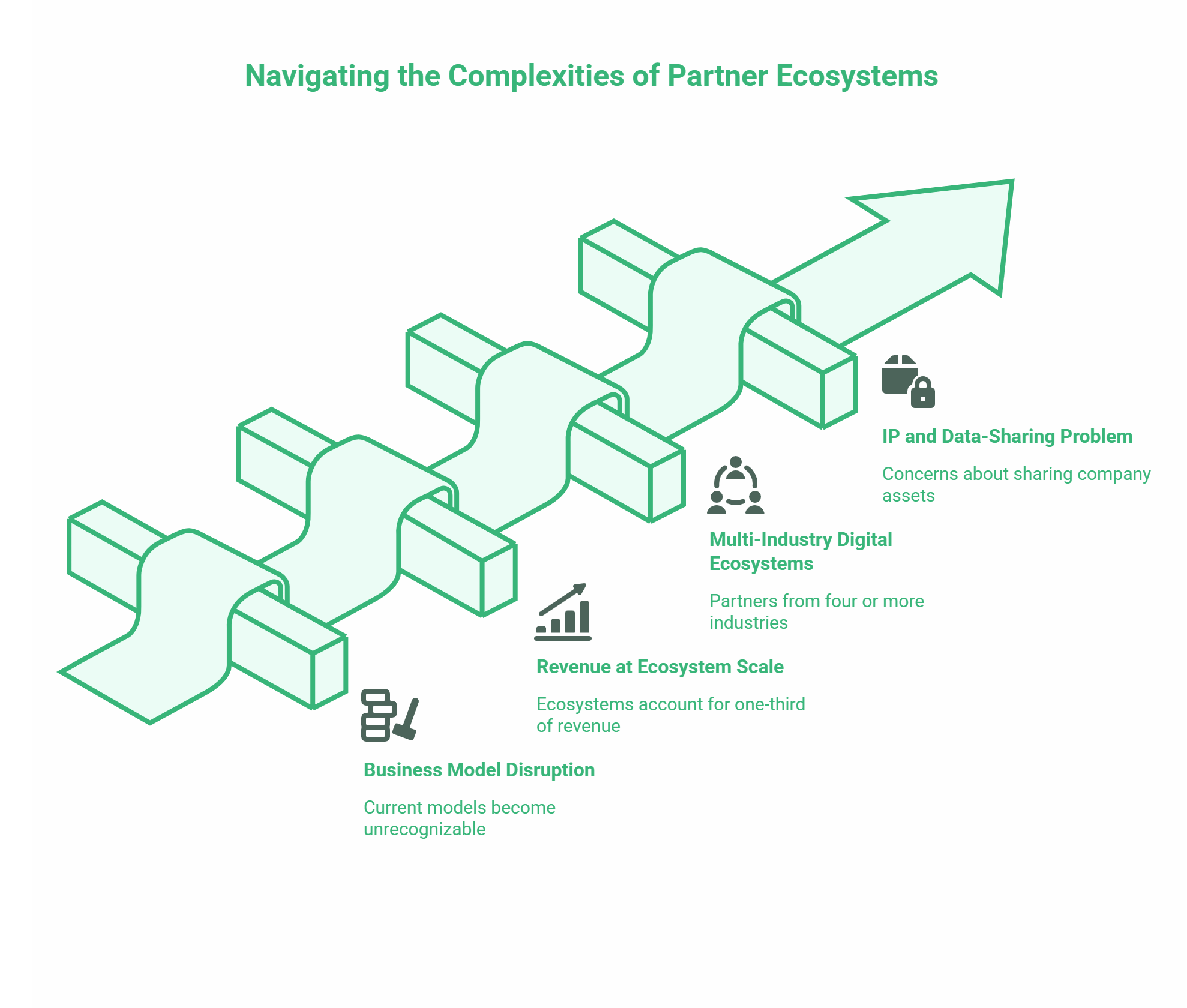
The bilateral business partnership of two companies working together is giving way to something more complex: multi-party digital ecosystems where value is created through networks of relationships rather than single alliances. The data on this shift is significant.
Ecosystems and Business Model Disruption
76% of business leaders believe that partner ecosystems will make current business models unrecognisable within a decade, according to research by Accenture. That is not a marginal view. It reflects the experience of sectors already transformed by platform economies: retail, transport, media, and financial services.
For businesses outside those sectors, the practical implication is that the question of who to partner with is increasingly also a question of which ecosystem to participate in. The ecosystem defines much of the competitive context.
Revenue at Ecosystem Scale
Partner ecosystems are forecast to account for approximately one-third of global revenue by 2030, representing around $80 trillion, according to McKinsey analysis. Even accounting for the imprecision inherent in projections of this scale, the direction is clear. The share of economic activity flowing through ecosystem structures is growing, not stabilising.
Microsoft provides the most cited example: approximately 95% of the company’s commercial revenue flows through its partner ecosystem rather than direct sales. This is not a coincidence of the business model. It is a deliberate architecture built over decades.
Multi-Industry Digital Ecosystems
83% of digital ecosystems involve partners from four or more different industries, according to Accenture research. This cross-industry composition reflects how digital platforms create value: by connecting participants who would not otherwise interact directly. For SMEs, the implication is that relevant partnerships may exist outside the obvious vertical. A Belfast-based professional services firm might find meaningful ecosystem partners in technology, training, or financial services as readily as in its own sector.
84% of companies rate ecosystems as important or very important to their overall strategy, according to BCG research. The gap between strategic intent and execution remains wide, but the direction of strategic attention is not ambiguous.
The IP and Data-Sharing Problem
92% of companies that have not yet built effective ecosystem relationships cite concerns about sharing company assets, intellectual property, and competitive information, according to Accenture research. This is a real barrier and not simply a risk management oversight.
Data sharing restrictions within ecosystems create genuine friction. The businesses that manage this most effectively tend to establish clear, contractual boundaries around what is shared, with whom, and for what purpose before the ecosystem relationship begins rather than attempting to retrofit protections after problems emerge.
What the Statistics Mean for SMEs
The aggregate picture from partnership data suggests a straightforward strategic conclusion: partnerships work well for businesses that invest in selecting and structuring them carefully, and work poorly for businesses that pursue them reactively.
For SMEs in Northern Ireland and the UK, several specific implications follow from the data.
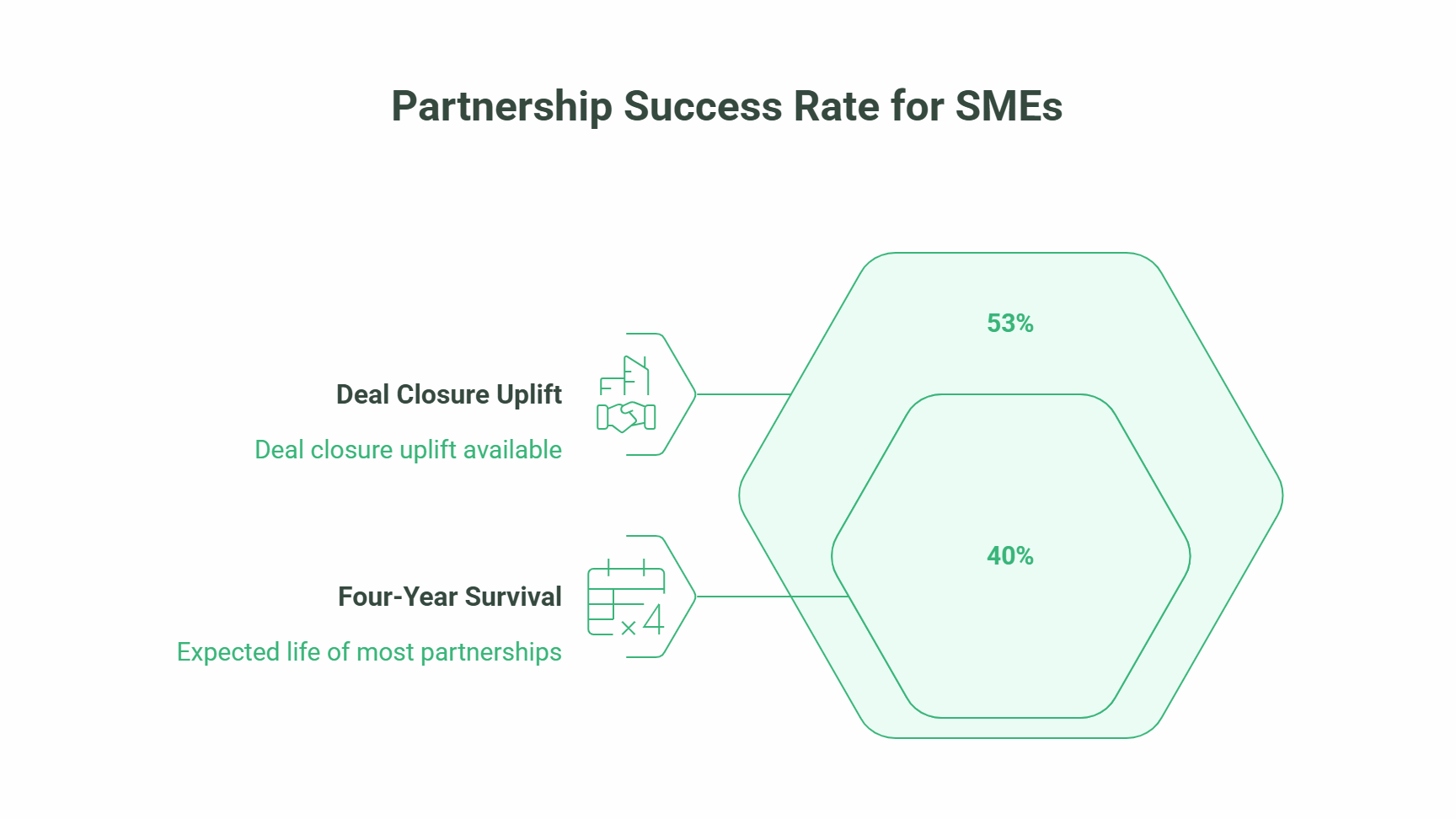
The 53% deal closure uplift is available to any business that can identify a credible referral or co-selling partner whose existing relationships overlap with its target customer base. This does not require a formal ecosystem. It requires one well-chosen partner and a workable agreement.
The 40% four-year survival rate means that the expected life of most partnerships is shorter than most business plans assume. Building in formal review points, clear performance metrics, and agreed exit conditions is not pessimistic. It is the practice that distinguishes the partnerships that last from the ones that quietly fade.
The ecosystem data points toward a longer-term strategic question: which platforms and networks is your business participating in, and is that participation structured to deliver value or simply to maintain presence? For most SMEs, the honest answer is that ecosystem participation is passive rather than deliberate.
Ciaran Connolly, founder of ProfileTree, puts it directly: “The businesses we work with that get the most from partnerships are the ones that treat them like a product. They define what success looks like before they start, they build in ways to measure it, and they’re willing to end partnerships that aren’t working rather than hoping they’ll improve. The ones that struggle treat partnerships as a networking exercise and then wonder why nothing materialises.”
ProfileTree works with SMEs across Northern Ireland, Ireland, and the UK on digital strategy, including how to position partnership and referral programmes within a broader digital marketing strategy. If your business is planning to build or restructure its partnership approach, a clear digital presence that supports partner credibility is one of the foundations worth getting right first.
Frequently Asked Questions
What percentage of business partnerships fail?
Around 70% of business partnerships fail to meet their original objectives. The failure rate has remained broadly consistent across multiple studies. The primary causes are unequal commitment between partners, misaligned goals, poor governance structures, and insufficient planning before the agreement is signed. Fewer than 40% of partnerships are still active after four years.
How do business partnerships increase sales?
Deals that involve a partner are 53% more likely to close than those pursued through direct sales alone. The mechanism is not simply warm introductions. A partner adds credibility, contextual knowledge, and relationship capital to the sales process. For B2B businesses in particular, a partner who already has trust with the target buyer can reduce the sales cycle significantly.
What are the main challenges in managing business partnerships?
The three most commonly cited challenges are: maintaining active, mutually rewarding relationships over time (identified by 45% of executives as a primary difficulty); data integration across channel programmes (a problem for 70% of channel sales managers); and the absence of a formal partner management strategy, which affects 39% of companies. Most partnership failures are attributable to governance gaps rather than a fundamental incompatibility between partners.
What is a partner ecosystem and why does it matter?
A partner ecosystem is a network of businesses that create value together through structured relationships, typically built around a platform or shared infrastructure. Unlike a bilateral partnership between two companies, an ecosystem involves multiple parties, often from different industries. Partner ecosystems are forecast to account for approximately one-third of global revenue by 2030. 76% of business leaders believe ecosystems will fundamentally change current business models within a decade.
How should an SME approach forming a business partnership?
Start with selection criteria rather than targets. Define what a good partner looks like in terms of customer overlap, values, operational approach, and strategic goals before beginning outreach. Build the governance structure before you need it: agreed performance metrics, review cadence, and exit conditions. Allocate resources to partner activation, not just partner recruitment. Most partnerships underperform not because the partners were wrong for each other but because neither party invested in making the relationship work after the initial agreement.
What is the difference between a strategic partnership and a channel partnership?
A strategic partnership typically involves a deeper, longer-term collaboration between two businesses with shared goals, often including co-development, joint go-to-market activity, or shared investment. A channel partnership is more transactional: one business resells, refers, or distributes the products or services of another in exchange for a commercial arrangement. Both types appear in the partnership statistics literature, and both have significant failure rates. The governance requirements for strategic partnerships are generally higher because the stakes and the complexity are greater.