
Market Penetration Strategy: A Guide for UK SMEs
Table of Contents
Most SMEs assume that growth means launching a new product or chasing a new market. A market penetration strategy takes the opposite approach: it wins a bigger share of the market and customers you already understand, using the product or service you already offer. For a business with a limited budget and a proven offer, this is usually the fastest, lowest-risk route to more revenue.
This guide covers what a market penetration strategy actually is, how to calculate your current penetration rate, which tactics work for UK and Irish SMEs and where the approach carries real risk.
What Is a Market Penetration Strategy?
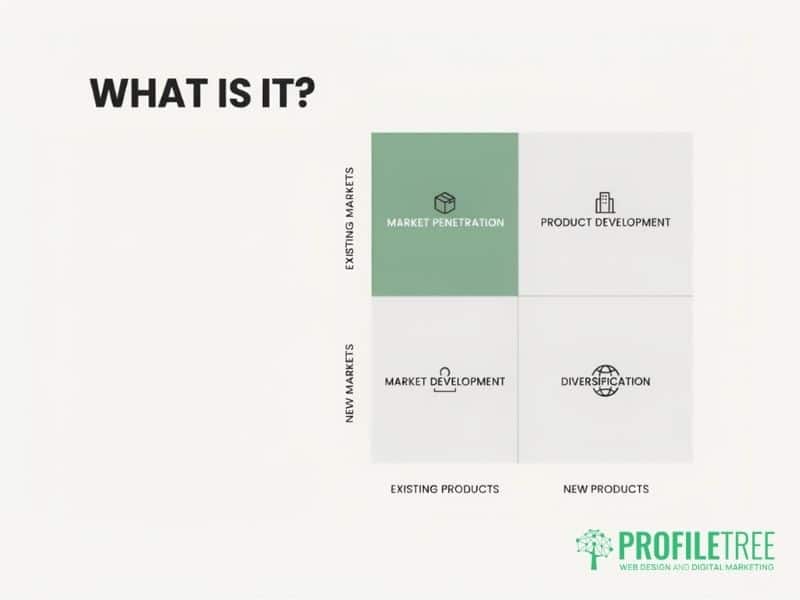
A market penetration strategy is a plan for increasing the share of an existing market that your business captures. You’re not changing the product, and you’re not entering a new market. You’re competing harder in familiar territory, either by taking customers from competitors or by converting people in your target market who haven’t yet bought from anyone.
This distinguishes penetration from almost every other growth conversation an SME has. Launching a new service or targeting a new region both feel more ambitious, but they also carry more risk and a longer payback period. Penetration works with what you can already prove: an existing product that customers already buy, sold to more of the people who already fit your ideal customer profile.
The concept sits inside the Ansoff Matrix, a growth planning framework developed by Igor Ansoff in 1957. The matrix maps four growth options against two variables: whether the product is new or existing, and whether the market is new or existing.
Where Penetration Fits in the Ansoff Matrix
Market penetration occupies the lowest-risk quadrant of the four, which is why it tends to be the sensible starting point before an SME considers a costlier growth path.
| Strategy | Product | Market | Risk Level |
|---|---|---|---|
| Market Penetration | Existing | Existing | Lowest |
| Product Development | New | Existing | Medium |
| Market Development | Existing | New | Medium |
| Diversification | New | New | Highest |
For SMEs in competitive UK and Irish markets, the appeal is straightforward. Entering a new geography or launching a new product line is difficult to justify without a proven base to build from, whereas a penetration strategy builds on evidence you already have about what works.
How to Calculate Your Market Penetration Rate
Before building a strategy, you need a baseline. The market penetration rate formula is simple:
(Number of your customers ÷ Total addressable market size) x 100 = Market penetration rate (%)
Take a digital marketing agency in Belfast with 40 active clients. If the total addressable market, meaning the number of SMEs in Northern Ireland actively spending on digital marketing services, is 2,000 businesses, the agency’s penetration rate is 2%.
Whether that’s good or bad depends entirely on the category. Business-to-business services typically sit at 2 to 6%. Consumer products often reach 10 to 40%. Market leaders in mature categories can exceed both ranges by a wide margin, but for most SMEs the realistic goal is incremental: moving from 2% to 4%, or from 8% to 15%, within a defined, winnable segment rather than chasing an entire national market.
The harder part of the calculation is usually defining the total addressable market accurately. A software product with a global user base is close to impossible to penetrate meaningfully as a single figure, so it’s worth narrowing the definition before you trust the number. A detailed customer segmentation exercise that narrows the market by trade, geography, company size and spend makes the metric genuinely useful rather than a vanity number. Recalculate after each major campaign so you have a working trend, not a one-off snapshot.
Market Penetration Strategies for UK Businesses
These tactics range from pricing decisions to digital channel investment, and most SMEs combine several rather than relying on one.
Penetration Pricing
Entering or competing at a lower price point lowers the barrier to switching. Lidl and Aldi built significant UK grocery market share this way over two decades, competing on price against established players. The risk is margin pressure if prices can’t rise later as the brand matures, so penetration pricing works best as a time-limited acquisition tool rather than a permanent position.
Visibility Through Search and Content
For most UK SMEs, becoming more visible to the part of the market that has not yet chosen you is the most accessible penetration tactic. Ranking on page one for a category search in your area, such as “commercial cleaning Northern Ireland,” captures a share of that search market every month without ongoing per-click cost. A business that moves from position eight to position two for a high-intent local keyword has measurably increased its market penetration before a single sale has changed hands. A competitor gap analysis in search shows who currently owns that visibility and where the openings are.
Product and Service Improvements
Winning more of the same market doesn’t always require a new product. Improving reliability, adding functionality, or tightening service delivery can win customers who were previously choosing a competitor because of one specific gap. In B2B services, this works particularly well: a web development agency that introduces a faster turnaround guarantee or a more structured post-launch support package may attract clients who left a competitor over exactly that shortfall.
Loyalty and Retention
Increasing what existing customers buy from you is also market penetration. Tesco’s Clubcard is the most cited UK example, but the principle scales down easily. A structured loyalty or referral initiative that turns one satisfied customer into two increases penetration without a single new lead being bought, and it’s almost always cheaper than acquisition.
Distribution Channel Expansion
Reaching more of the same market through additional channels is a direct penetration tactic. A business selling only through its own website that adds a marketplace presence, or a B2B provider moving from direct sales only to a self-serve digital option, accesses parts of the existing market it was not reaching before. For service businesses, this often means adding a YouTube channel that answers questions potential clients are already searching for, or a content programme that captures search traffic at different stages of the buying journey.
Strategic Partnerships
Working with a non-competing business that serves the same audience is a cost-efficient route to penetration. A digital training provider partnering with a local enterprise agency to deliver workshops reaches part of the SME market it could not reach alone, without the cost of building that audience from nothing.
UK and Ireland Case Studies in Market Penetration
The clearest examples of market penetration in the UK come from retail and financial services, where the tactics are visible and well-documented.
Lidl and Aldi’s expansion against Tesco, Sainsbury’s, and Asda is the standard UK penetration case study: same grocery market, same basic product range, won through price positioning and consistent store rollout rather than a new format. Tesco’s Clubcard shows the retention side of the same coin, deepening spend within an existing customer base rather than chasing new shoppers. Challenger banks such as Revolut grew UK market share largely through low-friction sign-up and referral mechanics rather than traditional advertising spend, a model that smaller service businesses can borrow from at a much smaller scale through their own referral schemes.
None of these examples required a new product. Lidl and Aldi still sell groceries, Tesco still runs supermarkets, and Revolut still offers a current account and card. The lesson for a smaller SME is not the scale of these campaigns but the discipline behind them: each business picked one lever, price, retention, or friction, and pushed on it consistently rather than spreading effort across several tactics at once.
Market Penetration vs Market Development
These two Ansoff quadrants get confused often because they both involve an existing product. The difference is the market you are targeting.
| Market Penetration | Market Development | |
|---|---|---|
| Product | Same | Same |
| Market | Same (existing) | New (geography, segment, or channel) |
| Risk | Low | Medium |
| Investment | Moderate | Higher |
| Primary goal | Win more of what you already serve | Reach new audiences with an existing offer |
| UK example | A Belfast accountancy firm targeting more SMEs in its existing client sectors | The same firm expanding into the Republic of Ireland market |
For most early-to-mid-stage SMEs, penetration is the right move before development. A useful test: if you haven’t reached a mid-range penetration rate for your category, roughly 10%+ for a defined B2B geography, there’s almost certainly more to win where you already operate before you spend on entering somewhere new.
B2B vs B2C: Adapting the Strategy for Service Firms
Most market penetration writing defaults to consumer products, which doesn’t map cleanly onto professional and B2B services.
For a B2C business, penetration is largely about acquisition volume: more customers buying the same product at the same price point. For a B2B service business such as a law firm, accountancy practice, or agency, penetration is often better measured as share of wallet within existing accounts rather than raw customer count. A firm that already serves a client’s accountancy needs but not its payroll or advisory work is under-penetrated within that single account, and cross-selling into it carries a lower acquisition cost than winning a brand new client.
Service firms also tend to sell through relationships rather than a single transaction, so penetration gains compound slowly and are easy to under-report. A quarterly review, timed alongside normal financial reporting cycles, keeps the target current rather than something you check once and forget. It also gives a business owner an early signal when a previously reliable account is quietly buying elsewhere, which is often the first sign that a competitor has found a gap worth exploiting.
Risks and Limitations of Market Penetration
Market penetration is the lowest-risk Ansoff quadrant, but it isn’t risk-free.
Price wars are the most common hazard. If your tactic is primarily price-led, a better-capitalised competitor can match or undercut you, and a small business is rarely positioned to win that fight over time. Penetration pricing should open a door; it shouldn’t become a permanent position.
Operational capacity is the second risk: a successful push that generates more demand than you can service damages the reputation the campaign was meant to build, so delivery, onboarding and customer service processes need checking before any campaign scales. Market saturation matters too. Some markets are genuinely crowded, and the cost of winning additional share eventually exceeds the return, at which point moving from penetration to development becomes the more sensible strategy.
Digital Channels as Market Penetration Tools for SMEs
Most of the tactics above now have a digital execution layer, and that’s what matters most for smaller businesses working with constrained budgets.
Digital activity is measurable in ways traditional marketing is not. You can track how your share of search impressions changes month on month and see whether content is reaching the right segment, which makes it possible to tie specific activity directly to penetration rate. The cost is also lower: a structured SEO and content programme typically delivers a better return than opening a new office or launching a new product line, particularly once a piece of content or a ranking position keeps delivering market access indefinitely rather than stopping when a campaign budget runs out.
A hyper-local focus works well within this. Rather than trying to penetrate a broad market thinly, concentrating on a smaller segment where dominance is achievable, such as one postal district or one industry vertical, produces a genuinely high penetration rate faster than competing everywhere at once.
Referral and community-led growth extends the same logic: existing customers are the lowest-cost channel for winning new ones in the same market, and this is particularly effective in tight-knit sectors where reputation moves quickly. Finally, positioning against a specific competitor weakness, whether that is response time, post-sale support, or niche expertise, gives a smaller business a defensible angle rather than competing on every dimension at once.
How ProfileTree Supports Market Penetration for UK and Irish SMEs
ProfileTree, a Belfast-based digital agency, works with SMEs across Northern Ireland, Ireland and the UK on the execution side of market penetration strategies, typically some combination of search visibility, content and training.
For a business with a clear target market but limited digital presence, improving organic search performance is often the highest-value starting point. A business that’s absent from the first page of Google for its core service in its primary geography is handing that share to competitors who do rank.
Where visibility already exists but isn’t converting into clients, the gap is usually further down the funnel: website performance and conversion path rather than search rankings. Improving that path can increase effective market penetration from the same volume of existing traffic. For businesses that want in-house capability rather than an outsourced arrangement, ProfileTree’s digital training programmes build the skills to run SEO, content and social campaigns independently.
As Ciaran Connolly, founder of ProfileTree, puts it: “Most SMEs we work with are not short of a market to sell into. They are short of visibility within a market they already understand, and that is a fixable problem long before it is a product problem.”
Building Your Market Penetration Roadmap
Start by calculating your current rate and defining your addressable market as precisely as you can. Identify which of the tactics above is realistic given your budget and delivery capacity, rather than attempting all of them at once. A website and search audit is a practical way to see where your current visibility gaps sit before committing to a specific channel.
Winning a larger share of a market you already understand, with a product you have already proven, is usually the lower-risk and lower-cost path to growth. Calculate your rate, identify where the gap between your position and your competitors is widest and focus your resources on closing it before looking for new markets to enter. Get in touch with ProfileTree to talk through where your penetration gaps are.
FAQs
1. What is a market penetration strategy?
It’s a plan to win more of an existing market with an existing product, either by taking customers from competitors or converting people who haven’t yet bought from anyone. It sits in the lowest-risk quadrant of the Ansoff Matrix.
2. How do you calculate a market penetration rate?
Divide your number of customers by your total addressable market size, then multiply by 100. The harder step is usually defining the addressable market accurately by trade, geography and company size.
3. What is a good market penetration rate for a small business?
For B2B service businesses, 2 to 6% in a clearly defined market is typical. Reaching 10% or above in a well-defined segment is a strong position. The context of the market matters more than the number on its own.
4. How is market penetration different from market development?
Penetration means winning more customers in the market you already serve with your existing offer. Development means taking that same offer into a new geography, segment, or channel, which carries a higher risk and investment.
5. Is penetration pricing a sustainable long-term strategy?
Rarely on its own. It works best as a short-term acquisition mechanism, paired with a retention model that normalises pricing once a customer is established, since competing on price permanently attracts buyers who leave for the next cheaper option.