
How to Build an SEO Content Strategy: A Practical Guide for SMEs
Table of Contents
Most small businesses across Northern Ireland, Ireland and the UK already publish content. Blog posts go up, social updates get scheduled, and the odd video lands on YouTube. Yet the traffic stays flat and the leads never quite arrive. The gap is almost never an effort. It is the absence of a content strategy that ties every piece of content to a clear search intent and a clear business goal.
An SEO content strategy is a structured plan for deciding what content to create, how to optimise it for search, and how to measure whether it earns organic traffic or supports sales. It connects keyword research, audience needs and publishing decisions into one system, rather than leaving content to chance. That definition matters because the businesses that treat content as a planned asset consistently outperform those treating it as a weekly chore.
This guide walks through a six-step framework you can apply to your own site, with examples drawn from how SMEs in Belfast, Dublin and across the UK actually operate. It also covers two areas most published guides skip: how AI search engines now decide what to cite, and how cross-border targeting works when your market spans both the UK and the Republic of Ireland.
What an SEO Content Strategy Is and Why It Matters
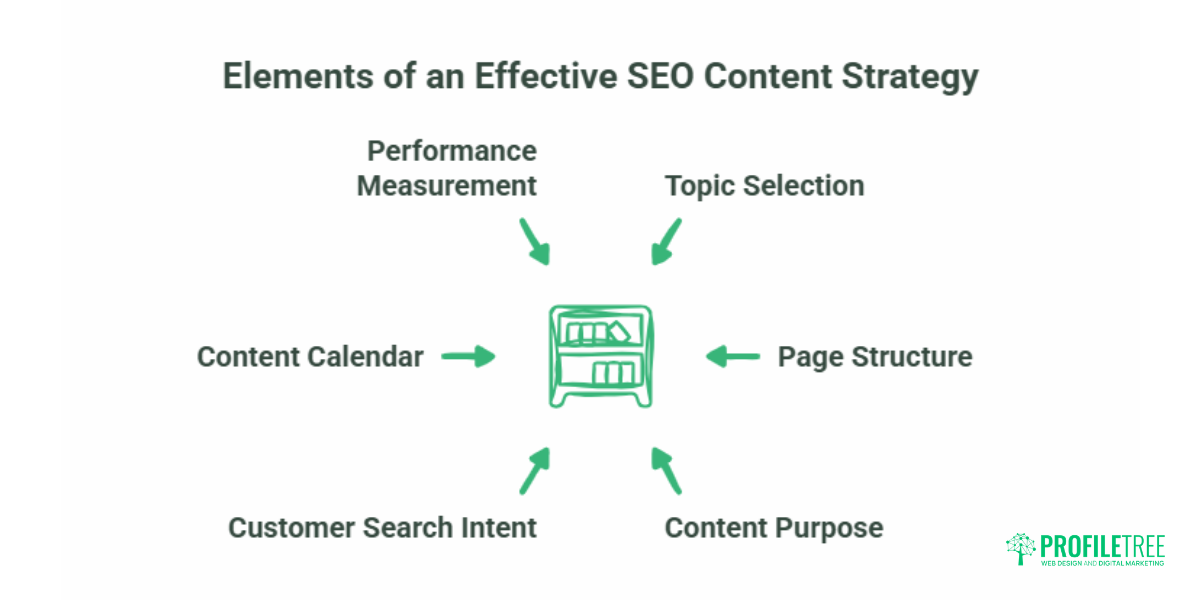
An SEO content strategy decides which topics you cover, how each page is structured, and why each piece exists, all anchored to what your customers actually search for. A content calendar tells you when to publish. A strategy tells you what to publish and why it will earn a return.
The distinction trips up a lot of business owners. Posting consistently feels productive, and consistency does matter, but volume without direction produces pages that rank for nothing and convert no one. The GSC data behind this very topic shows the pattern clearly: thousands of impressions for terms like “content strategy efficiency” and “online content strategy”, yet barely any clicks. Visibility without a plan to capture intent is wasted reach.
For SMEs, the stakes are higher than for large brands. You have a smaller team, a tighter budget and less room for content that does not pull its weight. A strategy forces every piece to justify itself: does it earn organic traffic, support a service you sell, or build authority in your field? If it does none of those, it should not exist. ProfileTree’s content marketing work with local businesses starts from exactly this question.
Content Marketing vs SEO Strategy: How They Differ
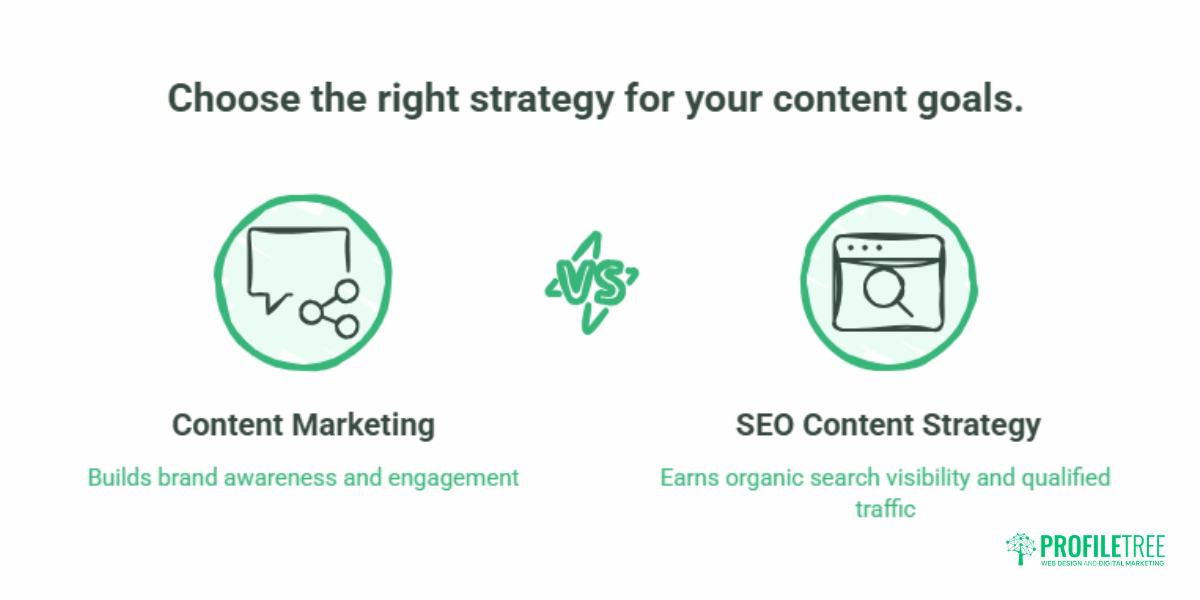
Content marketing and SEO strategy overlap, but they are not the same discipline. Confusing them leads to content that is either creative but invisible or technically sound but lifeless.
| Vector | Content Marketing | SEO Content Strategy |
|---|---|---|
| Primary objective | Build brand awareness and engagement | Earn organic search visibility and qualified traffic |
| Main channels | Social, email, PR, owned blog | Search engines and AI answer engines |
| Core KPIs | Reach, shares, engagement, sentiment | Rankings, organic clicks, conversions, citations |
| Typical formats | Video, social posts, newsletters, guides | Pillar pages, how-to guides, comparison content, FAQs |
| Shelf life | Often short, campaign-led | Long, evergreen, when maintained |
In practice, the two work best together. A strong piece of content marketing earns the shares and links that improve search performance, while an SEO content strategy makes sure that content is built to be found in the first place.
The Three Pillars of an SEO Content Strategy
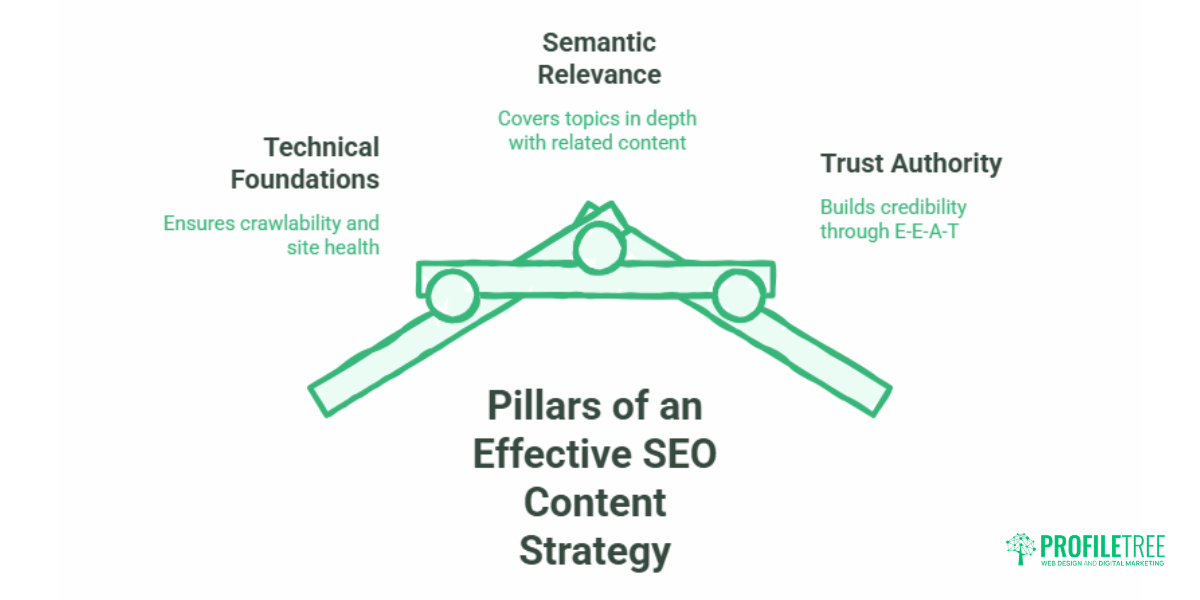
Every effective SEO content strategy rests on three pillars: technical foundations, semantic relevance and trust authority. Get one wrong, and the other two cannot carry the weight.
Technical foundations cover crawlability and site health: can search engines and AI crawlers reach, read and index your pages? Slow load times, broken internal links and pages buried five clicks deep all undermine otherwise good content. This is where your content strategy meets your website development and website hosting and management, because a fast, well-structured site is the platform everything else sits on.
Semantic relevance is about topic depth, not single keywords. Search engines reward sites that cover a subject thoroughly through clusters of related content, rather than one thin page chasing one term. Grouping your pages into topic hubs signals genuine expertise.
Trust authority maps to E-E-A-T: experience, expertise, authoritativeness and trustworthiness. Real author credentials, accurate sourcing and a clear business identity all feed this. Google’s February 2026 update made author credentials a first-class ranking input, so naming who wrote a piece and why they are qualified is no longer optional.
Step 1: Audit Your Existing Content and Build Topical Authority
Before producing anything new, audit what you already have. Most SMEs are sitting on years-old posts, and a content audit tells you which of those earn traffic, which could work, and which are dragging the whole site down.
Pull your data from Google Search Console and, if you use Bing, its equivalent reports. Look at clicks, impressions and average position for every page. A page with strong impressions but no clicks, like this topic’s “content strategy efficiency” term sitting at position 53, is appearing in search but never getting chosen. That is a fixable problem, not a reason to delete.
Categorising Assets: Keep, Update, Consolidate or Remove
Sort every page into one of four buckets. Keep the pages earning traffic and conversions, and leave their URLs alone. Update pages with potential, those ranking on page two or three for relevant terms, by improving depth and structure. Consolidate thin pages that compete with each other for the same keyword, merging them into one stronger asset. Remove pages that are off-topic, outdated and unfixable.
This auditing discipline is the backbone of how we approach search engine optimisation for clients. It is unglamorous work, but it usually produces faster gains than writing new content, because you are recovering authority you already hold. ProfileTree’s own guide to measuring content marketing success tracks the same principle from the reporting side.
Step 2: Define Your Audience and Map Regional Intent
Once you know what you have, define who you are writing for. Build simple audience profiles covering the customer’s role, their problem, and the language they use to describe it. The phrasing matters: real searches like “how do you optimize content strategy?” and “how to improve content strategy” tell you exactly how people frame their needs, and your headings should echo that language.
For many SMEs here, audience definition includes a wrinkle the US-centric guides ignore entirely: you may be selling across two regulatory regions at once.
Handling Cross-Border Intent Across the UK and Ireland
A business in Belfast serving customers in both Northern Ireland and the Republic of Ireland is targeting two markets with different legal frameworks, different consumer expectations and sometimes different currencies. A Dublin-based searcher and a Belfast-based searcher might use the same words but operate under different rules, EU directives on one side of the border and UK regulations on the other.
For content, that means a single generic page often serves neither audience well. Where the search intent genuinely differs, separate pages targeting each region can outperform one catch-all. A solid digital marketing strategy settles this question before you write, deciding where to localise and where one page will do. Forcing duplicate pages that only swap a city name, though, gets you nowhere; the content has to be meaningfully different.
Zero-Search-Volume Keywords for High-Value Niches
Keyword tools often report “0” volume for highly specific B2B terms. In regional and specialist markets, that figure is misleading. A term that a tool says nobody searches might be searched ten times a month by exactly the ten companies you want as clients. For SMEs in niche sectors, these low-volume, high-intent terms are frequently worth more than any head term, because the searcher is already qualified.
Step 3: Conduct Keyword Research and Build Topic Clusters
With your audience mapped, move from broad seed terms to organised clusters. Start with the words your customers use, expand them with the questions they ask, then group everything into themes rather than treating each keyword as a separate page.
Grouping Keywords into Semantic Hubs
A topic cluster is one in-depth pillar page surrounded by several supporting articles, all linked together. The pillar covers the broad subject; each cluster page answers a specific sub-question and links back to the pillar. This structure concentrates topical authority and is one of the strongest signals you can send about genuine expertise. For a content strategy hub, the pillar might be this guide, with cluster pages on content audits, editorial calendars and content distribution all feeding into it.
Scoring Business Value Against Search Volume
Not every rankable keyword is worth chasing. Score each topic on how directly it connects to something you sell. A high-traffic term with no commercial link is a vanity target; a lower-traffic term that attracts buyers is gold. This is where keyword research meets honest commercial judgement, and where many content programmes go wrong by chasing traffic for its own sake.
Step 4: Structure Content for AI Search and Generative Engines
Search no longer means ten blue links. AI Overviews, ChatGPT, Gemini and Perplexity now answer questions directly, often citing a handful of sources, and getting cited requires a specific kind of structure. This is the area where most published guides lag, so it is worth getting right.
Securing Citations in AI Overviews and Chatbots
AI systems favour content they can parse and extract cleanly. Pages covering several sub-questions within one topic are far more likely to be cited than narrow ones. So are pages with clear tables, direct answers and self-contained sections. Statistics and first-hand data earn citations at a higher rate than vague qualitative claims.
Formatting for Extraction
Write the answer first, then the explanation. Open each section with a one or two-sentence direct response to the question that the heading implies, then expand underneath. Keep sections self-contained so a model can lift one without needing the rest of the page for context. Use tables for comparisons, keep paragraphs short, and make sure your most important content sits high on the page rather than buried at the bottom. These habits help human readers and AI crawlers in equal measure, which is the whole point.
Step 5: Execute With a Human-in-the-Loop Editorial Process
A strategy is only as good as the content it produces, and this is where most SMEs struggle to scale. The temptation is to lean on AI tools to churn out drafts cheaply. Done without oversight, that is a fast route to generic, unedited content that search engines increasingly ignore.
The fix is a human-in-the-loop workflow: use AI for research, outlining and first drafts, then put every piece through genuine human editing, fact-checking and the addition of real experience. This is precisely what we teach through digital training and what our AI training programmes are built around, helping teams use these tools well rather than badly.
Standardising Your Content Briefs
A good brief is the single biggest lever for quality. Before any writing starts, the brief should state the target keyword, the search intent, the headings, the internal links to include and the angle that makes the piece different. A clear brief stops freelancers and AI tools alike from producing bland, interchangeable copy. Tools like AI for enhancing marketing can speed up the research that feeds a brief, but the editorial judgement stays human.
Enforcing Quality and Cutting Generic AI Noise
Set a short quality bar every draft must clear: does it say something the top-ranking pages do not, is every non-obvious claim sourced, does it read as a person wrote it? Vary sentence length, cut filler, and add the local context and genuine opinion that generic content lacks. If a draft could have been written about any business anywhere, it would not have been finished.
Step 6: Measure Performance and Tie Content to Revenue
The final step closes the loop: measure what your content actually does, then feed that back into the strategy. Vanity metrics like raw page views tell you little. The numbers that matter connect content to outcomes.
Track three layers. Traffic metrics, organic clicks, impressions and average position show whether you are being found. Engagement metrics, time on page and shares show whether the content holds attention. Conversion metrics, leads, enquiries and sales show whether it pays. Google Search Console handles the first layer for free, and reviewing it monthly is enough for most SMEs to spot what is working.
The harder discipline is attribution: understanding which content touched a customer before they bought. Sales cycles for many B2B services run long, so a guide read in January may influence a deal closed in April. Customer lifetime value, not immediate conversion rate, is the truer measure of whether a content investment paid off. Content that attracts high-value clients can look slow on paper while delivering the best return overall.
Beyond your blog, your content strategy reaches into other channels, too. Repurposing a strong guide into a video marketing asset or a social media series multiplies its reach, and a well-built website gives all of it a fast, credible home.
How to Create Content People Actually Read
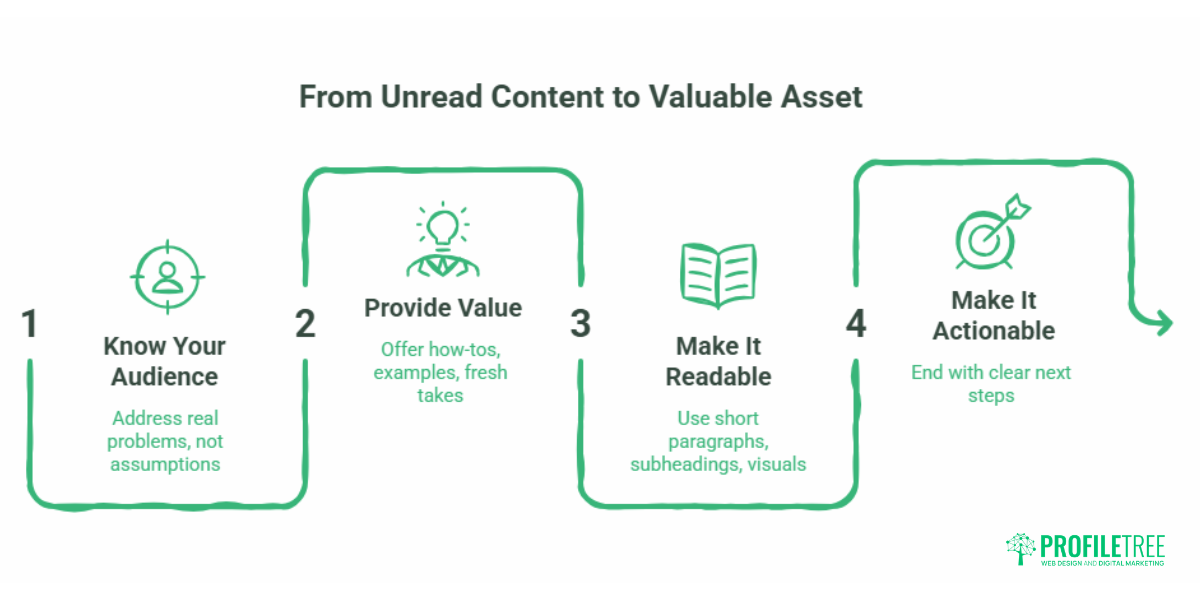
Strategy decides what to write; craft decides whether anyone finishes it. A few habits make the difference for SME content.
Know your audience well enough to write to their actual problems, not your assumptions about them. Lead with a headline that promises a clear benefit and skip the jargon. Provide genuine value in the body, whether that is a specific how-to, a real example or a fresh take, because educational content that solves a problem earns the engagement that thin content never will.
Make it easy to read. Short paragraphs, descriptive subheadings and clear sentences let people scan, which is how most read online. Use visuals where they add something: a process diagram, an annotated screenshot, a short video. Then make it actionable, ending sections with a clear next step the reader can take. Authenticity carries weight, too; content that sounds like a real person with real experience builds the trust that converts.
“After working with hundreds of businesses across the UK and Ireland, the same pattern shows up again and again. Companies creating content without a strategy waste enormous resources, while strategic content becomes their most valuable marketing asset. The difference between random content creation and a planned approach is measurable in traffic, leads and revenue.”
Ciaran Connolly, founder of ProfileTree
Frequently Asked Questions
What is an SEO content strategy?
An SEO content strategy is a structured plan for creating, optimising and organising web content so it ranks in organic search results and satisfies user intent. It connects keyword research, audience needs and publishing decisions into one system, rather than leaving content to chance.
What are the three pillars of an SEO content strategy?
The three pillars are technical foundations, semantic relevance and trust authority. Technical foundations cover crawlability and site health so search engines and AI crawlers can read your pages. Semantic relevance is topic depth built through clusters of related content rather than single keywords. Trust authority maps to E-E-A-T, supported by real author credentials, accurate sourcing and a clear business identity.
What is the difference between content marketing and SEO strategy?
Content marketing aims to build brand awareness and engagement across channels like social, email and PR. An SEO content strategy specifically optimises content to be found, parsed and ranked by search engines and AI answer engines. The two overlap and work best together, but their primary goals and main channels differ.
How does AI search affect my content strategy?
AI answer engines now respond to many queries directly and cite a small number of sources. To earn those citations, content must be structured for extraction: direct answers at the start of sections, self-contained passages, clear tables and first-hand data. Writing only for traditional blue-link rankings now leaves visibility on the table.
Is a content calendar the same as an SEO content strategy?
No. A content calendar is a scheduling tool that records when content is published. An SEO content strategy is the analytical framework that decides which topics you choose, how each page is structured and why it serves a business goal. The calendar executes the strategy; it does not replace it.
How long does an SEO content strategy take to show results?
Most businesses see meaningful organic movement within three to six months, though it varies. Existing domain authority, publishing frequency and how competitive your terms are all affect the pace. Sites with established authority and a regular publishing rhythm tend to see results sooner than brand-new domains.
Turning Content Into a Measurable Asset
A content strategy is not a document you write once and file away. It is the system that decides where your limited time and budget go, and it earns its keep by making every piece of content pull its weight. Audit honestly, write for genuine intent, structure for both readers and AI, keep humans in the editorial loop, and measure against revenue rather than vanity metrics.
For SMEs across Northern Ireland, Ireland and the UK, the businesses winning organic search are rarely the ones publishing the most. They are the ones publishing with a plan. If you want a steer on where your own content stands, ProfileTree analyses content performance and builds strategies designed around what your business actually sells.