
Customer Service Training: 5 Skills Great Courses Build
Table of Contents
Good customer service training builds five things: question technique, language control under pressure, ownership of a problem from start to finish, the confidence to handle a difficult conversation, and judgement about when an AI tool should hand a customer to a person. Courses that teach scripts instead tend to fade within weeks, because a script covers the situations someone anticipated and none of the ones that actually arrive. Format matters less than whether people practise, get feedback and are measured afterwards on something other than attendance. UK employers spent an average of £2,710 per person trained in 2024, so the question worth asking is not what a course costs but what changes in the three months after it.
What should customer service training actually cover?
Five skills, in roughly this order of value.
Question technique. Most service failures start with someone solving the wrong problem. Training people to ask a second and third question before offering an answer fixes more complaints than any amount of politeness coaching.
Language under pressure. Not scripted phrases, but the habit of describing what you can do rather than what you cannot, and of avoiding the words that escalate a call. This is learnable and it survives contact with real customers.
Ownership. One person holding a problem until it is resolved, including the part where they chase a colleague. Teams that pass customers sideways generate the complaints that teams with clear ownership never see.
Difficult conversations. Angry customers, refusals, bad news about a delivery date. This is the skill people most often lack and the one that most needs practice rather than slides.
Judgement about AI. Newer, and increasingly the difference between a service team that copes and one that frustrates people. Staff need to know what the chatbot or assisted reply tool is likely to get wrong, and when to take over. Teams building this literacy alongside their service skills tend to get there through practical digital training rather than a one-off briefing.
Everything else on a typical course agenda, product knowledge, systems, tone of voice guidelines, sits underneath those five. Useful, but not the part that changes how a customer feels at the end of a call.
Which training format suits your team?
The format that suits you depends on team size, shift patterns and how much practice the skill needs. No format wins outright.
| Format | What it does well | Where it falls down | Suits |
|---|---|---|---|
| In-person workshop | Role play, live feedback, difficult conversation practice | Takes the team off the floor, hard to repeat for new starters | Teams of five upwards learning a skill that needs rehearsal |
| Online or e-learning | Fits around shifts, repeatable for every new starter, low cost per head | Little practice, easy to click through without absorbing anything | Policy, product and process knowledge |
| On-the-job coaching | Feedback on real calls and real customers, so it transfers immediately | Depends entirely on whether the coach is any good at coaching | Small teams with an experienced lead |
| Blended | Knowledge online, practice in the room, reinforcement afterwards | More to organise, and the reinforcement is the part usually skipped | Most SMEs, if someone owns the follow-up |
Online is now the default for most UK employers who train. The Employer Skills Survey 2024, a survey of 22,712 employers run for the Department for Education and Skills England, found that 70 per cent of training employers had funded or arranged online training or e-learning, up from 67 per cent in 2022 and 51 per cent in 2017. Take-up is lowest in Northern Ireland at 61 per cent. That shift makes sense on cost and logistics. It also explains why so much service training now covers knowledge well and practice badly.
Why do scripts fail where skills hold up?
A script covers the situations someone imagined in advance. Customers turn up with the others.
Scripted teams sound identical and unravel the moment a call leaves the expected path, because nobody has been taught the underlying judgement. Skill-based training does the reverse: slower to land, harder to measure in week one, still working in month six. The practical test is whether your training gives people rules or gives them reasons. Rules break. Reasons travel.
This matters most in the sectors where customer contact is constant. The Employer Skills Survey found the highest density of skills gaps in Hotels and Restaurants, where 6.2 per cent of staff were judged by their employer to lack full proficiency, followed by Wholesale and Retail at 5.3 per cent. Those are the two most customer-facing sectors in the survey, and retail is among the sectors least likely to train.
How do you train people for difficult conversations?
By practising them, badly, in a room where it does not cost you a customer.
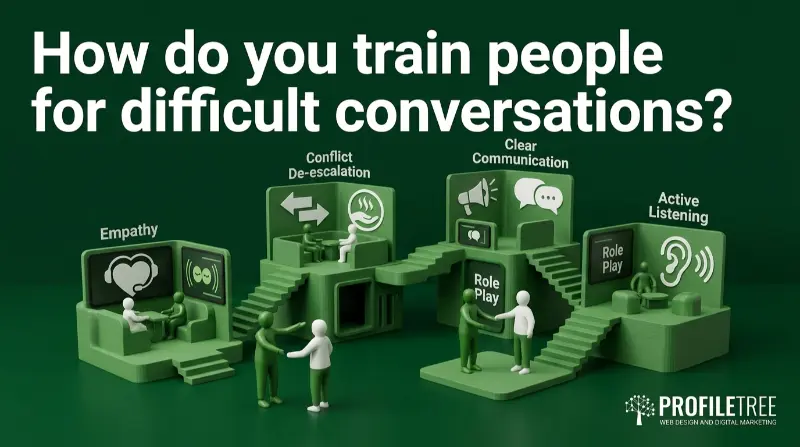
Reading about de-escalation changes nothing. What works is rehearsal: one person plays the customer, one handles it, everyone watches, and the group picks apart what happened to the conversation rather than what the handler should have said. Three rounds of that teaches more than a day of theory. Acas publishes a free guide to challenging conversations written for line managers, and the structure it sets out for staying in control of a conversation transfers directly to customer-facing situations.
Two things to build in. Give people explicit permission to say no, with a form of words they have practised, because staff who feel unable to refuse make promises the business then breaks. And agree in advance when a conversation gets handed to someone else, so escalation is a process rather than a personal failure.
How do you know whether the training worked?
Pick the measure before you book the course, not after.
Attendance and satisfaction scores from the day tell you whether people enjoyed themselves. Useful for the trainer, useless to you. Measure something that existed before the training and will exist after it: complaint volume, repeat contacts about the same issue, time to resolution, the proportion of enquiries settled without escalation, or a simple post-contact rating if you already collect one. Take a reading for the month before and the three months after.
Set expectations honestly while you are at it. UK employers provided 5.7 training days per person trained in 2024. Smaller sites did more, at 8.2 days per trainee among employers with two to four staff, though only 44 per cent of those smallest employers trained anyone at all. A single day of training is not going to move a number that has been stuck for two years, and anyone promising otherwise is selling.
Ciaran Connolly, founder of ProfileTree, puts the measurement problem plainly: “Nearly every business we talk to about service training has run some before. Almost none of them can tell you what changed afterwards, because nobody wrote down the number beforehand. Book the course second. Decide what you are trying to move first, and give it a quarter before you judge it.”
What is AI changing about customer service training?
It is removing the easy contacts and leaving your team the hard ones.
Where a chatbot or assisted reply tool handles the simple queries, the calls that reach a person are, by definition, the ones the machine could not settle: the angry, the unusual, the ones where something has already gone wrong twice. That raises the skill floor for the whole team rather than lowering it. Training that assumes staff spend their day on routine questions is now training for a job that has already changed.
Three things belong in the curriculum. What your AI tools get wrong, taught by example from real transcripts. When to take over, with a clear trigger rather than a judgement call under pressure. And how to pick up a conversation a machine started without making the customer repeat themselves. Teams that also want to use these tools well, rather than only recover from them, tend to pair service training with structured AI training so the two sides are learned together.
Employers are moving this way already. The proportion providing training in new technology rose to 50 per cent in 2024 from 46 per cent in 2022, one of several training categories to grow while overall provision fell.
What should you ask a training provider before you book?
Six questions, and the answers tell you more than the brochure.
- How much of the day is practice rather than presentation? Under half is a warning sign for anything involving difficult conversations.
- What happens in the four weeks afterwards? Reinforcement is where transfer either happens or does not.
- Can you train a new starter in six months’ time without repeating the whole course?
- What do you need to know about our customers before you write the material?
- What measure would you expect to move, and by when?
- Who delivers it, and have they done this job rather than just taught it?
Budget context helps you judge the quote. Employers spent an average of £2,710 per person trained in 2024 across all training types, and £6,260 per trainee at sites with two to four employees, where fixed costs spread across fewer people. Total UK training expenditure fell to £53.0 billion from £59.0 billion in 2022, in real terms, so the market you are buying in is shrinking, which is worth knowing when you negotiate.
For teams that want a structured route rather than a single course, Future Business Academy runs programmes that build these skills over time rather than in one sitting.
The short version
Customer service training works when it builds judgement rather than scripts, gives people practice at the conversations they dread, and is measured against a number that existed before the course. Format is secondary: online suits knowledge, in-person suits rehearsal, coaching suits small teams with a capable lead. The newest requirement is teaching staff to work alongside AI tools, because automation removes the routine contacts and leaves people the difficult ones. Figures on this page come from the Employer Skills Survey 2024, published by the Department for Education and Skills England, checked in September 2026.
Frequently Asked Questions
What should customer service training actually cover?
Question technique, language under pressure, ownership of a problem from start to finish, difficult conversations, and knowing when to take over from an AI tool. Product and systems knowledge matter too, but they are the easy part to teach and the part least likely to be missing.
How long should a customer service course be?
Long enough to include practice, which usually means at least half a day for anything involving difficult conversations. UK employers averaged 5.7 training days per person trained across all training in 2024, so a single half day is a start rather than a programme, and spacing shorter sessions over a few weeks tends to transfer better than one long day.
Is online customer service training any good?
It is well suited to policy, product and process knowledge, and it lets you train new starters without rebooking anything. It is weak where the skill needs rehearsal and feedback, which covers most of what people actually struggle with, so pair it with practice rather than treating it as the whole answer.
How do you measure whether customer service training worked?
Choose a measure before the course and read it for the month before and the three months after: complaint volume, repeat contacts about the same issue, time to resolution, or escalation rate. Satisfaction scores collected on the training day itself measure the trainer, not the change in your business.
Do small teams need formal training at all?
Small teams often need it more, because there is no one to learn from by osmosis and one person’s habits set the tone for every customer. Only 44 per cent of UK employers with two to four staff provided any training in 2024, and only 21 per cent of them provided supervisory training, which is why service standards in very small businesses tend to depend on whoever happens to answer the phone.
Should customer service training cover AI tools now?
Yes, because automation changes which contacts reach a person. Staff need to know what your tools get wrong, when to take over, and how to pick up a conversation a machine started, and none of that is obvious without being taught.
We sent the team on a customer service course and nothing changed. What did we do wrong?
Usually one of three things. The course taught scripts rather than judgement, so it stopped working the first time a customer went off-script; there was no reinforcement in the weeks afterwards, so people reverted to habit; or nobody measured anything beforehand, so a real improvement is invisible and a failure is unprovable. Before booking again, write down the number you want to move, tell the provider what it is, and plan what happens in the month after the training rather than only the day itself.
How much should a small business expect to pay for customer service training?
Quotes vary widely by format and group size, so treat published day rates as a starting point rather than a benchmark. For context, UK employers spent an average of £2,710 per person trained in 2024 across all training types, rising to £6,260 per trainee at sites with two to four employees, because the cost of a session spreads across fewer people.
What is the difference between customer service training and sales training?
Service training is about resolving a problem the customer already has, while sales training is about moving someone towards a decision they have not made yet. The skills overlap in listening and question technique, and they diverge sharply in pacing, because a service conversation goes wrong when it feels like it is being steered.
Getting it to stick
The course is the cheap part. Whether anything changes depends on what happens in the weeks after it, who reinforces it, and whether anyone is watching a number. ProfileTree works with businesses across Northern Ireland, Ireland and the UK on building that structure around training rather than selling a day and leaving, usually starting with what your customer contacts actually look like now.