
Automotive SEO: Helping UK Dealerships and Garages Rank
Table of Contents
So you’re comparing automotive SEO agencies and trying to work out which one actually understands a forecourt, not just a keyword spreadsheet. That’s the right question to ask. Automotive SEO for a UK car dealership or garage looks nothing like SEO for a solicitor or a restaurant: stock turns over weekly, manufacturer brand guidelines restrict what you can say, and half your customers are searching from a mechanic’s bay with a dead alternator, not a laptop.
ProfileTree, a Belfast-based web design and digital marketing agency, works with car dealers, independent garages, MOT stations and parts retailers across Northern Ireland, Ireland and the UK, providing car dealer SEO for showrooms and pointing aftermarket businesses towards the garage-specific support they need. This page sets out how automotive SEO actually works for dealership businesses, what dealer SEO services from an automotive SEO agency should include, and where most motor trade websites lose visibility without realising it.
How UK Car Buyers and Drivers Search Today
Automotive SEO starts with understanding two very different searchers: the buyer and the driver in need of a service. A buyer researching a new or used car moves through stages, from broad “best family car” comparisons through to specific dealer searches once they know roughly what they want. A driver with a flat tyre or an MOT due date searches with urgent, local intent: “MOT near me”, “tyre fitting Belfast”, “car service today”. Both searchers end up typing something with a location in it, which is why automotive SEO is, at its core, local SEO with extra technical layers on top.
Marketplaces like Auto Trader and Motors.co.uk dominate the broad, generic searches (“used cars”, “cars for sale”). A dealer website competing head-on for those terms rarely wins; the marketplaces have too much scale. Real opportunity sits where the marketplaces answer badly: specific make and model combinations, local garage and MOT queries, finance questions, and anything tied to a particular showroom or service bay.
Good automotive SEO agency work identifies which of these gaps your business can realistically own, rather than chasing volume that a marketplace will always win. This is true whether the client is a single dealership or a group running several forecourts, and it’s the first thing an automotive SEO agency should map out before touching a single page.
Local intent runs through almost everything in this sector. Test drives need a physical visit. Warranty work is tied to a specific dealer. Vehicle services need the car dropped off somewhere. Even a search as generic as “car service” carries an implied location, because nobody wants to drive forty miles for an oil change.
That’s why any automotive SEO strategy has to start with location, whether the business is a single independent garage or a multi-site dealer group covering half of Northern Ireland. The same logic applies whether the immediate need is car dealer SEO for a showroom chasing footfall or a garage chasing same-day bookings; dealer SEO services that treat location as an afterthought miss most of the realistic search volume in this sector.
Dealership SEO: Winning Local Car Dealer Searches
For car dealerships, the searches that matter most combine a brand, a location, or both: “Ford dealer Belfast”, “used cars Lisburn”, “BMW approved used Northern Ireland”. Ranking for these depends on a mix of Google Business Profile strength, on-site local signals, and consistent citations across automotive directories. This is the core of dealership SEO, and it’s where most car dealer SEO agencies concentrate their early efforts, because the return is faster than waiting on competitive organic terms. Automotive SEO for a dealership is, in practice, local SEO done thoroughly, layered with the technical work a rotating stock feed demands.
Google Business Profile is the single most valuable asset a dealership has for local visibility. The primary category needs to match the business precisely (Car Dealer, Used Car Dealer, Auto Repair Shop), and every relevant service, from finance to valeting, should be listed as a secondary category or service entry.
Photos matter more here than in most industries: showroom shots, current stock, the service bay, and the team all build trust before a buyer even clicks through. Posts about new stock arrivals or seasonal offers keep the profile active, and that’s exactly what Google rewards with better local visibility. Dealer SEO services that skip this step and jump straight to blog content are usually solving the wrong problem first.
Reviews carry particular weight for dealership SEO. Car purchases and service bookings both involve trust, often more than a typical retail purchase, so a steady flow of recent Google reviews does two jobs at once: it supports Local Pack rankings, and it gives a hesitant buyer the social proof they need before picking up the phone. A dealership sitting on forty reviews from 2019 looks less credible than one adding new reviews every month, regardless of the overall star rating.
Any car dealer SEO agency worth the retainer treats review generation as an ongoing task, not a one-off request sent out after launch. An automotive SEO agency auditing a dealership’s profile should check the Q&A section too, since unanswered buyer questions sitting there for months send a weaker trust signal than the star rating alone.
Google Business Profile for Multi-Location Dealer Groups
Dealer groups with several sites face a different set of local SEO problems. Each location needs its own Google Business Profile, its own location page on the website, and genuinely different content; templated pages with the town name swapped out rarely rank and can look thin to Google. NAP data (name, address, phone) has to match exactly across every listing, directory and citation, because inconsistencies quietly undermine the ranking signals a single-site dealer doesn’t have to worry about.
Centralised oversight with local execution tends to work best: one team manages the strategy and consistency, while location-specific content, offers, and reviews stay genuinely local. This is standard territory for a car dealer SEO agency working across several forecourts, but it’s the detail that gets skipped when it’s handled in-house alongside everything else a dealer principal has to manage.
For a three or four-site dealer group, dealer SEO services that coordinate citations and reviews centrally, while keeping each profile locally distinct, tend to outperform a scattered, site-by-site approach within a couple of reporting cycles.
SEO for Garages, MOT Stations and Parts Retailers
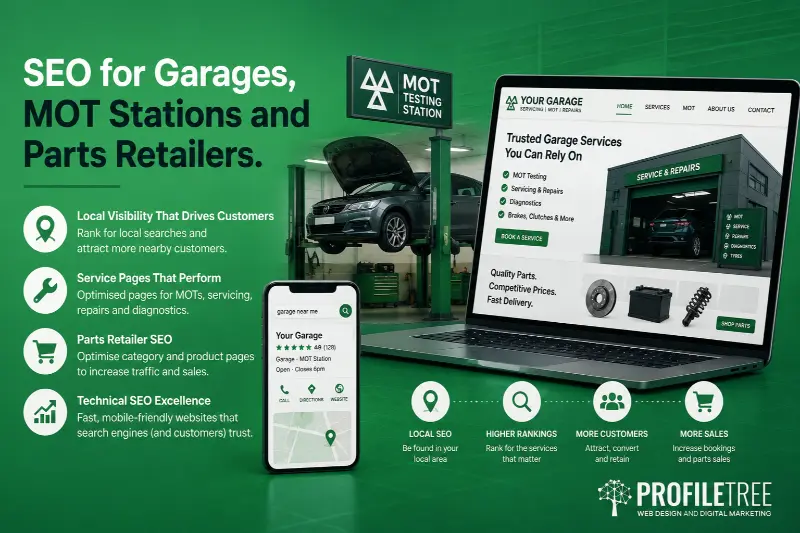
Aftermarket automotive SEO, covering garages, MOT test centres, tyre fitters and parts retailers, runs on a shorter, more urgent search cycle than dealership sales. Nobody researches an MOT for three weeks; they search, compare a handful of local results, and book. That compresses the window in which local SEO has to do its job, and it puts even more weight on Google Business Profile completeness, review volume, and clear service pages than dealership SEO does. Search Console data for automotive queries on this site shows a smaller, but genuine, pocket of searches specifically for MOT and garage services alongside the far larger volume of dealer-focused terms; it’s a segment worth targeting deliberately rather than folding into a general dealership plan.
The buying decision, the page structure, and the trust signals that work for a garage differ enough from dealership SEO that they deserve their own treatment. For the full approach, covering dedicated service pages, pricing transparency, booking convenience and trust signals for mechanics and MOT centres, see ProfileTree’s guide to SEO for garages.
Manufacturer-Authorised Dealer SEO: Compliance Challenges
Franchised dealers carry a constraint that independents and garages don’t: manufacturer brand guidelines. Logos, colour palettes, approved imagery, and even permitted phrasing around new models are often locked down by the manufacturer, and stepping outside those guidelines can risk the franchise agreement itself. Automotive SEO for a franchised dealer has to work within that framework rather than around it, which rules out some of the more flexible content approaches that work well for independents.
This shows up practically in a few recurring places. New model landing pages often need to use manufacturer-supplied copy and imagery, which limits how much unique content a dealer can add; the workaround is usually a separate, locally-written section covering stock availability, finance options and the dealership’s own service offer, sitting alongside the manufacturer material rather than replacing it. Approved used programmes come with their own certification language that has to be reproduced accurately, which needs coordination between the dealer’s marketing team and the manufacturer’s brand guidelines before anything goes live.
Multi-brand dealer groups add a further layer, since each franchise within the group may answer to different manufacturer rules on the same site. A car dealer SEO agency working across franchised dealerships needs a process for checking planned content against each manufacturer’s current guidelines before publishing, not just a one-off compliance check when the site was first built. Getting this wrong doesn’t just cost rankings; it can cost the franchise relationship, which makes it one of the few areas of automotive SEO where caution has to outweigh speed.
Franchise rules only bind manufacturer-approved dealers; a garage running independent SEO for garages doesn’t carry this compliance layer at all. An automotive SEO agency running dealer SEO services for a franchised group needs a sign-off process that the garage side of the business simply doesn’t need.
Vehicle Inventory and Technical SEO for Dealer Websites
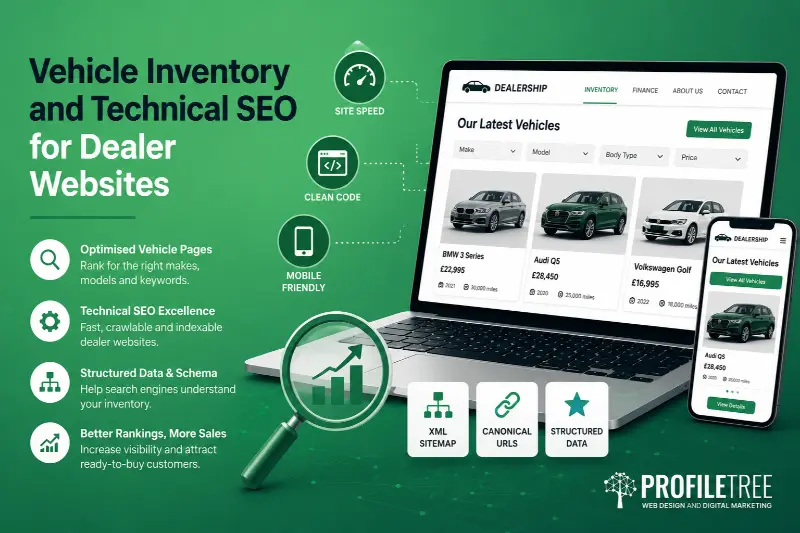
Stock turnover creates a genuinely unusual technical automotive SEO problem: pages for sold vehicles. Leaving a sold car’s page live indefinitely frustrates buyers and wastes crawl budget. Deleting it outright with a hard 404 throws away whatever ranking signal that page had built up.
The middle ground, and the approach generally recommended as part of any dealer SEO services engagement, is a 301 redirect to a closely matching vehicle in current stock, or to the relevant make and model category page, so the link equity carries forward and the visitor lands somewhere useful rather than on an error page.
Individual vehicle pages can rank for specific searches (“2023 VW Golf Belfast”, “automatic Ford Focus Northern Ireland”), provided each page has enough genuine content, description, specification, and condition notes to avoid looking thin. A stock feed that only outputs a photo and a price tag rarely earns a ranking on its own merits. Titling each page consistently, for example “[Year] [Make] [Model] [Variant] for sale in [Location]”, with full specs, condition notes and service history, then marking it up with vehicle schema, gives Google enough to work with even on a page generated automatically from a stock feed.
Make, Model and Location Pages Sit Above the Stock Feed
Individual vehicle pages come and go with stock, but make and model pages capture a different, more durable kind of search: buyers looking for “used Volkswagen Golf” or “Ford Fiesta for sale”, not for one specific car. A page built around a make or model earns rankings for “[model] for sale [location]” that a rotating stock feed never will on its own, because it stays in place while the individual cars underneath it change.
Location pages do the same job geographically. One per town or county actually served, with genuinely different content rather than a swapped place name, works far better than a single generic coverage-area page. A dealer group with sites in three towns needs three distinct pages, each grounded in that town’s stock, footfall and local reputation, not one page repeated with find-and-replace.
Faceted navigation, letting a buyer filter by make, fuel type or price, needs careful handling so Google doesn’t end up crawling thousands of near-duplicate filtered URLs; canonical tags and sensible indexing rules keep this under control. This technical layer is what separates a genuine automotive SEO agency from a general web developer bolting SEO on as an afterthought.
Image handling deserves specific attention on automotive sites, since they tend to be more image-heavy than most. Vehicle photos should be compressed without visible quality loss, saved in WebP format, given descriptive file names before upload, and served with lazy loading so a stock page with thirty photos of one car doesn’t stall on mobile.
Any structured data for vehicles, pricing or business details should sit in the site’s schema plugin rather than hand-coded in page content, so it stays consistent and doesn’t conflict with what a developer implements at the template level. Dealer SEO services that ignore this technical layer often see content and local work underperform simply because the site itself is working against them.
What a ProfileTree Automotive SEO Engagement Delivers
A ProfileTree automotive SEO engagement typically starts with an audit of the existing site: Google Business Profile completeness, current local rankings for dealer-relevant terms, technical issues around stock pages and sold vehicle handling, and a review of citation consistency across automotive directories.
From there, the priority order usually runs local signals first (GBP, citations, reviews), technical fixes second (sold vehicle redirects, image optimisation, faceted navigation), and content third (service pages, buying guides, location pages), because local fixes tend to show movement fastest and give a dealer owner confidence that the wider work is worth the investment.
“Automotive clients come to us thinking their website is the problem, when the actual barrier is usually a thin Google Business Profile and a stock feed that’s fighting against them technically,” says Ciaran Connolly, founder of ProfileTree. “Fix the local foundation first, and the rest of the SEO work has something solid to build on.”
Ongoing work covers ranking and traffic reporting specific to dealership terms; ongoing review generation support; ongoing citation management across automotive-specific directories such as WhoCanFixMyCar and general listings like Yell; and continued content development as stock and services change. ProfileTree’s automotive SEO work sits alongside its wider search engine optimisation, digital strategy and website development services, so dealers needing a rebuilt site or a broader digital marketing plan can bring that under one roof rather than coordinating separate suppliers.
Whether the brief is car dealer SEO for a multi-site group or wider dealer SEO services, an automotive SEO agency should be able to show its working at each stage rather than asking for trust on reputation alone.
Turning Automotive Search Into Booked Enquiries
Automotive SEO succeeds or fails on details that are specific to this industry: how a business handles a sold vehicle page, whether a make or model page actually differs from the stock feed underneath it, and whether a franchised dealer’s local content can flex within manufacturer rules.
Generic SEO advice misses most of this. ProfileTree provides automotive SEO for car dealerships and independent dealer groups across Northern Ireland, Ireland and the UK, built around the way this sector actually works rather than a template borrowed from another industry. Get in touch to talk through where your dealership currently stands and what a focused automotive SEO plan would look like for your sites.
FAQs
How long does automotive SEO take to show results?
Local signals such as Google Business Profile improvements and new reviews can shift visibility within a few weeks. Organic rankings for competitive dealer terms typically need three to six months of consistent work. Multi-location dealer groups and heavily contested markets can take longer.
How much does automotive SEO cost?
Costs vary with the number of locations, stock volume, and the competitiveness of the local market. A single-site independent dealer has a lower monthly investment than a multi-location dealer group needing coordinated local SEO across several towns. Ask for a scoped quote based on your specific sites and goals.
Can a dealer website really compete with Auto Trader?
Not for broad, generic searches; the marketplaces have too much authority there. The realistic opportunity sits in local searches, specific make and model combinations, and branded searches for the dealership itself, where a well-optimised dealer site can outperform a marketplace listing.
Should sold vehicle pages be deleted or redirected?
Redirecting to a similar vehicle or the relevant category page generally works better than deleting outright. A hard 404 throws away the ranking value the page had built up, while a 301 redirect carries that value forward and gives the visitor something useful to land on.
Should a dealer show prices on the website?
Yes, for vehicles and services where possible. Hidden prices suggest something to hide and cost the dealer the enquiry; a stated finance figure or an indicative price removes friction that a vague “enquire for pricing” page adds.