
Local SEO for Solicitors: Be the First Choice for Legal Help
Table of Contents
When someone needs a solicitor, they search locally. Whether it’s a family going through divorce, a first-time buyer needing conveyancing, or a business facing an employment dispute, people want legal representation nearby. They want face-to-face meetings. They want someone who understands local courts, local property markets, and local business conditions.
This local preference makes search visibility essential for law firms. The practices appearing when potential clients search “solicitor near me” or “conveyancing solicitor [town]” capture enquiries. Those not appearing lose clients to competitors, often without ever knowing the opportunity existed.
This guide covers local SEO for solicitors: optimising your Google Business Profile for legal searches, structuring your website to rank for practice area keywords, generating the reviews that influence client decisions, and navigating the regulatory considerations specific to legal marketing.
Why Local SEO Matters for Law Firms
Legal services have characteristics that make local search particularly important.
Clients strongly prefer local representation. Even as remote work becomes common, clients want solicitors they can visit. Court appearances require local knowledge. Property transactions involve local searches. Employment matters involve regional tribunals. Proximity matters.
Legal needs are urgent and emotional. Someone facing divorce, criminal charges, or a business dispute searches with urgency. They need help now. The firms appearing immediately in search results capture these high-intent enquiries.
Trust is the primary purchase driver. Legal matters involve sensitive personal and financial information. Clients need confidence in their solicitor before sharing details. Search visibility, reviews, and professional presentation build that trust.
Competition is geographic. Your competitors are other firms serving your area, not solicitors nationwide. Dominating local search is achievable because the competition pool is limited.
Different practice areas have different search behaviour. Conveyancing clients search differently from family law clients. Personal injury clients search differently from commercial clients. Local SEO for solicitors lets you target specific practice areas in your geographic market.
Google Business Profile for Solicitors
Your Google Business Profile determines whether you appear in the local pack, the prominent box of businesses in Google Maps results.
Category Selection for Law Firms
Categories directly impact which searches show your firm.
Primary category: “Solicitor” or “Law Firm” captures broad legal searches in your area.
Secondary categories by practice area:
- Conveyancing Solicitor
- Divorce Lawyer
- Family Law Attorney
- Personal Injury Lawyer
- Criminal Justice Attorney
- Estate Planning Attorney
- Real Estate Attorney
- Immigration Attorney
- Employment Attorney
- Corporate Lawyer
- Notary Public (if applicable)
Google’s category options vary; add all relevant categories that match your actual practice areas. Missing categories means missing searches.
Service Listings for Legal Practices
Detail every service area your firm handles. Google matches these with specific searches.
Property:
- Residential conveyancing
- Commercial conveyancing
- Remortgage conveyancing
- Lease extensions
- Property disputes
Family:
- Divorce and separation
- Child custody arrangements
- Prenuptial agreements
- Cohabitation agreements
- Financial settlements
- Domestic violence injunctions
Wills and probate:
- Will writing
- Lasting powers of attorney
- Estate administration
- Probate services
- Inheritance disputes
- Trust creation
Personal injury:
- Road traffic accident claims
- Workplace accident claims
- Medical negligence
- Criminal injury compensation
Employment:
- Unfair dismissal claims
- Redundancy advice
- Settlement agreements
- Employment tribunal representation
- Workplace discrimination
Commercial:
- Business formation
- Commercial contracts
- Partnership agreements
- Shareholder disputes
- Commercial property
- Business sales and acquisitions
Someone searching “lasting power of attorney [location]” finds firms listing that specific service.
Profile Completeness
Complete every available field:
- Business description: Use full character allowance. Describe your firm, practice areas, client types you serve, and what distinguishes you. Include location naturally.
- Opening hours: Reflect actual availability. If you offer evening appointments for clients who work during the day, show this.
- Attributes: Complete all relevant options: accessibility features, appointment requirements, languages spoken.
- Services with descriptions: Explain what each service involves in client-friendly language, not legal jargon.
Photos for Law Firms
Solicitors need photos that build professional trust while appearing approachable:
- Office exterior: Shows your premises exist and are professional.
- Office interior: Reception area, meeting rooms, office environment. Clean, professional spaces reassure clients.
- Team photos: Professional headshots of partners and solicitors. Individual photos with names and roles help clients identify who they might work with.
- Credentials: Law Society membership, specialist accreditations, Lexcel certification, Conveyancing Quality Scheme logo.
- Community involvement: Sponsorship events, charity work, business networking. Shows the firm is embedded in the local community.
Authentic photos of your actual team and premises perform better than stock images.
Website Optimisation for Law Firms
Your website converts search visibility into client enquiries and supports organic rankings.
Practice Area Page Structure
Create dedicated pages for each practice area rather than one generic services page.
Conveyancing page targeting “conveyancing solicitor [location]” and “property solicitor [location].” Cover residential and commercial separately if both are substantial practice areas. Explain the process, typical timeframes, and fee structures.
Family law page targeting “divorce solicitor [location]” and “family solicitor [location].” Address divorce, children matters, financial settlements, and domestic issues. Acknowledge the emotional nature of these matters.
Wills and probate page targeting “wills solicitor [location]” and “probate solicitor [location].” Explain why wills matter, what probate involves, and when clients need professional help versus DIY options.
Personal injury page targeting “personal injury solicitor [location].” Cover no-win-no-fee arrangements, claim types handled, and the claims process. Address common client concerns about cost and risk.
Employment law page targeting “employment solicitor [location].” Address both employee and employer clients if you serve both. Cover unfair dismissal, redundancy, and settlement agreements.
Commercial law page targeting “commercial solicitor [location]” and “business solicitor [location].” Cover contract work, business formation, disputes, and transactions.
Each page needs substantial depth, local relevance, clear calls to action, and proper schema markup.
ProfileTree’s website design services help law firms build websites that rank and convert.
Solicitor Profile Pages
Individual solicitor profiles support local SEO and client trust:
- Dedicated pages for each solicitor with photo, qualifications, experience, practice areas, and professional memberships.
- Schema markup for each person (Person schema connected to Organisation schema).
- Professional achievements: Notable cases (where appropriate), publications, speaking engagements, appointments.
- Personal touches: Appropriate personal information that makes solicitors human: community involvement, interests outside law.
These pages rank for name searches and build confidence when clients research who they’ll work with.
Location Pages
Multi-location firms need pages for each office. Single-location firms serving multiple areas should consider carefully:
For multiple offices: Each office needs its own Google Business Profile and dedicated website page with unique content about that location: team based there, areas served, court coverage.
For a single office: Create location content only where you have a genuine presence. A firm with one office shouldn’t create thin pages for twenty surrounding towns. Focus on your actual catchment area with meaningful local content.
Mobile and Technical Requirements
Legal services websites need:
- Security:HTTPS is essential. Clients share sensitive personal information; security certificates are non-negotiable.
- Accessibility: Many clients access legal services at difficult times. Accessible design serves everyone properly.
- Fast loading: Particularly on mobile where initial research often happens.
- Clear contact options: Phone prominently displayed, contact form, office address with map.
- Schema markup: LocalBusiness and LegalService schema with accurate firm information, Attorney schema for solicitor profiles.
Your website development should prioritise security, accessibility, and performance.
Building Reviews for Law Firms
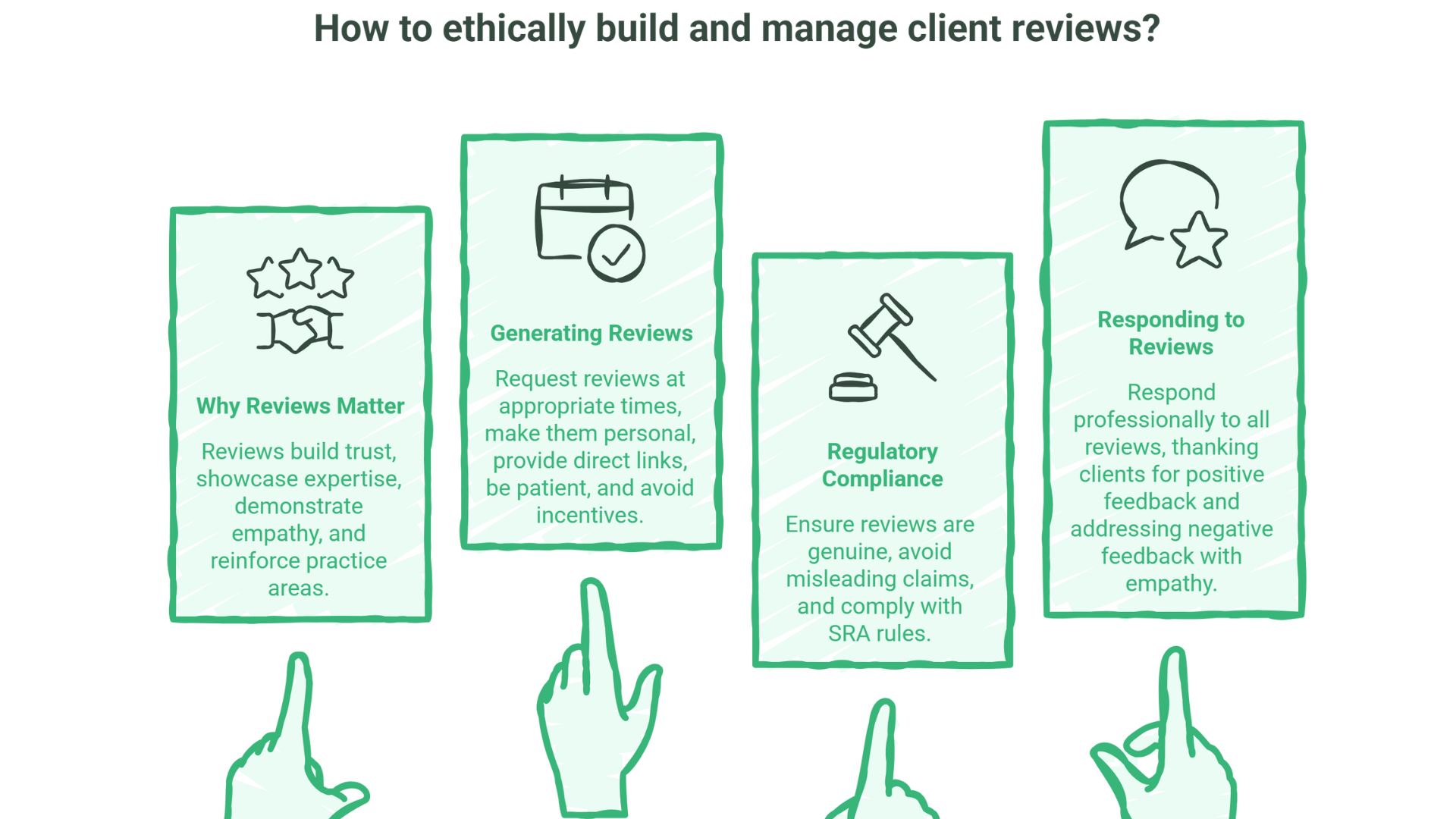
Reviews significantly influence solicitor selection. Legal matters involve trust; potential clients look carefully at what existing clients say.
Why Reviews Matter for Solicitors
- Trust is everything in legal services. Clients share sensitive personal, financial, and sometimes criminal information. Strong reviews provide crucial reassurance.
- Legal expertise is hard to evaluate otherwise. Clients can’t judge legal competence before engaging. Reviews proxy for quality and client satisfaction.
- Emotional matters require empathy evidence. Family law, personal injury, and criminal clients need solicitors who handle difficult situations sensitively. Reviews mentioning how they were treated reveal this.
- Specific review content reinforces practice areas. Reviews mentioning “divorce,” “house purchase,” or “employment tribunal” help you rank for those terms.
Generating Reviews Ethically
- Time requests appropriately. After successful case completion, after property exchange, after settling a claim. When clients feel relief or satisfaction, they’re most willing to help.
- Make requests personal. The solicitor who handled the matter should request the review, not generic firm communications.
- Provide direct links. Send clients directly to your Google review page. Every extra step reduces completion rates.
- Be patient with timing. Some matters take months or years. Don’t request reviews mid-case. Wait for natural conclusion points.
- Never offer incentives. Regulatory rules prohibit incentivising reviews. The review must be genuinely voluntary.
SRA and Regulatory Compliance
The Solicitors Regulation Authority permits client reviews but requires:
- No misleading claims about services or results
- No promises of specific outcomes
- Reviews must be genuine client experiences
- No suppression of negative reviews through improper means
- Advertising rules apply to how you use reviews
Most review generation practices are fine, provided you’re honest and don’t manipulate. When in doubt, check SRA guidance or seek compliance advice.
Responding to Reviews
Respond to all reviews professionally:
- Positive reviews: Thank clients genuinely. Keep responses appropriate; don’t discuss case details even in positive contexts.
- Negative reviews: Respond professionally without breaching confidentiality. “We’re sorry you feel your experience didn’t meet expectations. Please contact us directly to discuss your concerns” is appropriate. Never argue or reveal client information.
- Confidentiality always applies. Even if a client reveals case details in their review, you cannot confirm or discuss those details in your response.
Citations for Law Firms
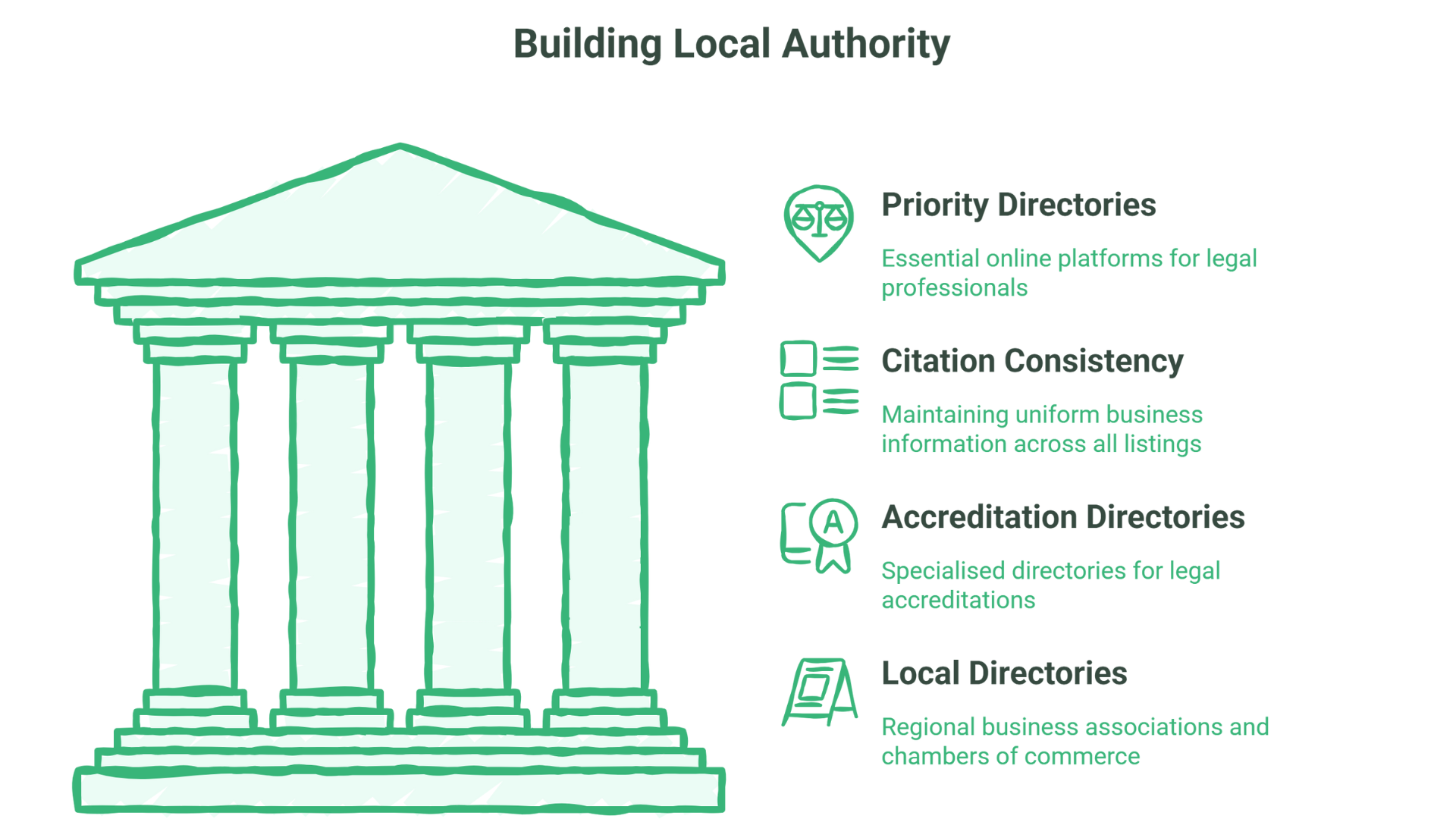
Citations build local authority through consistent business information across directories and platforms.
Priority Directories for Solicitors
General directories:
- Google Business Profile
- Bing Places
- Apple Maps
- Yelp
- Thomson Local
- Yell
Legal directories:
- Law Society Find a Solicitor
- The Legal 500
- Chambers and Partners
- Solicitors.guru
- Find a Solicitor (SRA directory)
Accreditation directories:
- Conveyancing Quality Scheme directory (if accredited)
- Lexcel directory (if accredited)
- Resolution (for family law)
- APIL (for personal injury)
- SFE (for wills and probate)
Local directories:
- Chamber of Commerce
- Local business associations
- Regional business directories
Citation Consistency
Maintain identical Name, Address, and Phone number everywhere:
- Firm trading name versus registered name
- Address format consistency
- Phone number format
Audit existing citations and correct inconsistencies. Old listings with previous addresses create confusion.
Content Marketing for Law Firms
Content attracts visitors searching for legal information who may become clients.
Content Topics That Work for Solicitors
Process and guidance content:
- What to expect during divorce proceedings
- How conveyancing works step by step
- Making a will: complete guide
- Employment tribunal process explained
Cost and decision content:
- How much does conveyancing cost?
- Divorce solicitor fees explained
- Do I need a solicitor for probate?
- When should I hire an employment solicitor?
Rights and obligations content:
- Your rights during divorce
- Employment rights when made redundant
- Landlord legal obligations
- Director responsibilities in a limited company
Local legal content:
- Court locations in [your area]
- Local property market legal considerations
- Regional employment tribunal information
This content captures informational searches and positions your firm as helpful experts.
ProfileTree’s content marketing services help law firms create content that attracts clients.
Content Compliance
Legal content requires care:
- No specific advice. General information is fine; specific advice to individuals is not. Use clear disclaimers.
- Accurate and current. Law changes. Outdated content damages trust and may mislead. Review content regularly.
- No guarantees of outcomes. Content cannot promise specific results or claim expertise you don’t have.
- Clear sourcing. Reference legislation and official guidance where appropriate.
Standing Out in Competitive Legal Markets
Most areas have multiple law firms competing for similar clients. Differentiation matters.
Practice Area Specialisation
General practice firms compete with everyone. Specialists attract clients seeking specific expertise:
Niche positioning: “Belfast’s employment law specialists” or “Family law experts for Northern Ireland” creates clearer positioning than “Full-service law firm.”
Accreditation signals: Conveyancing Quality Scheme, Resolution membership, APIL accreditation, Lexcel certification; these differentiate from non-accredited competitors.
Sector focus: Agricultural law, technology startups, healthcare sector; serving specific industries creates expertise that competitors lack.
Local Authority Building
Become genuinely embedded in your local business community:
- Local business involvement: Chamber membership, business networking, local event sponsorship.
- Community presence: Charity work, school governance, local organisation support.
- Local content creation: Comment on local business issues, regional legal developments, community matters.
- Local media relationships: Become the solicitor local journalists call for legal comment.
ProfileTree’s digital strategy services help law firms develop positioning that differentiates.
Measuring Success
Track metrics that matter for law firm growth:
- Search visibility: Rankings for priority terms: “solicitor [location],” practice area terms plus location.
- Website traffic from local search: Segment analytics to show traffic specifically from local queries.
- Enquiry volume by practice area: Track where leads originate and which practice areas generate enquiries.
- Enquiry quality: Are local SEO leads becoming clients? What matter types? What fee levels?
- Review growth: Monthly review count, average rating, sentiment trends.
- Competitive benchmarking: How do you compare with local competitors on reviews, rankings, and visibility?
“Law firms that take local SEO seriously consistently outperform those relying solely on reputation and referrals,” observes Ciaran Connolly, ProfileTree founder. “Referrals remain valuable, but potential clients now search to verify recommendations before making contact. Appearing professionally in that search (strong reviews, clear practice areas, credible presentation) confirms the referral and wins the client.”
FAQs About Local SEO for Solicitors
How long does local SEO take for solicitors?
Google Business Profile optimisations typically show results within 2-4 weeks. Website improvements and citation building take 2-4 months to impact rankings meaningfully. Competitive practice areas in busy markets may take 6-12 months to achieve strong positions. Less competitive practice areas and smaller towns show results faster.
Which practice areas are most competitive for local SEO for solicitors?
Personal injury and conveyancing are typically most competitive due to high case values and volume. Family law is moderately competitive. Wills, probate, and commercial work are often less competitive locally. Competition varies significantly by location; check your specific market by searching key terms and examining competitor profiles.
Should I target individuals or businesses?
Most firms serve both. Your SEO strategy should address both but may prioritise based on practice mix. Consumer searches (divorce, conveyancing, wills) have higher volume; commercial searches have potentially higher matter values. Create distinct content paths for individual and business clients.
Are there SRA restrictions on legal marketing I should know about?
The SRA requires that marketing is not misleading, does not make claims about success rates or outcomes that cannot be substantiated, does not compare services unfavourably to competitors without evidence, and maintains confidentiality. Review generation is permitted but must not be incentivised or manipulated. Most standard local SEO practices are compliant. When unsure, check current SRA guidance.
How important are reviews compared to other factors?
Extremely important for solicitors. Legal services involve significant trust; clients need reassurance before sharing sensitive information. Strong reviews from real clients provide crucial social proof. In competitive searches, firms with substantially more and better reviews typically outperform competitors. Aim for 30+ reviews with 4.5+ rating as a baseline; more is better.
Should we create content about recent cases?
General educational content about legal topics is valuable and appropriate. Content about specific cases requires extreme care; confidentiality applies even after matters conclude. You may reference case types you handle and general outcomes achieved, but never identify clients or reveal confidential details without explicit written consent.
Can a single-office firm compete with multi-location competitors?
Absolutely. Multi-location firms often have a weaker local presence in any specific area because they spread attention across many locations. A single-office firm genuinely embedded in its community (active in local business networks, strong local reviews, location-specific content) often outranks larger competitors locally. Focus deeply on your specific area rather than spreading thin. ProfileTree’s SEO services help law firms compete effectively regardless of size.