
Google Business Profile Management: The UK Guide
Table of Contents
Your Google Business Profile (GBP) is the most visible piece of digital real estate you control for free. When someone nearby searches for your service, it is your GBP (not your website) that determines whether you appear in Google Maps, the local 3-pack, or the knowledge panel on the right-hand side of results.
The challenge is that the platform has changed considerably. Google’s Gemini AI now feeds directly from GBP data to populate local recommendations in AI Overviews, making profile freshness a ranking factor in both traditional search and AI-generated answers. At the same time, new UK legislation under the Digital Markets, Competition and Consumers Act (DMCCA) has introduced legal obligations around how businesses manage and respond to reviews.
This guide on Google Business Profile management covers everything a UK business owner needs to know: verification, optimisation, the freshness framework, legal compliance, and how to tailor your profile for the specific nuances of operating in Northern Ireland, Scotland, or Wales.
The New Rules of GBP: Why the Platform Has Changed
Understanding what Google Business Profile actually does in 2026 requires a shift in thinking. The platform is no longer simply a digital directory entry; it has become an active data source that feeds into Google’s AI systems and influences how local businesses are recommended across Search, Maps, and AI Overviews alike.
From Static Directory to AI Data Feed
When Gemini 2.5 generates a local recommendation, it draws on structured data from GBP listings: business categories, service descriptions, recent posts, review sentiment, and response patterns. Profiles that publish regularly and maintain accurate, detailed information are more likely to be cited in AI-generated answers than those that have been left dormant.
This means the traditional “set it and forget it” approach actively works against you. Google’s own guidance confirms that profile activity, including posts, photo uploads, and review responses, is treated as a relevance signal. Businesses that treat their GBP as a living asset rather than a one-time form-filling exercise consistently outperform those that don’t, particularly in competitive local markets.
For SMEs in the UK and Ireland, this shift has practical implications. Our article on AI for local SEO explores how Gemini’s local recommendations work and what businesses can do to appear in them more consistently.
Is Google Business Profile Still Free?
Yes. Creating and maintaining a Google Business Profile remains free. Google does not charge for the listing itself, for posting updates, or for responding to reviews. There are paid advertising products (Local Services Ads and Google Ads with location extensions) that can amplify your profile’s reach, but the core profile and management tools are available at no cost.
The investment required is time, consistency, and, in many cases, professional management expertise to keep the profile performing at its potential. Businesses with limited internal resources often find that outsourcing management delivers a better return than attempting to handle it alongside other operational priorities.
The Core Ranking Pillars: Relevance, Distance, and Prominence
Google’s local algorithm uses three primary signals to decide which businesses appear in the local pack. Relevance measures how well your profile matches what someone is searching for. Distance calculates how far your business is from the searcher (or the location they specify). Prominence considers how well-known and active your business appears, drawing on review signals, website authority, citation consistency, and profile activity.
Of these three, prominence is the one most directly influenced by ongoing management. You cannot change where your business is located, and relevance is largely determined by accurate categorisation. Prominence, by contrast, is built over time through consistent engagement. Understanding GBP performance data gives you a clearer picture of where your profile currently stands and what is driving or limiting visibility.
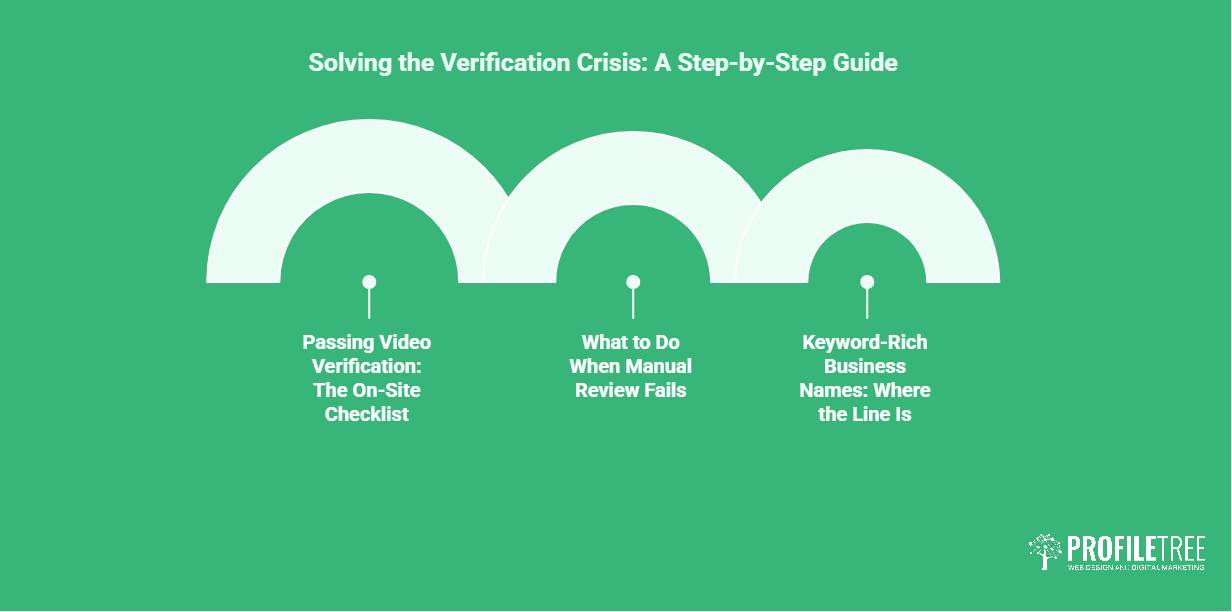
Solving the Verification Crisis: A Step-by-Step Guide
Verification has become one of the most common pain points for UK businesses setting up or recovering a Google Business Profile. Since Google phased out postcard verification for most business types, video verification has become the default method, and many business owners find the process confusing or encounter repeated failures.
Passing Video Verification: The On-Site Checklist
Google’s video verification process requires you to record a continuous, unedited video that proves you are physically present at the business location and that the business operates there. The video must be shot in a single take with no cuts.
Before you record, make sure you have the following in place:
- Begin outside the building and show the street address or building signage clearly on camera.
- Walk through the entrance while keeping the camera rolling, showing the exterior and any permanent signage.
- Inside, show equipment, stock, furniture, or fixtures that are consistent with the business category you have declared (for example, kitchen equipment for a restaurant, chairs and desks for an office).
- Show your phone, tablet, or computer logged into the Google account associated with the profile, so Google can connect the device to the account.
- Record in good lighting. Dark or blurry footage is a common reason for rejection.
For service-area businesses that operate from a home address or do not have a customer-facing premises, the process differs slightly. You must show the address you registered, the vehicle or equipment used for the business, and evidence of the business name (branded clothing, a van livery, or business cards, for example).
What to Do When Manual Review Fails
If your video submission is rejected or your profile enters a “Pending” state that does not resolve within the stated timeframe, do not resubmit immediately. Multiple failed attempts in quick succession can trigger a longer review hold.
Instead, open a support case through the Google Business Profile Help Centre and request manual review. Include the name of the business, the registered address, the Google account email, and any supporting documentation: Companies House registration, a utility bill showing the trading address, or a current lease agreement. The more evidence you provide, the faster the manual review typically resolves.
Profile suspensions are a separate issue from failed verification. The three most common causes of suspension in 2026 are address mismatches between the profile and other online listings, suspected spam or keyword stuffing in the business name field, and the use of virtual office or shared address services. If your profile has been suspended, the resolution process requires a formal reinstatement request with supporting documentation.
Keyword-Rich Business Names: Where the Line Is
One of the most frequent mistakes UK businesses make is adding service keywords to their registered business name on the profile. For example, a company called “Smith & Co” registers as “Smith & Co Plumbers Belfast Emergency Callouts.” Google’s guidelines are clear: the business name field must reflect your actual trading name, nothing more.
Adding keywords to the business name is a guideline violation and can result in suspension. The correct approach is to place keywords in the services section, the business description, and in post content, where they are both permitted and effective.
Optimising Your Profile for the Local 3-Pack
Appearing in the local 3-pack, the three business listings that appear beneath the map in a local search result, is the primary goal of GBP optimisation. The businesses that appear there are not necessarily the most well-known or the longest-established; they are the ones whose profiles most closely match what Google determines to be relevant, nearby, and prominent for that specific search.
Category Selection and Attribute Configuration
Your primary category is the single most important field on your profile. It tells Google what type of business you are, and it directly determines which searches trigger your listing. Choose the most specific primary category available, rather than a broad one. A dental practice should choose “Dentist” rather than “Healthcare”; a joinery business should choose “Joinery” rather than “Contractor.”
Secondary categories expand the searches you can appear for without diluting your primary signal. Use them for genuine additional services, not for keyword padding. A web design agency, for example, might add “Internet Marketing Service” and “Software Company” as secondary categories if those genuinely reflect the work it does.
Attributes add further specificity. They communicate details like accessibility features, accepted payment methods, whether the business is woman-led or LGBTQ-friendly, and operational information like outdoor seating or free Wi-Fi. Google uses attributes to refine matching, particularly for searches that include specific requirements. Fill in every attribute that applies accurately.
Service Listings and Business Description
The services section is one of the most underused elements of a GBP. Rather than listing one broad service, break down your offering into specific services with individual descriptions. A plumber who lists “emergency boiler repair,” “central heating installation,” and “bathroom fitting” as separate services will appear for each of those specific searches independently, rather than relying on the primary category alone to carry all three.
The business description field allows up to 750 characters. Use it to state clearly what you do, who you serve, and what makes your business worth contacting. Write it in plain, specific language and incorporate the terms your customers would use to search for you. Avoid promotional phrases and superlatives; Google treats these as low-quality signals. For a broader view of how description and metadata strategy feed into Google’s quality guidelines, our YMYL update guide provides additional context.
Photo Strategy: What Actually Drives Engagement
Profiles with a higher volume of recent, varied photos consistently outperform those with few or dated images in terms of views and customer actions. The emphasis here is on “recent” as much as “volume.” Adding photos regularly signals to Google that the business is active, and this feeds into the freshness signals that influence ranking.
Variety matters as well. Include exterior shots that show the building and signage, interior shots that show the working environment, team photos that put faces to the business, and images of work completed or products in use. Stock photos add no value and can be counterproductive; Google’s systems increasingly distinguish between original images and generic stock assets.
Geo-tagged photos, where location metadata is embedded in the image file, provide an additional local signal. Most smartphone cameras include this data by default, but it is worth confirming before uploading a large batch of images.
The Freshness Framework: Maintaining AI Visibility
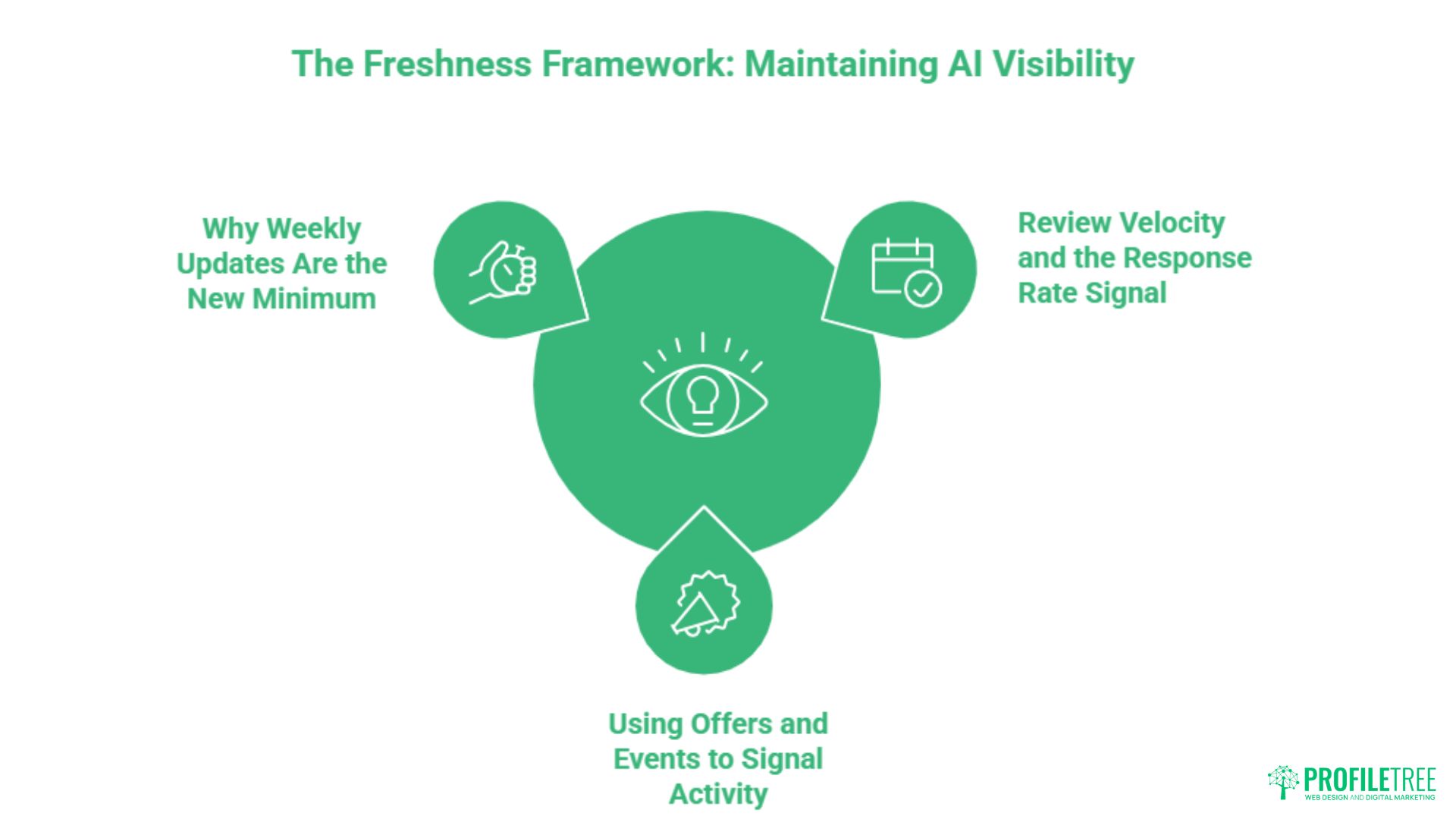
Profile freshness has become one of the primary differentiators between businesses that appear consistently in local search and AI Overviews and those that do not. Google’s systems measure how recently a profile has been updated, how regularly posts are published, and whether review responses are being written within a reasonable timeframe. Taken together, these signals contribute to the “prominence” dimension of the local ranking algorithm.
Why Weekly Updates Are the New Minimum
Google Posts expire after seven days unless they are classified as Events (which run until the end date you set) or Offers (which run until the expiry date). A profile that published one post six months ago and has published nothing since sends a clear signal of inactivity. In competitive markets, this will cost you positions to businesses that post consistently.
The practical minimum for most UK SMEs is one post per week. For businesses in highly competitive sectors, two to three posts per week is a stronger target. Posts do not need to be elaborate; a photo of a completed job, a short explanation of a common customer question, or a note about adjusted hours during a bank holiday are all valid and sufficient. The volume and regularity of the activity matter more than the sophistication of each individual post.
Our guide to AI tools for GBP covers how AI-assisted content tools can be used responsibly to support a consistent posting schedule without compromising authenticity.
Using Offers and Events to Signal Activity
Offer posts and Event posts carry additional weight in the algorithm because they represent structured, time-bound signals rather than general updates. An Offer post that runs for two weeks keeps the profile active throughout that period without requiring a new post every seven days. An Event post for a workshop, open day, or promotional period creates a calendar entry that appears prominently in some search results.
For Northern Ireland businesses, seasonal events, local bank holidays (which differ from the rest of the UK), and community events tied to the local calendar provide natural opportunities for timely, relevant content. The same applies to businesses in Scotland around Hogmanay or Burns Night, and in Wales around St. David’s Day and the school holiday calendar. Tying GBP activity to genuinely local events is a straightforward way to add regional specificity that national or generic competitors cannot easily replicate.
Review Velocity and the Response Rate Signal
Review velocity refers to how consistently new reviews arrive over time, as opposed to a single burst of reviews followed by months of silence. Google’s algorithm treats a steady stream of recent reviews more favourably than a large historical total with nothing recent added.
Generating reviews ethically requires a systematic approach: asking satisfied customers at the right moment, making the review link easy to access (via a short URL or QR code), and following up with a gentle reminder for customers who agreed to leave one but have not yet done so. Buying reviews, offering incentives for positive reviews, or using any automated system to generate fake reviews is a violation of Google’s guidelines and, as of April 2025, carries legal risk under UK consumer protection legislation. Our reputation management statistics article shows how review signals affect consumer decision-making and business visibility in practice.
UK Legal Compliance, Regional Nuances, and Measuring Success
UK businesses face a specific set of obligations and opportunities that do not apply in the same way to US or global GBP guides. The DMCCA has introduced meaningful legal exposure around review management, while businesses in Northern Ireland, Scotland, and Wales face regional search patterns that require tailored handling.
The DMCCA and Its Impact on Review Management
The Digital Markets, Competition and Consumers Act, which came into full effect in April 2025, introduced specific provisions around fake and misleading reviews. Under the Act, businesses have a positive obligation to take “reasonable steps” to prevent fake reviews from appearing on their profiles and to see that review processes are not manipulated to create a misleading impression.
In practice, this means you cannot simply ignore a surge of suspicious five-star reviews, even if you did not arrange them. You have an obligation to investigate and, where appropriate, report them to Google for removal. Ignoring the issue is not a neutral position; it can constitute a breach of the Act’s requirements on misleading commercial practices.
For negative reviews, the same legal framework applies in a different direction. Posting fake negative reviews about a competitor is also illegal under the DMCCA. If you believe a competitor is doing this to your profile, document the reviews, report them to Google, and if the pattern continues, seek legal advice.
AI-Generated Review Responses: The Legal and Algorithmic Risk
The widespread availability of AI writing tools has made it tempting to automate review responses entirely. We would advise against this approach for two reasons. First, fully automated responses generated without human oversight risk producing responses that misrepresent your business or fail to address the specific content of a review, which could fall foul of the DMCCA’s rules on misleading commercial communications. Second, Google’s 2026 quality signals specifically measure “authentic engagement” signals, and formulaic responses that do not address the individual review are increasingly recognised as low-quality interactions.
The appropriate use of AI in review management is as a drafting assistant, not as an autonomous responder. Use it to generate a draft response, then review, personalise, and publish it yourself. This keeps a human in the loop, satisfies the DMCCA’s “reasonable steps” standard, and produces responses that are more likely to satisfy the reviewer and impress potential customers reading the exchange.
Cross-Border SEO: The Northern Ireland Challenge
Businesses based in Northern Ireland face a GBP challenge that no other UK region shares: they operate in a jurisdiction that is simultaneously part of the UK and, in many commercial respects, closely integrated with the Republic of Ireland. A business in Newry, Derry, or Enniskillen may genuinely serve customers on both sides of the border but must decide how to configure its service area and which keywords to target.
The practical approach is to set the primary profile with a UK address and configure the service area to cover the relevant cross-border postcodes. Because Google Maps treats the UK and ROI as separate regions, you may also benefit from creating a separate, ROI-focused profile if you have a genuine trading presence or registered address in the Republic. Operating a single profile and attempting to rank for both Irish and UK local terms simultaneously is less effective than having a distinct presence in each market.
For businesses in Northern Ireland building their broader digital presence, understanding the regional geography of Northern Ireland is a useful context when defining service areas and crafting locally relevant GBP content.
Managing Bilingual Attributes for Welsh and Scottish Gaelic Businesses
Businesses in Wales and parts of Scotland can add bilingual business names and descriptions to their GBP. Google supports Welsh and Scottish Gaelic as additional language options within the profile. Adding a Welsh-language business name, for example, allows the profile to appear for Welsh-language searches, which is particularly relevant for businesses serving Welsh-speaking communities in north and west Wales.
This is a low-competition opportunity. Very few businesses outside the public sector have configured Welsh or Gaelic language attributes, meaning those that do gain a visibility advantage for searches in those languages, which costs no additional budget.
Measuring Success Beyond the Green Arrow
The GBP insights dashboard provides data on profile views, search queries that triggered the profile, and customer actions taken (calls, direction requests, website clicks, and message initiations). These metrics are the right starting point, but they need to be read in context to be useful.
Profile views tell you how many times your listing appeared in search results, but not whether it appeared for the right searches. The search query report is more revealing. If the majority of your profile views are being triggered by branded searches (people searching directly for your business name) rather than category or service searches, it suggests your prominence for non-branded local searches is low and needs attention.
The metric that matters most commercially is the volume of calls and direction requests, since these represent genuine intent to contact or visit. Tracking these alongside your broader Google Maps strategy gives a more complete picture of how local search is contributing to business outcomes. For a structured framework to assess your current local search position, our content audit framework can be adapted for local SEO reviews.
GBP Management Pricing: What to Expect
All prices and figures in this guide are indicative UK examples and correct at the time of writing; use them as a benchmark rather than fixed quotations.
A one-time setup and optimisation engagement, covering profile creation or audit, category research, service listings, business description, initial photo upload, and attribute configuration, typically falls in the range of £300 to £600 for a single-location business.
Ongoing monthly management, including regular posting, review monitoring and response, Q&A management, and monthly reporting, generally ranges from £200 to £500 per month depending on review volume, posting frequency, and market competitiveness. Multi-location businesses are priced on a per-location basis with volume reductions for larger portfolios.
Conclusion
Google Business Profile management in 2026 requires consistent attention, legal awareness, and a clear understanding of how the platform feeds into AI-driven search. Businesses that post regularly, respond to reviews professionally, verify their profiles correctly, and tailor their content to genuinely local audiences will consistently outperform those that treat their listing as a background administrative task.
For personalised guidance on what your profile needs, speak to the ProfileTree team about local SEO management for your business.
FAQs
How much does professional GBP management cost in the UK?
Monthly management for a single-location business typically falls between £200 and £500 per month, depending on the volume of reviews, the frequency of posting required, and how competitive the local market is. Initial setup or optimisation of an existing profile is usually a one-time cost in the range of £300 to £600.
Why has my Google Business Profile been suspended?
The three most common causes of suspension in 2026 are: an address mismatch between the profile and other online listings; keyword stuffing in the business name field (adding service terms beyond your actual trading name); and the use of a virtual office, shared workspace, or P.O. box address where Google requires a genuine physical trading location.
Do I need a physical office to have a Google Business Profile?
No. Service-area businesses that travel to customers, such as plumbers, electricians, cleaners, and mobile tradespeople, can create a profile without displaying a public address. You register your home or operational address for verification purposes, but configure the profile to show a service area rather than a street address.
How often should I post on my Google Business Profile?
Standard Google Posts expire after seven days, so publishing at least once per week is the minimum required to maintain a consistently active profile. In competitive markets, two to three posts per week is more effective. Offer and Event posts run until their set end date, so scheduling these around genuine business activities can help maintain visibility during periods when weekly updates are difficult to sustain.
Can I use AI to reply to Google reviews?
AI tools can be used to draft review responses, but fully automated responses published without human review carry both a legal risk under the DMCCA and an algorithmic risk under Google’s 2026 quality signals. The recommended approach is to use AI to generate a draft, then review, personalise, and publish it yourself.