
Advanced Customisation Options for Personalised Web Experiences
Table of Contents
The digital divide is widening between businesses delivering relevant experiences and those serving generic content. While 71% of customers expect personalised content, 26% of UK consumers refuse to spend with companies they don’t trust with data. Organisations mastering personalised web experiences gain a competitive advantage, while those failing risk losing customers to competitors who better understand their needs.
This guide provides a roadmap for building personalised web experiences that drive conversions without compromising privacy. You’ll discover compliant strategies aligned with the Data (Use and Access) Act 2025, first-party data techniques, and value exchanges, making customers willing partners. Gain actionable frameworks for transforming generic websites into personalised experiences that generate measurable results.
Successful personalised web experiences require three foundations: privacy-first data collection, treating information as value exchange rather than surveillance, strategic frameworks balancing expectations with regulatory compliance, and technology infrastructures unifying customer data while maintaining transparency. Organisations aligning these elements build sustainable competitive advantages through superior customer relationships and optimised digital journeys.
Privacy Meets Performance

Modern personalised web experiences have moved far beyond displaying a returning visitor’s name or showing recently viewed products. Today’s sophisticated approaches use first-party data, behavioural insights, and AI-powered analysis to create experiences that feel intuitive rather than invasive.
The shift in consumer expectations is stark. Research shows 75% of Gen Z and 70% of Millennials expect companies to personalise website experiences to improve navigation. Yet these same demographics are highly privacy-conscious, demanding transparency about how their data is collected and used.
This duality creates what industry analysts call the “personalisation paradox”. This is when users want relevance but fear surveillance. Delivering effective personalised web experiences requires rethinking your entire approach to data collection and customer engagement.
The Value Exchange Model
Successful personalisation in 2026 centres on the concept of value exchange. Rather than covertly tracking user behaviour, forward-thinking organisations offer clear benefits in return for data sharing. This might include:
- Tailored product recommendations that save time
- Content filtered to match specific industry challenges
- Preferential pricing or early access to new services
- Streamlined checkout experiences that remember preferences
The key is making the benefit obvious and immediate. When visitors understand what they gain from sharing information, consent rates increase dramatically. Research indicates 57% of consumers are willing to share personal information in exchange for personalised offers or discounts.
ProfileTree’s approach to web design incorporates these principles from the ground up. Our websites are built with personalisation frameworks that prioritise transparency and user control, creating the trust necessary for effective data collection.
Moving Beyond Generic Experiences
Generic web experiences represent more than missed opportunities. They’re competitive liabilities. Creating personalised web experiences that respond to specific user needs has become a critical differentiator in crowded markets. When a B2B decision-maker in Belfast lands on a homepage filled with irrelevant case studies and broad messaging, the disconnect is immediate. They’re seeking solutions to specific problems, and generic content signals that your organisation doesn’t understand their needs.
Consider two scenarios:
- Generic Approach: A professional services firm shows the same homepage to all visitors, regardless of industry, company size, or browsing history. The bounce rate sits at 68%, and the average session duration is under 60 seconds.
- Personalised Approach: The same firm uses first-party data to segment visitors by industry and previous interactions. Manufacturing clients see case studies from their sector, while retail visitors get relevant insights about their challenges. Bounce rates drop to 41%, and session duration increases to 3 minutes 45 seconds.
The difference isn’t just statistical but commercial. Personalisation reduces the cognitive load on visitors by removing irrelevant information, showing respect for their time and demonstrating sector-specific expertise.
UK Data Compliance: Turning Regulation Into Advantage
The Data (Use and Access) Act 2025, which received Royal Assent in June 2025, has reshaped the UK data protection landscape. While some view increased regulation as a burden, organisations that understand these changes can turn compliance into competitive differentiation. Understanding how to create personalised web experiences within this regulatory framework is now a core business competency.
Key Changes Affecting Personalisation
The Act introduces several modifications to UK GDPR that directly impact how businesses can deliver personalised web experiences:
- Recognised Legitimate Interests: The legislation establishes six new lawful bases for processing personal data that are automatically recognised as legitimate interests. This streamlines the legal framework for certain personalisation activities, reducing the administrative overhead of demonstrating legitimate interest.
- First-Party Analytics Cookies: Perhaps most significantly for web personalisation, the Act now permits first-party cookies for statistical and research purposes without explicit consent. This means organisations can analyse user behaviour on their own websites to drive improvements and personalisation without the friction of cookie consent banners for analytics purposes.
- Relaxed Automated Decision-Making Rules: The Act softens restrictions on automated decision-making (ADM) for non-special category data, making it easier to implement AI-driven personalisation without requiring meaningful human involvement in every decision.
These changes create opportunities for UK businesses to implement more sophisticated personalisation while maintaining strong privacy protections. However, they also increase the importance of getting your data strategy right from the outset.
The “Creepy vs Cool” Threshold
Understanding where personalisation crosses from helpful to invasive is crucial. Recent case law, including the 2025 RTM v Sky Betting & Gaming judgment, has introduced additional complexity around what constitutes valid consent, particularly for vulnerable users.
The court introduced a concept of “autonomous consent,” suggesting that consent must be truly freely given, not just technically compliant. This sets a higher bar than many organisations currently meet.
Cool Personalisation:
- Remembering a returning visitor’s industry to show relevant case studies
- Offering content recommendations based on pages they’ve viewed
- Streamlining forms by pre-filling information they’ve previously provided
- Suggesting products that complement their purchase history
Creepy Personalisation:
- Displaying specific demographic information gathered from third-party sources
- Referencing behaviour on other websites without clear disclosure
- Making assumptions about personal circumstances without explicit data sharing
- Using location data to make inferences about lifestyle or income
The distinction often comes down to transparency and user control. If visitors understand what data you’re collecting and can see the direct benefit, personalisation feels helpful. When data appears from unknown sources or the tracking feels excessive, trust breaks down.
Building Compliant Data Foundations
For organisations serving UK markets, building compliant personalisation starts with audit and architecture:
- Data Audit: Map all customer data you currently collect, where it’s stored, how it’s processed, and who has access. Many organisations are surprised to discover data scattered across multiple systems with inconsistent governance.
- First-Party Focus: Prioritise data you collect directly through your own websites, applications, and customer interactions. This provides the strongest legal foundation and typically delivers better personalisation results than purchased third-party data.
- Consent Management: Implement robust consent management platforms that track exactly what users have agreed to and allow easy withdrawal of consent. The Act requires responding to complaints within 30 days and maintaining accessible complaint procedures.
- Privacy by Design: Build privacy considerations into every stage of your web development process, not as an afterthought. This includes data minimisation (collecting only what you need), purpose limitation (using data only for stated purposes), and appropriate security measures.
“The organisations that succeed with personalisation in 2026 are those that see privacy compliance as a feature, not a constraint,” says Ciaran Connolly, Director at ProfileTree. “When you build trust through transparent data practices, customers become willing partners in personalisation rather than reluctant subjects of tracking.”
Strategic Implementation Framework
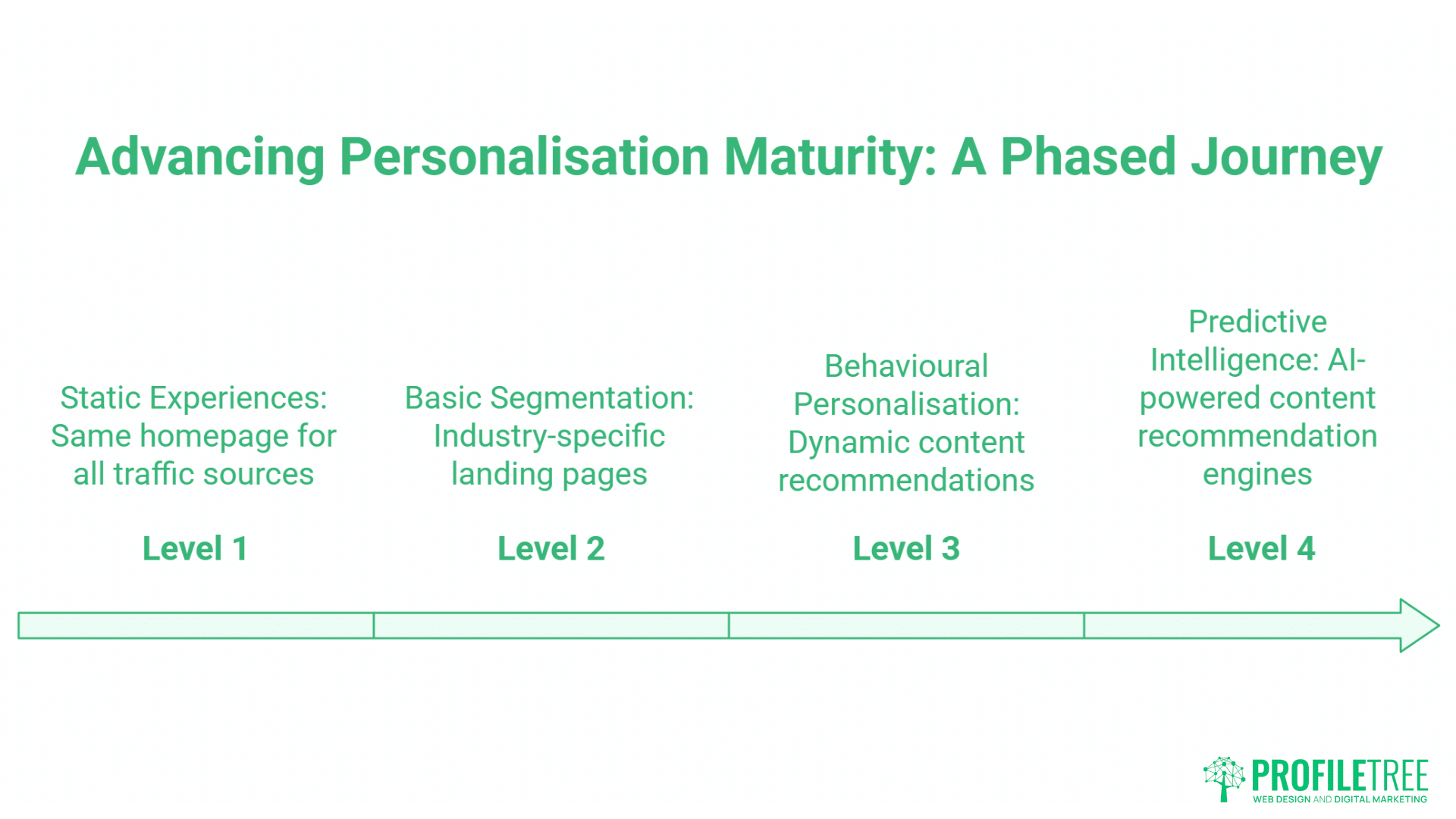
Implementing effective personalisation requires systematic planning and phased execution. The maturity model below helps organisations assess their current position and identify next steps.
Level 1: Static Experiences
At this baseline level, all visitors see identical content regardless of context. While this ensures consistency, it fails to acknowledge that different visitors have different needs.
Characteristics:
- Same homepage for all traffic sources
- No segmentation of content or messaging
- Generic calls to action across all pages
- No tracking of returning visitors
Next Steps: Begin implementing basic segmentation using UTM parameters to track traffic sources. This allows you to understand which channels drive engagement and tailor landing pages accordingly.
Level 2: Basic Segmentation
Organisations at this level use demographic or firmographic data to create broad segments, showing different content to distinct groups.
Characteristics:
- Industry-specific landing pages
- Geographic targeting for regional content
- Segmented email campaigns
- Basic returning visitor recognition
Next Steps: Move toward behavioural triggers that respond to actual user actions rather than just demographic categories. This might include content recommendations based on browsing history or progressive profiling that gradually collects more detailed information.
Level 3: Behavioural Personalisation
At this stage, websites respond dynamically to user behaviour, adjusting content and recommendations in real-time based on actions taken during the current session and historical interactions.
Characteristics:
- Dynamic content recommendations
- Personalised product suggestions
- Behavioural email triggers
- Session-based customisation
- First-party data capture optimised
Next Steps: Implement predictive analytics to anticipate user needs before they’re expressed, and begin orchestrating experiences across multiple channels for consistent personalisation.
Level 4: Predictive Intelligence
The most advanced personalisation uses AI and machine learning to predict user intent and deliver the “next best action” before users explicitly request it.
Characteristics:
- AI-powered content recommendation engines
- Predictive lead scoring
- Proactive service suggestions
- Cross-channel orchestration
- Real-time optimisation across all touchpoints
Implementation Considerations: This level requires significant technical infrastructure, including customer data platforms (CDPs), advanced analytics capabilities, and integration across your entire marketing technology stack.
The Technology Stack
Effective personalised web experiences at scale require integrating several technology components:
- Customer Data Platform (CDP): A CDP creates a unified customer database that consolidates data from all sources, such as CRM systems, marketing automation platforms, website analytics, and transactional systems. For B2B organisations, this is particularly valuable because it can track account-level behaviour across multiple users within the same organisation.
UK B2B e-commerce exceeds £200 billion, with professional buyers expecting the same personalised experiences as consumers. CDPs help B2B companies manage the complexity of multiple decision-makers, longer sales cycles, and high-value transactions.
- Web Content Management System (CMS): Your CMS needs native personalisation capabilities or strong integration with your CDP. WordPress, the platform ProfileTree primarily uses for client websites, offers numerous personalisation plugins and can integrate with enterprise CDPs through APIs.
- Marketing Automation Platform: Email and marketing automation systems deliver personalised content across channels based on triggers and behaviours tracked through your CDP.
- Analytics and Testing Tools: Robust analytics platforms measure the impact of personalisation efforts, while A/B testing tools allow you to optimise personalisation strategies systematically.
The key is creating a “single source of truth” where customer data flows seamlessly between systems, avoiding the data silos that plague many organisations.
Vertical-Specific Approaches
Personalised web experiences must adapt to industry contexts. What works for e-commerce differs significantly from professional services or B2B technology companies.
- Professional Services (Legal, Accounting, Consulting): Focus on demonstrating sector expertise and building authority. Personalise content recommendations to showcase relevant insights, case studies from similar clients, and thought leadership that addresses specific challenges. Use behavioural data to identify which service areas generate interest and route leads to specialists accordingly.
- B2B SaaS and Technology: Prioritise product education and feature discovery. Track which features prospects explore, personalising follow-up content to address specific use cases. Use intent data, downloaded whitepapers, attended webinars, and pricing page visits to identify buying signals and adjust messaging. Implement progressive profiling to gradually understand company size, tech stack, and specific requirements without overwhelming prospects with lengthy forms.
- FinTech and Financial Services: Security and compliance are paramount. Delivering personalised web experiences must happen within secure, authenticated environments. Focus on personalised portal experiences that help clients understand their financial position, access relevant products, and receive proactive recommendations. Use transaction history and financial goals to deliver timely, contextual advice while maintaining strict data protection standards.
- Healthcare and Medical Services: Navigate stringent privacy regulations while delivering personalised patient experiences. Focus on appointment management, educational content about specific conditions or treatments, and secure communication channels. Personalisation often centres on practical service delivery, remembering preferences, reducing form filling, and providing relevant health information, rather than marketing-focused personalisation.
Building Trust Through Data: The First-Party Strategy
The demise of third-party cookies isn’t a crisis. It’s an opportunity to build direct relationships with your audience based on trust and value exchange. Building personalised web experiences on first-party data creates stronger foundations for long-term customer relationships.
Zero-Party Data Collection
Zero-party data is information that customers intentionally and proactively share with you. This might include preferences explicitly stated through quizzes, preference centres, or account settings.
The advantage of zero-party data is its accuracy and legitimacy. When customers tell you directly what they want, you don’t need to infer or guess. This approach aligns perfectly with UK privacy regulations because it’s based on explicit, informed consent.
Implementation Tactics:
- Preference centres where users select content topics of interest
- Interactive assessments that provide value (industry benchmarks, cost calculators) while collecting data
- Onboarding flows that ask direct questions about goals and preferences
- Account dashboards where users control what information they share
First-Party Data Infrastructure
First-party data (information collected directly through your owned channels) forms the foundation of privacy-first personalisation.
Collection Points:
- Website forms and registrations
- Email engagement and click behaviour
- Content downloads and gated resources
- Customer service interactions
- Purchase and transaction history
- Product usage data (for SaaS and digital products)
The key is collecting data ethically, storing it securely, and using it only for stated purposes. Transparency builds trust; hidden tracking destroys it.
Authentication-Based Personalisation
The future of personalised web experiences is authenticated. By encouraging users to create accounts and log in, you gain the ability to deliver highly personalised experiences while maintaining clear consent and strong security.
Authenticated personalisation offers several advantages:
- Consistent Cross-Device Experiences: When users log in, you can recognise them across devices and platforms, delivering seamless experiences whether they’re on mobile, tablet, or desktop.
- Enhanced Security: Authentication provides a framework for secure data handling and gives users control over their information through account management features.
- Clearer Legal Basis: When users create accounts, they explicitly agree to your terms and privacy policy, establishing a clear legal basis for data processing.
- Better Data Quality: Authenticated user data tends to be more accurate and complete than anonymous tracking data, leading to more effective personalisation.
The challenge is giving users compelling reasons to create accounts. This requires clear value propositions, exclusive content, saved preferences, faster checkout, personalised recommendations, that make authentication worthwhile.
Measuring Personalisation Impact
Delivering personalised web experiences requires measuring impact against business outcomes, not just engagement metrics. While increased time on site and pages per session are positive signals, the ultimate measures are commercial.
Key Performance Indicators
- Conversion Rate by Segment: How do personalised web experiences perform compared to generic ones? Track conversion rates for personalised vs control groups across different segments.
- Customer Lifetime Value (CLV): Personalised web experiences should increase CLV by improving customer satisfaction, increasing repeat purchases, and building loyalty. Track how CLV differs between customers who receive personalised experiences and those who don’t.
- Time to Conversion: For B2B companies with long sales cycles, personalisation should accelerate the journey from awareness to purchase by delivering more relevant content at each stage.
- Customer Acquisition Cost (CAC): Effective personalisation reduces waste in your marketing spend by showing relevant content to qualified prospects. Track whether personalisation reduces your CAC.
- Retention and Churn Rates: For subscription and recurring revenue businesses, personalisation should reduce churn by increasing engagement and satisfaction.
Testing and Optimisation
Personalisation shouldn’t be “set and forget.” Continuous testing and optimisation are essential:
- A/B Testing: Test personalisation strategies against control groups to validate that they’re actually improving outcomes. Not all personalisation attempts succeed; rigorous testing separates effective strategies from assumptions.
- Multivariate Testing: For more mature personalisation programmes, test multiple variables simultaneously to understand which elements drive results.
- Segment Performance Analysis: Different segments may respond differently to personalisation tactics. Regular analysis helps identify which approaches work for which audiences.
ProfileTree’s approach to web design incorporates analytics and testing frameworks from the outset, making it straightforward to measure personalisation impact and optimise continuously.
Your 90-Day Personalisation Roadmap
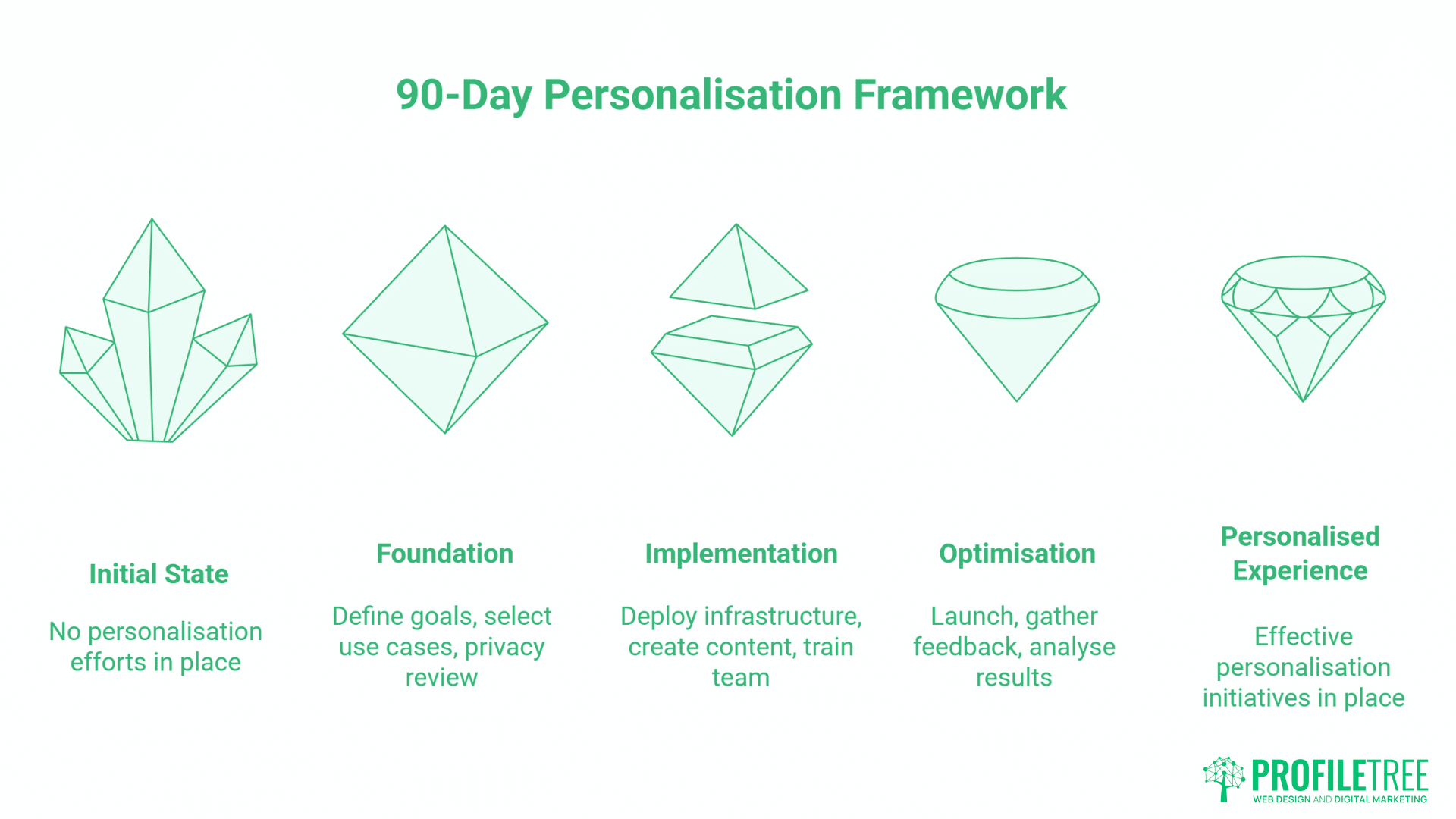
Implementing effective personalisation doesn’t require years of planning or massive technology investments. This 90-day framework provides a practical starting point:
Days 1-30: Foundation
- Audit Current State: Document all data collection points, storage systems, and current personalisation efforts. Identify gaps in your data infrastructure and compliance posture.
- Define Strategic Goals: Establish clear objectives. Are you trying to increase conversions, reduce bounce rates, accelerate sales cycles, or improve customer retention? Specific goals drive focused implementation.
- Select Initial Use Cases: Choose 2-3 high-impact personalisation opportunities that align with your goals and are technically feasible. Common starting points include personalised homepage content for returning visitors, industry-specific landing pages, or behaviour-triggered email campaigns.
- Conduct Privacy Review: Assess your current practices against UK GDPR and the Data (Use and Access) Act requirements. Update privacy policies, consent mechanisms, and data handling procedures as needed.
Days 31-60: Implementation
- Deploy Technical Infrastructure: Implement or optimise your CMS, analytics, and marketing automation platforms to support personalisation. This might include installing plugins, configuring integrations, or setting up basic segmentation rules.
- Create Personalised Content Variants: Develop alternative content versions for different segments. This could include industry-specific case studies, role-based value propositions, or regionally relevant messaging.
- Build Data Collection Mechanisms: Implement forms, preference centres, or progressive profiling systems to begin collecting zero-party and first-party data ethically.
- Train Your Team: Ensure your marketing, sales, and technical teams understand the personalisation strategy, their roles in execution, and how to use new tools.
Days 61-90: Optimisation
- Launch and Monitor: Roll out your initial personalisation initiatives, starting with lower-risk implementations. Monitor performance closely, watching for both intended outcomes and unintended consequences.
- Gather User Feedback: Collect qualitative feedback about personalised experiences. Do users find them helpful or intrusive? Are there technical issues or confusion?
- Analyse Results: Review quantitative performance data against your defined goals. Which personalisation tactics are working? Which need refinement?
- Plan Next Phase: Based on learnings from your initial implementation, plan your next set of personalisation initiatives. Consider expanding successful approaches to additional segments or channels.
The Path Forward
Personalised web experiences represent the convergence of customer expectations, technological capability, and regulatory frameworks. For UK and Irish businesses, the opportunity is clear: organisations that master privacy-first personalised web experiences will build competitive advantages through superior customer relationships and optimised digital experiences.
The key is starting with a clear strategy, building on solid data foundations, and maintaining an unwavering commitment to transparency and user control. Creating effective personalised web experiences isn’t about collecting maximum data. It’s about collecting the right data, with proper consent, and using it to deliver genuine value.
ProfileTree’s web design, digital marketing strategy, and AI implementation services help organisations navigate this complex landscape, building personalised web experiences that balance personalisation with privacy, performance with compliance, and innovation with trust.
The question isn’t whether to implement personalised web experiences for customers who already expect them. The question is whether you’ll do it ethically, effectively, and in ways that build lasting customer relationships rather than eroding trust. For businesses committed to that approach, the opportunities in 2026 and beyond are substantial.
Conclusion
Personalised web experiences have evolved from a competitive advantage to a business necessity. The organisations that thrive in 2026 will master the balance between delivering relevant, engaging experiences and respecting user privacy. Success requires strategic planning, robust technical infrastructure, and unwavering commitment to transparency and ethical data practices that build customer trust.
The Data (Use and Access) Act 2025 has created new opportunities for UK businesses to implement sophisticated personalisation while maintaining compliance. By focusing on first-party data, authentication-based experiences, and treating data collection as value exchange, organisations can create digital experiences that customers trust and engage with willingly, driving measurable business results.
FAQs
What is web personalisation and why does it matter?
Personalised web experiences involve adapting digital journeys based on user data, preferences, and behaviour. They matter because 71% of customers expect personalised content, and companies implementing effective personalised web experiences see 5-15% revenue increases while reducing customer acquisition costs by up to 50%.
How does the Data (Use and Access) Act 2025 affect personalisation?
The Act permits first-party analytics cookies without explicit consent for statistical purposes, introduces recognised legitimate interests for certain data processing, and relaxes automated decision-making restrictions. These changes make compliant personalised web experiences more straightforward for UK businesses while maintaining strong privacy protections.
What’s the difference between first-party, zero-party, and third-party data?
Zero-party data is information customers intentionally share (preferences, quiz responses). First-party data is collected through your owned channels (website behaviour, purchases). Third-party data comes from external sources. Post-cookie, successful personalised web experiences focus on zero-party and first-party data collected with explicit consent.
How can SMEs implement personalisation without massive technology investments?
Start with basic segmentation using existing CMS capabilities, implement simple behavioural triggers, and focus on collecting first-party data through forms and preference centres. Many WordPress plugins offer personalisation features at modest cost. The key is starting with high-impact, low-complexity use cases before scaling to more advanced approaches.
What are the risks of getting personalisation wrong?
Poor personalisation can damage trust, violate privacy regulations (risking fines up to €20 million under UK GDPR), increase bounce rates, and harm brand reputation. The “creepy” threshold, where personalisation feels invasive rather than helpful, varies by context, making transparency and user control essential safeguards.
Partner With ProfileTree for Expert Personalised Web Experiences
ProfileTree specialises in building privacy-first personalised web experiences for organisations across Northern Ireland, Ireland, and the UK. Our web design services integrate personalisation frameworks that rank well, generate leads, and convert visitors into customers. Contact us today to transform your digital presence.