
Measuring AI SEO Success: A UK Business Guide
Table of Contents
Most SEO reporting in 2026 still treats a page one ranking on Google as the finish line. That misses half the picture. Search now includes AI Overviews, ChatGPT, Gemini and Perplexity, and none of them sends a click the way a classic blue link does. AI SEO performance tracking is the practice of measuring two outcomes: how you perform in traditional search and whether your brand is cited when AI systems answer a question directly.
For SMEs across Northern Ireland, Ireland, and the UK, the challenge is compounded by cookie consent rules that obscure a portion of your GA4 data. This guide covers the metrics that actually matter for AI SEO performance, the UK-specific blind spots in your reporting, how to build a simple dashboard, and when it makes sense to bring in outside help.
What Is AI SEO Performance Tracking?
AI SEO performance tracking means using AI-assisted tools and methods to measure how well your content ranks in classic search and whether it gets pulled into AI-generated answers such as Google’s AI Overviews, ChatGPT Search, or Gemini. It sits on top of traditional SEO measurement rather than replacing it. Average position and impressions still matter. They just are not the whole story anymore.
Two things separate AI SEO performance tracking from the reporting most SMEs already do. First, it treats citation in an AI answer as a measurable outcome, even when that citation produces no click. Second, it uses AI tools to handle the grunt work of data collection and pattern spotting, freeing you to focus on the handful of numbers that map to revenue.
Predictive Analytics vs Historical Reporting
Traditional SEO reporting is backwards-looking. It tells you what happened last month. AI-assisted tools add a forward-looking layer, flagging that a keyword cluster is trending down before the drop shows up in your monthly numbers, or that a competitor’s new page is gaining visibility in a topic you own. Treat these forecasts as a prompt to look closer, not as a guarantee. A model trained on thin data will produce a confident-sounding prediction that turns out to be noise.
Why Traditional Rank Tracking Isn’t Enough Anymore
For years, the average position was the number that mattered most. That has changed. Zero-click search, where the answer appears directly on the results page or inside an AI Overview, means a page can satisfy a searcher’s question without anyone visiting your site. Google’s AI Overviews now appear across a wide range of commercial and informational queries, and ChatGPT Search, Gemini, and Perplexity answer plenty of questions that used to be routed through a traditional search engine.
This shift is part of a broader move that many UK businesses are making toward using AI across their marketing, rather than just in their search reporting. ProfileTree’s AI transformation services cover the wider shift, with AI SEO performance tracking as one piece.
None of this makes rank tracking useless. If you do not appear in the results at all, you will not get cited in an AI Overview either; most AI Overviews still draw from pages that rank well organically. What has changed is that the average position is now one input among several, not the single number a monthly report should lead with.
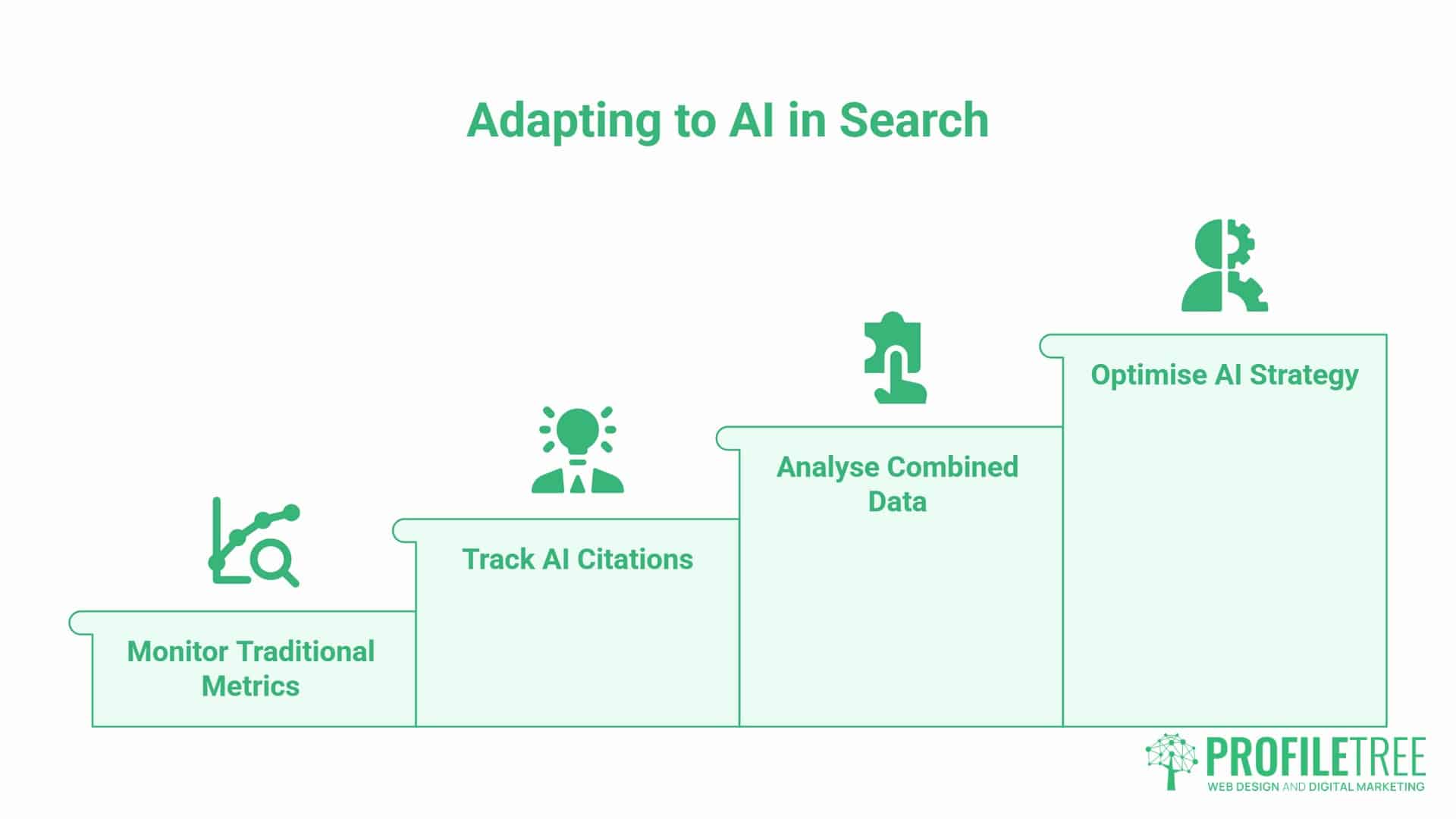
The practical result is that you need two parallel tracking habits. Keep monitoring your rankings, click-through rate, and organic sessions as you always have. Alongside that, start recording whether your brand or your content gets cited when someone runs a relevant query through an AI system. Neither view on its own tells you the full story of your AI SEO performance.
The Metrics That Actually Matter for AI SEO Performance
Tracking forty metrics produces noise. Tracking the right nine or ten produces decisions. The table below splits metrics into the traditional measures you likely already track and the AI-era measures most SMEs have not yet started tracking.
| Metric | What It Measures | Era | Primary Tool |
|---|---|---|---|
| Average position | Where you rank for a given query | Traditional | Search Console/rank tracker |
| Organic click-through rate | Whether your title and meta earn the click | Traditional | Search Console |
| Non-branded organic traffic | New demand you are winning, not just brand searches | Traditional | GA4 + Search Console |
| Organic conversions | Commercial result of search traffic | Traditional | GA4 |
| Impression share in AI surfaces | Visibility inside AI Overviews and snippets, even without a click | AI-era | Search Console / Bing AI reports |
| Brand citation frequency | How often are you named when AI tools answer a relevant question | AI-era | Manual checks / Bing AI Page Stats |
| Semantic proximity | How closely your content matches the intent of a topic cluster, not just one keyword | AI-era | SERP / NLP analysis tools |
| Sentiment in AI summaries | Whether AI-generated answers describe your brand accurately and favourably | AI-era | Manual review |
Brand citation frequency, sometimes called AI share of voice, is the closest AI-era equivalent to a ranking position. It answers a simple question: when someone asks an AI system about your service, does your business get named? No single dashboard covers this across every AI platform yet, so most SMEs build it manually. Run a list of priority queries through ChatGPT, Gemini and Google’s AI Overview on a set schedule and log the results.
Semantic proximity matters because AI systems do not match on individual keywords the way a search engine did a decade ago. They cluster content around the intent behind a topic. A page that thoroughly answers AI SEO performance and its related sub-questions is more likely to be pulled into an AI answer than a page that repeats one exact phrase without addressing the wider topic. Building that kind of depth is closer to the work of ProfileTree’s content marketing services than a purely technical SEO fix, since it depends on genuinely useful writing rather than keyword placement.
Tracking Visibility in AI Search
Measuring AI SEO performance without a citation metric is like measuring advertising reach without knowing which channels aired your advert. The approach below approximates it until better native tooling exists.
Manual citation checks: build a list of fifteen to thirty priority queries, the ones a genuine customer would type or ask aloud. Run each through ChatGPT, Gemini, Perplexity and Google’s AI Overview on a monthly cadence, and record whether your brand, your content or your name gets cited. It is manual and a little tedious, but it establishes a baseline you can track over time.
Impression share as a proxy: Google Search Console counts an AI Overview appearance as an impression even when no click follows, so a page showing rising impressions with a flat or falling click count is not necessarily failing. It may be feeding an AI answer instead of a traditional listing. Bing’s AI Page Stats reporting gives a more direct citation count for pages indexed by Bing and Copilot, worth checking alongside Search Console if you have any meaningful Bing traffic.
Does an AI Overview hurt your click-through rate? One of the questions we hear most is whether an AI Overview that appears above your listing affects your click-through rate. The honest answer is that it depends on the query. Informational queries with a short, factual answer see the biggest CTR drop, because the AI Overview often satisfies the searcher outright.
Commercial and comparison queries, where the searcher still needs to weigh up options, tend to hold up better; people still click through to compare providers even after reading a summary. If you see CTR falling on a page that gained an AI Overview appearance, check whether the query is informational before assuming your title or meta description is the problem.
The UK and Irish Problem: GDPR, Cookie Consent and Regional Search
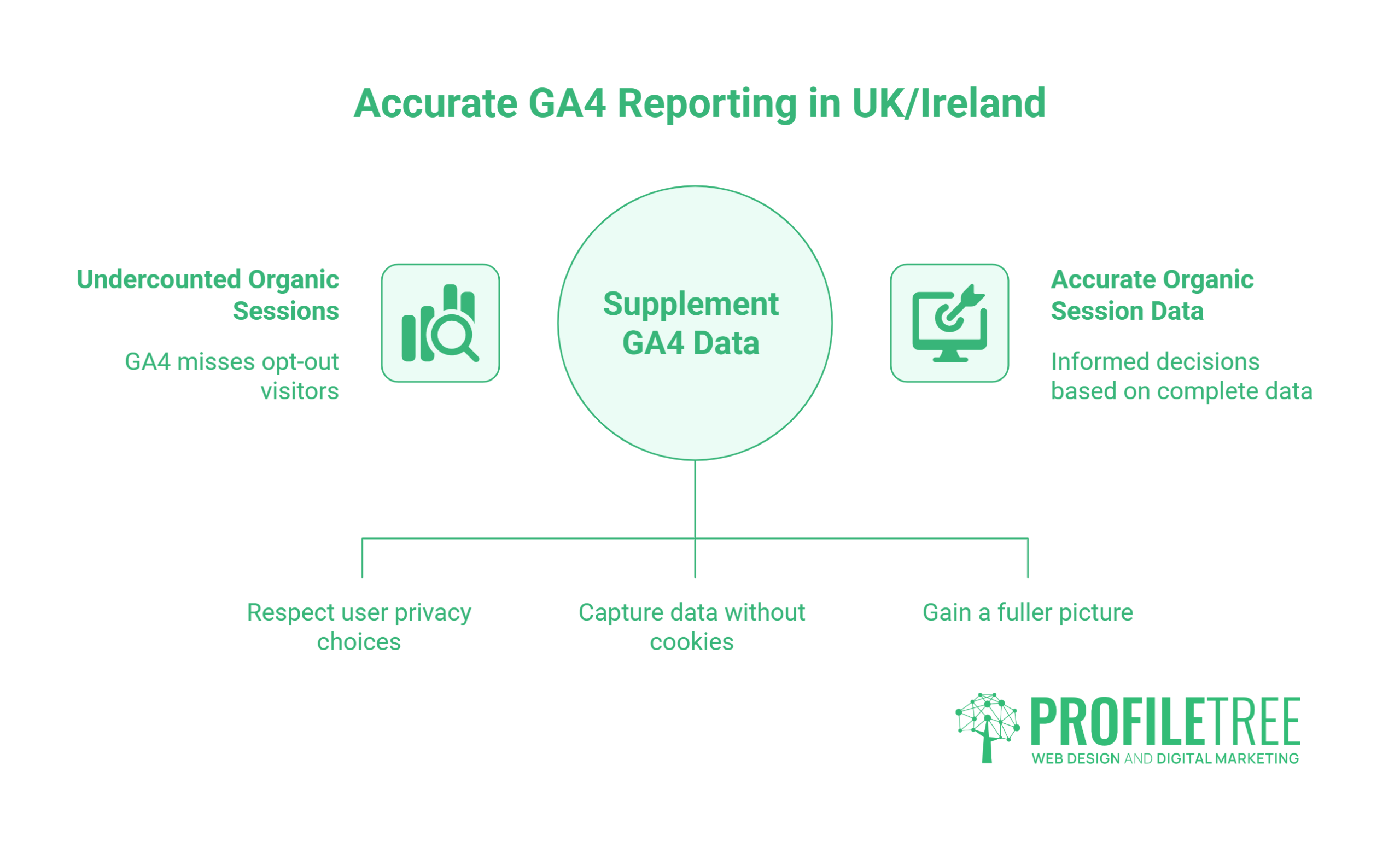
Most SEO advice assumes GA4 numbers are complete. In the UK and Ireland, they rarely are. Strict cookie consent rules under UK GDPR and the Data Protection Act mean a meaningful share of visitors opt out of tracking, so GA4 quietly undercounts organic sessions. If your AI SEO performance reporting relies solely on GA4, you are making decisions based on partial data.
Search Console click data is collected server-side, so cookie banners do not affect it. Comparing Search Console clicks against GA4 sessions for the same period gives you a rough sense of the gap, and you can apply that correction factor to your conversion maths rather than trusting GA4’s numbers at face value.
A well-designed consent flow recovers some of that legitimately, and getting the technical setup right matters for both compliance and data quality. The Information Commissioner’s Office publishes current guidance on cookies and consent, worth reviewing if your banner has not been checked in the last year.
There is a second UK and Irish quirk that most AI SEO tools miss entirely: they are built for a US audience and do not account for regional language variation. A search for “solicitor” and a search for “lawyer” convey the same intent for a Belfast law firm, but many AI-assisted keyword tools, trained mostly on US data, treat them as loosely related rather than functionally identical. The same applies to a run of other UK and Irish terms with US equivalents. If you are relying on an AI tool’s automatic keyword clustering, check it against the language your own customers use in Search Console’s query data before trusting the grouping.
One more caution specific to AI tools: some AI-powered SEO platforms scrape competitor pages and public data to build their recommendations. That is generally fine for public content, but if a tool is pulling and processing personal data, gathering reviews with names attached, or scraping user-generated content, that activity needs to sit within GDPR’s rules on lawful processing. Check what a new AI tool actually collects before connecting it to your site, not after.
Building a Simple AI SEO Performance Dashboard
You do not need enterprise software to get a working view of your AI SEO performance. A dashboard built from free and low-cost tools covers most SME needs.
Start with Search Console and GA4 as your base layer; both connect natively to Looker Studio, which is free and provides a single view rather than two separate exports. Add a simple manual log, a spreadsheet is genuinely fine here, for AI citation checks: date, query, which AI tool, cited or not, and a short note on what was cited. This is the part most automated dashboards still cannot do for you.
If you want to go a step further, Search Console’s API lets you pull historical query and page data programmatically rather than exporting CSVs by hand each month, which matters once you are tracking more than a handful of pages. Connecting AI tools into that kind of reporting setup is exactly the sort of work covered by ProfileTree’s AI-enhanced marketing services, and it is a task worth handing to a developer or technical SEO if you do not have the time to build it yourself.
Whatever you build, review it on a fixed schedule rather than only when something looks wrong. A monthly check catches a slow decline before it becomes a quarter-long problem. A weekly check on your highest-value pages catches faster-moving issues like an indexing fault or a sudden ranking drop.
When Professional Support Beats DIY Tracking
Plenty of SMEs track their own SEO performance competently. The real question is not capability, it is return on your time. If you are spending several hours a week assembling reports you rarely act on, that time is worth more spent elsewhere in the business.
Bring in support when the stakes rise: a traffic drop you cannot diagnose, a site migration, expansion into a new region, or a board that wants search tied directly to revenue. A digital partner can set up the measurement framework properly once, so the ongoing reporting runs with minimal upkeep afterwards. ProfileTree’s digital strategy services cover this groundwork, from defining which metrics map to revenue through to building the dashboard itself.
The most workable setup for most SMEs is a mix: an agency builds and audits the system, and your own team runs the weekly checks. ProfileTree’s AI training for SMEs course is aimed at exactly that handover, so your team can take over the day-to-day monitoring once the framework is in place, rather than staying dependent on outside help indefinitely.
“AI SEO performance tracking gets easier once you stop trying to watch everything. Pick the three or four numbers that map to revenue, and check them every week.”, Ciaran Connolly, founder of ProfileTree.
Good AI SEO performance tracking comes down to picking a small number of metrics that map to revenue, layering in a basic AI citation check, and correcting for the parts of your data that UK and Irish privacy rules hide from you. None of this needs to be complicated or expensive to start. If your current reporting is eating up time you don’t have, ProfileTree’s search engine optimisation services can help you build a tracking setup that runs itself.
Frequently Asked Questions
How do you track AI SEO performance?
Combine traditional metrics, organic traffic, conversions, and click-through rate from Search Console and GA4 with a manual log of AI citation checks across ChatGPT, Gemini and Google’s AI Overview. Track both alongside each other rather than replacing one with the other.
What’s the difference between traditional rank tracking and AI SEO tracking?
Traditional rank tracking measures where you sit in the classic search results for a given query. AI SEO tracking adds a second layer: whether your content or brand gets cited when an AI system answers a question directly, which can happen with or without you ranking in position one.
Can AI tools predict future keyword rankings?
To an extent. Predictive tools can flag a keyword cluster trending down or a competitor gaining visibility before it shows up in your monthly numbers. Treat these as prompts to investigate, not guarantees; forecasts built on thin data produce confident-sounding results that don’t hold up.
Does Google’s AI Overview affect click-through rate?
Often, yes, but it depends on the query. Purely informational queries with a short factual answer tend to see the sharpest CTR drop, because the AI Overview can fully satisfy the search. Commercial and comparison queries hold up better, since people still want to weigh up their options directly.
Is AI SEO tracking GDPR compliant?
The tracking itself, watching your own Search Console and GA4 data, does not raise GDPR issues. The risk sits with third-party AI tools that scrape or process personal data, including reviews or user-generated content, without a lawful basis. Check what a new tool actually collects before connecting it to your site.
How do I know if my brand appears in AI search answers?
Run your priority queries through ChatGPT, Gemini and Google’s AI Overview and record whether you’re cited. Rising Search Console impressions alongside a flat click count can also be a sign your content is feeding an AI answer rather than a traditional listing.
Which AI tool is best for automated SEO reporting?
There is no single best option for every SME. Search Console and GA4 cover the basics for free and should be your starting point regardless of budget. Semrush and Ahrefs both offer AI-assisted reporting layers if you need more depth, and Bing Webmaster Tools now includes a free AI Page Stats report worth checking if you get any Bing traffic. Pick based on what you are already paying for rather than adding a new subscription purely for AI features.