
Natural Language Processing in Business Communication: 12 Practical Applications
Table of Contents
Natural language processing sits at the point where artificial intelligence meets the words your customers, colleagues, and competitors use every day. At its core, language processing gives machines the ability to read, interpret, and generate human language, turning unstructured text buried in emails, support tickets, and social posts into something a business can actually act on.
This guide covers 12 real-world examples of natural language processing in business communication, from customer-facing interactions to internal efficiency and digital marketing performance. ProfileTree, the Belfast-based web design and digital marketing agency, has worked with SMEs across Northern Ireland, Ireland, and the UK on integrating language processing tools into their communication and marketing workflows.
Part 1: Customer-Facing Language Processing Applications
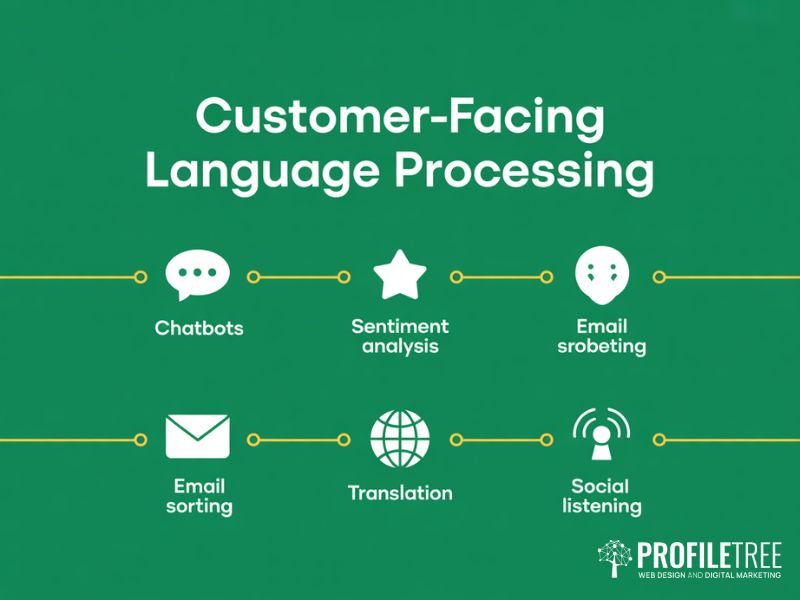
The most immediate and visible impact of language processing is on the front line of customer interaction. Customers expect fast, relevant responses across every channel, and language processing provides the infrastructure to deliver that at a scale no human team can match alone. The following examples represent the most practical entry points for businesses looking to improve external communication.
1. Intelligent Chatbots for Scalable Support
Modern chatbots powered by language processing go well beyond the rule-based bots of five years ago. Instead of matching keywords to pre-set responses, NLP-driven bots understand the intent behind a query, even when it is phrased unusually or contains spelling errors. ProfileTree’s AI chatbot services for SMEs are built on exactly this type of intent-aware language processing, enabling bots to ask clarifying questions, access account information, and hand off to a human agent when required.
The business case is straightforward. A language processing chatbot handles repetitive, high-volume queries around the clock at a fraction of the cost of additional support staff. For an e-commerce business dealing with hundreds of delivery queries daily, this alone can justify the investment.
Named Entity Recognition (NER) pulls out key details such as order numbers and product names. Intent Classification determines what the user wants to achieve. The language processing model then routes the conversation accordingly. Read more in our guide to chatbots for small business.
2. Sentiment Analysis for Customer Feedback
Language processing can read thousands of customer reviews, survey responses, and social media comments and return a structured picture of how people feel about a product, service, or brand. This is sentiment analysis, and it moves businesses from reactive feedback management to proactive issue detection.
Aspect-based sentiment analysis identifies not just whether a comment is positive or negative, but which specific element of the experience it refers to. A hotel might find that guests rate the rooms positively but flag the check-in process consistently. Without language processing, spotting that pattern across 1,000 reviews is a major manual undertaking.
Social media marketing teams use positive sentiment tracking to identify what to replicate and promote, while negative sentiment flagging triggers fast internal routing to relevant teams. Trend monitoring over time shows whether issues are improving or worsening.
3. Automated Email Sorting and Smart Replies
Email remains the primary channel for business-to-business communication in the UK and Ireland, and the volume of inbound messages is a genuine operational burden for growing businesses. Language processing classifies incoming emails by topic, urgency, and intent, routing them to the right team member without manual sorting.
Smart reply suggestions, as seen in Gmail and Outlook, use language processing to generate contextually appropriate short responses. For sales teams handling high volumes of enquiries, this cuts response time significantly. Pairing email language processing with a structured digital strategy ensures these tools support rather than replace a coherent communication plan.
4. Real-Time Machine Translation
For businesses serving customers across multiple language regions, language processing-powered translation removes the barrier of having dedicated multilingual staff for every market. Machine translation has improved substantially with the arrival of large language models, and while human review remains important for high-stakes content, automated translation is now reliable enough for customer service queries, product descriptions, and internal documentation.
Belfast and Northern Ireland businesses exporting across the EU particularly benefit here, given the regulatory and language complexity of serving multiple markets simultaneously.
5. Social Media Listening and Brand Monitoring
Language processing analyses public social media content in real time, surfacing mentions of a brand, product, or competitor even when the company is not directly tagged. This gives marketing and PR teams a genuinely current picture of brand perception. ProfileTree’s social media marketing service uses language processing tools to monitor brand sentiment and inform campaign decisions.
Topic modelling, a core language processing technique, identifies the subjects being discussed in relation to a brand and tracks how those conversations shift over time. For digital marketing strategy, this is genuinely useful operational data.
Part 2: Internal Communication and Operational Efficiency
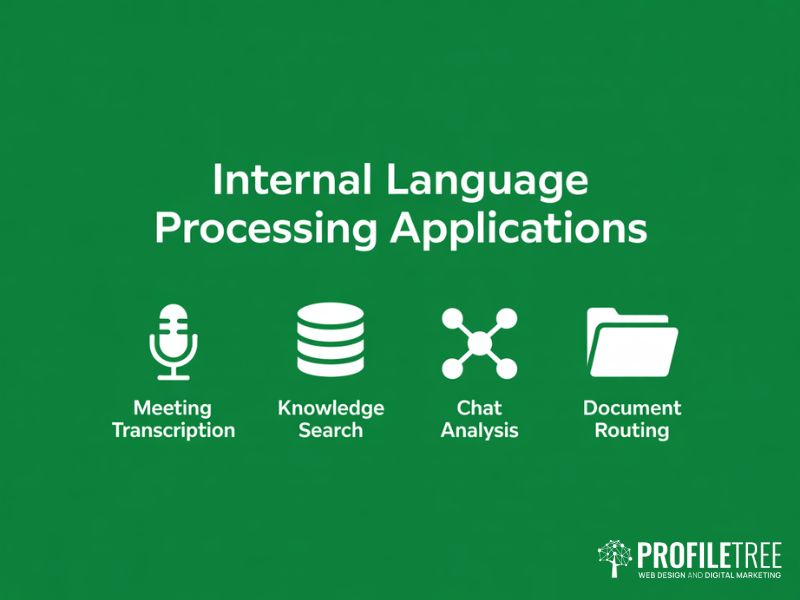
The internal efficiency gains from language processing receive far less attention than customer-facing applications, but for many businesses this is where the more immediate return on investment sits. Communication overhead, knowledge fragmentation, and manual documentation are expensive problems. Language processing addresses all three.
6. Meeting Transcription and Actionable Summaries
Tools such as Otter.ai, Fireflies, and Microsoft Copilot use language processing to transcribe meetings in real time and generate structured summaries including decisions made, action items assigned, and open questions. For businesses where a significant portion of the working week is spent in meetings, this reduces the time spent on minutes and follow-up significantly.
Meeting transcripts also become searchable. A project manager can retrieve what was agreed in a call from three months ago without scrolling through email chains. That is a practical productivity gain that compounds over time.
7. Internal Knowledge Base Search
Traditional intranet search relies on exact keyword matching. A staff member searching for the company’s GDPR policy might type the query differently from how the document is titled and return no results. Language processing enables semantic search, understanding the meaning behind a query rather than just matching strings.
For growing businesses with substantial internal documentation, this reduces the time employees spend searching for information and decreases reliance on colleagues to locate documents. Our digital training programmes cover how to get the most from knowledge management tools that use language processing at their core.
8. Internal Chat Analysis for Team Health Signals
Language processing can analyse internal communication patterns in platforms like Slack or Microsoft Teams to surface signals about workload, morale, and communication bottlenecks. Patterns of urgency, frustration, or confusion in messaging data can alert managers to issues before they escalate.
This needs to be implemented transparently, with clear communication to staff about what is analysed and why. When done properly, it gives leadership objective data to support team management decisions rather than relying solely on subjective assessments.
9. Onboarding Document Processing and Routing
HR teams deal with significant volumes of documentation during onboarding. Language processing can read, classify, and route documents automatically, verify that required forms are complete, and flag exceptions for human review. What previously took administrative staff several hours per new employee can be reduced substantially, freeing HR time for the parts of onboarding that genuinely require human attention.
Part 3: Language Processing for Digital Marketing and SEO
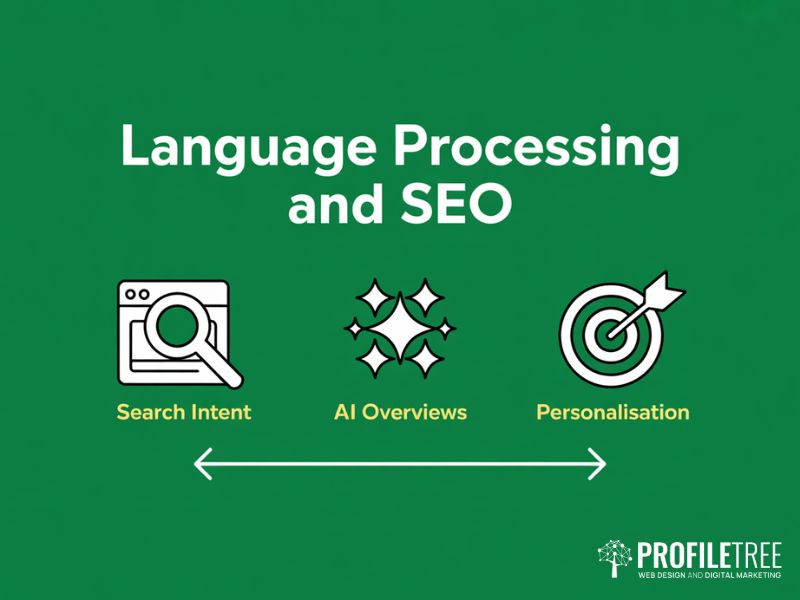
For a digital agency like ProfileTree, language processing is not just a topic we advise clients on. It sits inside the tools we use every day for keyword research, content strategy, and search engine optimisation. Understanding how language processing affects search is now a core part of doing SEO well.
10. How Search Engines Use Language Processing
Google has used language processing models including BERT and MUM to interpret search queries for several years. Search engines no longer match keywords mechanically. They understand the intent behind a search. A query like “best way to fix a slow WordPress site” will surface pages about WordPress performance optimisation even if those pages do not use the exact phrase from the query.
For content writers and SEO practitioners, this changes the job. Writing naturally about a topic in depth, covering the sub-questions a reader would have, produces better results than inserting keyword phrases at calculated density. According to Google’s own search quality guidance, content that demonstrates genuine expertise and satisfies user intent is the primary standard for ranking. Our content marketing service is built around this principle: language processing has rewarded thorough, well-structured writing over keyword-heavy filler.
11. AI Overviews and Generative Search Visibility
Google AI Overviews, ChatGPT, Perplexity, and Gemini all use language processing to extract information from web pages and synthesise answers. Content that appears in these AI-generated summaries reaches users who may never click through to the source page. Being cited in an AI Overview is now a distinct visibility objective, separate from but related to traditional organic rankings.
Pages that earn AI citations share certain characteristics: they answer questions directly in the opening section, they use clear heading structures, they include FAQ content with schema markup, and they demonstrate genuine expertise through named authors and specific, verifiable claims. All of these reflect good language processing-friendly content structure.
ProfileTree structures client content to answer the primary query in the first 150 to 200 words, uses question-based H2 headings, and includes FAQPage schema on pages with Q&A sections. This serves both traditional search rankings and AI citation visibility simultaneously. Find out more in our guide to Google AI Overviews for businesses.
12. Content Personalisation and Audience Segmentation
Language processing analyses user behaviour, on-site search queries, and engagement patterns to enable meaningful content personalisation. For e-commerce businesses, this means surfacing product descriptions and recommendations aligned to what a user’s browsing history suggests they care about. ProfileTree’s AI marketing and automation service combines language processing with CRM data to close the gap between the broad content a business publishes and the specific problem a visitor has arrived to solve.
Language Processing Applications: A Practical Comparison
The table below compares the 12 applications across three dimensions relevant to SME decision-making: implementation complexity, typical time to value, and primary business function.
| Application | Complexity | Time to Value | Function |
|---|---|---|---|
| Intelligent chatbots | Medium | 1 to 3 months | Customer service |
| Sentiment analysis | Low to Medium | Weeks | Marketing / CX |
| Email sorting and smart replies | Low | Days to weeks | Operations |
| Machine translation | Low | Days | Customer service |
| Social media listening | Low to Medium | Weeks | Marketing / PR |
| Meeting transcription | Low | Immediate | Operations |
| Knowledge base search | Medium | 1 to 2 months | Internal efficiency |
| Internal chat analysis | High | 3 to 6 months | HR / Management |
| Onboarding document processing | Medium | 1 to 2 months | HR |
| Search engine content optimisation | Low | 1 to 3 months | SEO |
| AI Overview visibility | Low to Medium | 2 to 4 months | SEO / Content |
| Content personalisation | High | 3 to 6 months | Marketing |
The E-I-M Framework: Getting Started with Language Processing
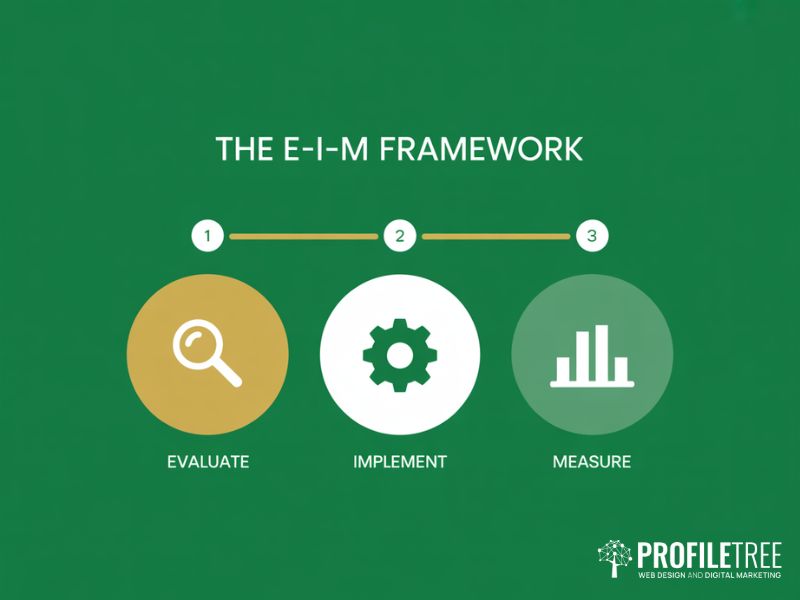
Most businesses that fail to benefit from language processing do not fail because they chose the wrong tool. They fail because they started with a tool rather than a problem. The E-I-M framework (Evaluate, Implement, Measure) gives SMEs a structured path from identifying the right language processing application to demonstrating its value.
Step 1: Evaluate Your Communication Bottlenecks
Before selecting any language processing tool, identify where your team spends the most time on communication tasks that are repetitive, high-volume, or dependent on reading and classifying text. Common bottlenecks for SMEs include inbound customer enquiries, manual feedback review, meeting notes, and internal document search.
Rank these by two criteria: how frequently the bottleneck occurs and how much it costs in staff time. The intersection of high frequency and high cost is your starting point for language processing investment. Map the volume of emails, tickets, or documents processed per week. Estimate the monthly staff hours consumed. Assess how often the current manual process produces errors or delays.
Step 2: Implement at the Right Scope
Language processing implementation for SMEs typically falls into one of three categories: adopting a SaaS platform with language processing built in (such as HubSpot, Intercom, or Zendesk), integrating a language processing API into an existing system, or commissioning a custom solution for a specific workflow. Most SMEs should start with the first category. ProfileTree’s digital strategy consultancy helps businesses assess which approach matches their technical resource and use case before any investment is made.
A business needing to add sentiment analysis to customer feedback can use an off-the-shelf platform within weeks. A business wanting to build a bespoke internal knowledge base with semantic search needs a more considered approach.
Step 3: Measure the Right KPIs
Language processing investments are only worth continuing if they can be measured. Set a baseline before implementation and track it for at least 90 days after. The most consistently useful metrics are response time reduction, ticket deflection rate, staff hours saved per month, and customer satisfaction score movement.
Avoid the trap of measuring proxy metrics like “number of AI interactions” that tell you about activity rather than impact.
| Language Processing Application | KPI to Track |
|---|---|
| Chatbot | Ticket deflection rate, resolution time, CSAT score |
| Sentiment analysis | Issue detection lead time, NPS trend |
| Email sorting | Average response time, misrouting rate |
| Meeting transcription | Hours saved on minute-taking per month |
| SEO content optimisation | Organic impressions, average position, AI Overview citations |
Security, Privacy, and GDPR Considerations
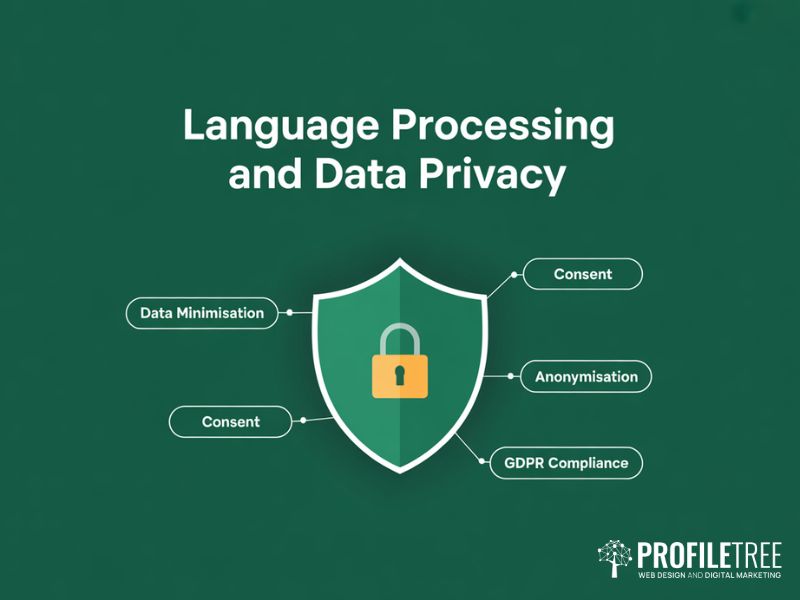
Any language processing application that processes customer or employee data carries data protection obligations. For UK and Irish businesses, GDPR and the UK Data Protection Act 2018 require that personal data is processed lawfully, stored securely, and retained only as long as necessary.
Key considerations when deploying language processing: collect only the text data required for the specific task; inform customers and staff when their communications are being processed by AI systems; strip personal identifiers from datasets before they are used to train or fine-tune models where possible; verify that third-party providers store data within acceptable jurisdictions; and ensure your systems can respond to right-to-erasure requests. See our guide to GDPR compliance for small businesses for the practical steps involved.
ProfileTree recommends that any SME implementing language processing tools carries out a Data Protection Impact Assessment (DPIA) before deployment, particularly for applications involving employee data or sensitive customer communications.
The Future of Language Processing for SMEs
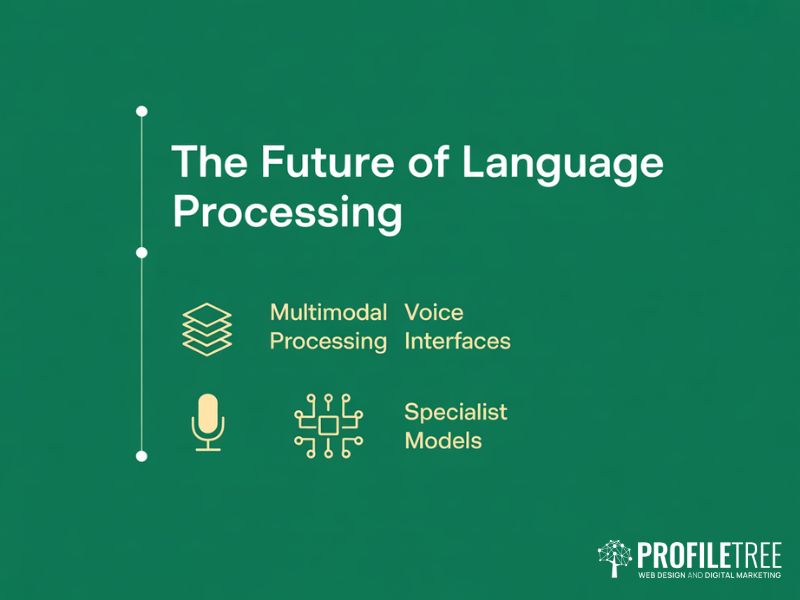
Language processing is developing quickly, and the tools available to SMEs in 2026 are substantially more capable than those of three years ago. Three developments stand out as particularly relevant for small and medium-sized businesses.
Multimodal language processing, which combines text with voice, image, and video understanding, is becoming accessible through APIs. For businesses investing in video marketing and production, the ability to automatically transcribe, summarise, and index video content opens up genuinely new ways to structure and distribute knowledge.
Voice-based language processing is reshaping customer service. As voice interfaces become more common on mobile and smart devices, the ability to handle spoken queries with the same accuracy as text queries will shift from differentiator to baseline expectation.
Smaller, specialised language processing models trained on industry-specific data are also becoming viable for businesses that previously could not afford bespoke AI development. A Northern Ireland manufacturing firm, for instance, could deploy a language processing model trained specifically on engineering documentation and technical queries relevant to its sector. ProfileTree’s AI training and digital training programmes help businesses prepare their teams and data infrastructure for the tools arriving in the next two to three years.
FAQs
What is natural language processing in simple terms?
Language processing is the branch of artificial intelligence that enables computers to read, understand, and generate human language. It is the technology behind chatbots, spell-checkers, search engines, and translation tools. In a business context, it turns unstructured text into structured, actionable outputs.
How does language processing improve customer service?
It enables chatbots to handle routine queries at scale, analyses customer feedback automatically to surface issues faster, and routes incoming messages to the right team or agent based on content. The combined effect is shorter response times and more consistent service quality.
Is language processing the same as machine learning?
They are related but not identical. Machine learning is a broad family of techniques for learning from data. Language processing is a specific application area that uses machine learning to understand and generate human language. All modern language processing systems use machine learning, but not every machine learning application involves language.
What are the main risks of using language processing tools?
Data privacy is the most immediate risk: language processing tools handle text that may contain personal data, carrying GDPR obligations. Accuracy is a second concern, particularly with ambiguous language or industry jargon. Bias in training data is a third, especially relevant for HR applications such as CV screening.
How much does language processing implementation cost for an SME?
Off-the-shelf SaaS platforms typically start at a few hundred pounds per month. API-based integrations are usage-priced, making them accessible at low volumes. Custom development is substantially more expensive and is generally only justified where no existing platform fits the use case.