
Local SEO for Healthcare Practices: Get Found by Patients
Table of Contents
Local SEO for Healthcare is important. When someone needs a dentist, physiotherapist, chiropractor, or other healthcare provider, they search locally. Nobody travels hours for routine healthcare when there are practices nearby. This makes local search visibility essential for healthcare businesses—appearing when patients search “dentist near me” or “physiotherapist [your town]” translates directly into new patient enquiries.
Healthcare practices face unique local SEO considerations: building trust for services involving personal well-being, managing reviews sensitively, maintaining professional standards, and navigating data protection requirements. This guide covers local SEO specifically for healthcare practices: dental surgeries, physiotherapy clinics, chiropractic practices, osteopaths, opticians, private GP services, and similar healthcare providers.
Why Local SEO for HealthcareMatters
Healthcare practices have characteristics that make local search particularly valuable.
Proximity drives patient choice. Convenience matters for ongoing healthcare relationships. Patients want providers close to home or work for regular appointments. Local visibility puts you in front of people seeking care in your area.
Trust requirements are high. Healthcare decisions involve personal well-being. Patients need confidence in their provider before booking. Strong local presence—reviews, professional presentation, clear credentials—builds that essential trust.
Lifetime patient value is substantial. Acquiring a patient through search who becomes a regular creates years of value. A dental patient attending twice yearly for decades, a physio patient returning whenever injuries occur—the investment in patient acquisition pays dividends over time.
Competition is local. Your competitors are other practices serving your area, not providers nationwide. Dominating local search is achievable because competition is geographically limited.
Online research precedes appointments. Even patients referred by their GP or another provider typically research the practice online before booking. Appearing professional in that research confirms confidence.
Google Business Profile for Healthcare Practices
Your Google Business Profile determines whether you appear in local pack results when patients search for healthcare services.
Category Selection by Practice Type
Select the most appropriate primary category:
Dental:
- Dentist (general)
- Cosmetic Dentist
- Pediatric Dentist
- Orthodontist
- Dental Implants Provider
- Emergency Dental Service
Physical therapy and rehabilitation:
- Physiotherapist
- Physical Therapy Clinic
- Sports Medicine Clinic
- Rehabilitation Centre
Manual therapy:
- Chiropractor
- Osteopath
- Massage Therapist
- Sports Massage Therapist
Vision care:
- Optician
- Optometrist
- Eye Care Centre
- Contact Lens Supplier
Other healthcare:
- Medical Clinic
- Private Doctor
- Podiatrist
- Audiologist
- Speech Therapist
- Mental Health Clinic
- Counsellor
Add relevant secondary categories for all services offered. A dental practice offering orthodontics and cosmetic dentistry should include those as secondary categories.
Service Listings for Healthcare
Detail every service your practice offers:
Dental services example:
- General check-ups and examinations
- Dental hygiene appointments
- Fillings and restorations
- Root canal treatment
- Extractions
- Crowns and bridges
- Dental implants
- Teeth whitening
- Veneers
- Invisalign/clear aligners
- Dentures
- Emergency dental treatment
- Children’s dentistry
Physiotherapy services example:
- Initial assessment and diagnosis
- Manual therapy
- Sports injury rehabilitation
- Post-surgical rehabilitation
- Back and neck pain treatment
- Joint pain treatment
- Workplace injury recovery
- Chronic pain management
- Exercise prescription
- Dry needling/acupuncture
- Shockwave therapy
Someone searching “teeth whitening [location]” or “sports physio [location]” finds practices listing those specific services.
Photos for Healthcare Practices
Photos build confidence in a clinical environment:
Facility photos:
- Reception and waiting area (clean, welcoming)
- Treatment rooms
- Equipment and technology
- Accessibility features
- Exterior showing your premises
Team photos:
- Professional headshots of practitioners
- Team group photo
- Staff at work (appropriately staged)
Credentials:
- Professional registration certificates
- Qualifications
- Accreditation logos
- Awards
Patient experience:
- Welcoming environment shots
- Comfortable, modern facilities
- Technology in use (without patients visible)
Quality guidelines:
- Professional, well-lit images
- Clean, organised environments
- Current photos showing actual facilities
- No patient faces without explicit consent
Healthcare photos must balance professionalism with approachability. Sterile clinical environments can feel intimidating; show warmth alongside professionalism.
Attributes for Healthcare
Complete all relevant Google attributes:
Appointment information:
- Online booking available
- Walk-ins accepted (if applicable)
- Appointment required
Accessibility:
- Wheelchair accessible entrance
- Wheelchair accessible facilities
- Accessible parking
Payment and insurance:
- NHS patients accepted (if applicable)
- Private patients accepted
- Payment plans available
- Insurance accepted
Safety and hygiene:
- Hygiene practices highlighted
Opening Hours
Accurate hours are essential for healthcare:
Appointment hours: When patients can be seen.
Reception hours: If different from appointment availability.
Emergency availability: If you offer emergency services, make this clear.
Bank holiday closures: Update for all holiday closures—patients may need care on holidays.
Website Optimisation for Healthcare Practices
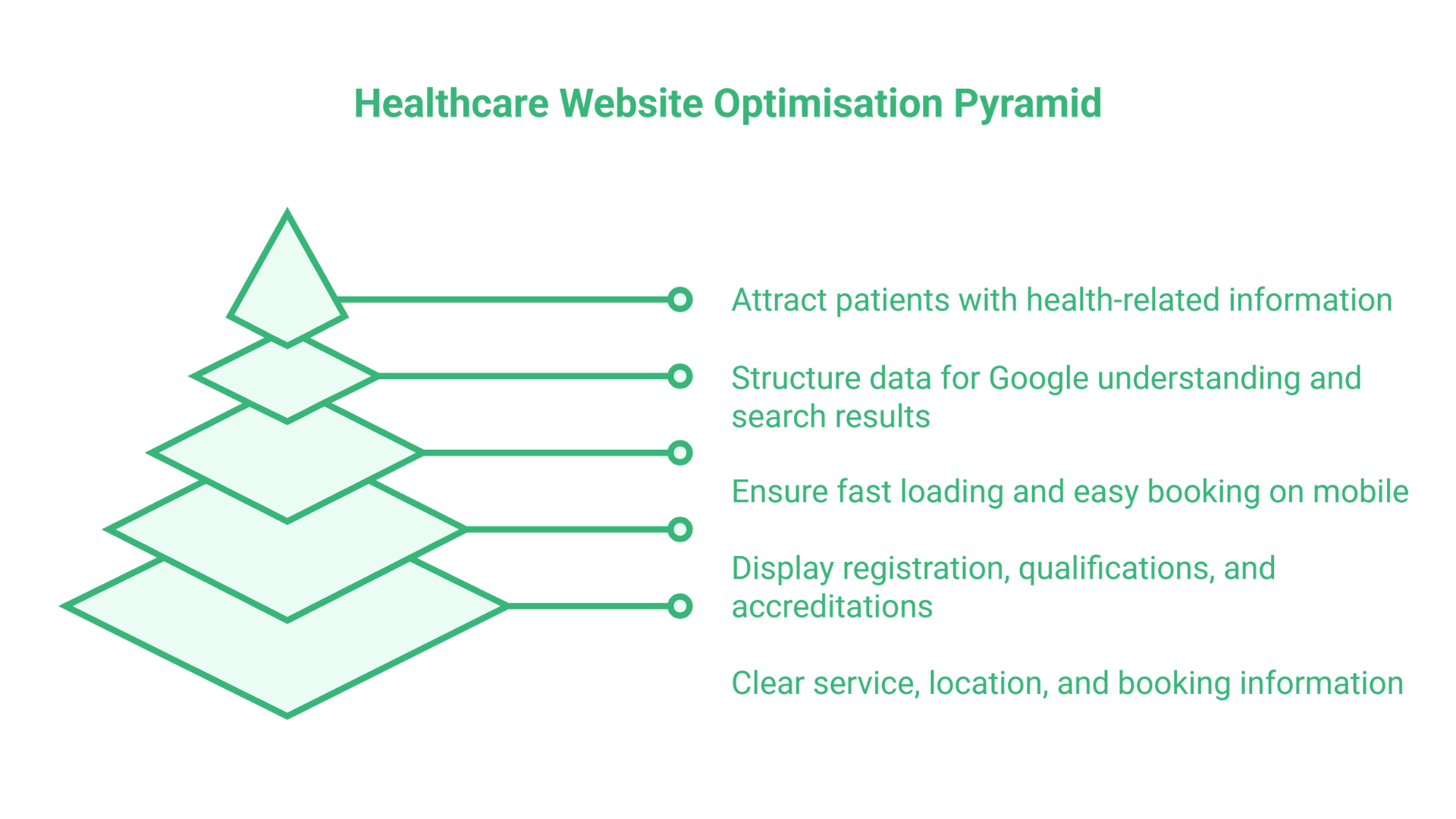
Your website converts search visibility into patient enquiries and supports professional credibility.
Essential Pages
The homepage clearly communicates your services, location, and how to book. Lead with patient-focused messaging—what you help patients achieve, not just what services you offer.
Services pages detailing each service area. Create separate pages for major services: general dentistry, cosmetic dentistry, orthodontics, as individual pages rather than one long services list.
Team page introducing practitioners with photos, qualifications, registrations, and areas of special interest. Patients want to know who will be treating them.
About page sharing your practice story, philosophy, and approach to patient care.
Contact and location page with address, map, parking information, public transport access, and phone number. Include clear booking instructions.
Online booking, if you offer it, integrated booking significantly increases appointment conversion.
Fees page (for private practices) with clear pricing or at least guidance on typical costs. Price transparency builds trust.
ProfileTree’swebsite design services help healthcare practices build websites that attract and convert patients while meeting professional standards.
Professional Registration and Credentials
Display professional credentials prominently:
Registration numbers: GDC (dentists), HCPC (physios, chiropodists), GCC (chiropractors), GOsC (osteopaths), GOC (opticians).
Qualifications: Degrees, specialist qualifications, postgraduate training.
Accreditations: CQC registration (England), relevant body accreditations.
Insurance: Professional indemnity confirmation.
These credentials are mandatory information in many cases and provide crucial trust signals.
Mobile Optimisation
Healthcare searches are increasingly mobile:
Fast loading: Patients researching options won’t wait for slow pages.
Click-to-call: Phone number must be tappable for enquiries.
Easy booking: If you have online booking, it must work flawlessly on mobile.
Clear service information: What you offer and how to access it, visible without excessive scrolling.
Your websitedevelopment should ensure an excellent mobile experience for healthcare websites.
Schema Markup for Healthcare
Structured data helps Google understand your practice:
LocalBusiness schema with appropriate type (Dentist, Physician, PhysicalTherapy, etc.).
MedicalOrganisation schema where applicable.
Service schema for each service offered.
Review the schema for displaying ratings in search results.
Person schema for individual practitioners with credentials.
Content for Healthcare Practices
Content attracts patients researching health topics:
Condition information:
- What causes [condition]?
- Symptoms of [condition]
- Treatment options for [condition]
- When to seek help for [condition]
Treatment explanations:
- What to expect during [treatment]
- Recovery from [procedure]
- How [treatment] works
- [Treatment] vs [alternative] compared
Prevention and advice:
- How to prevent [condition]
- [Body part] care tips
- Signs you need to see a [specialist]
Practice-specific:
- New patient information
- What to expect at your first appointment
- How to prepare for [treatment]
ProfileTree’s content marketing services help healthcare practices create content that attracts patients while maintaining clinical accuracy.
Reviews for Healthcare Practices
Reviews significantly influence healthcare provider selection while requiring sensitive handling.
Why Healthcare Reviews Matter
Trust is paramount. Healthcare involves personal well-being and vulnerability. Reviews from other patients provide crucial reassurance.
Credentials aren’t enough. Patients can’t evaluate clinical competence themselves. Reviews proxy for quality of care and patient experience.
Experience matters alongside outcomes. Reviews often focus on waiting times, staff friendliness, communication, and comfort—factors patients can evaluate directly.
Negative reviews strongly deter. One visible negative review about a healthcare provider creates significant concern for potential patients.
Generating Reviews Appropriately
Ask satisfied patients. After successful treatment outcomes, when patients express gratitude, these are appropriate moments to mention reviews.
Provide clear instructions. Many patients, particularly older ones, aren’t familiar with leaving Google reviews. Simple guidance helps.
Never pressure vulnerable patients. Patients in ongoing treatment or distress should never feel pressured to leave reviews.
Consider timing carefully. Ask after treatment concludes successfully, not during active care, when the relationship dynamic could feel coercive.
Use appropriate methods. Follow-up emails or texts after appointments, feedback cards at reception, and gentle verbal requests from reception staff.
Review Response for Healthcare
Respond professionally. Thank reviewers appropriately, acknowledge feedback constructively.
Never disclose patient information. Even if a patient reveals details in their review, your response must not confirm or reference treatment details.
Handle negative reviews carefully. Acknowledge concern, express desire to address issues, invite offline contact—without confirming any clinical details.
Example response to negative review: “We’re sorry to hear your experience didn’t meet expectations. Patient satisfaction is important to us, and we’d welcome the opportunity to discuss your concerns directly. Please contact our practice manager.”
GDPR and Patient Privacy
Healthcare reviews involve special considerations:
Never solicit reviews that would require patients to disclose health information. Generic satisfaction requests are appropriate; asking patients to describe their treatment publicly is not.
Don’t reference treatment in responses. Even positive responses should remain generic about the patient-practice relationship.
Respect patient autonomy. Some patients prefer privacy about healthcare relationships—never assume willingness to publicly review.
Citations for Healthcare Practices
Citations build local authority through consistent listings.
Key Directories for Healthcare
General directories:
- Google Business Profile
- Bing Places
- Yelp
- Thomson Local
- Yell
Healthcare-specific platforms:
- NHS website (for NHS practices)
- Private Healthcare Information Network
- Doctify
- WhatClinic
- Treatwell (for some therapies)
Professional body directories:
- General Dental Council register
- HCPC register
- GCC register
- GOsC register
- Relevant professional association directories
Local directories:
- Chamber of Commerce
- Local healthcare directories
- Private medical insurance provider directories
Citation Consistency
Maintain identical information everywhere:
Practice name: Exactly as registered, consistently formatted.
Address: Full, correctly formatted address.
Phone: Primary contact number, consistently formatted.
Registration numbers: Correct and current.
Audit citations regularly to ensure accuracy, particularly after any changes.
Standing Out From Competitors
Healthcare markets are often competitive. Differentiation helps attract patients.
Specialisation Positioning
Service specialisation: If you have particular expertise—sports injuries, cosmetic dentistry, children’s therapy—make it prominent.
Condition focus:Practices known for specific conditions attract patients seeking that expertise.
Approach differentiation: Holistic approach, evidence-based practice, patient-centred care—articulate what makes your approach distinctive.
Technology and Facilities
Modern equipment: Digital X-rays, advanced diagnostic tools, and the latest treatment technologies.
Facility quality: Comfortable, modern, accessible premises.
Convenience features: Online booking, flexible hours, minimal waiting times.
Patient Experience Focus
Communication style: How you explain conditions and treatments, involve patients in decisions.
Continuity of care: Seeing the same practitioner, coordinated care approaches.
Additional services: Support beyond clinical treatment—advice, exercises, ongoing guidance.
ProfileTree’s digital strategy services help healthcare practices develop positioning that differentiates in competitive markets.
Compliance Considerations
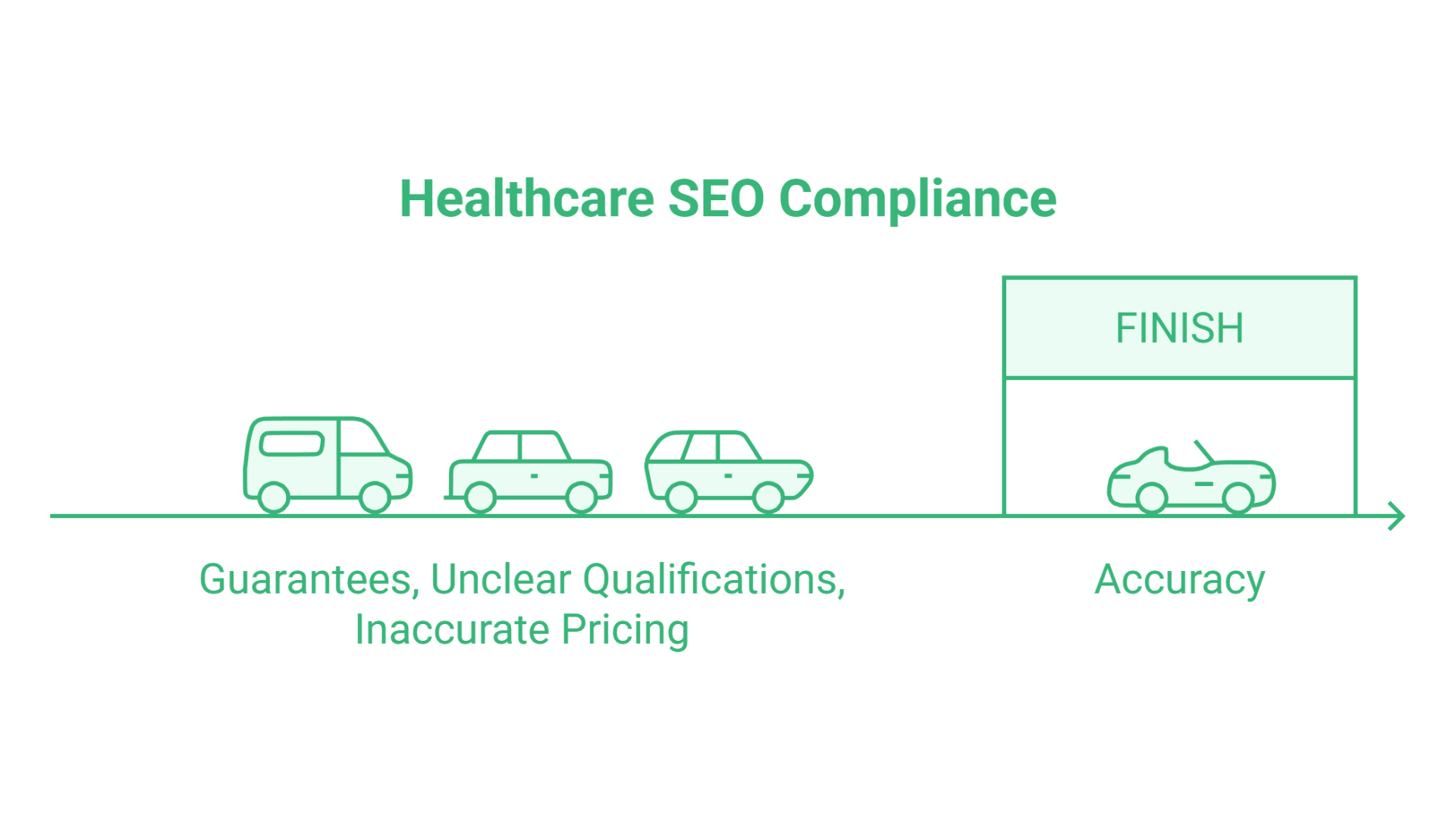
Healthcare local SEO must respect professional and regulatory requirements.
Advertising Standards
Healthcare advertising is regulated. Ensure:
Accuracy: All claims about services and outcomes must be truthful and verifiable.
No guarantees: Avoid promising specific clinical outcomes.
Qualification clarity: Practitioners’ qualifications and registration must be clear.
Price transparency: Where prices are shown, they must be accurate and complete.
CQC and Registration
Display registration appropriately. CQC-registered practices (England) should display registration information as required.
Professional registrations: Ensure all practitioner registrations are current and displayed where required.
Data Protection
Patient information: Never use identifiable patient information in marketing without explicit consent.
Review responses: Never confirm or reference treatment details, even in response to patient-initiated reviews.
Testimonials: If using patient testimonials, ensure proper consent is documented.
Measuring Success
Track metrics that matter for practice growth:
Search visibility: Rankings for key terms—”[practice type] [location],” specific service terms plus location.
Google Business Profile metrics: Profile views, direction requests, phone calls, website clicks.
Website traffic: Overall traffic and specifically traffic from local search.
Enquiry volume: New patient enquiries attributed to online discovery.
Conversion rate: What percentage of enquiries become patients?
Review metrics: Monthly review count, average rating, sentiment trends.
Patient acquisition cost: Marketing investment divided by new patients acquired.
Healthcare practices that invest in local SEO see compound benefits,” observes Ciaran Connolly, ProfileTree founder. “Strong local visibility attracts new patients, positive experiences generate reviews, reviews build trust that attracts more patients, and the cycle continues. Combined with the long-term value of patient relationships, local SEO investment delivers excellent returns for healthcare practices.
Frequently Asked Questions
How long does local SEO take for healthcare practices?
Google Business Profile optimisations show results within 2-4 weeks. Website improvements and citation building take 2-4 months to meaningfully influence rankings. Competitive healthcare markets may take 6+ months for significant ranking improvements. Consistent effort over 12 months typically delivers substantial growth.
Are there advertising restrictions on healthcare local SEO?
Local SEO itself isn’t restricted, but claims made in your content must comply with advertising standards. Avoid guaranteeing outcomes, ensure qualification claims are accurate, and follow your professional body’s advertising guidance. Standard local SEO practices—optimising your Google Business Profile, building citations, generating genuine reviews—are appropriate for healthcare.
How do I handle negative reviews about clinical care?
Respond professionally without confirming or referencing any clinical details. Express concern about their experience, invite them to contact the practice directly to discuss, and demonstrate commitment to patient satisfaction. Never argue about clinical matters publicly. If a review contains demonstrably false claims, consider reporting to Google and seeking advice from your professional body.
Should we show prices on our website?
For private practices, price transparency builds trust and pre-qualifies enquiries. Show clear pricing or meaningful price ranges. For NHS practices, explain NHS charges and any private options clearly. Patients increasingly expect price information—hiding costs creates suspicion and wastes time on enquiries from patients outside your price range.
How important are reviews for healthcare practices?
Extremely important. Healthcare decisions involve significant trust—patients rely heavily on other patients’ experiences. Strong reviews from genuine patients provide crucial social proof. In competitive markets, practices with substantially more and better reviews typically outperform competitors. Aim for consistent review generation rather than sporadic efforts.
Can we ask patients for reviews?
Yes, but appropriately. Ask about successful treatment outcomes when patients are satisfied. Never pressure vulnerable patients or those in ongoing treatment. Provide easy instructions for patients unfamiliar with online reviews. Generic satisfaction requests are appropriate; asking patients to describe specific treatments publicly raises privacy concerns. ProfileTree’s SEO services help healthcare practices build review generation processes that respect professional boundaries.
How do we balance clinical professionalism with approachable marketing?
Lead with patient benefits rather than clinical language. Explain what treatments achieve for patients, not just technical descriptions. Use photos showing welcoming environments alongside professional credentials. Address patient concerns and questions directly. Maintain accuracy and professionalism while being accessible to patients who aren’t healthcare experts.