
Google Penalty Recovery: Restoring Your Search Visibility After Penalties
Table of Contents
ProfileTree provides Google penalty recovery services for businesses across Northern Ireland, Ireland, and the UK that have lost visibility after a manual action or an algorithm update. If your traffic has dropped and you don’t know why, the first job is working out what actually happened, not guessing.
A Google penalty can strip years of ranking progress in days. Manual actions arrive as a notice in Search Console. Algorithmic penalties arrive as silence and a falling graph. Both need a different response, and both are recoverable in most cases, though not always to the exact position you held before.
This guide covers how to tell a penalty from a normal fluctuation, what a proper Google Search Console audit involves, how modern penalties around AI content and site reputation abuse differ from older link-based issues, and what realistic timelines and costs look like for UK businesses.
Two categories come up repeatedly in the queries we see from UK businesses: link penalty recovery, where the issue traces back to unnatural or purchased backlinks, and AI Google penalty recovery, where AI-assisted content published at volume has triggered a quality-based demotion. Both are covered in detail below, alongside the more general manual action and algorithmic recovery process.
Whoever asked you to fix this, whether that’s a managing director or a board, wants two things from an update: a plain-English explanation of what happened and a realistic date for when things improve. Translate the technical audit into those terms early, rather than waiting until the reconsideration request is submitted to explain the timeline.
Is It a Penalty or a Natural Fluctuation?
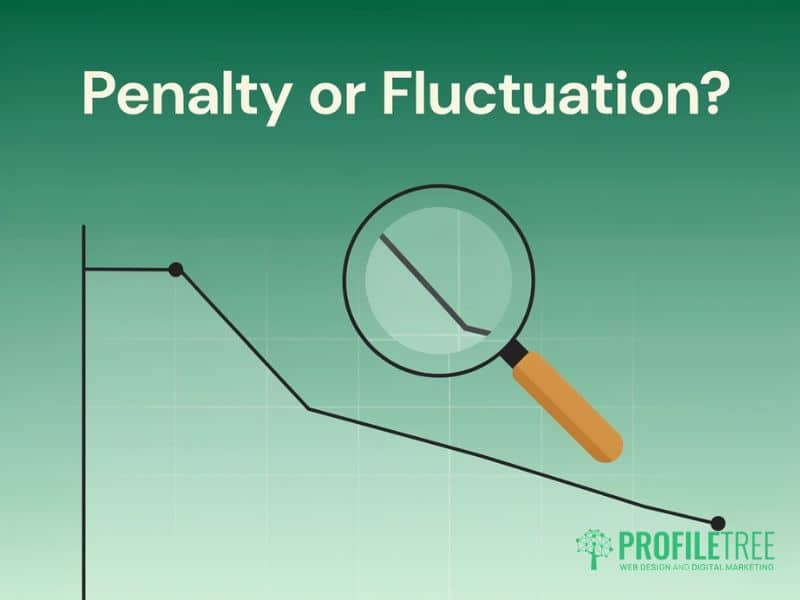
Start here. Before you commit weeks to Google penalty recovery work, confirm you’re actually dealing with a penalty and not a seasonal dip, a competitor overtaking you, or a technical fault. The process below runs in five stages: diagnose, audit, clean up, request reconsideration, and monitor. Each stage is covered in turn through this guide.
Manual Actions Are Easy to Spot
Manual actions show up directly, so this is the quickest check to run first. Log in to Search Console, open the Manual Actions section under Security & Manual Actions, and you’ll see a specific violation listed if Google’s team has taken action. There is no ambiguity here: if nothing appears, you do not have a manual action.
Algorithmic Penalties Take Detective Work
Algorithmic penalties are harder to spot because Google doesn’t notify you directly, so you’re working from patterns rather than a notice. You’ll notice a traffic cliff (a sudden, steep drop across many pages) or a slow decay (rankings sliding gradually over weeks). A traffic cliff that lines up with a known core update date usually points to an algorithmic issue. A slow decay might be a penalty, but it could equally be rising competition or seasonal demand.
Cross-check the timing against Google’s documented update history before assuming the worst. If your drop started exactly when a core update rolled out, that’s a strong signal. If it doesn’t line up with anything, look at technical causes first, such as indexing errors, a botched migration, or a robots.txt mistake, before assuming an algorithmic penalty recovery project is needed at all.
The same factors apply to an algorithmic drop as to a manual action, just without the notice: no direct notification, an algorithm update correlates with the timing, recovery depends on Google re-evaluating the site during a future crawl, and duration ranges from weeks to many months, depending on severity.
Auditing Your Google Search Console Data
Once you have confirmed a penalty, the audit tells you what to fix. This is where most Google penalty recovery services start, and it is the step businesses most often rush, understandably, because everyone wants the fix to start immediately.
Start With the Manual Actions Report
Open the Manual Actions report first, since it does the most work for the least effort. It names the specific issue (unnatural links to your site, thin content, structured data problems) and sometimes which parts of the site are affected. Read it twice; the exact wording matters when you come to write your reconsideration request later.
Cross-Reference Index Coverage and Performance
Next, check the Index Coverage and Pages reports. Compare which URLs are indexed now against which were indexed before the drop. Pages that have quietly dropped out of the index often point to a content quality or duplicate content issue rather than a manual link penalty.
Pull your Performance report and filter by date, comparing the weeks before and after the suspected drop. Look at impressions as well as clicks. A page that’s lost clicks but kept impressions is still being shown for relevant queries, which usually rules out de-indexing and points instead to a ranking demotion. Segment by device and country, too; a drop confined to mobile or to one market often has a different cause than a site-wide collapse.
If you manage a large site, export the data rather than relying on the dashboard filters. A spreadsheet lets you spot patterns across hundreds of URLs that the Search Console interface won’t surface on its own. This diagnostic stage typically takes two to five days for a straightforward site, longer where the drop covers thousands of pages or multiple subdomains.
It also helps to look sideways, not just inward. Check what the sites now outranking you have that yours doesn’t: fresher content, better technical performance, or simply a cleaner link profile. A penalty recovery plan built purely on fixing your own faults, without checking what improved around you, can leave you compliant but still not competitive.
Recovering From Modern Penalties: AI Content and Site Reputation Abuse
Older penalty guides focus almost entirely on link spam and thin content. Google’s more recent enforcement targets two additional categories that catch UK businesses off guard: scaled content abuse and site reputation abuse. Anyone searching for AI Google penalty recovery help is usually dealing with one of these two, rather than a traditional link issue.
Scaled Content Abuse
Scaled content abuse covers content, AI-generated or otherwise, published at volume with no real editorial input, designed primarily to manipulate rankings rather than help a reader. The fix is not deleting every AI-assisted article; it involves demonstrating a genuine human-in-the-loop editing process. Every published page needs a named author, factual accuracy checks, and evidence that someone with real subject knowledge reviewed it before it went live.
Site Reputation Abuse
Site reputation abuse, sometimes called parasite SEO, covers third-party content hosted on a trusted domain purely to borrow that domain’s authority, with little or no oversight from the site owner. If your site has ever hosted sponsored content, guest sections, or affiliate microsites with limited editorial control, this is worth auditing even without a direct notice from Google.
Where AI Actually Helps
An AI Google penalty recovery approach means using AI tools to speed up the audit, not to disguise low-quality content as human work. That distinction is the whole point of an AI Google penalty recovery process done properly: speed on the analysis side, judgment on the editorial side. ProfileTree uses AI-assisted analysis to scan large sites for thin, duplicate, or auto-generated pages far faster than a manual review, then has a human editor make the final call on what to keep, rewrite, or remove.
This distinction matters because the volume problem that caused the penalty in the first place can’t be solved by producing more unreviewed content, however it’s produced. Every page that survives the audit should be able to answer a simple question: Would this exist if search engines didn’t?
Businesses recovering from these newer policy categories tend to see a slower re-evaluation than a straightforward manual link action, because Google is assessing the whole site’s editorial standard rather than a defined set of URLs.
Cleaning Up Links, Content, and Technical Issues
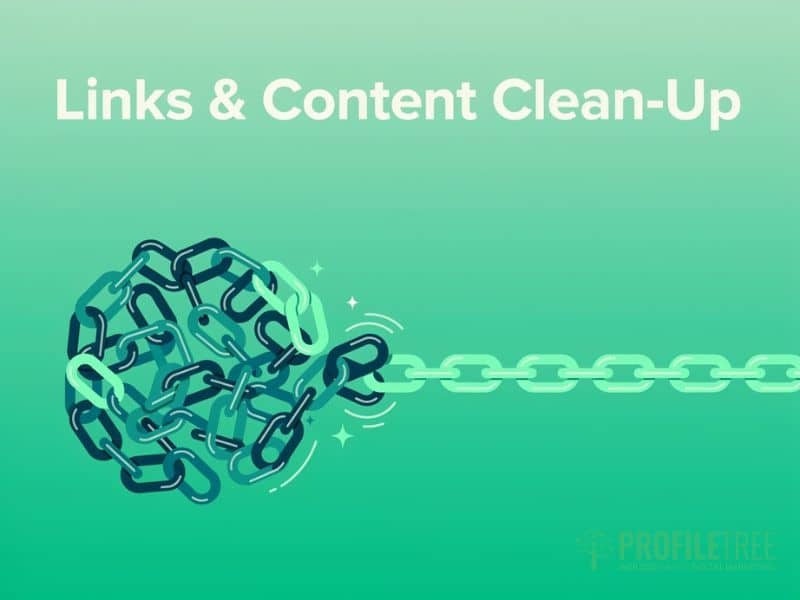
Technical remediation runs in parallel across three areas: links, content, and site infrastructure.
Link Audits and Disavow
Export your backlink profile from as many tools as you have access to; no single tool captures every link pointing at your site. Flag paid links, link scheme participation, low-quality directory submissions, and PBN links. For each toxic link, attempt removal by contacting the webmaster before reaching for the disavow tool. A link penalty recovery case built on genuine removal attempts, documented with dates and outreach copies, carries more weight with Google’s reviewers than a disavow file alone. Treat link penalty recovery as an outreach problem first and a disavow problem second.
The disavow tool still has a place, but treat it as a backstop for links you can’t get removed, not a first resort. Disavowing an entire link profile out of caution can strip signals that were helping you rank, and it won’t speed up a purely algorithmic drop that has nothing to do with links.
Businesses running their own audits in-house sometimes bring in outside support once the backlink profile analysis flags more toxic links than they can chase down alone.
Content and Technical Clean-Up
Work through the site page by page. Thin pages either get expanded with genuinely useful material or removed and redirected. Duplicate or near-duplicate pages get consolidated with a canonical tag or rewritten to serve a distinct search intent. Keyword-stuffed copy gets rewritten in plain language, often as part of a wider content marketing refresh rather than a one-off edit. Set a realistic pace: a few dozen pages reviewed each week properly beats a rushed pass across the whole site in a weekend.
Check for cloaking (different content served to users and Googlebot), unexpected redirects, and structured data that doesn’t match what’s visibly on the page. These are quick wins compared with link and content work, and Google’s crawlers pick up technical fixes faster than editorial ones.
Document every change as you go. Screenshots, before-and-after content, dated outreach emails, and disavow file versions all become evidence for the reconsideration request or for demonstrating good faith during an algorithmic recovery.
The Reconsideration Request Process
Manual actions require a reconsideration request once remediation is complete; algorithmic penalties don’t have an equivalent submission, so this stage of Google penalty recovery applies specifically to manual actions.
A strong request acknowledges the issue directly rather than disputing it. Reviewers read hundreds of these; a defensive or evasive submission slows things down. State plainly what Google flagged, explain how it happened, and detail exactly what you did to fix it, with evidence attached or linked.
Include your backlink audit results, a list of links removed with dates, your disavow file if you submitted one, and examples of content changes where relevant. Vague statements such as “we’ve improved our content” without specifics tend to get rejected.
Google typically reviews reconsideration requests within a few weeks, though this varies with the review queue. If your request is rejected, the response usually indicates what’s still missing; address that directly in a follow-up rather than resubmitting the same evidence.
While you wait, keep working. A rejected request that arrives after two months of inactivity looks worse than one that arrives alongside continued, visible improvement.
Realistic Timelines, Costs, and UK Considerations
None of this is quick, and any guide that promises a fixed number of weeks is guessing. The three factors below (time, cost, and UK-specific context) shape what a realistic recovery actually looks like.
Timelines
Timelines vary more than most guides admit. A straightforward manual action tied to a small number of unnatural links can be cleared in two to four months, covering audit, outreach, disavow, and reconsideration review. A complex, site-wide link profile or a large content clean-up typically runs four to eight months. Algorithmic recovery has no fixed review date; Google re-evaluates sites over its normal crawl and update cycles, and moderate-impact cases commonly take six to twelve months before rankings stabilise.
Link penalty recovery specifically tends to move faster than content-based recovery, since removing or disavowing a defined set of links is more clear-cut than proving an entire site has genuinely improved. A link-only manual action with good outreach records is often the quickest case in this whole guide.
Costs
Cost depends on scope, and there’s enough variation between cases that a single figure would be misleading. A limited manual action with a small link profile costs less than a full site-wide algorithmic recovery involving hundreds of pages and a large backlink profile. Ask for pricing after an initial assessment rather than assuming a fixed fee.
A quote for penalty recovery should set out what’s included: the initial audit, link outreach, content remediation, the reconsideration request itself, where relevant, and a defined period of post-recovery monitoring. Ask what happens if the first reconsideration request is rejected, since a second submission is common and should be covered rather than charged as an entirely separate project.
Reporting during a recovery project should be frequent enough to reassure, without becoming a distraction from the work itself. A short monthly update covering audit progress, links removed, content pages reviewed, and any change in rankings or impressions is usually enough for most stakeholders to stay informed without needing a weekly call.
UK-Specific Considerations
For UK service businesses specifically, a penalty rarely stays confined to organic rankings alone. A site-wide demotion often affects Local Pack visibility too, so check your Google Business Profile performance alongside your organic data. Keep your Companies House listing and NAP details (name, address, phone) consistent across directories; inconsistent business data is a minor but real contributor to trust signals during recovery. Professional services firms should also check that any HMRC-related guidance pages on their site are accurate and properly sourced, since inaccurate regulatory content is exactly the kind of thin or misleading page Google’s quality systems are built to catch.
Full recovery to your previous rankings is possible but not guaranteed. Competitors keep improving while you’re fixing things, so measure success against sustainable, quality-led visibility rather than a specific position. This is where an ongoing Google penalty recovery services engagement differs from a one-off fix: monitoring continues after reconsideration to catch any repeat issues early, usually through a quarterly link and content review.
Why Businesses Choose ProfileTree for Google Penalty Recovery
ProfileTree runs Google penalty recovery services for SMEs across Northern Ireland, Ireland, and the UK, combining backlink and content audits with the wider search engine optimisation work needed to rebuild visibility once a site is clear. That covers both link penalty recovery cases and the newer AI Google penalty recovery cases, since the two often overlap on larger sites.
“Most of the UK penalty cases we see land in one of three buckets: thin content published faster than anyone can properly edit it, unnatural links bought or exchanged years ago and forgotten about, and sites caught in a core update because their overall quality never quite matched what was ranking around them,” says Ciaran Connolly, founder of ProfileTree. “The businesses that recover fastest are the ones that stop looking for a shortcut back and instead fix the actual problem.”
Recovery work sits alongside ProfileTree’s broader digital strategy support, so businesses come out the other side with a plan for preventing a repeat rather than just a fixed site. ProfileTree’s 5-star Google rating, built on more than 450 client reviews, reflects the kind of ongoing SEO guidance clients get alongside technical audit work.
This full-service integration means the same team handling a reconsideration request can also handle the SEO and content work needed to rebuild rankings once the penalty clears, rather than leaving a business to manage two separate suppliers.
FAQs
1. How do I know if I have a Google penalty?
Check the Manual Actions section of Search Console first; a listed violation confirms a manual action. If nothing appears there but you’ve seen a sudden traffic drop, compare the timing against known algorithm update dates. A gradual decline is more likely due to competition or seasonality than a penalty.
2. How long does Google penalty recovery take?
A simple manual action tied to a small number of links can be cleared in two to four months. Algorithmic recovery has no fixed review date and commonly takes six to twelve months for moderate cases. Complex, site-wide issues can take longer in both categories.
3. Does deleting content fix a penalty?
Sometimes, but not automatically. Thin or low-value pages usually need improving or removing with a proper redirect plan, not mass deletion. Deleting content without addressing the underlying quality issue rarely resolves an algorithmic penalty on its own.
4. Should I disavow every suspicious link?
No. Attempt removal first and reserve the disavow tool for links you genuinely can’t get taken down. An overly aggressive disavow file can remove links that were helping your rankings, and it won’t speed up an algorithmic recovery that has nothing to do with links.
5. Will my rankings return to where they were?
Often, but not always, to the exact previous position. Competitors keep moving while you’re fixing the underlying issues, so some businesses land close to their old rankings and others settle lower despite full technical compliance. Sustainable, quality-led visibility matters more than matching an old snapshot.