
Digital Compliance and Regulations in Northern Ireland: The Business Strategy Guide
Table of Contents
For many business owners in Belfast, Derry and across the border regions, digital compliance and regulations can feel like a never-ending list of obligations. UK GDPR, PECR, Cyber Essentials, NIS2, the EU AI Act: the landscape is wide, and the consequences of getting it wrong are real. Digital compliance and regulations in Northern Ireland carry an extra layer of complexity that businesses in Manchester or Dublin simply do not face, because NI operates within a dual regulatory environment that spans both the UK internal market and the EU single market.
This guide is not a dry legal checklist. It is a practical strategy resource built for business owners, marketing managers and digital decision-makers who want to understand digital compliance and regulations well enough to act on them. Throughout, we examine how NI firms can approach digital compliance and regulations not as a burden but as a genuine commercial differentiator: a way to win contracts, protect reputation and trade across two of the world’s most valuable markets without friction.
ProfileTree is a Belfast-based web design and digital marketing agency that works with SMEs across Northern Ireland, Ireland and the UK. Since 2011, the team has completed over 1,000 web and digital projects, and digital compliance and regulations form a recurring theme in client strategy work at every level.
Why Digital Compliance and Regulations Are Different in Northern Ireland
Northern Ireland occupies a position that no other UK region shares. Because of our trade and legal relationship with the Republic of Ireland and the broader EU single market, digital compliance and regulations here are shaped by influences from both London and Brussels. A sound digital strategy for NI businesses must account for this dual-regulatory context from the outset, long before any question of individual regulations arises.
The Windsor Framework and the Digital Bridge
The Windsor Framework defines NI’s unique post-Brexit position. While most digital regulations affecting NI businesses are managed at a UK-wide level, firms that handle goods, services or data across the border with the Republic of Ireland must remain aware of EU regulatory developments. This is particularly relevant for digital compliance and regulations involving data transfers, AI systems and online trading.
In practical terms, this creates what compliance specialists describe as a high-water mark requirement: NI businesses serving both UK and ROI customers must satisfy the stricter of the two sets of rules. For those with the systems in place to do this, it becomes a commercial advantage. Our guide to UK digital compliance for e-commerce websites explores how this applies specifically to online retail operations across the region.
The Dual-Market Advantage
Rather than viewing this position as a burden, forward-thinking NI businesses are reframing digital compliance and regulations as a gateway. If your systems, data handling practices and digital infrastructure already meet EU standards, you are positioned as a more attractive supplier, partner or vendor to European clients. GB firms seeking to expand into the ROI market face compliance gaps that NI firms have already addressed. This advantage compounds when combined with strong SEO services that build organic visibility, since compliant, well-structured digital infrastructure supports search performance alongside regulatory standing.
“The businesses we see winning contracts across both markets are those that treated compliance as a design principle rather than an afterthought. When your digital infrastructure is built around sound data governance and security from the outset, the cost of compliance falls sharply while your commercial reach expands.” Ciaran Connolly, Founder, ProfileTree
The Four Pillars of NI Digital Regulation
Digital compliance and regulations in Northern Ireland can be grouped into four distinct pillars. Each pillar covers a different dimension of your digital operations, and together they form the regulatory architecture within which every NI business operates online. Understanding each pillar allows businesses to prioritise compliance activity based on their own risk profile and commercial ambitions.
1. Data Privacy: UK GDPR and the EU Interface
Data privacy sits at the centre of digital compliance and regulations for the majority of NI businesses. Since the UK’s exit from the EU, businesses in Northern Ireland must comply with the UK Data Protection Act 2018 and the UK GDPR. For most day-to-day purposes, the rules on collecting, storing, processing and deleting customer data remain closely aligned with their EU counterparts.
The NI difference emerges most clearly in data transfers. If your business uses cloud servers hosted in Dublin, employs staff working remotely in the Republic, or provides services to customers across the border, you are engaged in international data transfers under the UK framework. You must have a Data Processing Agreement in place that acknowledges the UK’s Adequacy Decision from the EU, confirming that data moving between the two can do so freely under current arrangements. The Information Commissioner’s Office publishes detailed guidance on international transfer requirements and is the primary regulatory body NI businesses should monitor for updates.
| Requirement | UK GDPR | EU GDPR (ROI Interface) |
|---|---|---|
| Lawful basis for processing | Required | Required |
| Data Subject Rights | 8 rights recognised | 8 rights recognised |
| International Transfer Mechanism | UK Adequacy Decision | SCCs / Adequacy |
| Supervisory Authority | ICO (UK) | DPC (Ireland) |
| Maximum Fine | Up to £17.5m or 4% turnover | Up to €20m or 4% turnover |
Do not aim for minimum UK compliance. By maintaining EU GDPR parity in your data practices, your NI business remains accessible to any European partner or client. This applies equally to your content marketing strategy: compliant data collection practices underpin every email list, lead magnet and personalised campaign your business runs.
2. Cyber Security: Cyber Essentials and NIS2
Cyber security has moved from a technical consideration to a board-level priority within digital compliance and regulations for NI businesses. Northern Ireland has established itself as a recognised centre for cyber security expertise, and the expectations placed on local firms reflect that standard.
Cyber Essentials certification is no longer optional for any NI firm seeking government contracts through either the NI Executive or UK central government procurement. It is a prerequisite. The certification covers five technical controls: firewalls, secure configuration, user access control, malware protection and patch management. For businesses handling sensitive client data or operating critical infrastructure, Cyber Essentials Plus provides a higher level of assurance through independent testing.
The NIS2 Directive is an EU framework that NI firms supplying cross-border critical infrastructure need to understand. NIS2 applies to sectors including energy, water, digital infrastructure, healthcare and financial services. If your business forms part of a supply chain that crosses into the Republic, your downstream partners may require NIS2-aligned security practices from you regardless of your own direct regulatory obligations.
3. Consumer Rights and E-Commerce (PECR)
PECR, the Privacy and Electronic Communications Regulations, governs digital marketing, cookies, electronic communications and online transactions. It sits alongside UK GDPR within the broader framework of digital compliance and regulations and is frequently overlooked until an enforcement issue arises. Our resource on compliance and security in online payments covers how PECR intersects with payment processing obligations for NI e-commerce businesses.
For NI businesses running e-commerce platforms, email marketing campaigns or any form of digital advertising, PECR defines the rules on consent, cookie notices, marketing messages and telephone preference. Businesses targeting both UK and ROI customers face additional complexity: a Belfast-based retailer operating a .ie domain or marketing specifically to customers in the Republic must align their cookie consent approach with the stricter transparency requirements expected by the Data Protection Commission in Ireland.
The Electronic Commerce Act 2000 also remains relevant for businesses conducting transactions digitally. It gives electronic signatures the same legal standing as handwritten ones and establishes the framework for enforceable digital contracts across both jurisdictions.
4. The AI Frontier: The EU AI Act and NI Businesses
This is the area of digital compliance and regulations that most NI businesses have yet to plan for, and the window for early-mover advantage is narrowing. The EU AI Act is the world’s first comprehensive legal framework for artificial intelligence. It applies not only to EU-based companies but to any business whose AI system produces outputs used within the EU. NI businesses already exploring AI marketing and automation tools will need to assess whether their chosen platforms fall within the Act’s risk classification framework, particularly where those tools influence decisions affecting customers or employees.
The Act classifies AI systems by risk level: unacceptable risk systems are banned outright; high-risk systems face strict requirements around transparency, human oversight, accuracy and documentation; limited-risk and minimal-risk systems carry lighter obligations. NI businesses using AI for hiring decisions, financial scoring or health-related applications will fall into the high-risk category and must prepare accordingly.
The practical steps are to audit current AI tool usage, classify each system by risk level, and ensure documentation and human oversight procedures are in place. This includes customer-facing tools such as AI chatbots used for service or lead qualification, which must be clearly identified as automated systems under the Act’s transparency requirements.
Sector-Specific Digital Compliance and Regulations: FinTech, HealthTech and E-Commerce
Digital compliance and regulations are not one-size-fits-all. The obligations on a FinTech startup in the Ormeau Baths differ substantially from those on a manufacturer in County Antrim or a healthcare platform serving patients across the island of Ireland. Below are the sector-specific considerations that apply most frequently in NI.
FinTech and Financial Services
Northern Ireland has developed a significant FinTech cluster, and firms operating in this space face layered digital compliance and regulations beyond standard GDPR. Our detailed resource on digital marketing compliance in financial services addresses the specific constraints that apply when FinTech firms promote their products digitally.
The Digital Operational Resilience Act (DORA) applies to financial entities and their critical ICT third-party providers across the EU. NI-based FinTech firms supplying services to ROI-regulated entities must ensure their ICT risk management frameworks, incident reporting processes and third-party risk assessments meet DORA requirements. Additional frameworks relevant to NI FinTech firms include MiFID II for investment services, AIFMD for fund management, EMIR for derivatives reporting and Solvency II for insurance businesses. The common thread across all of them is documented governance: the ability to demonstrate, through policies and audit trails, that risk is being managed systematically.
For FinTech firms running digital outreach campaigns, our resource on email marketing compliance for financial services covers the specific PECR and FCA considerations that apply to NI-based financial businesses communicating with both UK and ROI audiences.
HealthTech and Digital Health Services
Digital health services in Northern Ireland must comply with the Health and Social Care Act, which governs the confidentiality and security of personal health records. The Data Protection Act 2018 treats health data as a special category, meaning higher standards of consent and security apply. For businesses developing digital health tools, remote monitoring platforms or patient-facing applications, the combination of UK GDPR special category rules and NHS Digital data security standards creates a demanding compliance environment.
NI HealthTech firms with EU market ambitions should additionally track the EU’s Medical Device Regulation and the emerging requirements under the EU AI Act for high-risk AI systems used in clinical decision-making. Early alignment with these standards removes the largest single barrier to entering the ROI healthcare market.
E-Commerce and Retail Technology
Digital compliance and regulations for NI e-commerce businesses centre on consumer rights, payment security and data handling. The Consumer Rights Act 2015 applies to all UK online retailers. PCI DSS compliance is mandatory for any business accepting card payments, regardless of size. Building a compliant platform from the ground up is significantly more cost-effective than retrofitting legal requirements after launch; our web design services for NI businesses incorporate GDPR-ready architecture and PECR-compliant cookie frameworks as standard.
NI retailers selling to ROI customers face additional obligations under EU consumer protection law, including the right of withdrawal, pre-contractual information requirements and distance selling rules. Getting both frameworks built into your platform from the outset is cheaper than correcting the situation after a complaint or enforcement action.
Building a Compliance-First Business Model: Six Practical Steps
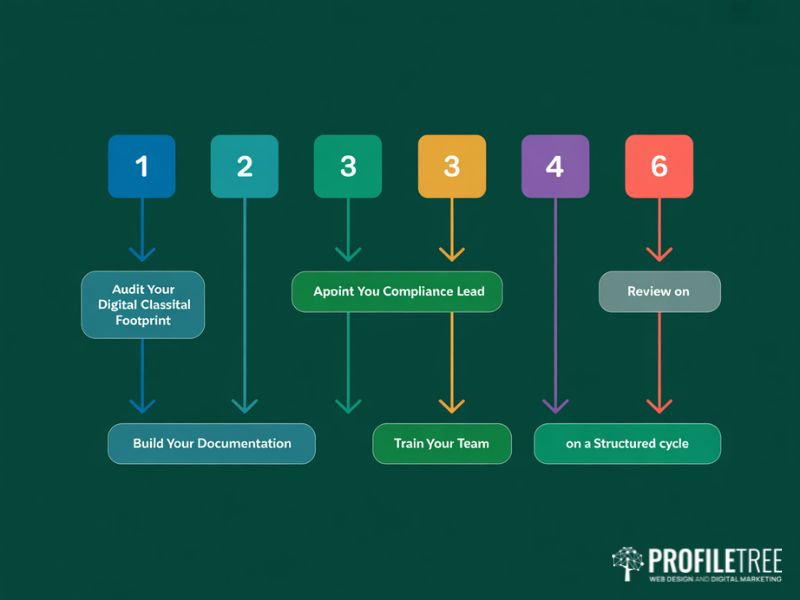
Effective management of digital compliance and regulations is not about responding to audits: it is about building systems that make compliance the default operating condition. The following six steps reflect the approach ProfileTree recommends to SME clients across Northern Ireland who want to manage regulatory risk without absorbing disproportionate cost.
Step 1: Audit your current digital footprint. Map every digital system, third-party tool and data flow your business uses. Identify where personal data is collected, stored and processed. Note which systems involve AI or automated decision-making. This audit is the foundation for every compliance decision that follows.
Step 2: Classify your obligations by framework. Based on your sector, size and market (UK-only, UK plus ROI, or wider EU), identify which specific regulations apply. Use the four pillars above as your starting framework. If your business operates across the border in any capacity, apply the stricter standard across your data handling practices.
Step 3: Appoint a lead for digital compliance and regulations. This does not need to be a full-time Data Protection Officer unless your business processes personal data at scale or handles special category data. It needs to be a named individual with the authority to enforce policy decisions. Many NI SMEs use an external DPO service to fulfil this function cost-effectively.
Step 4: Build your documentation. Digital compliance and regulations require evidence, not just intent. Your documentation should include a Record of Processing Activities, a Data Processing Agreement template for third-party vendors, a Data Breach Response Plan, a Cookie Policy and Privacy Notice, and an AI Usage Policy if you use AI tools in client-facing or decision-making contexts.
Step 5: Train your team. Human error remains the leading cause of data breaches. Regular digital training for your staff, covering compliance awareness alongside broader digital skills, is both a regulatory requirement and a practical risk management measure. ProfileTree delivers compliance-integrated digital skills programmes for SME teams across Northern Ireland.
Step 6: Review and update on a structured cycle. Digital compliance and regulations evolve. The EU AI Act, Online Safety Act, and anticipated updates to the UK GDPR regime all represent material changes on the near-term horizon. Set a review at least twice a year and after any major legislative update.
Common Compliance Pitfalls for NI SMEs
Businesses managing digital compliance and regulations for the first time frequently encounter the same set of mistakes. Awareness of these pitfalls allows you to avoid the time and cost of correcting them.
- Assuming UK GDPR compliance is sufficient for ROI customers: it is a starting point, not an endpoint.
- Using pre-ticked cookie consent boxes: these have not been compliant since 2019 and the ICO actively enforces against them.
- Failing to document third-party data sharing: if a vendor processes personal data on your behalf, you need a Data Processing Agreement in place before data sharing begins.
- Treating Cyber Essentials as a one-time exercise: the certification requires annual renewal and your security controls must be maintained throughout the year.
- Ignoring AI compliance because the tools seem low-risk: many AI tools used for marketing, recruitment or customer service carry obligations that most NI businesses have not yet assessed.
Digital Compliance Risk Matrix for NI Businesses
| Risk Area | Applies To | Key Framework | Priority |
|---|---|---|---|
| Data Transfers to ROI | Any business with ROI customers or suppliers | UK GDPR / EU Adequacy | High |
| Cookie Consent | All websites with analytics or marketing tools | PECR / ePrivacy | High |
| AI Tool Usage | Businesses using AI in decisions affecting people | EU AI Act | Medium-High |
| Cyber Security | All businesses, mandatory for public contracts | Cyber Essentials / NIS2 | High |
| Payment Security | E-commerce and card-present businesses | PCI DSS | High |
| ICT Resilience | FinTech / financial services with EU clients | DORA | Medium |
Taking the Next Step with Digital Compliance and Regulations

Digital compliance and regulations in Northern Ireland will continue to develop. The EU AI Act timeline, anticipated updates to the UK data protection framework, and the evolving cyber security landscape all point to a regulatory environment that demands ongoing attention rather than a single point-in-time response.
The businesses best positioned to manage this are those that treat digital compliance and regulations as a design principle. When governance, data protection and security are built into how a business operates digitally rather than bolted on afterwards, the cost of compliance falls and the commercial case for it strengthens. In Northern Ireland, where operating to the higher of two regulatory standards can become a genuine market differentiator, this principle carries particular weight.
ProfileTree supports SMEs across Northern Ireland, Ireland and the UK with web design, digital marketing, AI training and digital skills development. If digital compliance and regulations are on your business agenda, our team can help you build a digital strategy that integrates compliance from day one, protecting your operations while supporting your growth objectives.
FAQs
Do I need a Data Protection Officer if I am a small NI business?
Not necessarily. Most SMEs can appoint an internal lead or use an external DPO service instead. A dedicated DPO is only legally required if you process personal data at large scale or handle special category data such as health or financial records.
How often does the ICO actually fine small businesses?
The ICO issues fines far more frequently for systemic failures than for honest mistakes. Keeping your documentation current and responding promptly to any data subject requests significantly reduces your exposure, regardless of business size.
If I only use third-party tools like Google Analytics or Mailchimp, do I still have compliance obligations?
Yes. You are the data controller and remain responsible for how those tools handle your customers’ data. You need a Data Processing Agreement with each provider and a cookie consent mechanism that meets PECR requirements before any tracking fires.
What is the simplest first step for a business that has done nothing on compliance yet?
Start with a data audit: list every system that collects or stores personal data, who has access to it, and where it is hosted. That single document tells you where your gaps are and makes every subsequent compliance decision faster and cheaper.
Will the UK GDPR adequacy arrangement with the EU last?
It is reviewed periodically and is not guaranteed to continue indefinitely. NI businesses that maintain EU GDPR parity regardless of the UK adequacy status protect themselves against any future change and remain commercially viable for European clients either way.
Is there specific funding available in Northern Ireland to help businesses with digital compliance?
Invest NI and the UK Shared Prosperity Fund have both supported digital capability programmes that include compliance readiness. Eligibility changes regularly, so checking directly with Invest NI or your local council’s business support team is the most reliable route to current options.