
Chatbots Explained: The Complete Guide to Conversational AI for Business
Table of Contents
Businesses across Northern Ireland and the UK are being asked to make real decisions about chatbots right now. Whether it is a customer service manager wondering if a bot can handle out-of-hours enquiries, or a managing director weighing up the cost of an AI implementation project, the questions are the same: what exactly is a chatbot, how does one actually work, and when does it make commercial sense to deploy one?
This guide answers those questions plainly. It builds on the original overview of conversational AI and updates it to reflect where the technology stands today, particularly the shift from simple rule-based bots toward genuinely intelligent AI chatbots and the emerging category of agentic AI that can take actions rather than simply answer questions.
What Is a Chatbot and How Does It Work?
A chatbot is a software programme that simulates conversation with a human user, typically through a text interface on a website, messaging app, or customer service platform. The term is short for “chat robot,” and it covers everything from a basic FAQ pop-up on a local retailer’s site to the sophisticated AI systems handling millions of customer interactions for large enterprises every day.
For a long time, chatbots explained in any standard guide were essentially decision trees: the user types a question, the bot matches it to a pre-written answer, and the conversation moves forward along a script. These rule-based systems are still in use, but they represent only one end of a wide spectrum. The introduction of large language models changed the landscape significantly. Instead of matching keywords to canned responses, LLM-powered conversational AI understands the intent behind a question and generates a contextually appropriate reply. The practical difference for a Belfast business is substantial: a rule-based chatbot might handle twenty pre-programmed questions well and fail on the twenty-first, while an AI chatbot can handle queries it has never seen before.
Understanding the mechanics of conversational AI does not require a computer science degree, but having a working grasp of the main components helps when evaluating platforms and suppliers.
Natural Language Processing and Natural Language Understanding
Natural language processing (NLP) is the technology that allows a chatbot to interpret human language. When a user types a message, NLP breaks it down into its constituent parts and identifies the likely meaning. Natural language understanding (NLU) goes a step further, grasping the intent behind the words rather than just the words themselves.
This distinction matters in practice. A basic chatbot with only keyword recognition will treat “I want to cancel my order” and “I need to stop my delivery” as two different requests because the words do not match. An NLU-powered AI chatbot recognises that both sentences express the same intent and routes them to the same resolution path.
Machine Learning and How Chatbots Improve Over Time
Machine learning allows chatbots to get better with use. Unlike a fixed rule-based system that delivers the same output regardless of how many interactions it processes, an ML-enabled conversational bot analyses patterns across thousands of conversations and refines its responses accordingly. It identifies which answers satisfied users, which escalated to human agents, and which generated follow-up complaints, then adjusts its behaviour to improve outcomes.
This is the core distinction between a basic chatbot and practical AI. The former is static; the latter develops. For a business managing a growing customer base, the compounding improvement that comes from machine learning has genuine commercial value over time.
Retrieval-Augmented Generation: Giving Bots Access to Private Knowledge
One of the more significant advances in recent years is retrieval-augmented generation (RAG). This technique allows an AI chatbot to access a company’s specific knowledge base, product documentation, or internal systems in real time and incorporate that information into its responses.
Without RAG, a general AI chatbot can only answer from what it was trained on, which means it cannot discuss your specific products, pricing, or policies accurately. With RAG, the bot queries your own database before responding, grounding its answers in your actual business data. For UK SMEs, this is the difference between a bot that sounds smart but gives generic answers and one that can accurately handle a customer asking about a specific product or a service delivery timeline.
The Four Types of Chatbot Technology
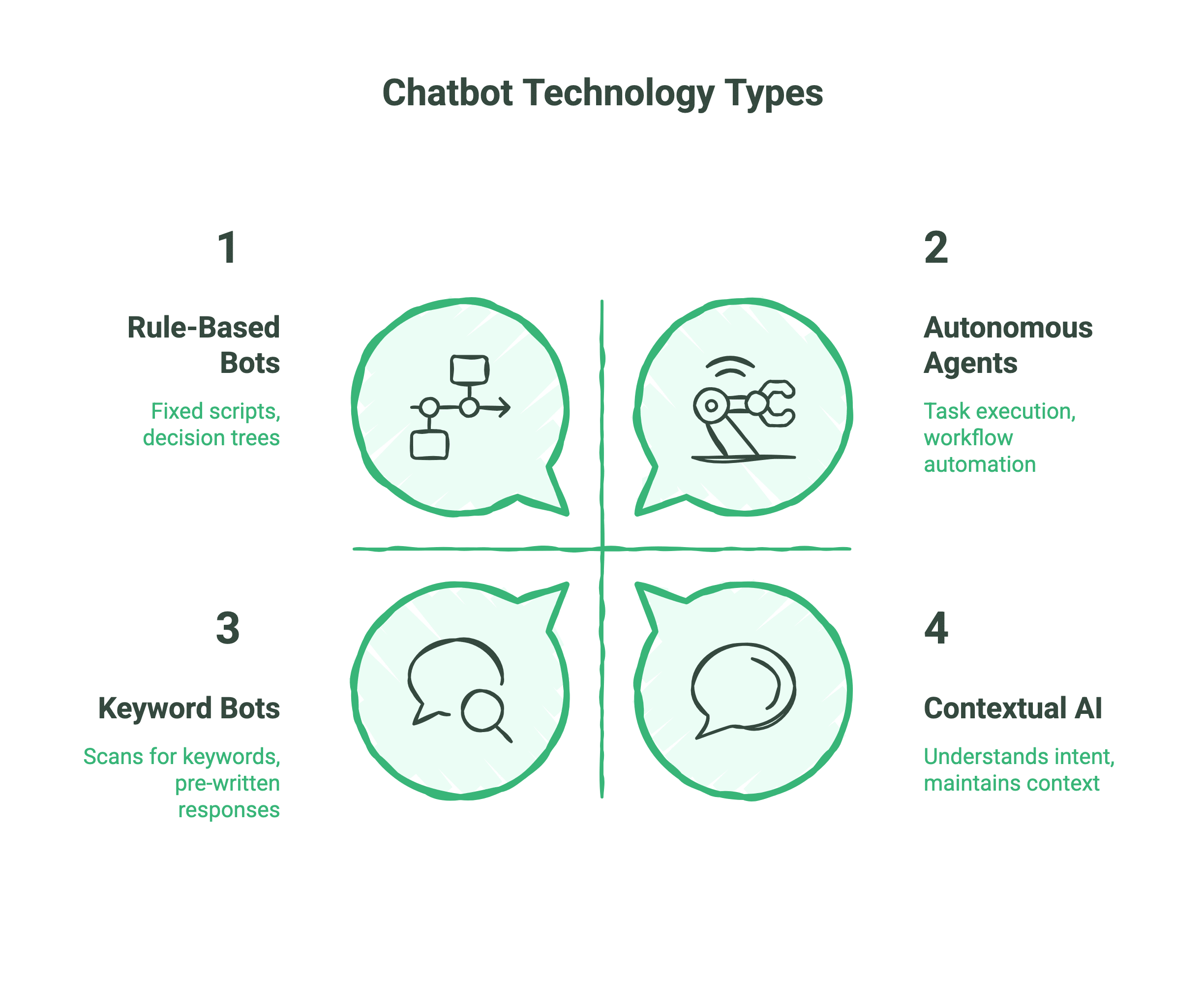
It helps to understand chatbot technology in terms of four broad generations, each representing a meaningful step forward in capability. Knowing where a given platform sits on this spectrum makes it much easier to match a solution to a specific business problem.
Generation 1: Rule-based and menu-driven bots operate on fixed scripts. The user selects from preset options; the bot follows a decision tree. They are reliable within their defined scope but break immediately when a user deviates from the expected path. Many business websites still use these for simple tasks like directing users to the right contact form.
Generation 2: Keyword recognition bots scan user input for specific words and trigger pre-written responses. They feel more conversational than menu-driven systems but are easily confused by synonyms, typos, or questions phrased in unexpected ways.
Generation 3: Contextual AI bots use NLP and machine learning to understand intent and maintain context across a conversation. They can handle follow-up questions and remember earlier parts of the exchange. Most modern AI chatbot platforms operate at this level.
Generation 4: Autonomous AI agents represent the current frontier. Rather than simply answering questions, these systems can execute tasks: booking appointments, updating records, processing returns, or triggering workflows in connected systems. A Generation 3 conversational bot tells a customer how to cancel an order; a Generation 4 AI agent cancels it for them. ProfileTree’s work with clients across Northern Ireland increasingly focuses on this fourth category, helping businesses understand where agentic AI adds genuine value and where simpler solutions are more appropriate.
Are Chatbots and Virtual Assistants the Same Thing?
The terms are often used interchangeably, but there is a meaningful distinction worth understanding before making any procurement decision. A chatbot is typically purpose-built for a specific context: a customer service channel, a lead capture flow, or an internal IT helpdesk. It is designed to handle a defined range of interactions well.
A virtual assistant, in the sense of tools like Siri, Alexa, or Google Assistant, is designed for broad, general-purpose interaction across an enormous range of tasks and domains. These systems are significantly more complex, are trained on far larger datasets, and operate across a wider range of device integrations. For business deployments, the chatbot model is almost always more appropriate. A general-purpose assistant introduces unpredictability into a customer-facing context; a well-scoped conversational bot stays within its lane and handles its defined tasks reliably.
Why UK Businesses Are Investing in Conversational AI
The commercial case for chatbots is well established, though the specific benefits vary considerably depending on the type of deployment and the maturity of the technology used. The businesses seeing the strongest returns are those that matched the solution precisely to a high-volume, well-defined problem rather than deploying a bot because the technology was available.
Customer service availability is the most commonly cited benefit. A conversational bot handles enquiries outside business hours without staffing costs. For businesses serving customers across multiple time zones, or simply those receiving high volumes of out-of-hours contact, this has a direct impact on response rates and customer satisfaction scores.
Cost reduction in customer support is measurable. Routing repetitive, low-complexity queries to an AI chatbot frees human agents to focus on complex cases that genuinely require judgement and empathy. The reduction in cost per interaction for standard queries is significant, though businesses should be realistic that the savings accrue gradually as the bot learns and the implementation is refined.
Lead capture and qualification is an area where well-implemented conversational AI adds revenue rather than simply cutting costs. A chatbot on a service business’s website can engage visitors in real time, collect contact details, and ask qualifying questions, delivering warmer leads to the sales team than a static contact form would generate.
Data collection and customer insight compounds over time. Every conversation a chatbot handles generates structured data about what customers are asking, where they encounter friction, and what information they cannot find on the site. For SMEs in Northern Ireland, this kind of ongoing insight into customer behaviour is often unavailable through any other channel at comparable cost.
Common Business Use Cases
Rather than describing what chatbots can theoretically do, it is more useful to outline the use cases that consistently deliver measurable results for businesses of the size most ProfileTree clients operate at.
Customer service triage is the most proven deployment. A conversational bot on a retail or service website handles the most common customer queries, such as order status, returns policy, opening hours, and contact routing, around the clock, reducing the volume of email and phone contacts that require human handling.
Lead capture on service websites has shown consistent results for professional services firms. A bot that engages visitors in real time, asks qualifying questions, and captures contact details typically outperforms a static contact form on both conversion rate and lead quality.
Internal helpdesk support is a growing use case for businesses with 50 or more employees. An AI chatbot connected to HR documentation and IT support knowledge bases can resolve a significant proportion of internal queries without escalation, reducing the administrative burden on HR and IT teams.
Appointment booking for businesses in healthcare, legal, and professional services automates a high-volume, low-complexity task that previously required dedicated administrative resource.
Deploying Chatbots Responsibly: Compliance and Common Myths
Choosing the right chatbot platform is only part of the decision. For UK and Irish businesses, the legal and operational context around deployment matters just as much as the technology itself. Getting compliance wrong is not a minor administrative inconvenience; it can result in significant ICO fines and lasting reputational damage.
UK GDPR and the Data Protection Act 2018
Any chatbot that collects personal data from users is processing that data under UK GDPR and the Data Protection Act 2018. This means businesses must have a lawful basis for collection, must inform users what data is being collected and why, and must be able to demonstrate how that data is stored, accessed, and deleted on request.
For most customer-facing chatbot deployments, the relevant lawful basis is either legitimate interests or consent. If the bot collects contact details for follow-up, consent is typically required. The ICO’s guidance on AI and data protection provides a practical framework for making this determination.
Data residency is a specific concern. Some chatbot platforms store conversation data on servers outside the UK or EEA. For businesses handling sensitive customer information, confirming where data is stored and under what jurisdiction it sits is a procurement requirement, not an afterthought.
ISO/IEC 42001 and Ethical AI Frameworks
The ISO/IEC 42001 standard provides a management system framework for responsible AI. While certification is not yet mandatory for UK businesses, adopting its principles during chatbot implementation demonstrates due diligence and reduces exposure to future regulatory risk as AI governance frameworks tighten.
Ethically, businesses should consider bias. AI chatbots trained on limited or unrepresentative datasets can produce systematically worse outcomes for certain user groups. For businesses serving diverse populations in Northern Ireland and across the UK, reviewing how a platform handles this risk is a reasonable part of the evaluation process.
Common Chatbot Myths, Addressed Plainly
Alongside the compliance questions, a few persistent myths tend to distort business expectations around what conversational AI can actually deliver.
“Chatbots will replace our customer service team.” This is the most persistent myth, and it is not supported by the experience of businesses that have deployed conversational AI thoughtfully. Bots reduce the volume of low-complexity interactions that human agents handle, freeing those agents for work that genuinely requires human judgement. The realistic outcome of a well-implemented deployment is a better-resourced human team working on more meaningful problems.
“Chatbots are too complicated for an SME to manage.” Modern no-code and low-code platforms have substantially reduced the technical barrier to entry. The complexity lies not in the technology but in defining what the bot should do, which is an operational question, not a technical one.
“The data our chatbot collects is anonymous.” Conversational data often is not anonymous in any meaningful sense. Users voluntarily share names, order numbers, contact details, and account information in chat interactions. Treating all chatbot data as potentially personal, and managing it accordingly under UK GDPR, is the correct default position.
How to Choose and Implement a Chatbot for Your Business
This is where the real decisions get made. A business considering conversational AI should begin not with “what can the technology do?” but with “what specific customer interactions are predictable enough and high-volume enough to justify automation?” For most SMEs, the answer is narrower than the sales pitch for any given platform suggests.
A well-implemented chatbot should deliver real-time responses to common, predictable queries; capture and route enquiries outside its scope to a human agent efficiently; and collect structured data from interactions in a format the business can actually use. A poorly implemented bot does the opposite of all three and damages the brand’s responsiveness image rather than enhancing it.
Define the use case first. A platform suited to e-commerce order tracking is not necessarily suited to B2B lead qualification or internal HR support. Matching the platform to the specific use case avoids paying for capabilities you will never use and finding gaps in the ones you need most.
Assess integration requirements. A chatbot that cannot connect to your CRM, helpdesk, or order management system will operate in isolation and create additional manual work rather than reducing it. Integration depth is often the defining factor in whether a deployment delivers its promised ROI.
Confirm data residency and compliance support. As noted above, where conversation data is stored matters for UK businesses. Check this before selecting a platform rather than discovering it post-contract.
Start with a contained pilot. Rather than deploying a chatbot across every customer touchpoint simultaneously, identify one high-volume, well-defined use case and implement it properly. Measure the outcome, refine the model, and expand from a position of demonstrated success.
ProfileTree helps businesses across Northern Ireland work through exactly this process, from use case definition through to platform selection and implementation support. If you are at the evaluation stage, getting in touch with our team is a practical starting point.
The Future: From Chatbots to AI Agents
The direction of travel in conversational AI is from bots that answer questions to agents that complete tasks. A chatbot in its traditional sense is reactive: it waits for a user to ask something and responds. An AI agent is proactive and autonomous: it can monitor conditions, make decisions within defined parameters, and execute multi-step processes without a human prompt at each stage.
In practice, this means an AI agent could not only answer a customer asking about a refund but process the refund, update the order management system, trigger a replacement shipment, and send a confirmation email, all within a single interaction and without human intervention. For businesses in Northern Ireland evaluating AI implementation, this distinction is a planning question as much as a technology question. Agentic AI requires more robust integration with business systems, clearer governance around what the AI is permitted to do autonomously, and stronger data management practices.
Getting the foundational chatbot deployment right is, in most cases, the right precondition for moving toward agentic AI. Ciaran Connolly, founder of ProfileTree, puts it plainly: “Most businesses in Northern Ireland are not yet ready to deploy AI agents because they have not yet clarified what they want a basic chatbot to do well. Start with the specific problem, define success clearly, and build from there.”
Conclusion
Chatbots explained simply are software programmes that simulate conversation. Understood properly, they are a spectrum of technology running from basic decision trees to sophisticated AI systems capable of operating autonomously within business workflows.
For most businesses, the relevant question is not whether to adopt conversational AI at some point, but how to do so in a way that delivers measurable value without creating compliance risk or frustrating the customers it is meant to serve. Those answers are operational and strategic, not just technical.
If your business is at the stage of evaluating options, ProfileTree provides the structured support that Belfast and Northern Ireland businesses need to make informed decisions. Contact the team now to discuss where conversational AI fits in your specific context.
Frequently Asked Questions
What is a chatbot?
A chatbot is a software programme that simulates conversation with a human user, typically through text on a website, messaging platform, or customer service tool. It can range from a simple menu-driven script to a sophisticated AI system powered by natural language processing and machine learning.
What is the difference between a chatbot and an AI chatbot?
A standard chatbot follows a fixed script and handles only the queries it was specifically programmed for. An AI chatbot uses natural language processing and machine learning to understand intent, handle unfamiliar queries, and improve its responses over time. The practical difference is flexibility: AI chatbots adapt; rule-based ones do not.
Is ChatGPT a chatbot?
ChatGPT is a general-purpose conversational AI built on a large language model. It is not a business chatbot in the traditional sense: it was not designed for a specific task or connected to any particular company’s systems. When businesses deploy ChatGPT-powered tools for customer service or internal use, they are building a purpose-built chatbot on top of the underlying model.
Are chatbots GDPR compliant?
They can be, but compliance is not automatic. Any chatbot collecting personal data from UK users must have a documented lawful basis, must inform users what is being collected, and must meet ICO requirements around data storage, access, and deletion. Where conversation data is physically stored is a specific concern when using cloud-based platforms with servers outside the UK or EEA.
Can a chatbot replace human customer service?
Not fully. Conversational AI handles high-volume, predictable queries well and at low cost. Complex complaints, emotionally sensitive interactions, and situations requiring genuine judgement all need human agents. A well-implemented chatbot improves what a human team can do; it does not remove the need for one.
How much does a business chatbot cost in the UK?
Entry-level SaaS platforms start at a few hundred pounds per month. Mid-range implementations with CRM integration and custom training typically run from £5,000 to £30,000 for initial deployment. Bespoke enterprise builds cost considerably more. For most Northern Ireland SMEs, a well-scoped SaaS pilot for one specific use case is the right starting point before committing to a larger investment.
What is the difference between a chatbot and an AI agent?
A chatbot answers questions. An AI agent takes actions. A chatbot might explain how to process a return; an AI agent processes it, updates the order system, and sends the confirmation automatically. Agentic AI requires deeper system integration and clearer governance about what the AI is permitted to do without human oversight.