
AI Adoption in UK SMEs: What the Latest Data Shows
Table of Contents
AI adoption has moved from boardroom curiosity to everyday operating decision for small and medium-sized businesses across the UK and Ireland. The question most owners ask now is not whether to use artificial intelligence, but which tools fit the business and how to roll them out without wasting money. Cheaper cloud tools, better local connectivity, and a wave of practical guidance have pushed AI adoption well beyond the early adopters. This article pulls together the most recent figures on AI adoption among UK SMEs, explains why the numbers are rising, looks at where the real value is landing, and sets out the barriers still holding many firms back. It is written for business owners, decision makers, and the people who have to make this work on a Monday morning.
The state of AI adoption in UK SMEs
AI adoption among UK SMEs has climbed steadily, driven by lower tool costs, wider access to cloud platforms, and growing confidence that the technology pays for itself. The headline pattern across recent industry surveys is consistent: more firms are using at least one AI tool each year, and the gap between large enterprises and smaller businesses is narrowing, though it has not closed.
How Fast Adoption is Growing
Research published by the British Chambers of Commerce with Atos in March 2026 found that 54% of UK SMEs are now actively using AI, up from 35% in 2025 and 25% in 2024. That is a sharp rise on figures from just two years earlier, and it puts AI use firmly in the mainstream for smaller firms. The strongest growth sits in content creation, customer service, and data tasks, where the tools are cheap, easy to trial, and quick to show a result. Medium-sized firms tend to be further along than micro-businesses, which often cite cost and complexity as the main reasons for holding off.
Where the Laggards Are
Not every business is moving at the same pace. Micro-businesses with fewer than ten staff remain the most cautious, and AI adoption is noticeably slower outside the larger commercial centres. This is rarely a lack of interest. More often it reflects thin in-house technical skills, uncertainty about data rules, and a sense that AI is built for bigger companies with dedicated IT teams. There is also a regional pattern worth naming: firms in and around major cities tend to adopt earlier, while businesses in more traditional industrial and rural areas often spend longer getting their basic data in order before any AI project makes sense. Closing that gap is where a clear digital strategy makes the biggest difference, giving a business a plan for where AI fits before any tool is bought.
Adoption Versus Integration
A useful distinction sits underneath the headline figures. Many SMEs have tried an AI tool, but far fewer have woven it into the systems they run every day, such as their CRM, accounting, or booking platform. Trying a tool is easy; integrating it so it changes how work actually flows takes intent, a little training, and a willingness to adjust a process. Structured digital training services are often what tips a firm from trial to genuine integration. The businesses seeing the strongest return are the smaller, more agile firms that move quickly from trial to genuine integration rather than leaving a clever tool sitting unused after the initial excitement fades.
Why AI adoption is accelerating
The rise in AI adoption is not down to a single cause. A handful of shifts have lined up at the same time: tools got cheaper and simpler, businesses watched their competitors succeed, and the pandemic left most firms far more comfortable working digitally. Together these have turned AI from a specialist project into something a small team can pick up in an afternoon.
Lower Costs and Simpler Tools
Earlier AI projects needed real budgets and specialist staff. Cloud and software-as-a-service tools changed that. A business now pays only for what it uses, with no servers to run and little or no coding required. A marketing manager can trial a content tool, a shop owner can add a chatbot, and a finance team can automate document handling, all without a capital project. That accessibility is the single biggest driver behind rising AI adoption in smaller firms.
Seeing Competitors Succeed
Word of mouth matters in local business communities. Once an owner sees a competitor down the road offering round-the-clock support through a chatbot, or turning around marketing content in half the time, the return on AI stops being theoretical. Visible local success creates a knock-on effect, and AI adoption tends to cluster as businesses follow the lead of peers they trust.
A Digital Habit That Stuck
The pandemic forced many SMEs online, and that shift never reversed. Teams that learned to run more of the business through digital channels were already primed to add AI on top. Chatbots absorb extra web queries, generative tools cut the time spent on routine writing, and analytics tools surface patterns a busy owner would otherwise miss. The groundwork laid during those years made the current wave of AI adoption far easier to start.
Where AI adoption is delivering real value for SMEs
Adoption figures only tell half the story. What matters to a business owner is where the technology actually earns its keep. Across ProfileTree client work and wider industry use, a clear set of practical applications has emerged where smaller firms see a genuine return rather than a novelty.
Content and Marketing
Few SMEs have a dedicated copywriting team. AI tools draft blog outlines, product descriptions, and social posts that a human then refines for tone, accuracy, and local context. The tool speeds the process; it does not replace editorial judgement. This is the heart of AI-enhanced marketing, where the gain comes from producing more without adding headcount, while keeping a person in charge of quality. The same logic applies to search: AI speeds up the analysis behind search engine optimisation, surfacing the queries and content gaps a small team would struggle to find manually.
Social, Email, and Video
The marketing gains from AI adoption reach well beyond written content. AI helps plan and schedule across channels, which makes day-to-day social media marketing manageable for a one-person team. It drafts and segments campaigns for email marketing work, and it speeds up the scripting and editing behind video marketing, a format that used to be out of reach for most smaller firms on cost grounds alone.
Customer Service
Modern chatbots built on language models handle queries far more naturally than the rigid, rule-based systems of a few years ago. They hold context across a conversation, answer common questions instantly, and free staff to deal with the cases that need a human. For a small firm that cannot run a large support team, well-configured AI chatbots are one of the fastest routes to a visible improvement in service.
Internal Knowledge and Admin
AI tools summarise long internal documents, pull key points from manuals, and help staff find answers without reading everything end to end. Some firms run private, tightly controlled instances so teams can query internal knowledge safely. The result is less time lost to admin and more time on work that actually moves the business forward. A common pattern in SME use is turning scattered policies, product information, and process notes into a single searchable resource that any team member can question in plain language, which cuts the steady drip of repeated internal questions that otherwise lands on a handful of senior people.
Finance and Operations
Beyond the front office, AI adoption is steadily reaching back-office work. Tools now read receipts and invoices into structured data, flag unusual patterns in spending, and help forecast demand so stock and staffing match what is actually coming. For a small operations team, that means fewer hours on manual data entry and a clearer view of the numbers, without the cost of a bespoke system. Tied into a proper digital strategy plan, those quiet operational gains compound month after month rather than sitting in isolation.
A practical guide to implementing AI in customer service
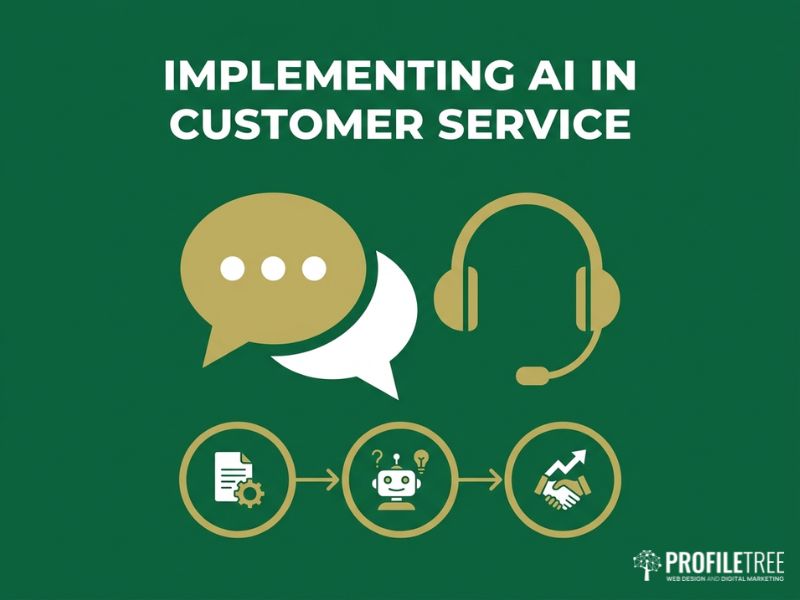
Knowing AI adoption is rising is one thing; rolling it out without wasting money is another. The most reliable approach starts small, targets a clear problem, and measures the result before scaling. The steps below apply to UK and Irish SMEs alike and work just as well for a hospitality booking system as for an e-commerce returns process.
Scope the Project First
Begin by listing the queries that eat the most staff time: shipping times, product specs, booking availability, returns. These high-frequency, low-complexity questions are the natural first target. Decide whether an off-the-shelf tool with built-in language-model support is enough, or whether the job needs a custom build that connects to your stock or booking system. Where a bot needs to plug into a live site or back-end system, that is a job for proper website development services rather than a quick plug-in. Getting the data connections right at this stage is what separates a useful bot from a frustrating one.
Weigh the Costs and Benefits
A basic AI-powered chatbot subscription typically runs from a modest monthly fee, with an initial setup or consulting cost on top. The maths is straightforward: if a tool removes half of a steady stream of routine calls and emails, the hours saved quickly outweigh the spend, and staff move on to higher-value work. A well-scoped AI chatbot solution tends to pay for itself fastest where query volume is high and predictable.
Close the Skills Gap
Many SMEs assume they need in-house IT staff to make this work. Most modern tools offer no-code setup, and the bigger task is keeping the underlying knowledge base current so the system stays accurate as products, prices, and seasons change. This is where ongoing digital training pays off: a team that understands the tool maintains it well, and the technology keeps delivering long after the initial setup.
“The businesses adopting AI properly now, and training their teams to use it well, will have a real productivity advantage within a year,” says Ciaran Connolly, founder of ProfileTree. “It is not about replacing people. It is about giving a small team the ability to do more, faster, with better results.”
AI adoption and GDPR: getting the data side right
Rising AI adoption brings a data-protection responsibility that smaller firms cannot ignore. The General Data Protection Regulation governs how any business collects, stores, and processes personal data, and feeding customer information into an AI tool counts. The good news is that the rules are manageable once you understand them, and getting this right early protects both customer trust and the business itself.
Minimise What You Expose
Strip out or anonymise personal identifiers before passing text into an AI tool. For chatbots that handle personal queries, favour a solution with EU or UK-based processing, and where data sits on your own platform, secure website hosting management keeps that information under proper control. The UK regulator, the ICO’s guidance on AI and data protection, sets out what compliant use looks like in practice. Less personal data in the system means less risk, and a smaller compliance burden.
Keep a Human in the Loop
Where an automated decision could significantly affect someone, GDPR expects a route to human review. Build that channel in from the start. Large language models can also produce confident but wrong answers, so staff should check outputs before they reach a customer, especially on anything financial, legal, or contractual. Human oversight is not a nice-to-have; it is part of doing this properly.
Common Pitfalls to Avoid
The recurring mistakes are predictable: collecting personal data without proper consent, storing it longer than needed, failing to check whether a third-party tool meets data-transfer rules, and leaning too heavily on automated decisions. A short data-protection impact assessment before any significant deployment catches most of these. Treat the data side as the first task, not the last.
“Data protection sits at the centre of any sensible AI rollout in the UK and Ireland,” says Ciaran Connolly. “A small firm can absolutely use these tools well, but it has to be done in a way that respects customer trust and the law from day one.”
The road ahead for AI adoption in UK and Irish business
AI adoption is still early in its curve, and the direction of travel is clear. The tools are becoming more capable, the regulation is maturing, and the businesses that build practical skills now will hold an advantage over those that wait. A few trends are worth watching for any SME planning ahead.
AI Assistants Become Standard
Within a few years, most SMEs will run some form of AI assistant on their site or inside their operations, handling queries and routine internal tasks as a matter of course. That makes the underlying site matter more, since an assistant is only as good as the website design service it sits on top of. Voice-based interfaces are likely to follow, connecting everyday customer questions directly to the business. What looks like an edge today will read as a baseline expectation tomorrow.
Industry-specific Tools Mature
General-purpose tools will give way to sector-tailored ones: stock management for retail, document scanning for legal and professional services, predictive maintenance for manufacturing. UK and Irish developers are well placed to build tools that reflect local language, regulation, and business norms, which is exactly where smaller firms get the cleanest fit.
Regulation Keeps Evolving
Post-Brexit, the UK is refining its own data and AI rules while staying close enough to GDPR to keep EU trade straightforward, and Ireland remains a central EU data hub. Expect tighter expectations around transparency, particularly where chatbots or generative content shape customer decisions. Staying informed is part of the job, and agility will matter more than any single tool choice.
An action plan for getting started with AI adoption
For owners ready to move, the path does not have to be daunting. A measured, staged approach lets a business capture the benefits of AI adoption while keeping cost and risk under control. The five steps below give any SME a workable starting point.
First, audit current processes and identify the admin tasks, marketing workflows, and customer queries that consume the most staff time; these are the prime candidates for automation. Marketing tasks such as search engine optimisation work are often a strong first target, since AI handles the heavy analysis while a person keeps editorial control. Second, choose tools that fit the job and the budget, weighing general tools against EU-based options where data protection is a concern. Third, address GDPR by anonymising personal data or securing proper consent before anything goes live. Fourth, pilot small, track the time saved or the lift in conversions, and only scale once the pilot proves itself. Fifth, stay informed by following guidance from the ICO in the UK and the Data Protection Commission in Ireland, along with relevant funding calls. Throughout, the firms that succeed treat AI adoption as a skills programme as much as a technology one, which is why structured support and team training so often decide whether a rollout sticks.
“The shift we see across client work is consistent,” says Ciaran Connolly, founder of ProfileTree. “The businesses that win with AI are not the ones with the most tools. They are the ones who picked a clear use case, trained their people, and measured what changed.”
FAQs
What AI tools are best suited to SMEs?
Chatbots for customer service, generative tools for content, predictive analytics for marketing, and AI-enabled CRM systems are the most common starting points. Pick the one tied to your biggest time drain.
Is AI expensive for a small business to implement?
No. Most tools now run on affordable monthly subscriptions priced by usage, so a small firm can start for a low monthly cost rather than a large upfront project.
How do SMEs keep AI use GDPR compliant?
Anonymise personal data before using it, get clear consent, choose providers with EU or UK-based processing, and run regular data-protection checks.
How quickly does AI adoption pay off?
Simple use cases such as a customer-service chatbot or content drafting often show time savings within the first few weeks, provided staff are trained to use them well.
Do we need technical staff to adopt AI?
Usually not. Many tools offer no-code setup. The bigger need is someone who keeps the knowledge base current and a team confident enough to use the tools properly.