
AI SEO Tools and the Future of Search Optimisation
Table of Contents
Where are AI SEO tools heading? Toward measurement that the search platforms supply directly, and away from the third-party guesswork that filled the gap when they did not.
That shift moved faster through 2026 than most SEO teams planned for, and it changes which AI SEO tools are worth paying for. This piece sets out what has actually shipped, what is still marketing language, and how to judge whether any given change matters to your site. If you want the discipline itself rather than its direction of travel, our AI SEO page covers how answer systems choose sources.
Google Finally Documented How AI Search Works
For two years, the most repeated claim in SEO was that nobody knew how AI Overviews picked their sources. That stopped being true in May 2026, when Google published its first official guidance on optimising for generative AI features.
Google’s guidance on optimising for generative AI features. The guidance is blunt about the question everyone was asking. Asked whether SEO is still relevant for generative AI search, Google’s answer is that it is, because the generative features are rooted in the same core Search ranking and quality systems. It names the two techniques doing the work. Retrieval-augmented generation relies on core Search ranking to retrieve relevant pages from the index before a response is generated. Query fan-out issues a set of concurrent related queries to gather more results than the original question would return on its own.
It also settles the naming argument. On the terms AEO and GEO, Google’s stated position is that optimising for generative AI search is optimising for the search experience, and therefore still SEO. Anyone selling the future of search optimisation as a separate discipline is arguing with the party that builds the systems.
None of that is a tactic. It is a foundation, and it is the first time the foundation has been written down.
Both Major Search Engines Now Report AI Visibility
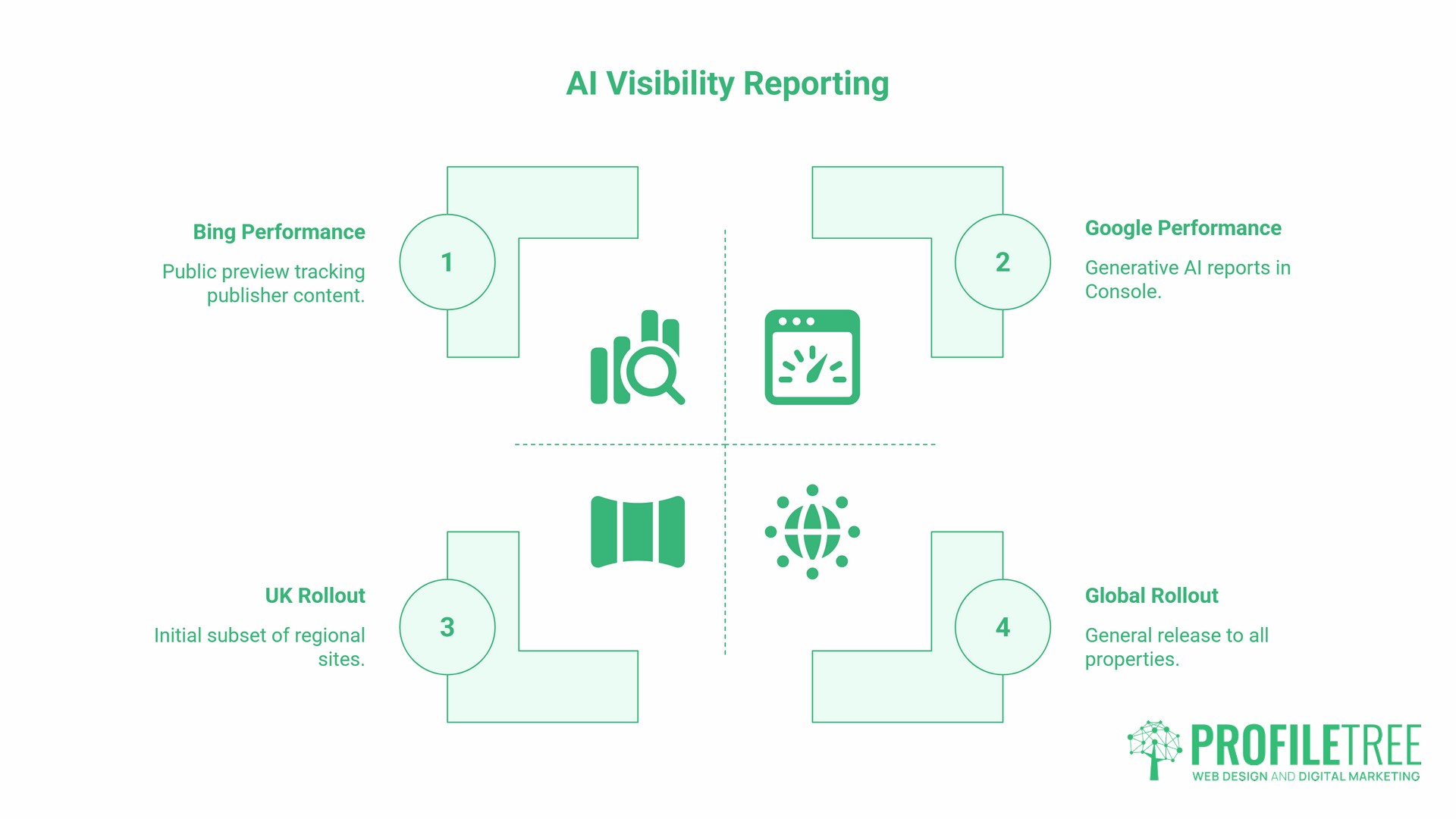
The bigger practical change was measurement, and Bing moved first.
Microsoft put AI Performance into Bing Webmaster Tools as a public preview in February 2026, showing how publisher content appears across Microsoft Copilot, AI-generated summaries in Bing, and selected partner integrations. The report highlights which pages are cited, how visibility trends change over time, and the grounding queries associated with your content.
Google followed on 3 June 2026 with generative AI performance reports in Search Console, isolating impressions from AI Overviews, AI Mode, and generative AI features in Discover. Data begins from 18 May 2026 with no historical backfill.
UK businesses saw the Google version before anyone else. The initial rollout went to a subset of UK-based sites in response to a Competition and Markets Authority mandate requiring Google to share the data. Republic of Ireland sites came in with the general rollout, which reached every Search Console property on 11 August 2026. If you trade on both sides of the border, our AI SEO Ireland page covers how the two markets differ in practice.
What Each Report Gives You, and What No AI SEO Tool Can Add
The two reports are not equivalent, and the difference decides what you can honestly claim in a monthly report.
| Measure | Google Search Console | Bing Webmaster Tools |
|---|---|---|
| Launched | 3 June 2026, all properties by 11 August 2026 | February 2026, expanded 16 June 2026 |
| What it counts | Impressions in AI Overviews, AI Mode, and Discover AI features | Citations in Copilot, Bing AI summaries and partner surfaces |
| Page-level detail | Yes | Yes |
| Query data | None | Grounding queries, which are retrieval phrases rather than user queries |
| Competitive context | None | Citation Share, your relative presence for a given grounding query |
| Click data | None | None |
| API access | No, manual CSV export only | Not at launch |
Read that table before you build reporting on either. Google gives you impressions with no query context at all, which means the honest answer to which query put you in an AI Overview is still that nobody outside Google knows. Bing gives you more, but its grounding queries are the internal retrieval phrases the system generated to support an answer, not what a user typed. Conflating the two is the most common error in current coverage of the report, and it will put a wrong number in front of a client.
One further caution on Bing. Site owners reported large jumps in the AI Performance data from 1 June 2026, and Microsoft publicly attributed those to routine data backfilling rather than any change in citation activity. If you set a baseline in that window, check it against a later period before you draw a trend from it.
Setting a Baseline You Can Defend
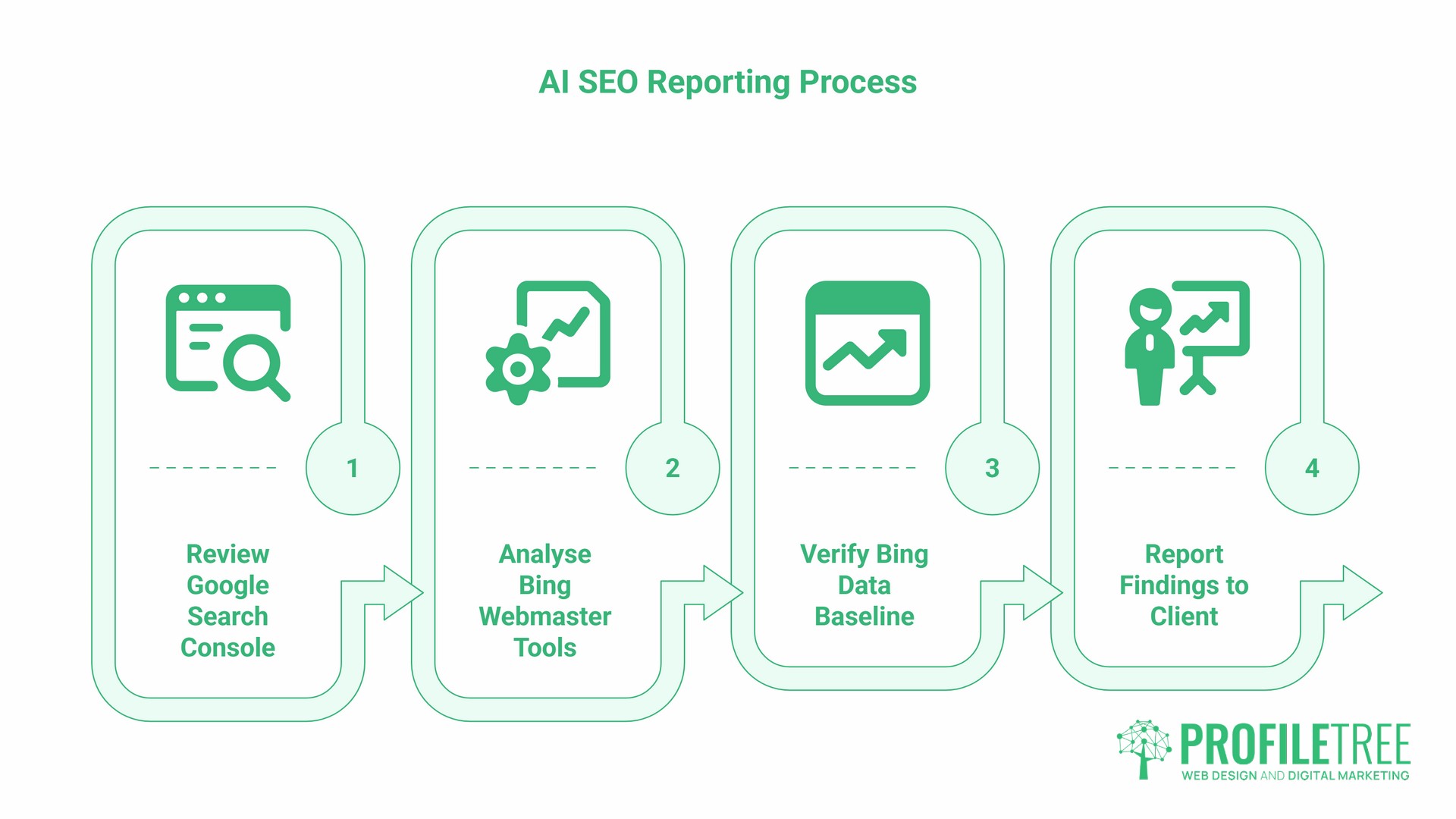
Both reports are young, so the useful work now is establishing a starting point rather than chasing movement.
Open the Search Console generative AI report and record the impression total, the top pages, and the country split for a full month. Do the same in Bing for total citations, the pages carrying them, and the grounding queries attached. Save both as dated exports, because neither platform serves this data through an API yet, and neither will backfill what you did not capture.
Then decide what you are going to report monthly, and say plainly what it does and does not prove. An AI impression is not a visit. A Copilot citation is not a lead. Presenting either as a business result is the fastest way to lose credibility when someone asks what it earned.
“The measurement caught up faster than anyone expected, and that is mostly good news. What it also means is that a lot of confident claims made over the last two years are now checkable, including some of ours.”
Ciaran Connolly, founder, ProfileTree
What AI SEO Tools Still Sell That Google Says To Ignore
Google’s guidance includes a myth-busting section, and it invalidates several things currently sold as AI SEO services.
On llms.txt files and similar machine-readable markup, Google says you do not need them to appear in Search, including its generative AI features, because Google Search does not use them, and maintaining one will neither harm nor help your visibility. On chunking, there is no requirement to break content into small pieces, because Google’s systems can understand multiple topics on a page and surface the relevant part. On rewriting for machines, you do not need to write in a specific way for generative AI search, since the systems understand synonyms and general meaning. On structured data, it is not required for generative AI search, and there is no special schema to add, although it remains worth using for rich results.
Google is equally direct about vendors. It advises caution with third-party tools that promise ranking success or claim to use internal Google metrics, because no third-party tool has access to its internal ranking or AI systems.
If a provider is selling you an llms.txt implementation as AI SEO, that is now a documented non-service. Ask what else in the proposal rests on the same assumption.
The Test Google Actually Wants You To Apply
Buried in the same guidance is the standard that matters more than any of the above. Google distinguishes commodity content, which restates common knowledge already widely available, from non-commodity content that provides an expert or experienced take going beyond the ordinary. Its stated position is that creating genuinely useful content will influence your presence in generative AI search more than anything else in the guide.
That is a harder brief than keyword coverage, and it has an awkward implication for AI-assisted production. A model trained on the open web is, by construction, very good at producing the common knowledge version of any topic. Left unedited, it generates commodity content by default. No AI SEO tools fix that, because the value your team adds is the part the model cannot supply: what you have actually seen happen, on real sites, that contradicts or complicates the general advice.
Apply the test to your own top pages. Read each one and ask whether a competent writer with no access to your business could have produced it from public sources. If the answer is yes, the page is commodity content, however well optimised it is.
Three Shifts Shaping the Future of Search Optimisation
Beyond what has shipped, three directions look durable enough to plan around.
- Measurement consolidates into the platforms. Google and Bing both publish AI visibility data in their own webmaster tools now, both free. Bing added Intents, Topics, Citation Share, and Compare in June 2026, and Microsoft has said more is coming. The gap that paid visibility trackers filled is narrowing from one side, and the platforms keep adding metrics those trackers currently estimate. Buy short contracts, not multi-year ones.
- Transparency becomes a competitive claim. Microsoft frames Citation Share as observational rather than a ranking system, and Google spells out what its report does not contain. Both are setting a standard of stating limits plainly. AI SEO tools that do not state theirs will look worse by comparison, and that is a useful filter when you are choosing between platforms.
- Forecasting gets harder to sell and easier to test. With impression and citation data available monthly, predictions about the future of search optimisation can finally be checked against something published. A forecast you cannot test against Search Console or Bing Webmaster Tools is an opinion with a chart attached. The same logic applies to content planning, which we cover in our guide to future-proofing a content strategy.
Agents Are Becoming a Second Audience for Your Website
The change with the longest tail is not about measurement at all. Google’s guidance now addresses agentic browsing directly, and it describes how those systems read a page.
Browser agents may visit a site to gather data on a user’s behalf. According to Google’s documentation, they do this by analysing visual renderings such as screenshots, inspecting the DOM structure, and interpreting the accessibility tree. Google also points to emerging protocols, including the Universal Commerce Protocol, that will let Search agents do more on a user’s behalf.
Read that list again from a build perspective. Screenshots mean visual rendering has to succeed without a human to work around a layout bug. DOM structure means semantic markup matters beyond styling. The accessibility tree means the work most sites treat as a compliance obligation is now also how an automated buyer reads your pricing.
That is the practical takeaway for anyone commissioning a site in the next two years. Accessibility has always had a legal and ethical case behind it. It now has a commercial one, and it is the same work either way. If your last accessibility audit was filed and forgotten, it is worth reopening for a different reason than the one that prompted it.
We would add one caveat. Agentic browsing is early, the protocols are unsettled, and nobody should rebuild a site around it today. Treat it as a reason to do the fundamentals properly rather than a new specialism to buy.
How To Buy AI SEO Tools Now
Four questions are now worth asking any vendor, and the answers are checkable rather than a matter of taste.
Does the tool claim access to data the platforms say nobody outside them has? If a product reports which user query triggered your AI Overview appearance, it is modelling that, not measuring it. Modelling is legitimate. Presenting it as measurement is not, and the distinction is the fastest way to sort serious vendors from the rest.
Does it replace something the free tools already give you? Every Search Console property has the generative AI report, and every verified Bing property has AI Performance. AI SEO tools charging for visibility counts need to add something beyond that, such as trending the exports you cannot yet schedule through an API.
Does it distinguish grounding queries from user queries? This is a specific and revealing question. A vendor presenting Bing grounding queries as search terms has either misread the documentation or is hoping you have.
Does the time saved survive the editing? An automated audit that flags real issues saves hours. One that produces false positives costs more time than it saves, and a content suggestion needing a full rewrite has delivered nothing. Measure a tool on output you shipped, not output it generated. The technology behind SEO tooling moves faster than the buying cycle, which is the main argument for short contracts.
Is Your SEO Stack Ready for What Is Coming?
Work through this before renewing anything.
- Generative AI report in Search Console located and a baseline recorded, since data only starts from May 2026
- Bing Webmaster Tools verified and AI Performance baseline recorded separately
- Both exports saved as dated files, because neither report is available through an API
- Any baseline set in June 2026 rechecked, given Microsoft’s backfill statement
- Grounding queries labelled correctly in every report you send a client
- Every claim made by your AI SEO tools checked against the platforms’ own documentation
- Any llms.txt work in your current scope reclassified as optional, not AI SEO
- Structured data kept for rich results, not justified as an AI requirement
- Accessibility and rendering reviewed with browser agents in mind
- Top pages assessed against Google’s commodity test
- Tool contracts kept short while platform reporting keeps expanding
- Business outcomes, not impressions or citations, set as the reporting headline
What We Are Not Predicting
Three honest limits, because a piece on the future of search optimisation that claims certainty is not worth reading.
Nobody can tell you the click value of an AI impression, because neither Google nor Bing publishes it. Anyone quoting a precise figure for how often AI Overviews appear is citing a third-party sample rather than a platform disclosure, so treat those numbers as estimates with a method behind them. And both reports are months old, in preview or recently rolled out, which means the metrics themselves may change before they stabilise.
What is safe to plan around is narrower and more useful. Measurement is moving in-house at the platforms, the free reporting is improving faster than paid AI SEO tools can differentiate against it, and the content standard is rising rather than falling.
If you want this applied to your own site, ProfileTree’s search engine optimisation team can review your current AI visibility across both platforms and set out what is worth changing.
FAQs
What are AI SEO tools?
They are platforms that assist with search optimisation using AI, covering research, technical auditing, content drafting and, more recently, tracking whether your site appears in AI-generated answers. The last of those is now partly supplied free by Google and Bing.
What is the future of search optimisation?
Measurement is moving into Google’s and Bing’s own webmaster tools, agents are emerging as a second audience for websites, and Google has published official guidance that rules out several widely sold tactics. The underlying ranking systems have not been replaced.
Is SEO still relevant for AI search?
Yes. Google states that SEO best practices continue to be relevant because its generative AI features are rooted in its core Search ranking and quality systems.
Can I see whether my site appears in AI Overviews?
Yes, in Search Console’s generative AI performance report, which now covers all properties. It shows impressions by page, country, device, and date. It does not show clicks, CTR, or the queries involved.
Does Bing show more than Google?
Currently, yes, in query context. Bing’s AI Performance report includes grounding queries and Citation Share alongside page-level citation data, whereas Google’s report shows impressions only. Neither shows clicks.
What is a grounding query?
It is the internal retrieval phrase the AI system generated to find supporting content, not the question a user typed. Reporting them as user search terms is inaccurate.
Do I need an llms.txt file?
Not for Google. Google Search does not use llms.txt files, and maintaining one will neither harm nor help your visibility or rankings. Other systems may use them, so it is a choice rather than a requirement.
Is structured data required to appear in AI answers?
No. Google says structured data is not required for generative AI search, and there is no special schema you need to add, though it remains worthwhile for rich results.
What should I look for in AI SEO tools?
Whether they claim access to data the platforms say no third party has, whether they duplicate the free reporting, whether they label grounding queries correctly, and how much editing their output needs before you can use it.