
How to Do SEO for News Sites: A Publisher’s Technical Guide
Table of Contents
Getting content into Google News and the Top Stories carousel is not simply a matter of publishing fast. SEO for news sites operates on different rules from standard organic search, with tighter technical requirements, stricter editorial standards, and a much narrower indexation window. Whether you run a regional publication in Northern Ireland, a trade media outlet covering a UK industry, or an SME that publishes content at an editorial pace, the same principles apply. Get the infrastructure right, and your content has a genuine chance of reaching readers when they are searching. Get it wrong, and even solid journalism disappears.
This guide covers the full technical and editorial picture: from sitemaps and structured data to headline strategy, E-E-A-T signals, and how non-news businesses can use news-style publishing to drive sustained organic traffic.
Why News SEO Is Different to Traditional Search
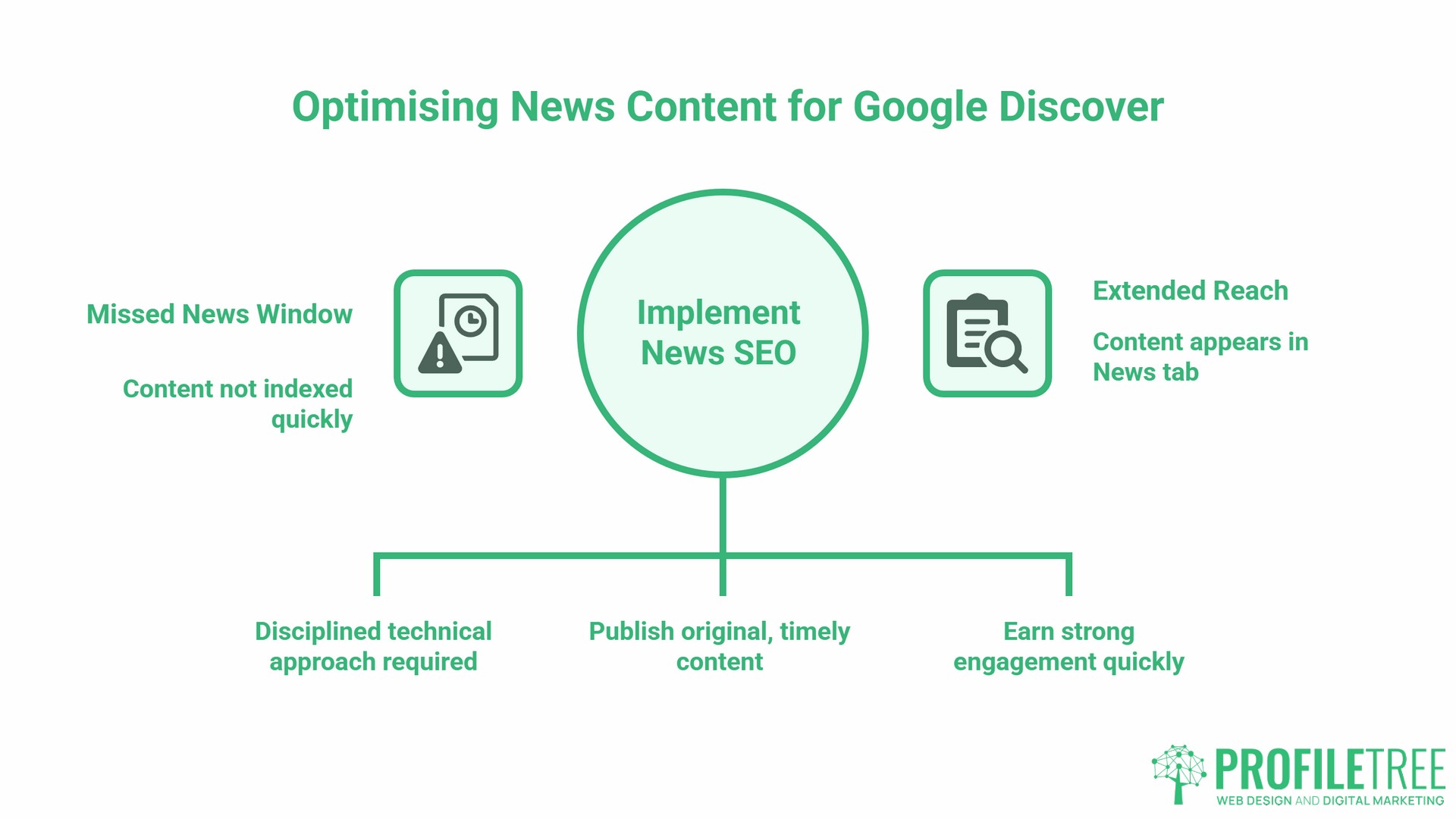
Standard SEO is a long game. You build authority over months, earn links gradually, and wait for rankings to settle. SEO for news sites works on a completely different timescale. A story that breaks at 9 am needs to be indexed and appear in Top Stories by 10 am, or it has missed its window. Google’s Googlebot-News crawler operates separately from the standard web crawler, and it prioritises sites that demonstrate consistent technical quality alongside fresh, original content.
The other key difference is freshness. For evergreen content, age and accumulated links are assets. For news content, Google’s freshness algorithm actively rewards recent publication. Articles in the Google News tab typically cycle through within 48 hours; Discover can surface older content, but only if it quickly earns strong engagement signals.
This creates a specific set of requirements that most standard SEO guides do not address. It is also why SEO for news sites demands a more disciplined approach to technical setup than most organisations apply to their content operations.
For content-led SMEs, the opportunity is real but often misunderstood. SEO for news sites is not exclusive to traditional media outlets. You do not need to be the BBC or the Belfast Telegraph to benefit from these principles. If your business publishes original, timely content on topics relevant to your sector, applying these techniques can significantly extend your reach in both the News tab and Google Discover.
Technical Infrastructure: Building for Speed and Indexation
Technical setup is the foundation of SEO for news sites. Before Google can surface your content in Top Stories or the News tab, its Googlebot-News crawler must be able to find, access, and index your articles quickly. Several specific technical requirements determine whether that happens.
Google News Sitemaps vs Standard XML Sitemaps
Most websites use a standard XML sitemap to help Google discover pages. News sites need an additional layer: a Google News Sitemap. This is a specialised XML file that tells Googlebot-News which articles were published in the last 48 hours. It must include the publication date, article title, and language. Without it, Google falls back to its standard crawl schedule, which is far too slow for time-sensitive content.
The News Sitemap must be updated in real time. Every time an article is published, the sitemap should update automatically. Most major CMS platforms handle this through plugins or built-in news publishing features, but the configuration needs to be verified rather than assumed. The sitemap should also be submitted to Google Search Console so Google can monitor it directly.
Key requirements for a valid News Sitemap:
- Articles published within the last 48 hours only
- One sitemap per publication, not per section
- Full publication date and time in the correct format
- Article title matches the H1 on the page
- Language tag correctly set
Standard XML sitemaps remain necessary for the rest of your site. The two serve different purposes and should be maintained separately.
The 48-Hour Indexation Window and Crawl Budget
Crawl budget refers to the number of pages Google will crawl on your site within a given period. For news sites, this is not an abstract technical concept; it directly determines whether breaking stories get indexed before they become stale.
Sites with slow server response times, excessive redirect chains, or bloated page weight force Googlebot-News to spend more time per page and crawl fewer articles overall. If your crawl budget is consumed by low-value archive pages, tag pages, or duplicate content, your new articles may not be crawled at all within the critical 48-hour window.
Practical steps to protect crawl budget on a news site:
- Block archive, tag, and category pages from being crawled if they have no unique content value
- Remove redirect chains; each additional hop slows the crawler
- Keep server response times consistently under 200ms
- Avoid publishing very thin articles; they consume crawl budget without contributing to authority
- Use canonical tags correctly to avoid duplicate content across AMP and standard URLs
Core Web Vitals also apply here. Google uses page experience signals as a tiebreaker between similarly authoritative sources, and a slow-loading article page can cost you a Top Stories placement even if your content is strong. Largest Contentful Paint, Interaction to Next Paint, and Cumulative Layout Shift are the three metrics to monitor and optimise.
ProfileTree’s SEO services include technical site audits that cover crawl budget analysis, Core Web Vitals, and News Sitemap configuration for content-heavy sites.
Structured Data for News Content
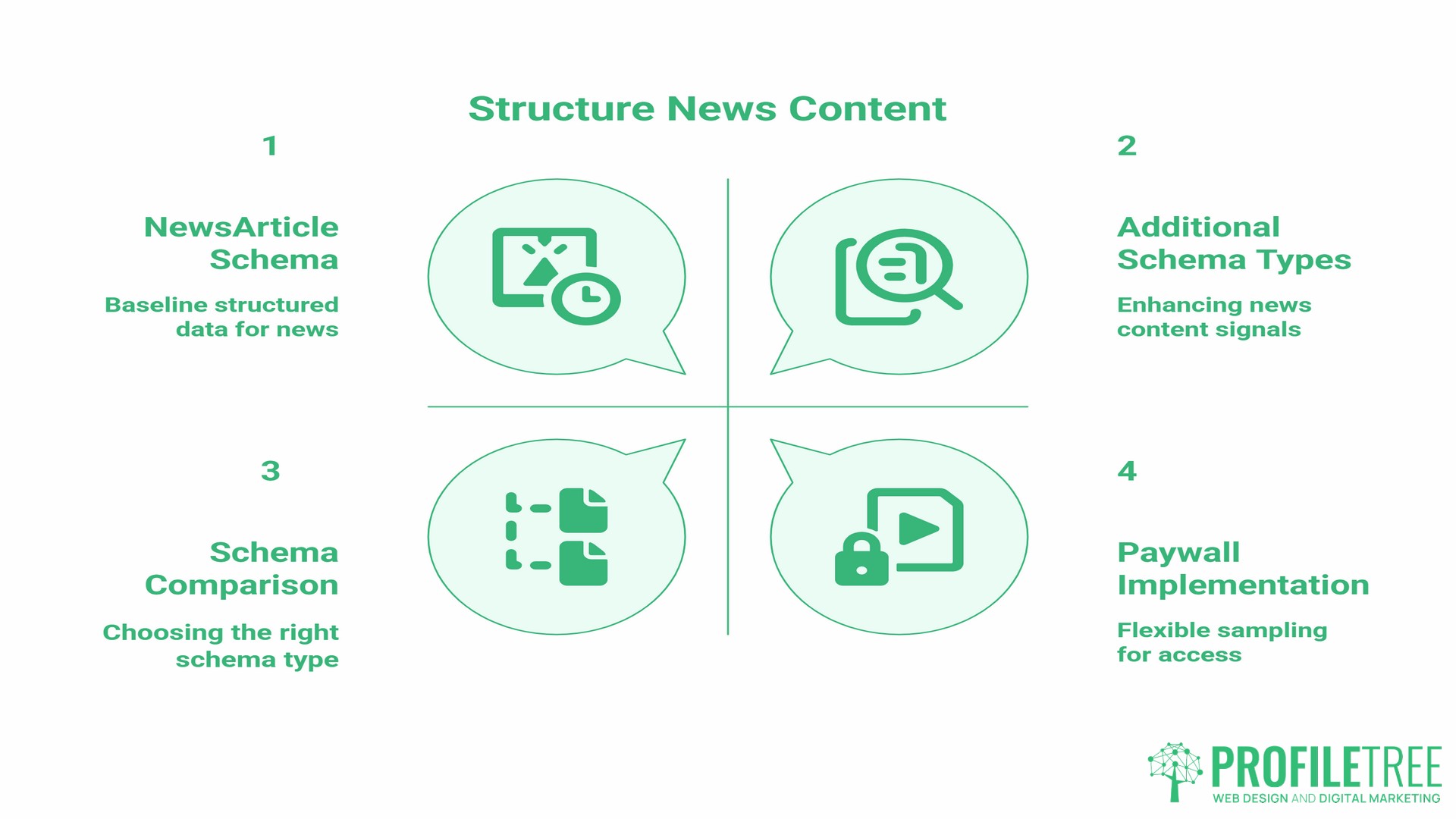
Structured data tells Google not just what your content says, but what type of content it is, who wrote it, when it was published, and how it should be treated in search results. For SEO for news sites, this is not optional. It is one of the clearest signals you can send to both the standard search index and Googlebot-News.
NewsArticle Schema
The NewsArticle schema type, implemented as JSON-LD in the page’s <head>, is the baseline structured data requirement for SEO for news sites. It differs from the standard Article type in that it signals to Google that the content is time-sensitive, has a named author, and belongs to a recognised publication.
A basic NewsArticle Implementation includes:
| Field | Purpose |
|---|---|
@type: "NewsArticle" | Identifies the content as news |
headline | Must match the H1 exactly |
datePublished | ISO 8601 format, including time and timezone |
dateModified | Updated whenever the article is edited |
author | Links to an @type: "Person" entity with name and URL |
publisher | Links to the organisation’s @type: "Organization" with logo |
image | High-resolution image meeting Google’s aspect ratio requirements |
isAccessibleForFree | Boolean; critical for paywalled content |
Getting the headline The field right is important. It must match the H1 on the page exactly. Mismatches between the schema headline and the visible heading can trigger validation warnings in Google Search Console and may reduce your eligibility for rich results.
Additional Schema Types Worth Implementing
FactCheck schema (ClaimReview) is worth adding to any content that verifies or debunks specific claims. Google surfaces FactCheck labels in search results, which can improve CTR for that content type.
OpinionNewsArticle is a subtype of NewsArticle used for clearly labelled opinion and editorial content. Using it correctly helps Google distinguish between editorial commentary and reporting, aligning with Google’s E-E-A-T expectations for transparency.
For authors, building out a proper Person entity in structured data, including a sameAs Reference to the author’s verified profiles on LinkedIn or a known author page strengthens the author authority signal that Google uses as part of its E-E-A-T evaluation.
A comparison of the most relevant schema types for news and content-heavy sites:
| Schema Type | Best For | Distinctive Requirement |
|---|---|---|
Article | General blog content | None specific |
NewsArticle | Time-sensitive reporting | Publisher entity required |
BlogPosting | Opinion or personal content | Less suited to news surfaces |
OpinionNewsArticle | Editorial / commentary | Must be clearly labelled on-page |
ClaimReview | Fact-checking content | Specific claim and rating fields |
Implementing the isAccessibleForFree Field
Publications using paywalls or metered access face a specific technical challenge. Google must be able to crawl the full article to index it, but visitors without a subscription see only a lead-in. This creates a situation in which what Google sees and what users see differ, which Google generally treats as cloaking.
The solution is Flexible Sampling combined with the isAccessibleForFree schema field. Setting "isAccessibleForFree": false alongside a cssSelector The code that identifies the paywalled section tells Google that the content has restricted access. In return, Google expects to be able to crawl the full article through its subscriber access crawler. Setting this up incorrectly can result in articles being deindexed, so this implementation requires careful testing against Google Search Console’s URL Inspection tool.
Google’s News Surfaces: Top Stories, the News Tab, and Discover
Google surfaces news content in several distinct places, and each has different eligibility requirements and ranking signals.
- Top Stories carousel: This appears at the top of main search results pages for queries with news intent. It is the most competitive placement, generally reserved for well-established news publications with strong E-E-A-T signals. Regional and trade publishers can appear here for niche queries, but competing against national outlets on broad topics is difficult without significant domain authority.
- Google News tab: Accessible from the tabs at the top of search results, this surface is broader than Top Stories and includes a wider range of publishers. It is where regional publications and content-led SMEs can realistically appear for relevant queries. Eligibility is determined by Google’s Publisher Center and does not require a manual application in most cases; Google assesses sites based on their content and technical signals.
- Google Discover: This is a feed-based surface rather than a search-driven one. Google Discover surfaces content to users based on their interests, browsing history, and engagement patterns, regardless of whether they searched for it. It can drive significant traffic to articles well beyond the 48-hour news window if the content earns strong engagement signals quickly after publication. High-quality images (at least 1200px wide, specified using
max-image-preview: largein robots.txt or via the robots meta tag) are a specific requirement for Discover eligibility.
Understanding which surfaces you are targeting changes how you approach publishing. A regional business news publication in Belfast should prioritise the Google News tab and Discover over Top Stories, where competition from national outlets makes consistent placement unlikely.
Editorial SEO: Headlines, Freshness, and Content Structure
Technical infrastructure determines whether Google can find and index your content. Editorial SEO determines whether that content ranks well once it is indexed. For SEO for news sites, this comes down to three things: headline quality, content freshness, and structural clarity.
Headline Strategy for News Content
News headlines must do two things simultaneously: accurately describe the content and give searchers a reason to click. Neither aim should be sacrificed for the other.
Google’s guidance for news publishers explicitly favours headlines that directly reflect the article’s content. Clickbait headlines that promise more than the article delivers damage E-E-A-T signals over time. At the same time, a technically accurate headline that is dry or opaque will not earn the click from a search results page.
Practical headline guidelines:
- Put the most important information first; readers and search engines both scan from left to right
- Keep headlines under 65 characters to avoid truncation in search results
- Use the specific names, locations, or numbers that define the story
- Avoid vague terms like “experts say” or “study finds” without naming who or which study
- Match the headline to the H1 on the page; mismatches create trust issues with readers and technical issues with schema
Avoiding clickbait is also in your interest from an algorithmic standpoint. Google’s quality systems assess whether content delivers on the premise set by its headline. A consistent pattern of high bounce rates or short dwell times after clicks from news surfaces can signal to Google that the content is not meeting reader expectations.
Content Freshness and Evergreen Balance
Publishing velocity alone does not improve rankings. Publishing consistently high-quality, original content at a regular pace does. This distinction is central to SEO for news sites: some organisations respond to the freshness signal by publishing large volumes of thin, hastily written articles, which damage rather than build authority.
A more effective approach for content-led SMEs is to maintain a mix of genuinely timely content and deeper evergreen pieces. The timely content captures news-intent traffic; the evergreen content continues earning search traffic and links over time. This is how a business that is not a traditional news publisher can still benefit from applying SEO for news sites principles to its content operation. ProfileTree’s content strategy guides cover this balance in detail.
Updating older content when circumstances change also sends a signal of freshness. Google distinguishes between cosmetic updates and substantive ones; adding a new section, updating statistics, or extending coverage of a topic counts. Changing the date without updating the content does not.
E-E-A-T for UK and Irish Publishers
Google’s E-E-A-T framework (Experience, Expertise, Authoritativeness, Trustworthiness) applies to all content, but for news publishers it is particularly consequential. Effective SEO for news sites depends as much on demonstrating publisher credibility as it does on technical configuration. News content, particularly reporting on politics, health, finance, or public safety, often touches on topics Google evaluates under a higher standard in its quality guidelines. Inaccurate or misleading news content can affect how people make important decisions, which is why Google’s quality raters apply particular scrutiny to publisher credibility and author expertise in this category.
Author Entity Signals
The most immediate E-E-A-T improvement most news sites can make is ensuring every article has a properly attributed author with a verifiable profile. This means:
- A named author on every article, not “Staff Reporter” or “Admin”
- An author bio page that describes their background, credentials, and area of coverage
- A
sameAslink in the author’s structured data pointing to their LinkedIn profile, a professional membership page, or another authoritative source
Google’s entity resolution systems cross-reference author names against external profiles, including LinkedIn, to verify that the person attributed on a page is a real, identifiable individual with a consistent professional history. An author whose LinkedIn profile aligns with their on-site attribution and whose publishing history is consistent across platforms carries more weight than an anonymous byline.
For regional publishers in Northern Ireland and Ireland, adding geographic specificity to author bios and publication descriptions also strengthens local relevance signals. A publication described as “covering business news in Belfast and the wider Northern Ireland economy” is more likely to be surfaced for locally-relevant queries than one with a generic description.
Editorial Transparency Signals
Beyond individual authors, publications should make it clear how their editorial processes work. This includes:
- A clear “About” page describing the publication’s ownership, funding, and editorial independence
- A corrections policy, even if it is brief
- Contact details for the editorial team
- Clear labelling of advertising, sponsored content, and editorial content
UK publishers operating under IPSO (the Independent Press Standards Organisation) regulation can reference this membership as an editorial credibility signal. Similarly, any formal media regulation or membership of a recognised press body should be mentioned on the About page, as these are the types of institutional signals that Google’s quality raters look for when assessing publisher trustworthiness.
For SMEs that publish content but are not press-regulated, the equivalent is to clearly demonstrate subject-matter expertise: named authors with relevant professional backgrounds, accurate sourcing, and content that reflects genuine knowledge of the industry being covered.
Ciaran Connolly, founder of ProfileTree, puts it plainly: “The organisations that will win in AI-driven search are the ones with the clearest evidence of who they are, what they know, and why readers should trust them. That is not a new standard; it is just one Google is now enforcing more consistently.”
Measuring Performance with Google Search Console
Google Search Console provides several specific data points that are particularly useful for news publishers.
- The Search type filter in the Performance report can be set to “News” to show how your content is performing specifically on the Google News surface, separate from standard web search. This is one of the most useful SEO tools for news sites, letting you identify which articles are earning impressions and clicks in the News tab and which are not.
- The URL Inspection tool lets you check whether an individual article has been indexed and whether there are any structured data errors. For news content where indexation speed matters, running URL Inspection on newly published articles and requesting indexing can speed up the process, though Google makes no guarantees about timing.
- Core Web Vitals data in Search Console shows how your article pages are performing on speed metrics. Poor Largest Contentful Paint performance is one of the most common reasons a technically sound news article fails to appear in Top Stories.
- The Sitemaps report shows whether your News Sitemap is being processed correctly and flags any errors. This should be checked regularly, not just at setup.
For SMEs that have not yet worked through a full GSC setup, ProfileTree’s SEO services include Search Console configuration and ongoing performance monitoring as part of broader content and technical SEO engagements.
Turning News Traffic into Long-Term Revenue
The goal of SEO for news sites is not simply to appear in Google News. It is to convert that appearance into a sustained audience, and that audience into a measurable business outcome, whether that is advertising revenue, newsletter subscribers, paid memberships, or direct commercial enquiries.
The content marketing principles that apply to SME publishing align closely with what works in news SEO. Original, well-structured content that earns trust over time builds the kind of topical authority that compounds: each article adds to a body of work that Google increasingly associates with a specific subject area or geographic market. ProfileTree’s digital marketing services support organisations in building this kind of authority systematically, rather than through ad hoc publishing.
If you are running a content operation and want to understand how news SEO principles can be applied to your specific situation, get in touch with the ProfileTree team.
Frequently Asked Questions
Do I need to submit my site to Google News manually?
No. Google assesses sites for inclusion in the News tab automatically based on their content and technical signals. However, registering in Google Publisher Center gives you additional control over how your publication appears in Google News, including your publication name, logo, and topic categories. It is worth doing even though it is not strictly required.
What is the difference between news SEO and standard SEO?
Standard SEO focuses on building long-term authority and ranking evergreen content over months or years. SEO for news sites operates on a much faster timescale, where indexation within hours matters and freshness is an active ranking signal. News SEO also involves specific technical requirements, including News Sitemaps, NewsArticle structured data, and crawl budget management, that are not relevant to most standard websites.
Why is my content not appearing in the Top Stories carousel?
Top Stories is highly competitive and generally favours well-established news publications with strong domain authority and E-E-A-T signals. Common reasons for absence include missing or incorrect NewsArticle structured data, poor Core Web Vitals performance, lack of a properly attributed author, or insufficient domain authority relative to competing publishers. Address the technical requirements first before drawing conclusions about authority.
How long do articles stay fresh in Google News?
The Google News tab typically surfaces content published within the last 48 hours. Google Discover can surface older articles for much longer if they earn strong engagement signals, but the standard news cycle is roughly two days. This is why the indexation window matters; an article that is not indexed within 48 hours of publication has effectively missed its news window.
Does my site need to be a registered newspaper to rank in Google News?
No. Google assesses content quality, technical standards, and E-E-A-T signals rather than formal press registration. SMEs, trade publications, and independent websites can all appear in Google News if their content meets the relevant standards. The key requirements are original reporting or commentary, clear authorship, proper technical configuration, and consistent publishing that demonstrates subject-matter expertise.
Can AI-generated news content rank in Google News?
Google’s spam policies cover “scaled content abuse,” which includes AI-generated content published at high volume without meaningful human oversight or editorial value. Content written or substantially drafted with AI assistance can rank if it meets quality standards and carries clear human editorial accountability. However, Google’s quality raters are specifically trained to identify content that lacks genuine expertise or experience, and news content is assessed at a higher standard than most other content types.