
Ethical Marketing for SMEs: Guide to Transparent Digital Strategy
Table of Contents
Ethical marketing is no longer a fringe concern reserved for B-Corps and sustainability brands. Across the UK and Ireland, business owners are asking harder questions about how their digital agencies collect data, write content, run paid campaigns, and design websites. The answers matter because consumers now treat transparency as a baseline expectation rather than a bonus.
This guide covers what ethical marketing actually means in practice, the UK and Irish regulatory frameworks that shape it, and how SMEs can apply its principles across SEO, web design, content, and AI without sacrificing commercial performance.
What Is Ethical Marketing?
Ethical marketing is the application of honesty, fairness, and social responsibility to every stage of the marketing process. It goes beyond compliance. A business can technically satisfy the letter of advertising law while still misleading customers through selective framing, manufactured urgency, or privacy-eroding data practices.
The philosophy rests on a straightforward premise: marketing that respects the people it is aimed at builds stronger, longer-lasting commercial relationships than marketing that manipulates them.
The difference between ethical marketing and sustainable marketing
These terms are often used interchangeably, but they describe different things. Sustainable marketing focuses specifically on environmental and social impact, typically addressing supply chains, carbon footprints, and resource use. Ethical marketing is broader. It covers all aspects of how a business communicates: advertising honesty, data privacy, pricing transparency, accessibility, and the ethics of using AI to produce content. A company can market sustainable products unethically. A service business with no environmental footprint can still practise ethical marketing by default.
The 7 Principles of Ethical Marketing
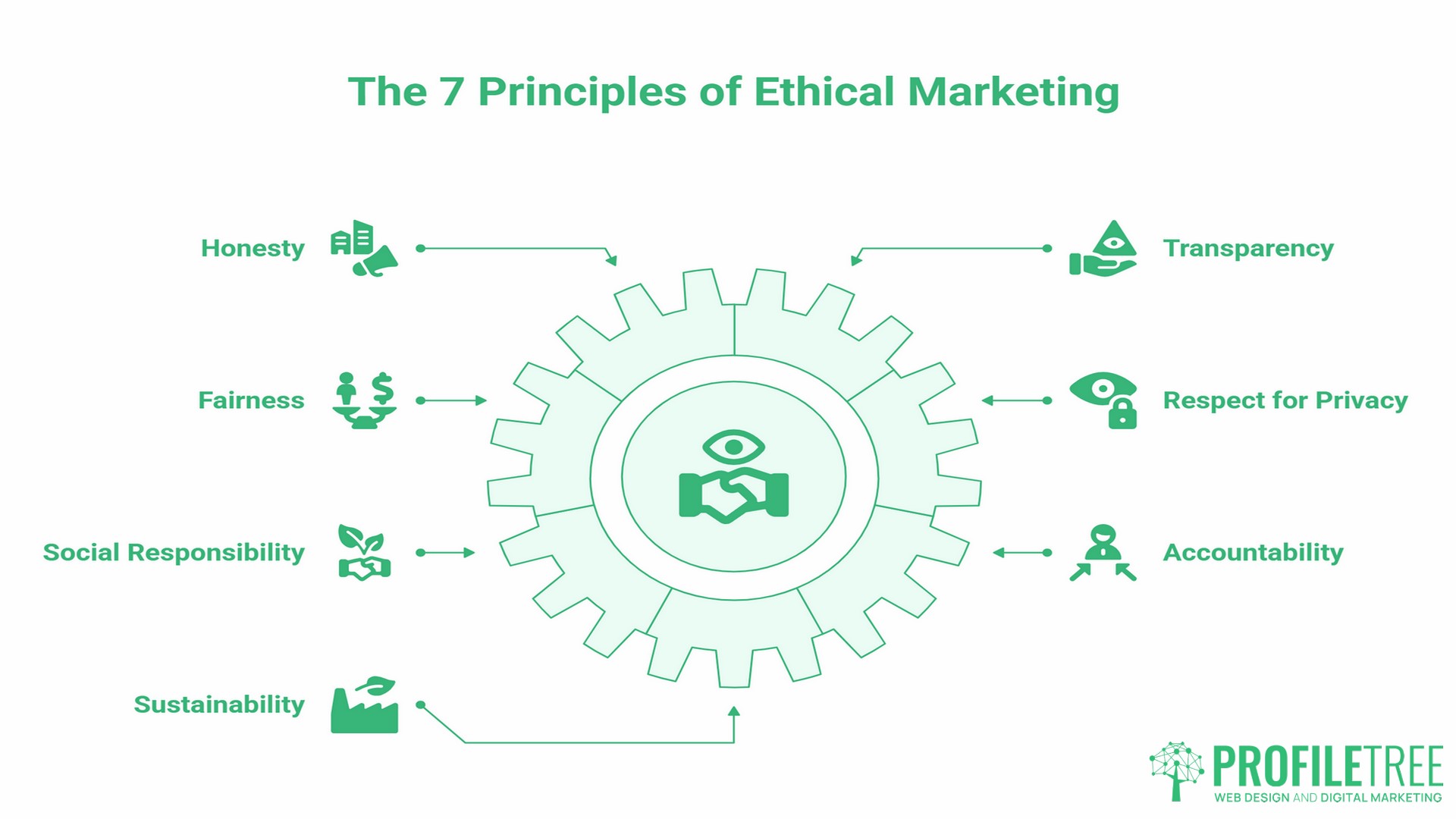
| Principle | What It Means in Practice |
|---|---|
| Honesty | Advertising and content accurately reflect what is on offer. No exaggerated claims. |
| Transparency | Pricing, data use, and business processes are disclosed clearly. |
| Fairness | All customer groups are treated consistently. No exploitative targeting. |
| Respect for privacy | Consumer data is collected with genuine consent and used only as disclosed. |
| Social responsibility | The business considers its broader impact on communities, not just its customers. |
| Accountability | The business owns its mistakes publicly rather than deflecting. |
| Sustainability | Long-term thinking governs decisions, not short-term revenue at any cost. |
A clearly labelled table format helps both readers and search engines process structured definitions, and is well-suited to queries like “what are the principles of ethical marketing”, where Google often surfaces list or table-style answers.
Ethical Marketing in the UK and Ireland: Legal Frameworks
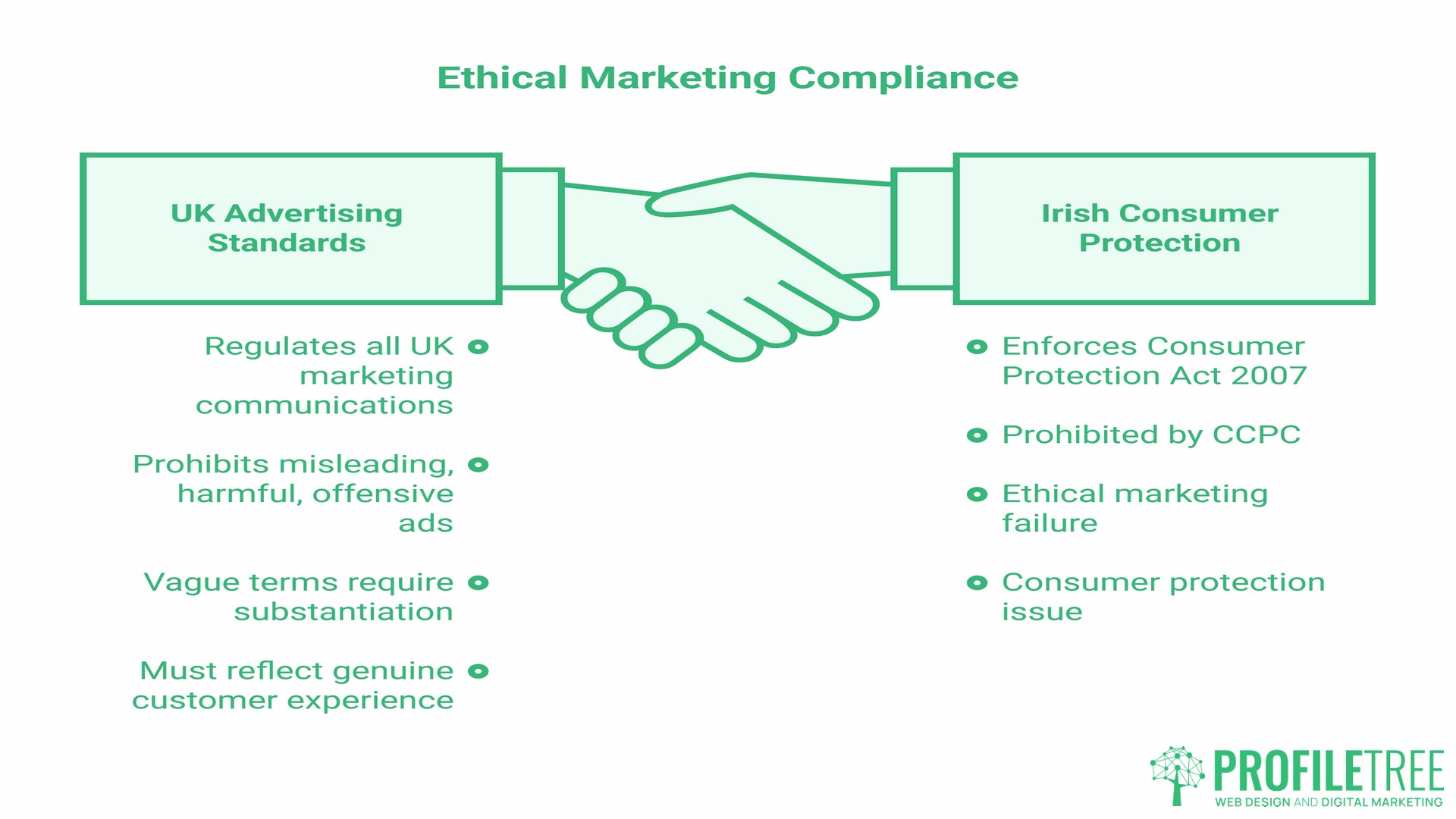
Most global guides on this topic reference the US Federal Trade Commission. For SMEs in Northern Ireland, Ireland, and Great Britain, the relevant bodies are different, and the rules carry real teeth.
Navigating ASA and CAP Guidelines (UK)
The Advertising Standards Authority (ASA) regulates all marketing communications in the UK, including paid social, influencer content, email campaigns, and website claims. Its Code of Non-broadcast Advertising (CAP Code) prohibits misleading, harmful, or offensive advertising and applies to businesses of all sizes.
Two areas that trip up SMEs most frequently are environmental claims and testimonials. Vague language such as “eco-friendly,” “green,” or “sustainable” without substantiation now draws ASA scrutiny. Similarly, testimonials must reflect genuine customer experience and cannot be selectively edited to imply outcomes that are not typical. The ASA’s publicly available rulings provide a useful reference for understanding where the line sits. For a broader view of how advertising law intersects with digital channels, the guide to legal implications of misleading advertising covers the key risks for UK businesses.
The CCPC and Consumer Protection (Ireland)
In the Republic of Ireland, the Competition and Consumer Protection Commission (CCPC) enforces the Consumer Protection Act 2007. The CCPC has pursued cases involving misleading price promotions, fake reviews, and subscription traps, all of which represent ethical marketing failures before they become legal ones. Northern Ireland businesses selling into the Republic should be aware that CCPC jurisdiction applies to consumers based there, regardless of where the seller is located.
Implementing Ethics Across Digital Channels
This is where theory becomes practice. Ethical marketing is not a values statement on a website; it is a series of choices made at every touchpoint of the digital strategy.
Ethical SEO: Transparency vs. Manipulation
Search engine optimisation has its own ethical spectrum. At one end: content that genuinely answers what people are searching for, presented accurately. At the other end: keyword stuffing, thin AI-generated pages designed to rank rather than inform, deceptive redirects, and link schemes that mislead search engines about a site’s authority.
Ethical SEO means building rankings through genuine relevance. It means writing title tags and meta descriptions that accurately represent what the page contains, so that click-through rates reflect real interest rather than manufactured curiosity. It means not publishing content on topics the business has no expertise in, simply because a keyword shows high search volume.
For SMEs, this approach is also commercially sensible. In March 2024, Google integrated its Helpful Content system into its core ranking algorithm, making content quality a continuous signal rather than a periodic check. Sites producing accurate, well-sourced content for real audiences have shown stability through subsequent core updates, while sites relying on manipulative tactics have declined. Ethical and effective SEO are now largely the same thing. The SEO guide covering Google’s YMYL update explains how these quality signals apply in practice.
Web Design: Avoiding Dark Patterns and Prioritising Accessibility
Dark patterns are user interface choices designed to manipulate visitors into actions they would not otherwise take: pre-ticked subscription boxes, hidden cancellation flows, countdown timers applied to offers that never expire, and cookie consent banners engineered to make “accept all” the path of least resistance. The UK’s Digital Markets, Competition and Consumers Act 2024 (DMCCA) directly prohibits many of these practices, and the CMA has pursued enforcement actions against businesses that use misleading urgency tactics and create cancellation friction. At the EU level, the Digital Services Act, which came into force for large platforms in February 2024, also addresses manipulative design choices for businesses reaching European consumers.
Ethical web design makes the user’s intended action easy and the exit equally accessible. It treats accessibility not as a legal checkbox but as a design standard, ensuring that websites work for people with visual, motor, or cognitive differences. A site that excludes a segment of potential customers due to poor accessibility is also missing a commercial opportunity.
Practically, this means providing sufficient colour contrast, keyboard navigability, descriptive alt text for images, and forms that do not rely solely on placeholder text to communicate what is required. These are also considerations for search performance, since Google’s page experience signals include Core Web Vitals and accessibility-related factors such as mobile usability.
Data Privacy and Ethical Lead Generation
GDPR applies to any business that collects personal data from individuals in the UK or the EU, regardless of where the business is based. Ethical data handling under GDPR is not technically complex, but it requires consistency: explicit consent before non-essential cookies are set, clear disclosure of what data is collected and why, a genuine opt-out that works, and data retention policies that are actually followed.
Where ethical marketing most commonly fails on data is in lead generation. Pre-checked consent boxes, bundled consent for multiple purposes, and vague statements like “we may contact you about relevant offers” all represent practices that neither satisfy the spirit of the GDPR nor meet the expectations of customers who are significantly more aware of their rights. The guide to data privacy in digital marketing sets out what SMEs need to have in place.
Ethical lead generation uses honest value exchange: a resource, a consultation, or a discount that is genuinely worth the contact information being provided. It does not manufacture false scarcity or use countdown timers to pressure sign-ups.
The Ethics of AI in Content Creation and Personalisation
AI tools now sit at the heart of most digital marketing workflows, from first-draft copywriting to personalised email subject lines. Their use raises specific ethical questions that few guides address directly.
- Transparency about AI-generated content: There is currently no UK legal requirement to label AI-generated marketing content. There is, however, a reputational risk when businesses publish AI-generated content that contains inaccuracies, fabricated citations, or claims the business cannot stand behind. Ethical practice means human review before publication, not publishing AI output verbatim.
- Algorithmic bias in personalisation: AI personalisation systems trained on historical data can replicate and amplify existing biases, showing different pricing, products, or content to different demographic groups in ways that are discriminatory even if unintentional. Businesses using AI personalisation tools should audit their segmentation logic for these patterns.
- Deepfakes and synthetic media: The use of AI-generated voices, likenesses, or video content in advertising without disclosure is an emerging ethical and legal concern. The UK government has indicated that transparency around AI-generated content in commercial contexts is an area of active policy development. Businesses producing video content should have a clear internal policy on AI-generated imagery, both to protect consumer trust and to stay ahead of regulatory developments.
Ciaran Connolly, founder of ProfileTree, notes that the most common mistake businesses make with AI in marketing is treating it as a cost-cutting shortcut rather than a productivity tool that still requires expert direction. The output is only as good as the brief, the review process, and the human judgment applied before anything is published.
Why Ethical Marketing Drives SME Growth
The commercial case for ethical marketing is more concrete than the values-based framing suggests.
Building Consumer Trust After a Trust Deficit
The trust landscape for brand communications is complicated. The Edelman Trust Barometer, which surveys over 32,000 respondents across 28 countries annually, consistently finds that media and advertising communications sit among the least trusted information sources, while peer recommendations and personal experience rank higher. Word of mouth, online reviews, and direct customer experience consistently outperform brand-controlled messaging in driving purchase decisions.
Ethical marketing addresses this directly. A business that is transparent about pricing, honest about its limitations, and transparent about how it handles customer data does not need to overcome the same scepticism. Trust is built structurally, not through individual campaigns.
Long-Term Brand Value vs. Short-Term Gains
Deceptive marketing tactics can generate short-term revenue. They also generate refund requests, negative reviews, regulatory complaints, and reputational damage that is expensive to undo. For SMEs without the brand equity of a major retailer, a single publicised lapse in ethical practice can materially affect sales.
Ethical marketing is also a stronger foundation for content marketing and SEO. Content that accurately represents expertise, written for genuine reader value, earns backlinks and shares that paid distribution cannot replicate. The transparency in the content marketing guide explores how this applies to editorial decisions specifically.
Ethical Marketing Examples Beyond the Giants
Patagonia and Dove appear in nearly every guide on this topic, partly because they are genuinely instructive and partly because most writers default to familiar examples. Both are worth understanding.
Lessons from Patagonia and Dove
Patagonia’s “Don’t Buy This Jacket” campaign from 2011 remains one of the most cited examples of ethical marketing in practice. The company ran a full-page advertisement in the New York Times on Black Friday, urging customers to consider whether they actually needed a new jacket before purchasing one. It was a commercially counterintuitive move that reinforced the brand’s environmental positioning and generated significant media coverage at no additional cost. The campaign worked because it aligned with Patagonia’s actual business practices, including its Worn Wear repair programme and use of recycled materials, rather than a standalone stunt.
Dove’s Real Beauty campaign, which launched in 2004 following a global study that found only 2% of women described themselves as beautiful, widened the advertising industry’s representation of what “beautiful” looked like by featuring women of different ages, sizes, and ethnicities. It was not purely altruistic: critics noted that Unilever simultaneously owned brands whose advertising operated on different principles, creating, in some descriptions, a mixed message at the corporate level. The campaign nonetheless shifted industry norms and demonstrated that challenging conventional advertising assumptions can build significant brand affinity. Dove’s own data attributes a substantial increase in sales during the first years of the campaign to the shift in strategy.
UK-Based Examples for SMEs
Toast Ale, a UK brewery founded in London, brews beer using surplus bread that would otherwise go to waste, and donates all its profits to environmental charities. Every bottle carries information about the bread source and the food waste problem it addresses. The model is reproducible: any SME that sources locally, pays fair wages, or operates with verifiable environmental commitments has a transparency story worth telling, provided it is substantiated rather than asserted.
Hiut Denim, founded in 2011 in Cardigan, Wales, revived local denim manufacturing after the town’s jeans factory closed in 2002, leaving hundreds of skilled workers unemployed. The brand’s marketing is built around verifiable craft, provenance, and the story of returning skilled work to the community. Production numbers and the manufacturing process are openly discussed. This transparency functions as marketing without resembling advertising.
For UK and Irish SMEs, the principle from both examples is the same: the most persuasive ethical marketing is built on practices that already exist, not on campaigns that outpace the reality they are promoting.
Measuring the Success of an Ethical Marketing Strategy
Most guides on ethical marketing describe its benefits in abstract terms. SME directors making budget decisions need more specific indicators.
- Customer Lifetime Value (CLV): Ethical businesses typically retain customers longer because their experience aligns with the promise. Tracking CLV against customer acquisition channels identifies whether trust-building content is attracting higher-value customers.
- Review quality and volume: Net Promoter Score and Google review data reveal whether customers are recommending the business unprompted, which is the most direct measure of trust.
- Referral traffic and earned media: A business producing accurate, genuinely useful content earns links and mentions that paid channels cannot generate. Referral traffic as a proportion of total traffic indicates whether the content strategy is building authority organically.
- Complaint and refund rates: These are lagging indicators but reliable ones. An increase in disputes following a campaign change is a signal worth investigating before investing further.
- ASA complaint history: For businesses running paid advertising, a clean ASA record is a measurable proxy for ethical compliance. Monitoring competitor ASA rulings in the same category is also a useful early-warning system for what scrutiny the sector is facing.
Ethical Marketing: A Practical Checklist for SMEs
Before running any campaign or publishing any content, the following questions serve as a working audit:
- Does this accurately represent what we offer?
- Would a customer feel misled after buying, compared to what we have advertised?
- Have we obtained genuine consent for any data we are collecting?
- Are our environmental or social claims substantiated, or are they aspirational?
- If a journalist read this, would they find it accurate?
- Does our website give users a genuine, accessible way to opt out of tracking?
- Have we reviewed AI-generated content for accuracy before publishing?
- Are our pricing and terms presented clearly, without hidden conditions?
- Does our advertising target vulnerable groups in ways they could not reasonably anticipate?
- Could any element of our UX be characterised as a dark pattern?
Making Ethics a Competitive Advantage
For SMEs across Northern Ireland, Ireland, and the UK, ethical marketing is a practical differentiator rather than an abstract commitment. The gap between what major competitors claim and what they demonstrably do creates space for businesses that are willing to be specific, honest, and consistent. That means transparent pricing, accurate advertising, accessible design, responsible data handling, and honest content, whether that content is written by a human or reviewed by one after AI assistance.
ProfileTree’s digital marketing strategy services and digital training programmes support SMEs in building strategies that perform without relying on the shortcuts that create longer-term risk. If you want a marketing approach that your business can stand behind publicly, get in touch with the team.
Frequently Asked Questions
What are the 7 principles of ethical marketing?
The seven principles are honesty, transparency, fairness, respect for privacy, social responsibility, accountability, and sustainability. In practice, they mean that marketing communications accurately represent what is on offer, data is handled with genuine consent, and the business considers its broader impact rather than solely commercial outcomes.
What is the difference between ethical marketing and green marketing?
Green marketing focuses specifically on environmental credentials, such as sustainability claims, eco-friendly materials, and carbon neutrality. Ethical marketing is broader and covers all aspects of honest commercial communication, including data privacy, advertising accuracy, pricing transparency, and accessible design. A business can practise ethical marketing without making any environmental claims.
How can a small business avoid greenwashing?
Only make environmental claims that are specific and verifiable. “Made from 50% recycled materials” is a substantiated claim. “Eco-friendly” without qualification is not. The ASA’s guidance on environmental advertising sets out what level of substantiation is required for common claims. If a claim cannot be verified, it should not be made.
Are there specific UK laws for ethical advertising?
Yes. The ASA’s CAP Code applies to all non-broadcast advertising in the UK, including digital channels. The Advertising Standards Authority can require businesses to remove or amend misleading campaigns. The CMA additionally investigates dark patterns and subscription practices under consumer protection law. In Ireland, the CCPC enforces the Consumer Protection Act 2007.
Is ethical marketing more expensive than traditional marketing?
In the short term, some ethical commitments carry a cost: better data management, more thorough content review, and accessible website design. Over the long term, ethical marketing reduces costs associated with customer disputes, regulatory action, and reputational repair. It also tends to produce higher-quality organic traffic, which is cheaper to acquire than paid alternatives at scale.
Does ethical SEO actually work commercially?
Yes. In March 2024, Google integrated its Helpful Content system into its core ranking algorithm, making content quality a continuous signal applied to all sites. Sites producing accurate, well-sourced content for real audiences have shown stability through subsequent core updates, while sites relying on manipulative tactics have declined. Ethical SEO and commercially effective SEO are, increasingly, the same strategy. The ethics and legalities of digital marketing cover how this applies across paid and organic channels.