
Local Search: A Practical Guide for UK and Irish Businesses
Table of Contents
Local search results drive more footfall and enquiries than most business owners realise. When someone in Belfast types ‘accountant near me,’ Google’s local algorithm decides which businesses surface in the Local Pack and which stay invisible. For UK and Irish SMEs, it’s not optional to get this right.
This guide covers the three factors that determine your ranking, UK-specific tactics that US-focused guides miss, and why zero-click conversions from Google Business Profile now matter as much as website traffic.
What Is Local Search?
Local search is any query where Google infers the user wants a nearby result. That’s explicit searches like ‘web design agency Belfast’ and implicit ones like ‘digital marketing agency’ typed on a phone in Manchester, where the device’s GPS shapes what they see.
The key output is the Local Pack (also called the Map Pack): three business listings above organic results, pinned to a map. Appearing there puts your name, rating, opening hours, and click-to-call button in front of users before they reach any other result on the page.
It isn’t SEO with a postcode bolted on. It optimises your business entity across multiple platforms so Google can confidently match you to users searching nearby. The ranking signals, strategy, and conversion path are all distinct.
Local Search vs. Organic SEO: Key Differences
| Factor | Local Search | Organic SEO |
|---|---|---|
| Primary goal | Appear in Local Pack for nearby searches | Rank in blue-link results for topic queries |
| Key ranking factors | Proximity, relevance, prominence | Content quality, backlinks, technical SEO |
| Main platform | Google Business Profile, Apple Maps, Bing Places | Website pages |
| Conversion path | Call or directions directly from the local search SERP | Click through to website, then convert |
| KPIs | Calls, direction requests, Local Pack visibility | Organic clicks, session time, conversions |
The Three Local Ranking Factors: Proximity, Relevance, and Prominence
Google uses three factors to decide which businesses appear in results. Each one is measurable and improvable, which means your position in the Local Pack isn’t fixed; it’s a function of how well you’ve addressed all three.
Proximity
Proximity is how close your business is to the person performing a nearby search. You can’t move your premises, but you can make sure your address is accurate and consistent across every platform where your business appears.
For service-area businesses (electricians, cleaners, IT support providers) that visit customers rather than hosting them, proximity is calculated from the service area you define in Google Business Profile rather than your registered address. Set it carefully: too broad weakens your relevance, too narrow loses genuine customers.
Relevance
Relevance is how closely your Google Business Profile and website match the query. Google reads your primary GBP category, description, listed services, website keywords, and review language to assess it.
Choosing the right primary category is one of the highest-impact actions you can take. A Belfast web design business with its GBP category set to ‘Computer Repair’ won’t rank in the Local Pack for ‘web design Belfast’ regardless of how strong its other signals are.
Prominence
Prominence measures how well known and trusted your business is, on and off Google. It’s built through review volume and quality, local backlinks, consistent NAP mentions across UK directories, and your site’s domain authority.
For new businesses, it takes time to build. The most practical starting point is consistent NAP details across key UK directories and a steady stream of genuine customer reviews. Prominence compounds: the more trusted signals Google finds, the more confidently it surfaces you.
The Anatomy of a Local Search Results Page
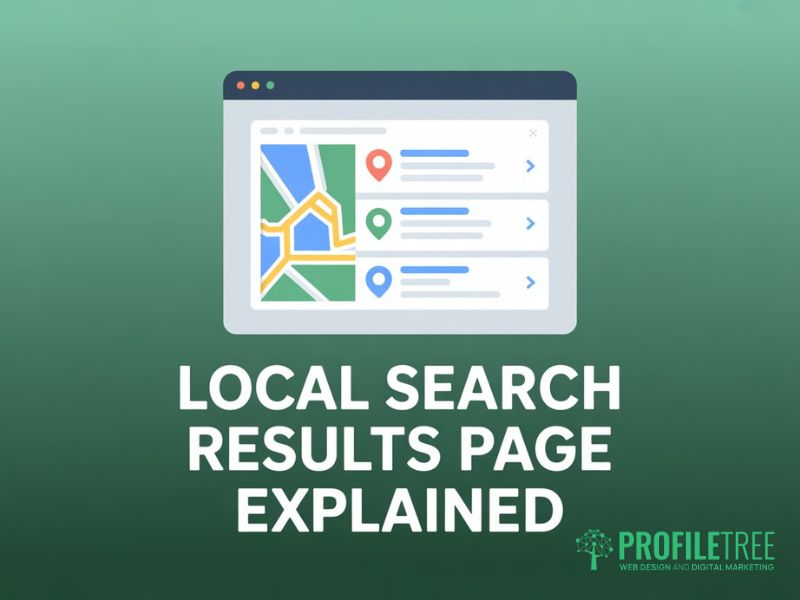
Understanding what appears on that results page helps you decide where to focus. The layout has changed considerably since 2022, and zero-click conversions are now a mainstream outcome your strategy needs to account for.
The Local Pack and Local Organic Results
The Local Pack shows three businesses with name, rating, address, phone, hours, and a GBP profile link. Below it are local organic results: blue-link results from websites with strong local relevance signals. Both positions matter, and the most effective strategies target both, since they draw from different ranking inputs. Local organic results, in particular, carry weight for users doing more research before choosing.
Zero-Click Conversions: Why Website Traffic Isn’t the Only Metric
A growing share of searches end without a website click. Users call the Local Pack number, tap ‘Get Directions,’ or read the hours and decide. These zero-click conversions are genuine business outcomes, not missed opportunities.
ProfileTree’s work with local businesses in Northern Ireland shows that GBP calls and direction requests, tracked separately from website traffic, give a far more accurate picture of your performance. When you review results, open Google Business Profile alongside your analytics: the full picture of what it is delivering lives across both.
Strategic Optimisation for the UK and Irish Market
Most guides on this topic are written for a US audience. They reference zip codes, American directories, and norms that don’t apply here. The following sections address the challenges that set the UK and Irish market apart.
NAP Consistency and UK-Specific Directories
NAP (Name, Address, Phone number) must be identical across every platform where your business appears. Even minor discrepancies (abbreviated street names, old postcodes, inconsistent phone formats) reduce Google’s confidence in your data. It’s one of the most common issues ProfileTree finds when auditing client accounts, and one of the easiest to fix.
The UK citation hierarchy differs from the US one. Priority order: Google Business Profile, Apple Business Connect, Bing Places for Business, Yell, Scoot, Thomson Local, Checkatrade (trades), and your local Chamber of Commerce directory. Consistent listings across these platforms are the foundation of credible NAP signals.
UK Local Citation Hierarchy for Local Search
| Platform | Priority | Notes |
|---|---|---|
| Google Business Profile | Essential | Primary local search signal |
| Apple Business Connect | High | Over 50% of UK mobile users use iPhones |
| Bing Places for Business | High | Powers Bing local search and AI assistant results |
| Yell | Medium | UK’s largest business directory |
| Scoot / Thomson Local | Medium | Legacy authority, still indexed by Google |
| Chamber of Commerce | Medium | Strong local relevance and prominence signal |
| Checkatrade / Rated People | Sector-specific | Trades and home services local search only |
UK Postcodes and County-Level Targeting
UK postcodes are more granular than US zip codes, which creates a real local search opportunity. ‘Electrician BT1’ signals a different intent to ‘electrician Belfast,’ which differs again from ‘electrician Northern Ireland.’ Each draws on a different proximity radius and expects a different local search result.
Include your postcode naturally in your GBP description and contact page. For county-level local search, set your GBP service area to reflect counties you genuinely cover and create location pages with original local content, not templated copy that swaps place names.
The Northern Ireland and Republic of Ireland Border Challenge
Businesses in border towns like Newry, Enniskillen, and Derry face a local search challenge no US guide addresses: appearing correctly for users on both sides of the border. A Newry business serves customers in Northern Ireland (GBP, UK framework) and the Republic (EUR, Irish law), but Google’s local search algorithm serves results based on the user’s physical location and device country setting.
The fix is more practical than it sounds: create separate location pages for NI and ROI service areas with appropriate currency and regulatory framing, and confirm your GBP service area covers postcodes on both sides. ProfileTree works with a number of Northern Ireland businesses serving all-island markets, and this cross-border local search issue comes up consistently.
Google Business Profile: Your Second Homepage for Local Search
Google Business Profile (GBP) is the single most important platform for local search visibility. When someone searches for your service in your area, your GBP profile is often the first thing they see and the last thing they need before contacting you. A well-maintained GBP generates Map Pack visibility and local search conversions that never touch your website.
Setting Up and Verifying Your Google Business Profile
Claim your listing at business.google.com. If one already exists, claim it rather than creating a duplicate, as duplicates harm your local search prominence signals. Google typically verifies UK businesses by postcard or, for established businesses, by phone or video.
Complete every field: name, address, phone, website, hours, description, primary and secondary categories, services, and photos. Incomplete GBP profiles rank below complete ones in local search. Your description (750 characters maximum) should naturally include your primary service and location, written for someone who’s never heard of you.
Photos, Posts, and Ongoing GBP Maintenance
GBP profiles with photos receive more local search direction requests and calls than those without. Add at least ten real images: your premises, team at work, and finished projects. Stock photography is discounted as a local search trust signal.
GBP Posts let you publish updates and offers directly to your local search profile. They expire after seven days, but a regular cadence signals to Google that the business is active. Monthly is the minimum; weekly works better in competitive local search markets.
Advanced Local Search Tactics: Beyond the Basics
Once your GBP is complete and your NAP is consistent across key UK directories, these tactics separate businesses that hold a Map Pack position from those still competing for one.
Local Citations vs. Hyper-Local Backlinks
Citations tell local search algorithms your business exists. Backlinks from local websites tell them it matters. Both build prominence, but a backlink from a genuinely relevant local source carries more local search weight than a directory listing.
Hyper-local backlinks for local search come from Belfast Telegraph, the Irish News, local business associations, event sponsor pages, and complementary local businesses. A Belfast Chamber of Commerce member page link strengthens your local search prominence considerably more than a generic national directory citation.
The most practical route to hyper-local backlinks is doing things worth writing about: sponsoring a community event, providing a comment for a local news story, or publishing original research about your local market. ProfileTree’s approach to building local search authority through content is covered in our guide to content marketing for Northern Ireland businesses.
Reviews and the UK Consumer Psyche
Reviews are a direct local search ranking signal, and UK consumers are sceptical of them. A GBP with 200 reviews and a 4.7-star rating often outperforms one with 50 reviews and a 5.0 in both local search rankings and conversion, because a perfect score looks curated. The goal isn’t a flawless rating; it’s a credible one with volume, recency, and professional responses.
Ask immediately after a successful project or visit, via a direct GBP review link sent by email or SMS. Respond to every review, positive and negative. For negative reviews, respond factually and without defensiveness. You can flag a review for removal only if it violates Google’s specific content policies; under UK law, most negative reviews must simply be outweighed by positive ones.
Technical Local SEO and UK-GDPR Compliance
Technical local SEO means optimising your website so Google’s crawler can clearly identify your location, services, and service area. For UK businesses, it also involves UK-GDPR obligations around location data, an angle most local search guides ignore entirely.
On-Page Local SEO Elements
Your NAP must appear in plain text in your footer or header, not only in an image or embedded map. Google’s local search crawler reads text; it can’t extract an address from a JPEG. Your contact page needs your full address with postcode, a phone number matching your GBP listing exactly, and an embedded Google Map.
For businesses targeting multiple areas, each location needs a dedicated location page with genuinely unique local search content: who manages that location, what services are available there, local case studies, and directions using recognisable local landmarks. Pages that only swap the city name provide almost no local search signal, and they’re unlikely to rank in local organic results either.
Apply local business structured markup at the page level via Rank Math or a similar plugin. Keep it out of the article body.
UK-GDPR and Location Data in Local Search
Most local search optimisation doesn’t require collecting personal location data, so UK-GDPR exposure is low. The area to watch is analytics: IP-based geolocation in Google Analytics must be disclosed in your privacy policy and cookie consent banner. Under UK-GDPR, IP addresses are personal data when they can be linked to an individual.
For businesses using location-based paid local search or geofencing, the data handling requirements are more detailed. The Information Commissioner’s Office provides current guidance at ico.org.uk.
Getting Started With Local Search
Local search visibility is built systematically, not all at once. For most UK and Irish businesses, the right starting point is completing and verifying Google Business Profile, auditing NAP consistency across key UK local search directories, and targeting a Map Pack position for your primary service queries, while building local organic results through a dedicated location page for each key service area.
ProfileTree’s SEO services for Northern Ireland businesses cover the full local search workflow from initial audit through to ongoing Local Pack management. If you’d prefer to build this in-house, our digital training programmes include practical local SEO modules for SME marketing teams with no prior technical background.
The businesses that win in local search aren’t necessarily the biggest. They’re the ones maintaining the most accurate, active, and trusted presence across the platforms where local customers are looking. That’s a repeatable process, achievable for any UK or Irish business.
FAQs
1. What is the difference between SEO and local SEO?
Standard SEO ranks website pages for topic-based queries where location isn’t a key factor. Local SEO, and local search optimisation more broadly, make a business visible in location-based searches, primarily in the Google Local Pack, where proximity, prominence, and geographic relevance determine rankings. The core difference is that local search optimises a business entity (mainly through GBP and citation consistency) while standard SEO optimises web pages.
2. Does my business need a physical address to rank in local search?
No, but it helps. Service-area businesses can rank in local search by defining a service area in Google Business Profile instead of showing a physical address, and Google uses that area to determine proximity for local search queries. Service-area businesses do typically rank less strongly than premises-based ones in the Local Pack, particularly in competitive markets, so listing a physical base improves your local search potential if you have one.
3. How long does it take to see results from local search optimisation?
For businesses with an incomplete GBP, local search improvements can appear within four to six weeks of completing the profile and building initial UK directory citations. In competitive local search markets (legal, hospitality, property in major UK cities), you’re typically looking at three to six months before meaningful Map Pack visibility. High review volume and hyper-local backlink acquisition are the factors that speed up local search results the most.
4. How do I check my local search rankings from a different location?
Your device’s location affects which local search results you see, so checking from your own office produces a biased view. Use a local search rank tracking tool that supports location-based simulations to check how you appear in a specific city or postcode area. For a quick manual check, tools that let you specify a search location are available free online and don’t require any technical setup.
5. Do I need a separate page for every location I want to rank in local search?
Yes, if you want to rank in local organic results for multiple areas. A single page targeting several cities rarely ranks in local search for all of them, because Google’s algorithm looks for pages that are specifically relevant to the searched location. Each location page needs genuinely unique local search content: local case studies, services available in that area, and directions using local landmarks