
AI Training Podcasts for Business Owners: A Practical Guide for UK SMEs
Table of Contents
Keeping up with artificial intelligence does not require a computer science degree. For business owners across Northern Ireland, Ireland, and the UK, AI podcasts have become one of the most practical ways to build working knowledge of a technology that is reshaping how companies market, operate, and grow. The problem is that most podcast roundups are written for Silicon Valley audiences, with little attention to the regulatory environment, business culture, or market conditions that UK and Irish SMEs actually face.
This guide cuts through that. It covers the podcasts worth your time, organised by what you actually need to know at different stages of your AI journey, from initial awareness through to active implementation.
Why AI Training Podcasts Work for Busy Business Owners
Learning That Fits Around Running a Business
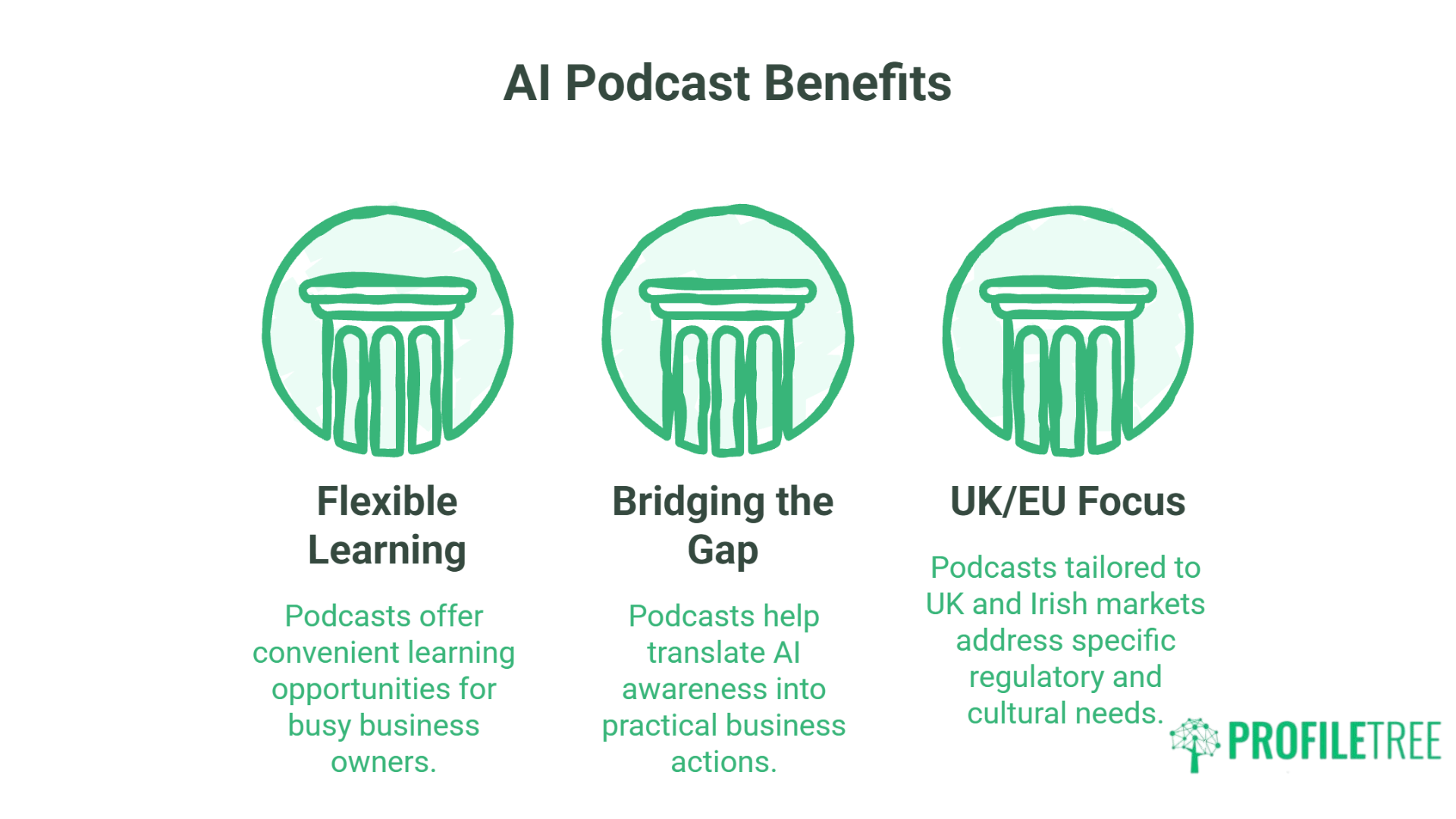
Most business owners are not sitting at a desk with two hours free to read a technical report. Podcasts solve this by converting commute time, gym time, or the hour between meetings into productive learning. The best AI business podcasts are designed to be followed without prior technical knowledge, and the better ones make a point of translating concepts into operational terms: what does this mean for your marketing budget, your customer service team, or your website?
The Gap Between Awareness and Action
There is a meaningful difference between knowing that AI exists and knowing what to do with it on Monday morning. The podcasts that are worth following in a business context are those that close that gap. They do not just describe what AI can do in abstract terms; they work through the practical mechanics of adoption, the common points of failure, and the questions you should be asking before committing resources.
What UK Business Owners Need That US Podcasts Miss
The majority of popular AI podcasts are produced in the United States, which creates a genuine information gap for UK and Irish listeners. Data protection law is different here. The regulatory direction set by the UK AI Safety Institute and the EU AI Act creates compliance considerations that most US-produced content simply does not address. When a podcast recommends a particular AI tool or workflow, it is worth noting whether the advice has been filtered through a UK or European lens, or whether it assumes an American legal and market context.
AI Podcasts for Strategic Business Leadership
For Founders and Directors Getting Started
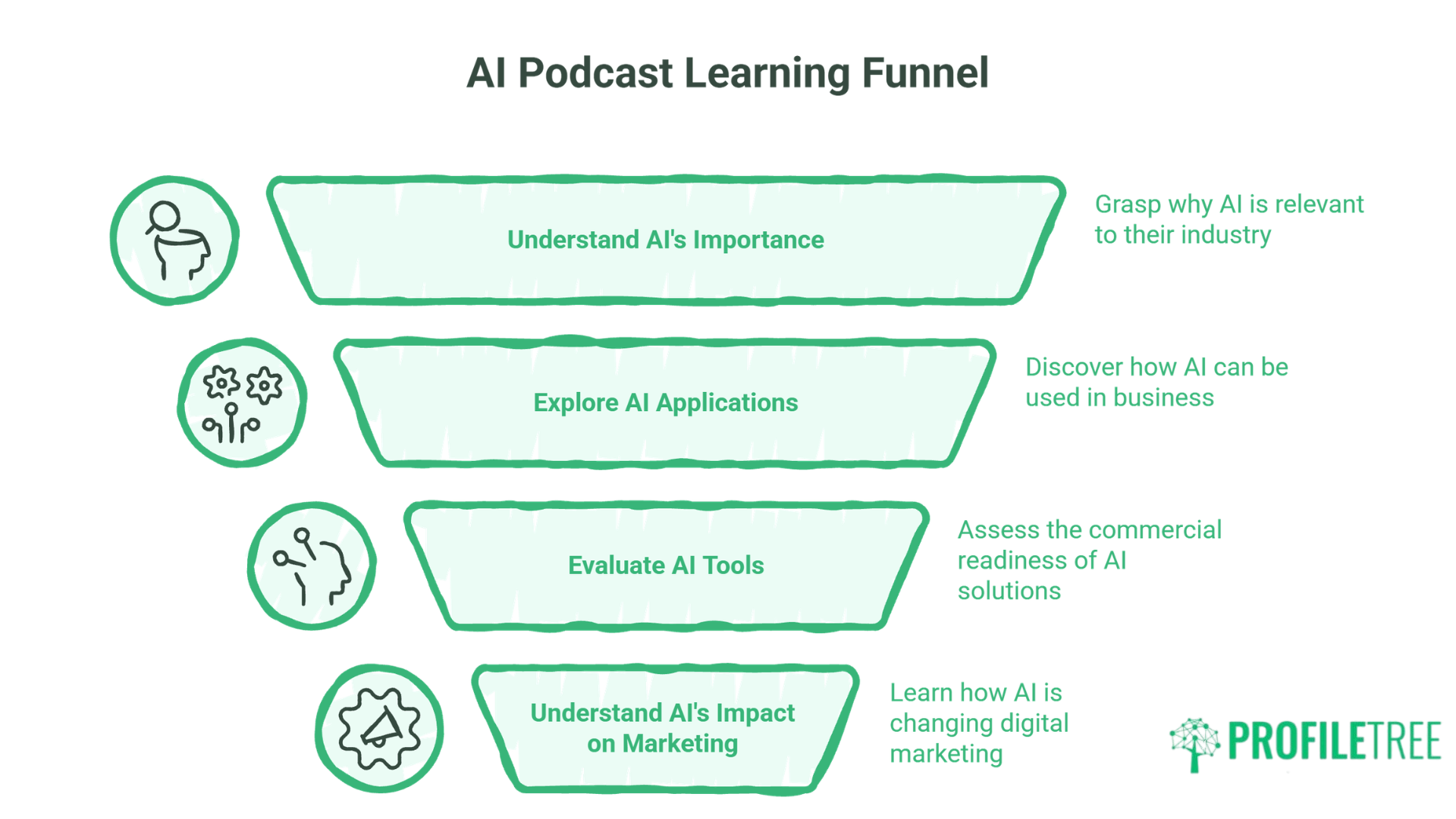
Business owners who are new to the topic need podcasts that explain why AI matters for their specific industry before moving on to how. The best entry-level options do not assume any prior knowledge, treat business outcomes as the primary frame of reference, and cover subjects like pricing models, integration timescales, and the human factors involved in rolling out new technology.
Practical AI (hosted by Daniel Whitenack and Chris Benson) is consistently useful for this audience. Episodes are structured around applying AI in real business contexts, and the hosts are disciplined about distinguishing between what is commercially ready and what remains experimental. For a business owner deciding whether to invest in an AI tool or workflow, the framing is more relevant than most.
The AI in Business Podcast (hosted by Daniel Faggella) focuses heavily on sector-specific adoption and is one of the few regularly updated shows that treats enterprise ROI and SME adoption as separate questions rather than collapsing them together.
For Marketing and Content Teams
AI is changing content production, search behaviour, and the mechanics of digital marketing faster than most agencies or in-house teams can track. Podcasts that address this directly are useful for marketing managers and content leads who need to understand what is changing in SEO, paid media, and content strategy before those changes show up in their performance data.
“AI is affecting how search works at a fundamental level,” says Ciaran Connolly, founder of ProfileTree. “Business owners who understand this early are in a much stronger position to brief their digital marketing teams and ask the right questions of their agency partners.”
ProfileTree’s work supporting SMEs across Northern Ireland and the UK with AI implementation and digital transformation regularly begins with exactly this kind of knowledge gap: business owners who have heard a great deal about AI but lack a structured way to evaluate what applies to their situation.
AI Podcasts for UK SME Operators
Podcasts That Acknowledge UK and EU Regulatory Context
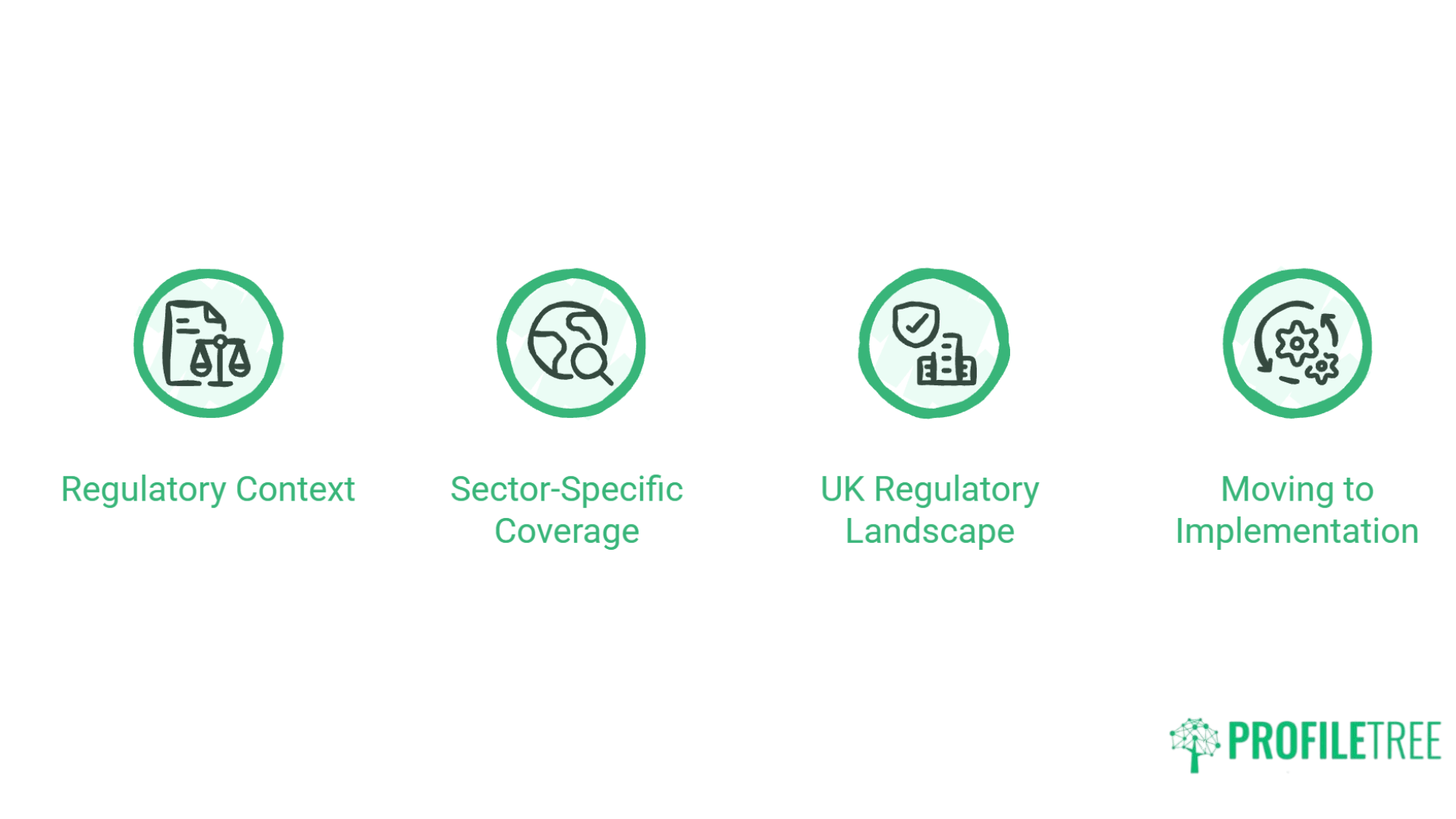
This is the most underserved category in AI podcast content. Business owners operating under UK GDPR, processing customer data, or considering AI tools that interact with personal data need to understand not just what a tool does but whether it can be used lawfully in a UK or EU context.
The AI Safety Podcast (80,000 Hours) addresses governance, safety, and the policy dimensions of AI deployment. It is more technical than most business podcasts, but it is worth periodic listening for any business owner who wants to understand the direction of travel in AI regulation rather than be caught out by it.
For sector-specific coverage relevant to UK business conditions, The Diary of a CEO (produced in the UK) and TWIML AI Podcast both cover AI adoption stories that translate more directly to a European business environment than most US alternatives.
The UK Regulatory Landscape in Brief
Business owners adopting AI tools in the UK are currently operating in a period of regulatory transition. The UK government’s AI Safety Institute has set a direction that prioritises innovation alongside governance, but specific sectoral rules (particularly in financial services, healthcare, and recruitment) are already in effect. Any AI tool that makes or supports decisions about customers, employees, or suppliers may fall within the scope of existing UK GDPR obligations, regardless of where the tool is hosted.
This does not mean avoiding AI tools. It means understanding the data flows involved and ensuring that the tools you adopt have clear data processing agreements and, where relevant, do not transfer personal data to jurisdictions without adequate protection. The cost-benefit analysis of AI implementation for SMEs is a starting point for thinking through these considerations in practical business terms.
Moving from Listening to Implementation
There is a pattern ProfileTree has observed across many SME engagements: business owners who have spent time with AI podcasts often arrive with a clear sense of what AI can do in principle, but struggle to translate that into a prioritised action list for their specific business. The gap is not knowledge; it is a structured process for auditing current operations, identifying the highest-value AI applications, and building the internal capability to adopt them without disrupting what already works.
A three-stage framework that works in practice is: Listen, Audit, Pilot. Spend time across a range of podcasts to build your vocabulary and awareness. Then carry out a structured audit of where your business currently spends time on repetitive or data-heavy tasks. Finally, run a small, low-risk pilot on the single highest-value application before committing to broader rollout. ProfileTree’s AI transformation work with UK and Irish SMEs follows exactly this pattern, and the challenges businesses face in AI adoption are well-documented enough that a structured approach makes a substantial difference to outcomes.
Matching Podcasts to Your Role and Stage
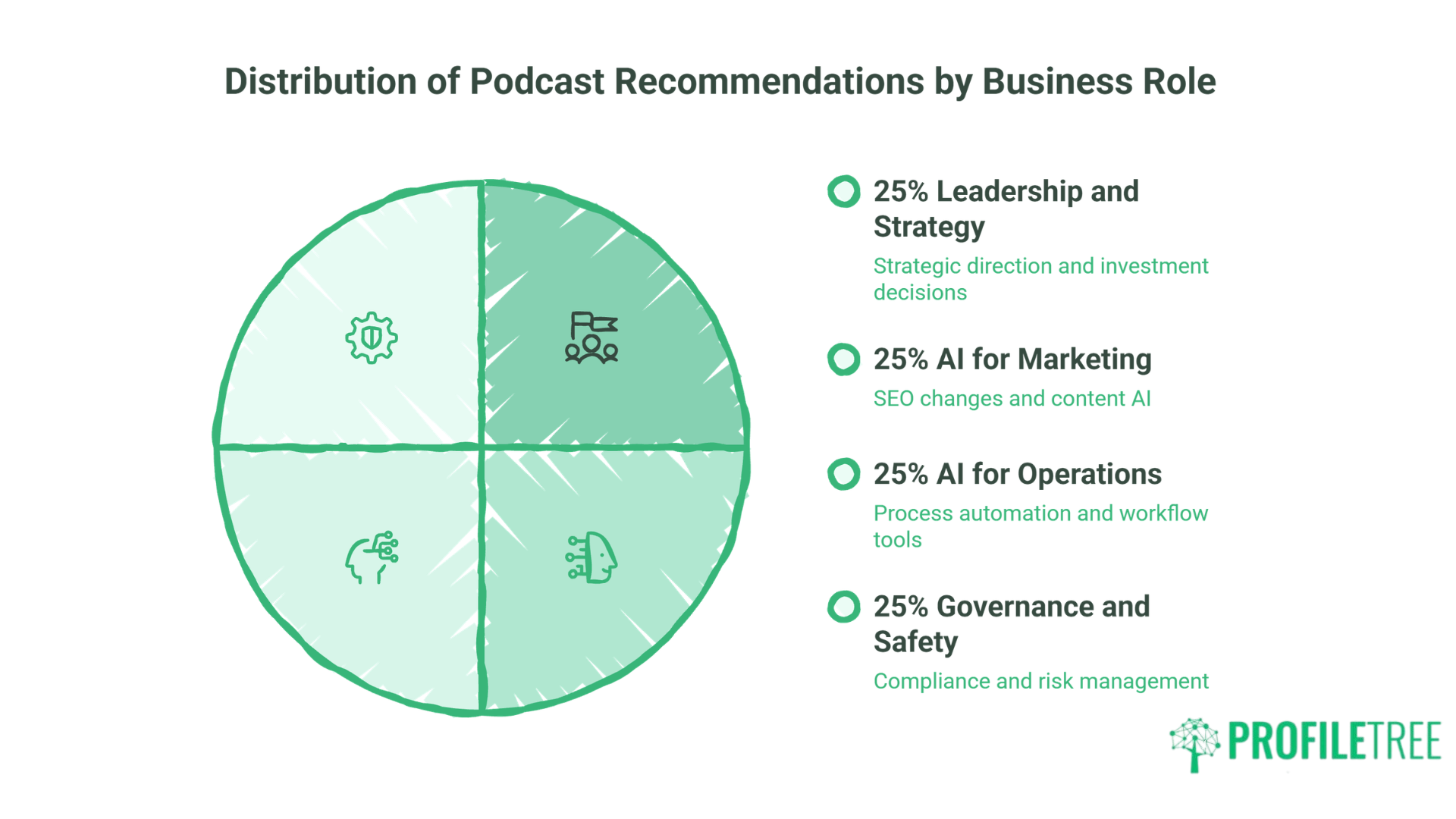
Different roles within a business need different things from AI content. The table below maps common business functions to the podcast category most likely to be immediately useful.
| Your Role | What You Need | Recommended Category |
|---|---|---|
| Founder / MD | Strategic direction, investment decisions | Leadership and strategy podcasts |
| Marketing Manager | SEO changes, content AI, paid media shifts | AI for marketing podcasts |
| Operations Lead | Process automation, workflow tools | AI for operations podcasts |
| Finance / HR | Compliance, risk, people-facing AI | Governance and safety podcasts |
The TWIML AI Podcast remains one of the most substantive general-audience series for anyone who wants to go deeper on specific topics. Episodes run to around 45 minutes and cover both technical and applied subjects, with guests from research, enterprise, and start-up contexts.
For marketing and content professionals specifically, Marketing Against the Grain (Kipp Bodnar and Kieran Flanagan) has become a reliable reference for the practical implications of AI on digital marketing strategy, with episodes that address search behaviour changes, content production at scale, and the shifting role of brand in an AI-mediated search environment.
From Podcasts to Practical AI Skills
Why Structured Training Adds What Podcasts Cannot
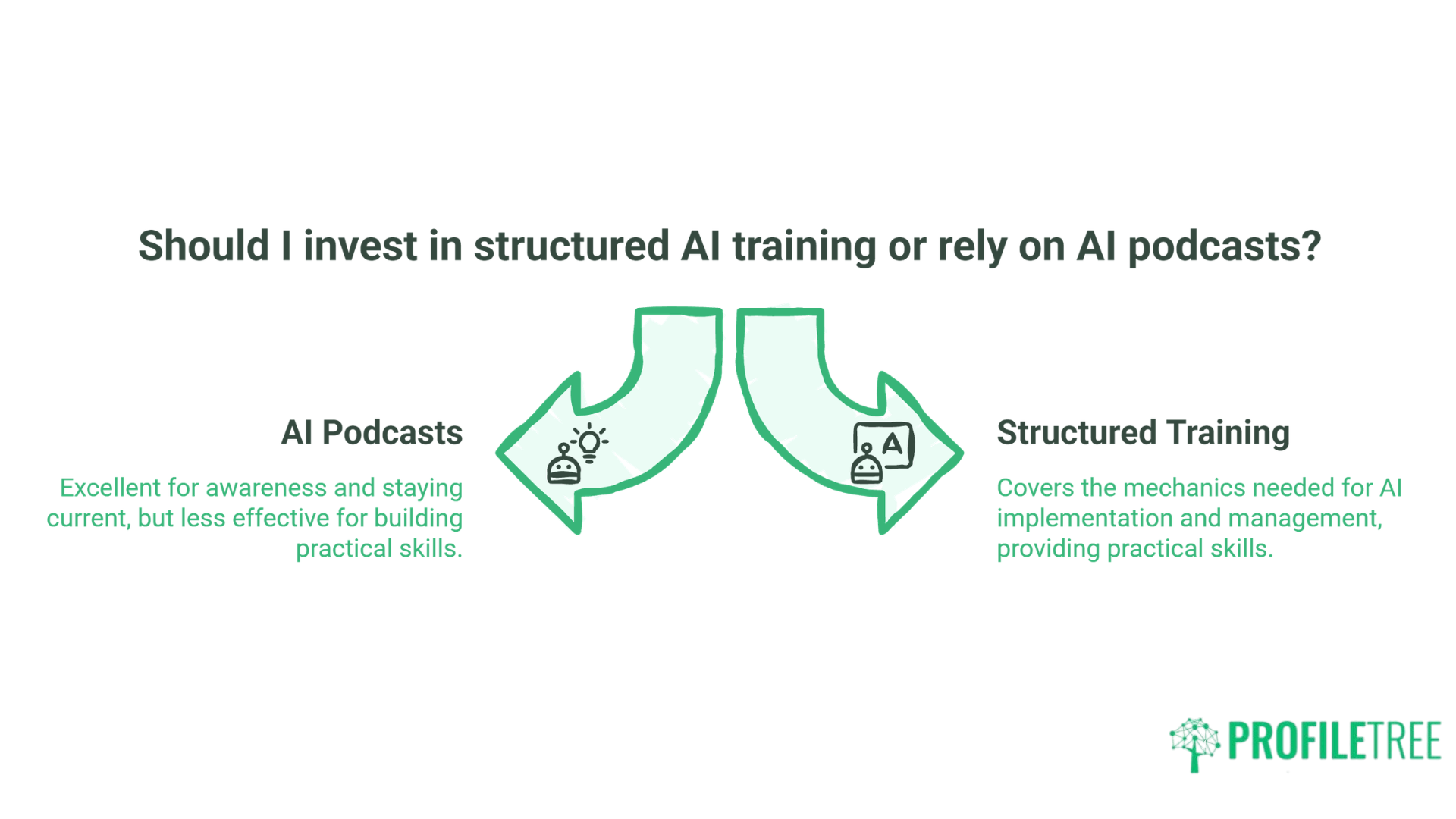
Podcasts are excellent for building awareness and staying current. They are less effective at building the specific, applied skills that let a team actually implement and manage AI tools. The distinction matters because business owners sometimes confuse the two: a team that listens to AI podcasts is not the same as a team that knows how to evaluate an AI tool, build a prompt library, interpret AI outputs critically, or audit an AI-generated piece of content before it is published.
Structured training covers the mechanics that podcasts tend to skip: how to write effective prompts for a given task, how to configure a tool for a specific workflow, how to build internal governance around AI use, and how to measure whether an AI adoption is actually delivering value. ProfileTree’s digital training programmes are designed specifically for SMEs in Northern Ireland, Ireland, and the UK, with the practical emphasis that podcast content rarely provides.
AI and Your Digital Marketing
One area where podcasts consistently create awareness but rarely provide actionable guidance is the intersection of AI and SEO. Search behaviour is shifting, and the way Google and other search engines surface content is changing as a direct result of AI. Business owners who understand this shift can make better decisions about their content strategy, their website structure, and how they brief their SEO agency or in-house team.
The effectiveness of AI training programmes for business teams is something ProfileTree has examined directly, and the pattern is clear: teams that combine structured learning with practical experimentation outperform those who rely on either alone.
Video as a Complementary Learning Format
Podcasts work well for audio learners and commuters, but video adds a dimension that audio cannot: the ability to show processes, interfaces, and outputs rather than describing them. ProfileTree’s digital training content covers AI implementation in a format that business owners can apply directly, including how AI tools integrate with existing websites and marketing infrastructure.
Watch ProfileTree’s digital training overview.
AI Implementation: The Step After the Podcast
Business owners who have built their AI awareness through podcasts and are ready to move toward implementation face a different set of questions. Which tools are appropriate for your business size and sector? What does integration with your existing website and CRM look like? Who in the team needs to be trained, and to what level? What does success look like in the first 90 days?
These are not questions that any podcast answers in a way that is specific enough to be useful. They require a structured assessment of your current digital infrastructure, your data and content assets, and the workflows where AI is most likely to deliver a return.
ProfileTree works with SMEs across Northern Ireland, Ireland, and the UK on exactly this transition, from initial AI readiness audits through to implementation support and team training. The AI adoption rates among UK SMEs indicate that the gap between awareness and action is still significant, and the businesses closing that gap earliest are those approaching it with a structured process rather than ad hoc tool adoption.
FAQs
What is the best AI podcast for business owners who are completely new to AI?
Practical AI is the most consistently accessible entry point for non-technical business owners. It focuses on applied use cases rather than theoretical concepts, and episodes are structured around the question of what AI means for real business operations. The TWIML AI Podcast is a useful step up once you have a basic working vocabulary.
Are these AI podcasts relevant for UK businesses, or are they mostly American?
Most of the leading AI podcasts are produced in the United States, which means the regulatory context, market conditions, and legal frameworks discussed often do not map directly to the UK or Ireland. UK business owners should apply UK GDPR and sector-specific compliance requirements as a filter before adopting any AI workflow that processes customer or employee data.
How can business owners use AI effectively after listening to podcasts?
The most effective pattern is to treat podcast listening as the awareness stage of a structured process. Use it to build vocabulary, identify the AI applications relevant to your sector, and understand the general direction of the technology. Follow this with a structured audit of your current operations to identify where AI could save time or improve output quality. Then run a small pilot on a single application before committing to wider adoption. This Listen, Audit, Pilot approach produces better outcomes than adopting tools reactively based on individual podcast recommendations.
How often should I listen to stay current with AI?
One focused episode per week is enough to stay meaningfully current without creating information overload. The more useful habit is to follow up on episodes that cover your specific business area, rather than trying to consume everything. AI is developing quickly, but the principles relevant to SME adoption are more stable than the news cycle suggests.
Which AI podcasts focus on AI ethics and compliance for small businesses?
The AI Safety Podcast (80,000 Hours) covers governance and policy in depth. For the UK-specific regulatory context, the UK government’s AI Safety Institute publishes guidance that supplements podcast content with the actual policy direction. Business owners in regulated sectors should treat this guidance as required reading alongside any podcast series they follow.
Do I need technical knowledge to benefit from AI business podcasts?
No. The podcasts listed in this guide are selected specifically because they do not require prior technical knowledge. The value for most business owners is not in understanding how AI systems work at a technical level but in understanding what they can do, where they are genuinely ready to use, and how to evaluate vendor claims critically.
Understanding AI through podcasts is a reasonable starting point. Acting on that understanding is where real competitive advantage comes from. For SMEs in Northern Ireland, Ireland, and the UK ready to move from awareness to implementation, ProfileTree’s AI transformation and digital training services provide the structured path that podcast content alone cannot.