
Nintendo Marketing Strategy: What SMEs Can Learn From It
Table of Contents
Nintendo has been selling the same core idea for over 40 years: play, not power. While Sony and Microsoft compete on processor specs and graphical fidelity, Nintendo competes on something harder to replicate: the emotional connection between a player and a character they first met as a child. That is the foundation of the Nintendo marketing strategy, and it is one of the most instructive case studies in modern brand-building.
For business owners and marketing managers in the UK and Ireland, there is more to learn here than nostalgia. Nintendo’s approach to audience segmentation, direct-to-consumer communication, cross-media storytelling, and pricing discipline aligns closely with the decisions any SME must make. This article breaks down how the Nintendo marketing strategy works, why it works, and what you can take from it.
The Core Positioning: Blue Ocean Strategy
Nintendo has consistently refused to compete on the same terms as its rivals. Where PlayStation and Xbox battle over hardware performance, Nintendo targets audiences that those platforms largely ignore: families, young children, casual players, and adults who grew up with Mario and want to share that experience with their own children.
This is a textbook example of Blue Ocean Strategy, the approach developed by W. Chan Kim and Renée Mauborgne that describes creating uncontested market space rather than fighting in an overcrowded one. Nintendo does not try to win the hardware power race. It sidesteps it entirely and, in doing so, sets its own terms for pricing, product design, and brand positioning.
What This Means for Your Business
The principle applies beyond gaming. Many SMEs in Northern Ireland and the UK default to competing on price or matching the feature set of larger rivals. Finding the audience that rivals overlook, then building deliberately for it, is where digital strategy support earns its keep, because that profiling work needs real audience research and a clear positioning brief rather than a hunch about who might buy.
The hard part is not identifying an underserved audience. It is holding your nerve when a larger competitor launches something flashier, and the temptation to match them feels overwhelming. Nintendo has faced that pressure through five console generations and has yet to blink.
Nintendo’s Marketing Mix: The 4Ps
Understanding the 4Ps of Nintendo’s marketing mix shows how tightly each element connects to the brand’s overall positioning. Each of the four decisions reinforces the others, which is why the strategy has survived hardware failures like the Wii U without the brand itself losing ground.
Product: IP as the Core Asset
Nintendo’s products are not really consoles. They are delivery vehicles for intellectual property. Mario, Zelda, Pokémon, and Donkey Kong are the products. The hardware is what you buy to access them.
The Switch 2 launch bears this out. Nintendo’s own quarterly reporting put the console at 3.5 million units in its first four days on sale in June 2025, and cumulative shipments reached 23.68 million by 30 June 2026, alongside 58.17 million units of Switch 2 software. Mario Kart World accounted for 14.70 million of that software total on its own by the end of March 2026. The hardware is sold because of what runs on it.
For an SME, the equivalent question is: what is your actual product? If your web design agency’s real product is peace of mind for a business owner who has never built a site before, every element of your marketing should be built around that, not around technical specifications.
Price: Maintaining Value Through Discipline
Nintendo holds its prices in a way that most consumer electronics brands do not. A first-party Nintendo title typically retails at full price years after launch. Mario Kart 8 Deluxe, released in 2017, had passed 71 million units by March 2026 while still selling close to its original price point.
Nintendo went further in 2026. Rather than discounting the Switch 2 to sustain momentum, it raised the Japanese price from ¥49,980 to ¥59,980 in May, a rise of roughly 20%. Sales held. That is the clearest demonstration available of what pricing confidence looks like when a brand genuinely believes its IP carries the value.
Discounting signals that a product’s perceived value was inflated. For service businesses, the same principle holds: frequent promotions train the market to wait for a lower price rather than paying a price that reflects your actual value.
Place: Distribution Across the UK and Ireland
Nintendo’s distribution across the UK and Ireland includes major retailers such as GAME and Smyths Toys, supermarkets, and its own digital storefront through the eShop. The mix is deliberate. Physical retail provides discovery and trial opportunities, while the eShop enables convenient purchases and builds a direct customer relationship unmediated by a retailer.
For service businesses, the equivalent is having both a strong organic search presence and direct audience channels: a newsletter, a YouTube channel, or a LinkedIn following, so you are not entirely dependent on any single platform for new enquiries.
Promotion: The Nintendo Direct Model
Nintendo replaced traditional press conference marketing with Nintendo Directs: pre-produced video presentations broadcast directly to consumers on YouTube and the Nintendo website. No journalists, no live event logistics, no editorial filter between the announcement and the audience.
A Nintendo Direct drops on a Tuesday morning and generates millions of views within hours, almost entirely through organic sharing. The content is produced to a high standard, timed carefully, and structured around genuine audience interest rather than advertiser formats.
This is a direct-to-consumer content model that any business can adapt. A professional YouTube series, a regular email update, or a well-produced explainer video creates the same unmediated relationship between a brand and its audience. ProfileTree’s video marketing team works with businesses across the UK and Ireland that want to build an owned media presence rather than rely entirely on paid advertising.
Nintendo’s Target Audience and Market Segmentation
Nintendo’s market segmentation is one of the most studied in the industry because it successfully reaches four distinct audiences without alienating any of them.
| Segment | Profile | Key Product Hook |
|---|---|---|
| Children (5–12) | Primary audience for Pokémon, Kirby, and Super Mario | Accessible gameplay, bright visuals, lower difficulty ceiling |
| Family households | Parents buying for shared use | Multiplayer titles, Switch’s living room flexibility |
| Casual adults | Infrequent players seeking low-commitment entertainment | Animal Crossing, Ring Fit Adventure |
| Nostalgic adults (25–45) | Grew up with Nintendo, repurchasing for themselves or their children | Mario, Zelda, Metroid, Donkey Kong |
The insight here is that Nintendo does not try to reach all four with the same message. Product releases, advertising campaigns, and social content are each calibrated to specific segments. The Switch’s launch advertising showed young adults playing on public transport and at social gatherings: a deliberate signal to the nostalgic adult segment that this was not just a children’s toy.
Nintendo’s target audience strategy succeeds because the segmentation is based on behaviour and emotional relationship with the brand, not just demographics. Age brackets alone would have produced a blander, less effective result.
For businesses setting their own segmentation, the process of identifying which group to prioritise, and what that group actually needs, is often where campaigns fall flat. Getting the segment definition right before producing any content is the more reliable sequence.
Brand Storytelling and the Role of Nostalgia
Nintendo’s characters are not conventional mascots. They are narrative assets with decades of emotional resonance. Mario has appeared in over 200 titles. Link has been on a quest since 1986. These are not just recognisable images; they are characters with genuine personal histories.
The marketing implication is that Nintendo does not need to explain why a new Mario game is worth buying. The brand does that work. A new entry into an established franchise inherits an audience and a pre-built emotional brief that no amount of paid advertising could manufacture from scratch.
For SMEs, the equivalent is brand consistency over time. A business that has maintained a clear identity, a recognisable voice, and a coherent set of values for ten or fifteen years starts to accumulate the same kind of goodwill. Brand storytelling examples from businesses across different sectors show how this compounds, and how it collapses when a brand tries to be something different every year.
Consistency in brand voice is something many growing businesses underinvest in, treating it as a cosmetic concern rather than a long-term commercial asset. Established content marketing services tend to start here, fixing a business’s editorial identity before producing any articles, videos, or social content, because building something coherent from the outset is far cheaper than retroactively repairing years of inconsistency.
The Nintendo Flywheel: Transmedia Marketing
Nintendo’s most significant recent strategic development is the construction of what can reasonably be called a marketing flywheel: a self-reinforcing system where each element of the brand amplifies the others.
Film, Theme Parks, and Hardware Sales
The Super Mario Bros. Movie (2023) took $1.36 billion worldwide and remains the highest-grossing video game film adaptation. Its sequel, The Super Mario Galaxy Movie, opened in April 2026 and passed $1 billion in its tenth weekend, making it the first release of 2026 to reach that mark and the highest-grossing film of the year. Across two films, the Mario franchise has now cleared $2 billion in global ticket sales.
The theme park side runs on the same logic. Super Nintendo World opened in Osaka in 2021, Hollywood in 2023, and at Universal’s Epic Universe in Orlando in May 2025, reaching audiences who have never held a Nintendo console. Each new game release then re-engages people who first met the characters through a film or a park.
Each element feeds the next. The film creates new Nintendo fans. The theme parks keep that audience engaged outside the home. The games and hardware convert that engagement into revenue. The characters then get a new film adaptation, and the cycle continues.
Applying the Flywheel to an SME Content Strategy
The flywheel principle is scalable well below Nintendo’s budget. A well-produced YouTube series generates organic search traffic, builds audience trust, and drives enquiries. A newsletter converts that audience into a direct channel. Case studies and reviews then feed back into search rankings and social proof. The compounding effect over 12 to 24 months is substantially greater than any single campaign.
ProfileTree’s work on YouTube channel development, video production, and content strategy for clients across Northern Ireland is built around this same logic. The marketing campaigns that went wrong piece on this site illustrates, by contrast, what happens when brands invest in one-off campaigns without the underlying flywheel to sustain momentum.
Nintendo’s Digital Marketing: Social Media and Creator Partnerships
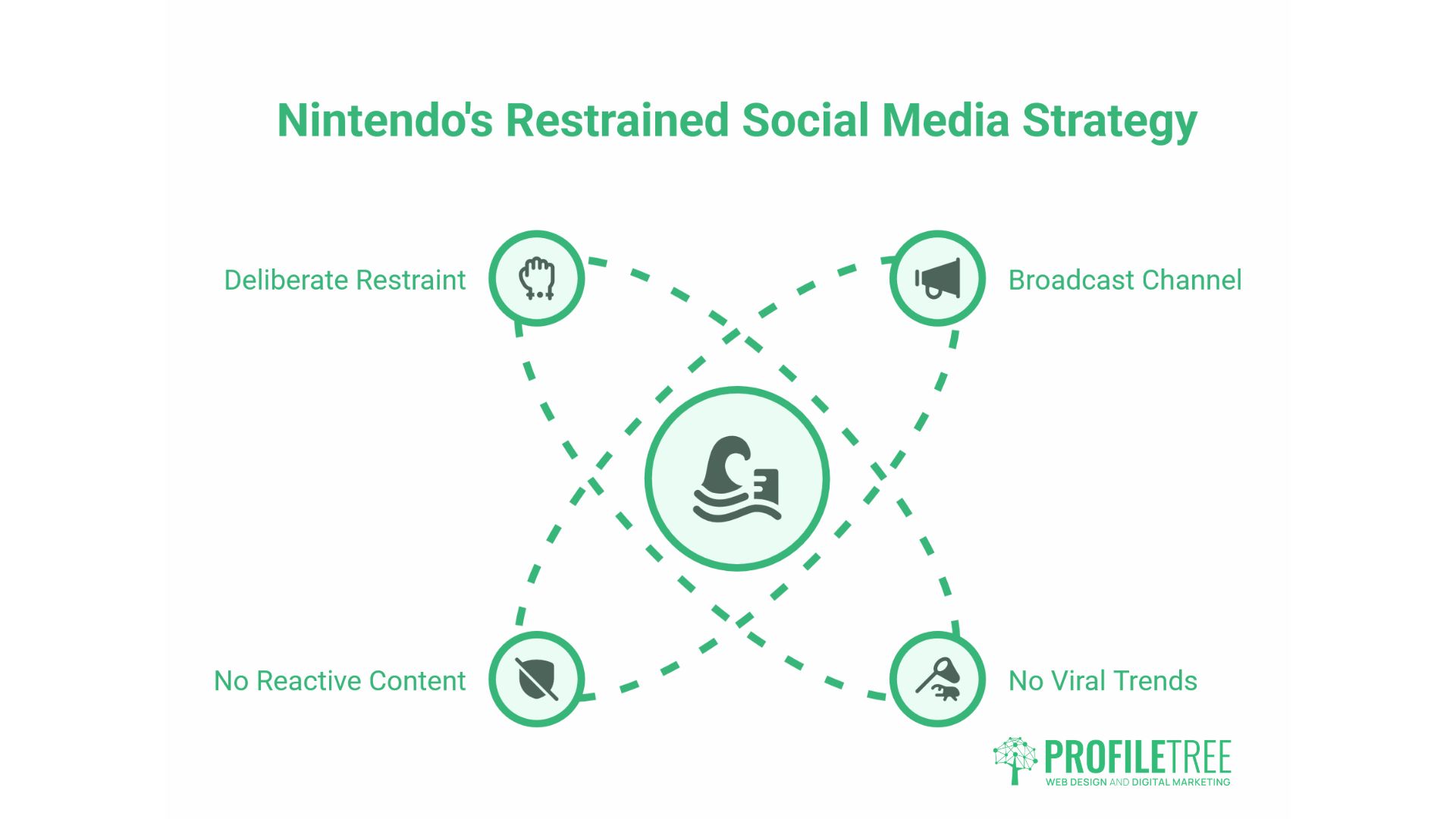
Nintendo’s social media approach is deliberately restrained compared to most consumer brands of its size. Its X (formerly Twitter) and Instagram accounts primarily serve as broadcast channels for announcements, trailers, and game updates. The company does not chase viral trends or engage in reactive social content.
The exception is YouTube, where Nintendo’s channel is one of the most-subscribed in the gaming category. Nintendo Direct videos, game trailers, and Nintendo Treehouse live streams function as long-form content marketing: building excitement, demonstrating gameplay, and converting audience intent into purchasing decisions.
Influencer and Creator Partnerships
Nintendo works with gaming content creators on YouTube and Twitch to reach audiences its own channels cannot fully cover. Creator partnerships are selected for audience alignment rather than pure follower count: a creator whose audience overlaps with the nostalgic adult segment delivers more value to Nintendo than a general entertainment influencer with twice the subscribers.
This reflects a broader shift in digital marketing that also applies to SMEs. Micro-influencers and specialist content creators in Northern Ireland and the UK often have smaller but more engaged audiences than mainstream social media personalities. Understanding the process of social influence is something businesses frequently underestimate when building out a content programme.
Nintendo’s UK and Ireland Market Presence
Nintendo has a well-established presence in UK retail. GAME stores prominently stock Nintendo hardware and first-party titles. Smyths Toys, which has a significant retail footprint across Ireland and the UK, is a key distribution partner for the family segment. UK gaming events, including EGX and Insomnia, have historically featured Nintendo activations, giving the brand a community presence beyond purely commercial retail.
The UK market also represents a different cultural context from Japan and North America, where Nintendo’s brand heritage is strongest. UK marketing for Nintendo tends to emphasise the social and family play aspects of the Switch over the portable, individual gaming angle that features more prominently in Japanese advertising. That kind of localisation, adapting the core message to the specific audience context rather than running identical global campaigns, is worth noting for any SME operating across multiple regions or serving both Northern Ireland and the Republic of Ireland audiences at once.
Nintendo SWOT Analysis
A current assessment of Nintendo’s strategic position as of 2026, roughly a year into the Switch 2 hardware cycle.
| Strengths | Weaknesses | |
|---|---|---|
| Internal | Unrivalled IP portfolio; hardware and software integration; multi-generational brand loyalty; strong first-party studio output; proven transmedia execution across film and parks | Heavy reliance on first-party IP; limited third-party AAA support compared to PlayStation and Xbox; online services perceived as inferior to competitors |
| External | Opportunities | Threats |
| Switch 2 installed base still building toward the original Switch’s 156 million; further film and park expansion; growth of mobile gaming audiences; AI-assisted game development | Slowing quarterly hardware momentum after the launch year; price rises testing consumer tolerance; mobile gaming cannibalising the casual player base; rising development costs; currency exposure from Japan-based operations |
The hardware transition risk warrants specific note. Every Nintendo hardware generation faces the challenge of convincing an existing installed base to upgrade while attracting new users. Nintendo’s marketing for the Switch 2 transition focused on backward compatibility and exclusive launch titles: a strategy that manages existing customer relationships while creating new purchase reasons. Quarterly shipments have since eased from their launch-year peak, which is the normal pattern and the point at which most brands reach for discounts. Nintendo raised prices instead.
What SMEs Can Take From the Nintendo Marketing Strategy
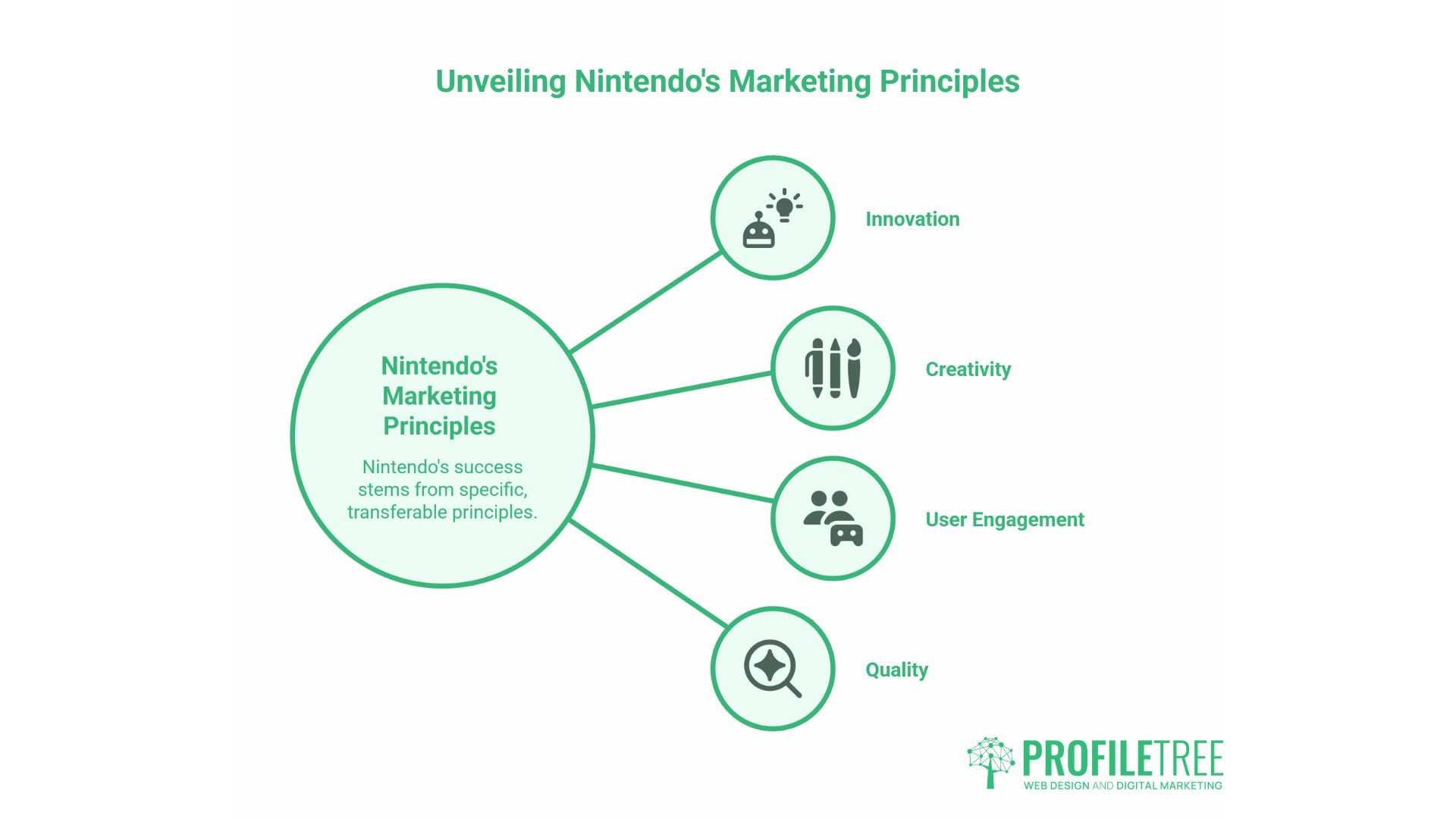
Rather than a general summary, here are the specific, transferable principles from Nintendo’s approach.
Own your audience directly. Nintendo Directs bypass editorial gatekeepers entirely. The equivalent for a service business is a YouTube channel, newsletter, or podcast that speaks to your audience without a platform algorithm in the middle.
Segment by behaviour, not just demographics. Nintendo does not market to “25 to 35 year olds.” It markets to people with a specific emotional relationship with its characters. Behavioural segmentation produces better-targeted content than age brackets alone.
Protect brand equity through pricing discipline. If your service is worth £3,000, discounting it to fill a quiet month trains the market to wait rather than buy at full price. Nintendo’s 2026 price rise, taken while quarterly hardware sales were cooling, is the opposite move to the one most businesses make under pressure.
Build a content flywheel, not one-off campaigns. Single campaigns produce short-term results. A YouTube series, supported by articles and social content, compounds over time.
Localise your message. Nintendo’s UK advertising differs from its Japanese advertising because the audiences differ. A business serving Belfast, Dublin, and London should be saying meaningfully different things in each context.
Ciaran Connolly, founder of ProfileTree, notes: “The businesses we see building the most durable online presence are the ones treating content as infrastructure, not as a campaign. Nintendo has been doing that with its IP for decades. The principle is exactly the same for an SME: build something consistent, own the audience directly, and the compounding effect takes over.”
The Bottom Line for UK and Irish SMEs
Nintendo’s longevity is not an accident of nostalgia. It is the result of consistent positioning, disciplined pricing, direct audience ownership, and a willingness to target the people that competitors ignore. The Nintendo marketing strategy works because every element of it serves the same idea: to engage the audience rather than interrupt them.
The 2026 numbers make the case more plainly than any framework could. A console a year into its cycle, a film franchise past $2 billion, and a price rise that held. None of that came from a clever campaign. It came from forty years of the same decisions, repeated. For SMEs in Northern Ireland, Ireland, and the UK, the principles are directly applicable regardless of sector or budget. Get in touch with the team to start the conversation.
FAQs
What is Nintendo’s primary marketing strategy?
Nintendo uses an IP-first, Blue Ocean approach: rather than competing with Sony and Microsoft on hardware power, it targets underserved audiences (families, casual players, nostalgic adults) and reaches them directly through Nintendo Directs and YouTube, bypassing traditional media.
Who is Nintendo’s target audience?
Nintendo targets four segments: children aged 5 to 12, family households, casual adult players, and nostalgic adults aged roughly 25 to 45, each addressed with distinct messaging through the same core product range.
What is Nintendo’s Blue Ocean Strategy?
Nintendo avoids the hardware power race entirely, instead targeting consumer needs (accessible gameplay, family sharing, portability) that PlayStation and Xbox deprioritise, leaving it to compete on its own terms with far less direct rivalry.
What are the 4Ps of Nintendo’s marketing mix?
Product (IP as the core asset, hardware as the delivery mechanism), Price (full-price discipline with minimal discounting), Place (UK retail via GAME and Smyths Toys plus the eShop), and Promotion (Nintendo Directs, YouTube, creator partnerships, and transmedia campaigns).
How well has the Nintendo Switch 2 sold?
Nintendo shipped 3.5 million Switch 2 units in the first four days after the June 2025 launch, its biggest hardware launch on record. Cumulative shipments reached 23.68 million by 30 June 2026, with 58.17 million units of Switch 2 software sold over the same period. Nintendo has guided for 16.5 million further console shipments in the financial year ending March 2027.
Why does Nintendo rarely discount its games?
Nintendo treats its intellectual property as an asset and the hardware as the delivery mechanism, so discounting a first-party title would undermine the perceived value of the franchise itself. Mario Kart 8 Deluxe, released in 2017, had passed 71 million units by March 2026 while holding close to its launch price. In 2026, Nintendo raised the Japanese Switch 2 price by roughly 20% rather than cutting it to sustain momentum, which is the clearest signal available of how the company views its own pricing power.