
Impressions vs Clicks: How to Analyse Digital Ad Metrics for Better ROI
Table of Contents
Every time a business owner looks at their advertising dashboard, two numbers tend to dominate the conversation: impressions and clicks. Both matter. Neither tells the full story on its own. Understanding what each metric actually measures, how they relate to each other, and what they mean for your return on investment is one of the most practical skills any marketing decision-maker can develop.
This guide covers the difference between impressions and clicks, how to calculate and interpret click-through rate, what the path from a click to a conversion actually looks like, and how to use this data to make smarter decisions about your digital advertising. Whether you manage your own campaigns or work with an agency, getting this foundation right will sharpen every marketing decision you make.
If your business is investing in digital marketing services but not systematically tracking these core metrics, you are likely spending more than you need to for the results you are getting.
What Impressions and Clicks Actually Measure
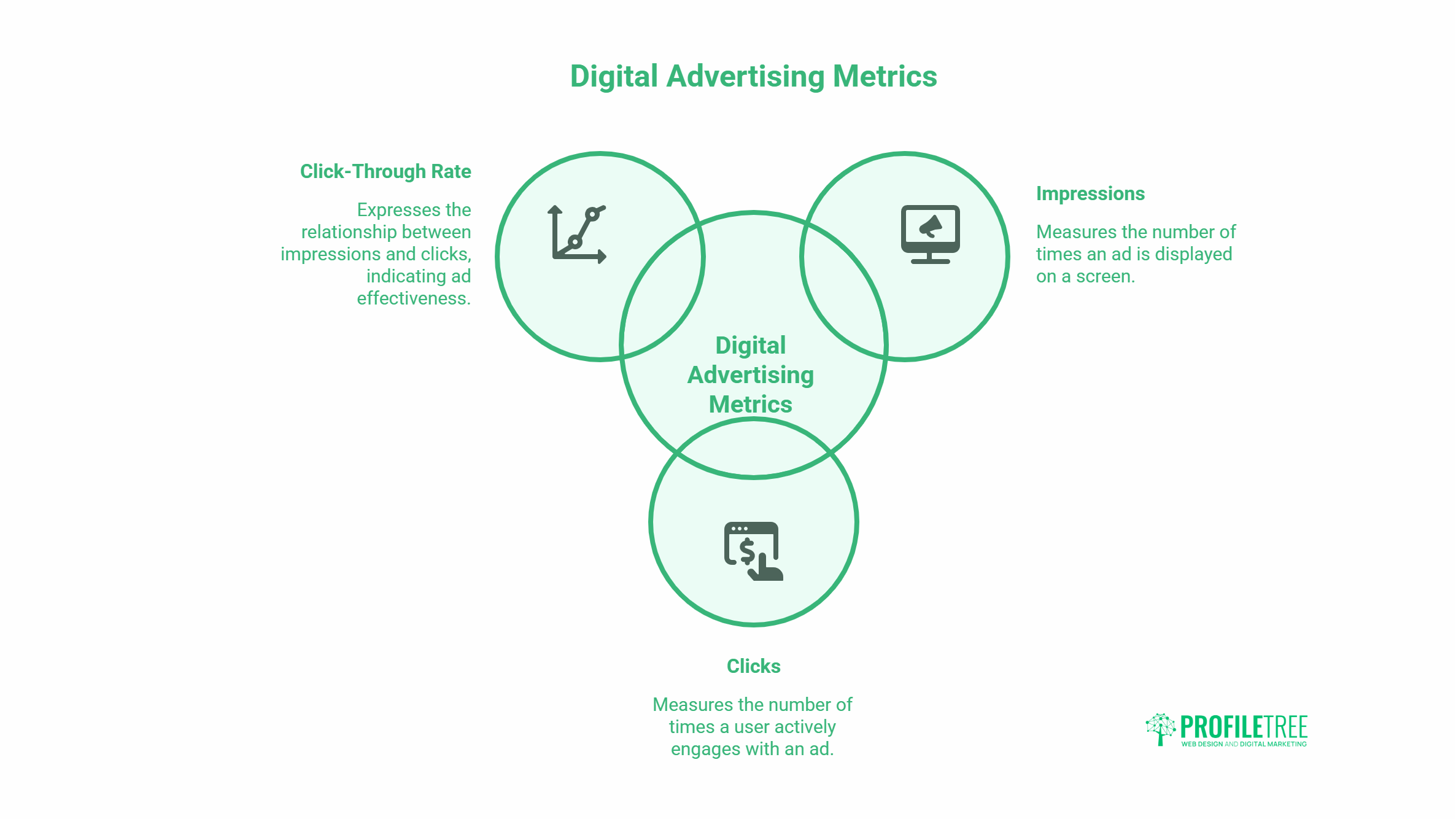
Impressions and clicks are the two most fundamental metrics in digital advertising, but they measure entirely different things. Confusing them, or treating one as a proxy for the other, leads to poor decisions about budget allocation, creative testing, and campaign strategy.
Defining an Impression
An impression is recorded every time your ad or piece of content is displayed on a screen, regardless of whether the person viewing it takes any action. It is a measure of reach: how many times your message appeared in front of a potential audience. High impression counts are generally positive for brand awareness campaigns, where the goal is visibility rather than immediate action.
Not all impressions are equal. A viewable impression, as defined by the Media Rating Council, requires at least 50% of the ad to be visible on screen for a minimum of one second. An ad that loads at the bottom of a page but is never scrolled to may count as an impression on some platforms without meeting the viewable standard. Knowing which type your platform reports is important when comparing performance across channels.
Defining a Click
A click is recorded when a user actively engages with your ad by selecting it and following the link. Where an impression measures passive exposure, a click measures active interest. It signals that your ad was not only seen but compelling enough to prompt someone to find out more.
Clicks are more directly tied to commercial outcomes than impressions. A campaign that generates thousands of impressions but very few clicks is reaching people without engaging them, which may point to a mismatch between the audience, the message, or the creative.
Why Both Metrics Matter Together
Looking at impressions or clicks in isolation gives you an incomplete picture. A high impression count with a very low click count tells you about reach but nothing about resonance. A high click count from a small impression pool may indicate strong relevance to a narrow audience. The relationship between the two is what matters most, and that relationship is expressed through click-through rate.
Click-Through Rate: Calculating and Interpreting It
Click-through rate connects impressions and clicks into a single, actionable figure. It is the metric most campaigns are optimised against in their early stages, and understanding what moves it up or down is central to improving paid advertising performance.
How CTR is Calculated
Click-through rate (CTR) is the percentage of impressions that result in a click. The calculation is straightforward:
CTR = (Clicks / Impressions) x 100
For example, if your ad received 150 clicks from 5,000 impressions, your CTR would be 3%. A higher CTR generally means your ad is resonating with the audience it is reaching. The message, visual, or offer is connecting well enough to prompt action.
What CTR Actually Tells You
A lower CTR can mean several things: the audience targeting is too broad, the creative is not relevant to what people are searching for, or the offer is not clear. Average CTRs vary significantly by industry and platform. Search ads typically see higher CTRs than display ads, because search targets users who are actively looking for something. Display advertising reaches users who may not be in an active buying mindset, so lower CTRs are expected and normal.
Benchmarking your CTR against your previous campaigns, rather than generic industry averages, is usually more useful. A consistent upward trend in CTR over time, even if you start below average, indicates that your targeting, messaging, and creative are improving.
The Limits of CTR as a Standalone Metric
CTR tells you whether people clicked. It does not tell you what happened next. A campaign with a high CTR and a poor conversion rate suggests the ad is promising something the landing page does not deliver. Analysing CTR alongside conversion rate, cost per click, and ultimately cost per lead or sale gives you a far more accurate view of campaign performance.
The Conversion Journey: From Click to Customer
A click is the beginning of a journey, not the destination. The conversion rate is what connects your advertising spend to actual business outcomes, and it is often where the most significant improvements can be made.
What Happens After the Click
Once someone clicks on your ad, they land on a page that either confirms their decision to engage or fails to. The conversion rate measures how often that landing page visit results in a desired action: a purchase, a form submission, a phone call, or a sign-up.
Conversion rate is calculated as:
Conversion Rate = (Number of Conversions / Total Clicks) x 100
If 200 people clicked your ad and 14 of them filled in an enquiry form, your conversion rate is 7%. That number, combined with your CTR and your cost per click, tells you the real cost of acquiring a lead or customer.
Common Drop-Off Points Between Click and Conversion
Most conversion losses happen at predictable points. The page loads too slowly and the visitor leaves before it finishes. The headline on the landing page does not match the promise made in the ad. The form asks for too much information too soon. There is no clear reason to act now rather than later.
“Most SMEs underestimate how much money they lose between the click and the conversion. Getting someone to click is one challenge; getting the page to do its job is another entirely,” says Ciaran Connolly, founder of ProfileTree.
Reviewing your conversion funnel with the same attention you give to your ad metrics is not optional if you want genuine ROI from your campaigns. Your web design and development plays a direct role here. A well-structured, fast-loading landing page consistently outperforms a generic one, regardless of how well the ad itself performs.
Optimising the Conversion Path
Three areas have the most consistent impact on conversion rates. Ad copy and creative need to set accurate expectations about what the visitor will find when they click. The landing page needs to fulfil that expectation clearly and quickly. The call to action needs to be specific, visible, and worth acting on.
Generic calls to action like “contact us” typically underperform against specific ones like “get your free website audit” or “book a 30-minute strategy call.” The more clearly you can describe what happens next and why it benefits the visitor, the more likely they are to take that step.
Content, Creative, and Landing Page Design
The gap between a campaign that breaks even and one that generates consistent returns is often found not in the targeting or the budget, but in the quality of the creative and the page it leads to.
Writing Ad Copy That Earns the Click
Effective ad copy addresses the visitor’s actual problem rather than describing your business’s capabilities. There is a significant difference between “We build websites for Northern Ireland businesses” and “Get a website that ranks, converts, and works on every device.” The second speaks to outcomes the business owner cares about; the first describes what you do.
Short, specific, benefit-led copy consistently outperforms longer, vaguer alternatives in search and display advertising. Every word should serve a purpose. If removing it does not change the meaning, remove it.
Landing Page Principles That Support Conversion
A landing page should be a direct continuation of the ad that brought someone there. If your ad promotes a free SEO audit, the landing page should open with that offer, not a general overview of your services. Consistency between ad promise and page content reduces the cognitive load on the visitor and increases the likelihood they will stay and convert.
Page speed matters considerably. Google’s own data indicates that the probability of a bounce increases significantly as page load time increases from one second to five seconds. A technically sound, fast-loading page is not a luxury; it is a baseline requirement.
Content marketing services are also relevant here. Well-structured, persuasive page content does not just support advertising campaigns; it builds the foundation of trust that makes conversion possible across every channel.
Data Analysis: Making Sense of Your Metrics
Campaign data only becomes useful when you know how to read it. Most platforms surface far more information than businesses act on, and the skill lies in identifying the signals that lead to better decisions.
Using Google Analytics to Track the Full Journey
Google Analytics gives you visibility into what happens after the click. Sessions, bounce rates, pages per session, and goal completions allow you to trace the path from ad impression through to conversion, or to identify where the journey breaks down.
Setting up goals in Google Analytics to track specific conversion actions, such as form submissions or phone number clicks, is what connects your advertising data to your actual business outcomes. Without that connection, you are measuring activity, not results.
Reading Search Console Data Alongside Paid Ad Data
Google Search Console provides data on organic impressions, clicks, and average position for your website’s pages. For businesses running both paid and organic search campaigns, comparing performance across both channels reveals useful patterns. If a keyword performs well organically but poorly in paid ads, the issue is likely the paid creative rather than audience intent. If an organic page has high impressions and low CTR, the title or meta description may need work.
The Search Console data also surfaces the exact language real users are using to find content. Incorporating that language into ad copy and landing pages is one of the more practical ways to improve both CTR and conversion rate simultaneously.
How AI Tools Are Changing Campaign Analysis
AI-powered analytics platforms are increasingly capable of identifying patterns in campaign data that would take a human analyst hours to surface manually. Anomaly detection, automated audience segmentation, and predictive performance modelling are now accessible to businesses well below enterprise scale.
Our AI transformation services can help you identify which of these tools are worth integrating into your current marketing setup and how to get practical value from them without overhauling your entire workflow.
Platform and Channel Considerations
Different platforms measure and report impressions and clicks in ways that are not always directly comparable. Understanding those differences is necessary before drawing conclusions from cross-channel performance data.
How Different Platforms Report Metrics
Search advertising, social media advertising, and programmatic display each report impressions and clicks in slightly different ways. Search platforms typically report impressions only when an ad was shown in response to a specific query. Social platforms may report impressions each time a post or ad appeared in a feed, including multiple views by the same person.
Understanding how each platform defines its metrics before you compare performance across channels prevents misleading conclusions. A 2% CTR on a search campaign and a 0.5% CTR on a display campaign are not necessarily evidence that one is performing better than the other; they reflect the different nature of each placement.
Mobile vs Desktop Performance
Mobile devices account for the majority of web traffic globally, but conversion rates on mobile are often lower than on desktop, particularly for high-consideration purchases. This is not always a creative or targeting problem; it is frequently a user experience issue. Forms that are difficult to complete on a small screen, pages that require extensive scrolling to reach the key information, and checkout flows not optimised for mobile all contribute to lower mobile conversion rates.
Reviewing your metrics segmented by device type often reveals opportunities that aggregate data hides entirely.
SEO and Paid Advertising Working Together
Organic search and paid advertising generate different types of data, but treating them as entirely separate disciplines is one of the more common inefficiencies in SME digital marketing.
Connecting Organic and Paid Search Data
High-performing paid keywords often point to organic content opportunities. Organic pages ranking on page two or three for commercial terms are strong candidates for paid support while organic rankings are being built. A joined-up approach, where keyword data, audience insights, and creative performance flow between both channels, consistently delivers better results than managing them in silos.
Keyword Intent and Ad Relevance
Not all keywords signal the same intent. Someone searching “what is click-through rate” is researching. Someone searching “digital marketing agency Belfast” is likely closer to making a buying decision. Matching your ad creative and landing page to the intent behind the keyword, rather than just the keyword itself, is one of the highest-leverage improvements most businesses can make to their paid search performance.
Legal and Ethical Standards in Digital Advertising
Compliance is not a secondary concern in digital advertising. The reputational and financial risks of getting it wrong are real, and the standards that govern UK and Irish advertising have become more prescriptive, not less, over recent years.
Advertising Transparency Requirements
Digital advertising in the UK is governed by the Advertising Standards Authority (ASA) and the Committee of Advertising Practice (CAP) codes. Ads must be clearly identifiable as advertising, must not mislead, and must be prepared responsibly. Audiences are increasingly attuned to dishonest advertising, and the reputational cost of misleading creative far outweighs any short-term performance gain.
Data Protection and GDPR Compliance
Any campaign that involves collecting data on user behaviour, running remarketing campaigns, or building audience lists must operate within the UK GDPR framework. This includes obtaining appropriate consent for tracking cookies, providing clear privacy notices, and giving users meaningful control over their data.
Businesses operating across both the UK and the Republic of Ireland should be aware that the two jurisdictions operate under related but not identical data protection frameworks. Campaigns targeting both audiences may need to account for that difference when setting up tracking, consent management, and data retention policies.
Frequently Asked Questions
What is the difference between impressions and reach?
Reach measures the number of unique individuals who have seen your ad at least once. Impressions measure the total number of times your ad was displayed, including multiple views by the same person. If 1,000 people each saw your ad twice, your reach would be 1,000 and your impressions would be 2,000. Reach is a better measure of how wide your audience exposure was; impressions are a better measure of how frequently your message appeared.
What is a good CTR for digital advertising?
It depends entirely on the channel and the type of ad. Search ads typically see CTRs of 2% to 5% for well-optimised campaigns, though competitive industries can be lower. Display ads commonly see CTRs below 1%, which is normal given that users are not actively searching for your product. Benchmarking against your own previous performance, rather than generic industry figures, is more useful for identifying whether a campaign is improving or declining.
Why would high impressions produce very few clicks?
Several factors can cause this pattern. The audience targeting may be too broad, serving the ad to people who have little interest in what you offer. The creative may not communicate the benefit clearly enough to prompt action. The offer may not be compelling relative to what competitors are showing the same audience. In search advertising, high impressions with low clicks can also indicate that the ad is appearing for queries that do not match the searcher’s actual intent.
How do impressions affect brand awareness?
Repeated exposure to your brand through impressions, even without clicks, contributes to familiarity over time. Research into advertising psychology shows that people are more likely to trust and choose brands they recognise, even if they cannot recall a specific ad. For businesses running longer-term awareness campaigns, impression volume across a well-defined audience is a legitimate objective, even when direct conversion is not the primary goal.
What should I do if my CTR is good but my conversion rate is poor?
This pattern almost always points to a disconnect between the ad and the landing page. The ad is doing its job by attracting clicks; the page is failing to deliver on the expectation the ad created. Audit the landing page for speed, clarity of the headline, relevance to the ad copy, and friction in the conversion process. Small changes to the headline, the call to action wording, or the form length often produce measurable improvements in conversion rate without any changes to the ad itself.
Does a higher impression count always mean better campaign performance?
Not necessarily. A high impression count from poorly targeted placements wastes budget without producing results. Quality of impression matters as much as volume. An ad shown to 10,000 people in your target market will typically outperform one shown to 100,000 people with limited relevance to your offer. Targeting precision, not impression volume, is usually the better lever to work with when trying to improve campaign efficiency.
Conclusion
Impressions tell you how many times your message appeared. Clicks tell you how many people acted on it. CTR connects the two and gives you a measure of relevance and creative effectiveness. But none of these metrics is the endpoint. The conversion, and ultimately the revenue it generates, is what justifies the spend.
Getting comfortable with these metrics, reading them in combination rather than isolation, and connecting them to real business outcomes is what separates businesses that get consistent value from digital advertising from those that spend without confidence.
If your campaigns are generating impressions without conversions, or clicks without leads, that data is telling you something specific. The skill is knowing how to read it and what to change.
For further reading, explore how content marketing supports your paid advertising strategy and how AI transformation tools are changing the way businesses analyse and act on campaign data.