
How to Ask for a Testimonial: Templates and B2B Strategy
Table of Contents
Requesting testimonials from satisfied clients is one of the most effective things a service business can do, and one of the most consistently postponed. Most business owners know they should be doing it. Most aren’t doing it consistently, not because they lack happy clients, but because the moment they sit down to write a request, the words feel awkward. Too formal, and it reads like a legal notice. Too casual, and it looks like you’re begging. Get the timing wrong, and even a genuinely satisfied client goes quiet.
This guide gives you 10 copyable templates for requesting testimonials via email, LinkedIn, SMS, and video, along with the strategic decisions that determine whether clients actually respond. There’s also specific guidance for B2B businesses navigating corporate approval processes, as well as a section on UK compliance requirements that most guides overlook entirely.
Why Client Testimonials Matter More Than Ever
A well-placed testimonial does something no service page can: it shows a potential client what it actually feels like to work with you, in someone else’s words. That shift in perspective is what moves a cautious buyer from “sounds good” to “let’s talk.”
For service businesses (whether you’re in web design, professional services, or any form of B2B work), testimonials fill the trust gap that opens when a buyer can’t test your product before committing. They’re also practical tools for content marketing: a single strong testimonial can become a case study, a social post, a featured quote on your homepage, or a pull quote in a proposal.
The question isn’t whether to collect them. It’s about doing it in a way that gets a consistent response.
The Timing Matrix: When to Ask
The single biggest variable in testimonial response rates isn’t your template: it’s timing. Ask too early, and the client hasn’t yet seen the full results of your work. Ask too late, and the experience has faded, along with their enthusiasm for writing about it.
The right moment is what you might call a “peak satisfaction” trigger: a specific point in the client relationship when the outcome is clear, and the positive feeling is fresh.
| Trigger Point | Ideal For | Why It Works |
|---|---|---|
| Project sign-off / delivery | Web design, development, campaign work | The result is immediate and visible |
| Unsolicited positive feedback | Any service | The client has already decided to praise you. Meet them there |
| First measurable result | SEO, digital marketing | There’s something specific to quote |
| 30 days post-launch | Web development, software | Client has lived with the result |
| Contract renewal | Retainer clients | Re-commitment signals satisfaction |
| Training completion | Digital training, workshops | Transformation is fresh in the participant’s mind |
One practical rule: if a client sends you an email with something like “really pleased with how the site turned out” or “that campaign outperformed what we expected,” that is your cue. Reply with thanks, then, in a separate message or postscript, ask if they’d be willing to include a few sentences of that feedback in a short testimonial. The conversion rate on those moments is considerably higher than cold requests sent weeks later.
The Types of Testimonial Worth Collecting
Not all testimonials carry equal weight. Before you decide what to ask for, it’s worth knowing which formats deliver the most for your business.
Written testimonials are the most versatile. A two or three-sentence quote from a named client, ideally with their job title and company, can go on your homepage, service pages, proposals, and social media. Short and specific beats long and vague: “ProfileTree rebuilt our website, and our enquiries increased by 40% in the first quarter” is worth ten times more than “great agency, very professional.”
Video testimonials carry more weight than written ones, particularly for higher-value services. A 60 to 90-second video of a client speaking directly to the camera is harder to fake, which is precisely why buyers pay attention to them. Clients often resist the idea (most people dislike being on camera), but many are more willing than you’d expect if you make the process simple. You don’t need a production crew for this; a short film shot on a modern phone with decent lighting is sufficient for most web use. For a polished version suited to a website hero section or YouTube video production for business, consider it.
Google reviews are a distinct category that warrants separate treatment. They affect both your local search visibility and your conversion rates. A client who gives you a Google review is giving you something that works publicly and indefinitely, but they require a direct link and a clear ask, which we’ll cover in the templates below.
LinkedIn recommendations carry professional credibility in B2B contexts. They appear on your company page and the recommender’s profile simultaneously, which extends your reach. The specific request process for LinkedIn is covered in its own template section below.
10 Copyable Testimonial Request Templates
The templates below cover every common scenario: a standard email request, a short mobile-friendly version, LinkedIn, SMS, video, Google reviews, follow-ups, incentivised requests, the B2B corporate approval situation, and the draft-first method. Copy, adjust the bracketed fields, and send.
Template 1: The Standard Email Request
Subject: A quick favour — would you share your experience?
Hi [Name],
Thank you again for [specific project or outcome]. It was a pleasure working with you on [brief reference].
I’m putting together some client testimonials for our website and wondered whether you’d be willing to write a few lines about your experience. Two or three sentences are more than enough; there’s no expectation of length.
If it helps, these three questions tend to give us the most useful quotes:
- What challenge were you trying to solve when you came to us?
- What did you find most valuable about working with us?
- What result or change have you noticed since?
You’re welcome to answer all three or just pick the one that feels easiest. You can reply directly to this email.
Thank you in advance. I really appreciate it.
[Your name]
Template 2: The Short and Direct Email (Mobile-Optimised)
Subject: Quick request — 2 minutes of your time?
Hi [Name],
Would you be up for leaving us a short testimonial? Two or three sentences about your experience working with us would be fantastic.
[Direct link to your testimonials submission page or Google review link]
No pressure at all, and thank you for everything so far.
[Your name]
Template 3: The LinkedIn Recommendation Request
Send this as a LinkedIn direct message, not via the automated LinkedIn recommendation feature, which feels impersonal.
Hi [Name] — I hope things are going well at [their company]. I’m looking to build out the recommendations section on our LinkedIn page and wondered whether you’d be willing to write a short one based on our work together on [project/service]? Even two or three sentences would make a real difference. If you’re up for it, you can add it via the ‘Recommend’ option on our [company/personal] profile page. No obligation at all — either way, it was great working with you.
Template 4: The SMS / WhatsApp Request
For clients you have an informal relationship with:
Hi [Name] — quick one: would you be happy to leave us a Google review or a short written testimonial? I know you mentioned being pleased with [outcome]. Even two sentences would be brilliant. [Link]. No pressure if now isn’t a good time.
Template 5: The Video Testimonial Request
Subject: Would you be up for a short video testimonial?
Hi [Name],
Following on from [project completion / recent positive feedback], I wanted to ask whether you’d be willing to record a short video testimonial: 60 to 90 seconds at most.
We’re not looking for anything produced. A phone video in good light is absolutely fine. We just ask three simple questions, you record your answers, and we handle everything else.
The questions would be:
- What problem were you trying to solve?
- What made you choose us?
- What’s changed since working with us?
If you’re happy to give it a try, I can send over simple recording instructions, or, if you’d prefer, we can arrange a brief call to record the conversation and edit it down.
Thank you. This would mean a lot to us.
[Your name]
Template 6: The Google Review Request
Subject: Could you help us with a Google review?
Hi [Name],
We’ve really valued working with [their company] and would be grateful if you’d consider leaving us a Google review. It takes about two minutes and genuinely helps other businesses find us.
Here’s the direct link: [Your Google Business review link]
If there’s anything specific about our work together you’d like to mention, [brief personalised prompt, e.g. “the website launch” or “the SEO results we saw in March”] — that always makes the biggest difference.
Thank you so much.
[Your name]
Template 7: The Follow-Up (For Non-Responders)
Send this five to seven days after the original request. Keep it brief and warm, not pushy.
Subject: Re: Quick favour — no pressure at all
Hi [Name],
I wanted to follow up on my earlier message about a testimonial. Completely understand if now isn’t the right time; there’s honestly no pressure.
If you do get a chance, even a sentence or two would be incredibly helpful: [link or direct reply invite].
Either way, thank you for being such a great client to work with.
[Your name]
Template 8: The Incentivised Request
Before offering incentives, read the UK compliance section below. When incentives are appropriate and disclosed correctly:
Subject: A small thank you — and a request
Hi [Name],
As a thank you for being such a valued client, we’d like to offer you [10% off your next invoice / a complimentary audit / early access to our new service], with no strings attached.
In return, if you’d be willing to leave us a short testimonial or Google review, that would mean a great deal. It only takes a few minutes: [link].
Please note: the thank you is offered regardless of whether you choose to leave a review, and we’d ask that you disclose that you received a courtesy offer when leaving any public review.
[Your name]
Template 9: The B2B Stakeholder / Legal Approval Template
This situation comes up often in corporate B2B: your main contact wants to help but needs sign-off from their PR, legal, or communications team. Give them the tools to make that request on your behalf.
Send this to your contact to forward internally:
Hi [PR/Legal contact name],
We recently worked with [Agency/Supplier name] on [project description], and I’d like to support their request for a client testimonial. This would involve a brief written quote from our team, attributed to [job title] at [company name], for use on their website and marketing materials.
The content would be approved by us before publication, and we would retain the right to request amendments or withdrawal at any time. There is no financial arrangement involved.
Could you confirm whether we can proceed with this? I’m happy to share a draft quote for review if that makes the approval process easier.
[Your contact’s name and title]
Template 10: The Draft-First Method
The most common reason a client never sends a testimonial isn’t unwillingness: it’s the blank page. Writing about someone else’s business feels harder than it should. The solution is to do the first draft for them.
This is entirely ethical as long as the client edits and approves the final version in their own words. Think of it as the same principle as ghostwriting: your job is to give them a starting point they can shape.
After completing a project, interview your client with three to five questions (see the FAQ section below for the best ones). Take notes or record the call with their permission. Draft a testimonial based on their actual answers (not invented content) and send it to them like this:
Subject: Draft testimonial for your review
Hi [Name],
Based on our recent conversation, I’ve drafted a short testimonial that captures what you described. Please feel free to change the wording entirely; this is purely a starting point to save you time.
“[Draft testimonial text based on what they actually told you]”
If you’re happy with it as written, or once you’ve made any changes, I’d just need your sign-off to use it on our website. A quick reply confirming approval is enough.
Thank you again. It was a pleasure working with you.
[Your name]
The B2B Approval Hurdle: Getting Through Corporate PR
In straightforward B2C relationships, a client who wants to give a testimonial can simply give one. In B2B, particularly when your client works for a larger organisation, the person you’ve built a relationship with often doesn’t have the authority to approve external statements on the company’s behalf. Their PR, legal, or communications function may require sign-off.
This is not a reason to give up on corporate testimonials; it’s a reason to make the process as easy as possible for the person inside the business who wants to help you.
A few practical steps that remove friction:
Draft it first. Use Template 10 above. A pre-written draft that just needs approval is far easier to get past a legal team than an open-ended request.
Be explicit about how it will be used. Corporate contacts are more likely to get sign-off if they can tell their PR team exactly where the testimonial will appear: website only, marketing materials, social media, or all three. Specify this upfront.
Offer anonymisation as an option. Some organisations have blanket policies against named endorsements. In that case, a quote attributed to “a manufacturing client in Northern Ireland” or “a professional services firm in Dublin” still has value, particularly as a short supporting statement rather than a headline testimonial.
Suggest an anonymous case study as an alternative. If a named testimonial is off the table entirely, a case study covering the challenge, the approach, and the outcome (without naming the client) gives you a piece of content marketing that demonstrates exactly the same thing. Pairing this with a content marketing strategy means the work doesn’t go to waste.
UK Compliance: GDPR and the Rules Around Incentivised Reviews
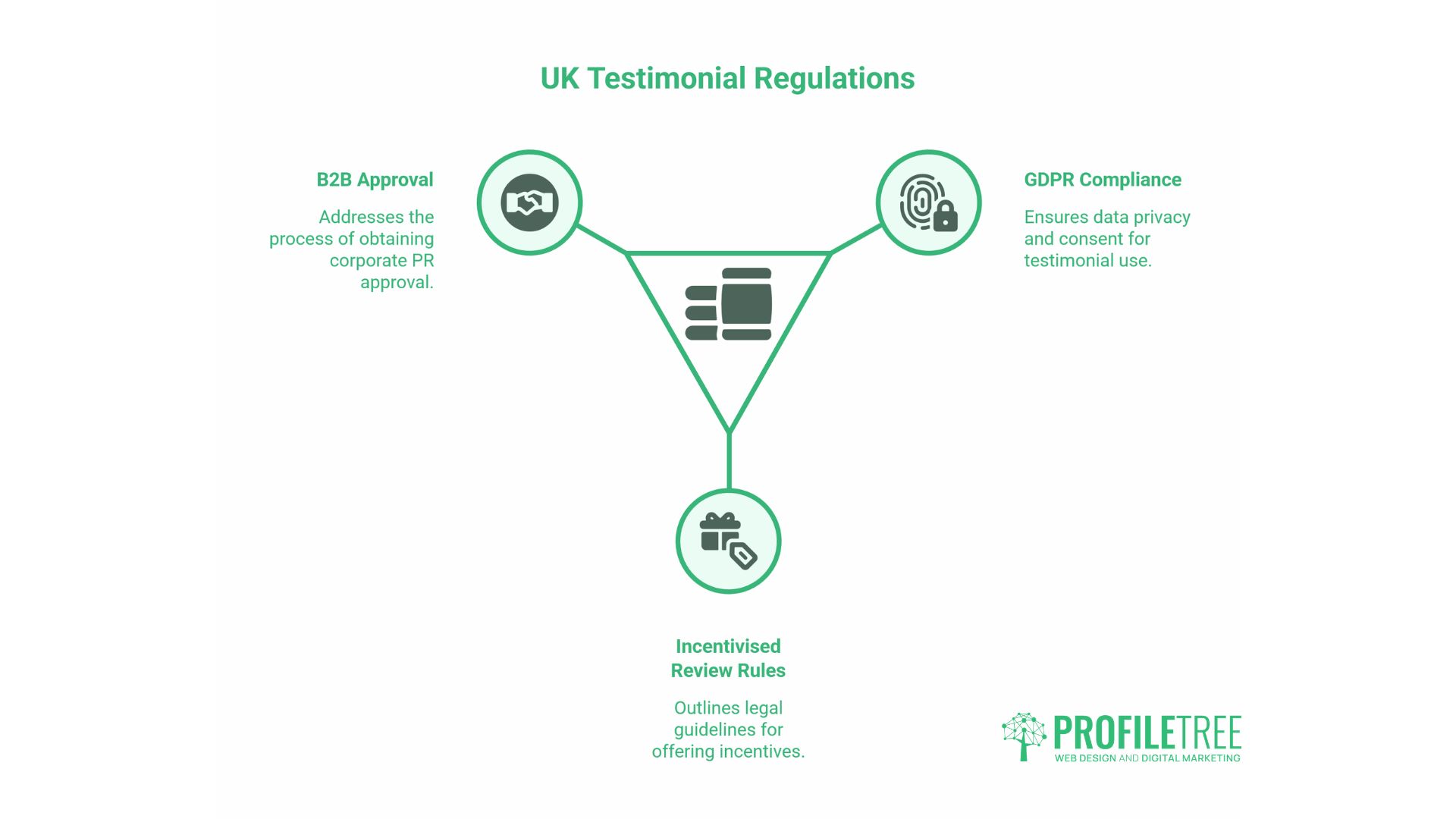
This section covers the UK regulatory context. Most testimonial guides are written for a US audience and miss requirements that apply specifically to UK and Irish businesses.
GDPR and data consent. When you host a testimonial on your website, particularly a video testimonial or one that includes a photograph, full name, and job title, you are processing personal data. Under UK GDPR, you need a legal basis for this. The most appropriate basis for testimonials is explicit consent. Keep a record of the client’s approval: a reply email confirming permission is sufficient. Include a note in that communication confirming they can withdraw consent at any time, which would require you to remove the testimonial.
The Consumer Protection from Unfair Trading Regulations 2008 (UK). These regulations prohibit fake or misleading consumer reviews. Posting a fabricated testimonial, or publishing a real one in a context that misrepresents it, can constitute an unfair commercial practice. This applies whether the fabrication is by you or generated by AI.
Incentivised reviews: the CMA position. The UK’s Competition and Markets Authority has been clear that incentivised reviews are not automatically illegal, but they must be disclosed. If you’ve offered a discount, gift, or any other benefit in exchange for a review, the reviewer must state this. On Google, for example, a review given in exchange for something of value must include a disclosure. Failure to disclose this can expose your business to regulatory action. The safest approach: make any thank-you gift genuinely unconditional (given regardless of whether a review is left) and still encourage disclosure.
LinkedIn Recommendations: Can you use them on your website? LinkedIn recommendations are technically subject to LinkedIn’s terms of service. The safest approach is to obtain the recommender’s explicit permission before reproducing their LinkedIn recommendation on your website. A quick message asking “Are you happy for me to use your LinkedIn recommendation on our website?” takes thirty seconds and removes any ambiguity.
Handling the “No”: How to Pivot to Useful Social Proof
Not every request will result in a testimonial, even from clients who are genuinely happy with your work. Timing, corporate policy, and personal preference all play a role. A refusal, or even a non-response, doesn’t have to be a dead end.
Google reviews as a lower-commitment alternative. Some clients who won’t write a testimonial will happily leave a Google review. The format is shorter and more familiar, and many business owners check Google reviews before making a formal statement. Ask specifically for this if your standard request gets declined.
An anonymous case study. If a client is happy to share the details of a project but not to be named, an anonymised case study, covering the brief, the approach, and the measurable outcome, is still a powerful piece of content. At ProfileTree, our content marketing work regularly draws on anonymised project examples precisely because they demonstrate process and results without requiring public attribution from the client.
Aggregate data instead of individual quotes. If individual testimonials are consistently difficult to collect, another route is to gather anonymous satisfaction data (a short post-project survey) and present the aggregate results: “93% of clients rated their experience as excellent or very good.” This isn’t a replacement for personal testimonials, but it adds a layer of social proof that doesn’t depend on any single client’s willingness to go public.
Where to Distribute Testimonials for Maximum Impact
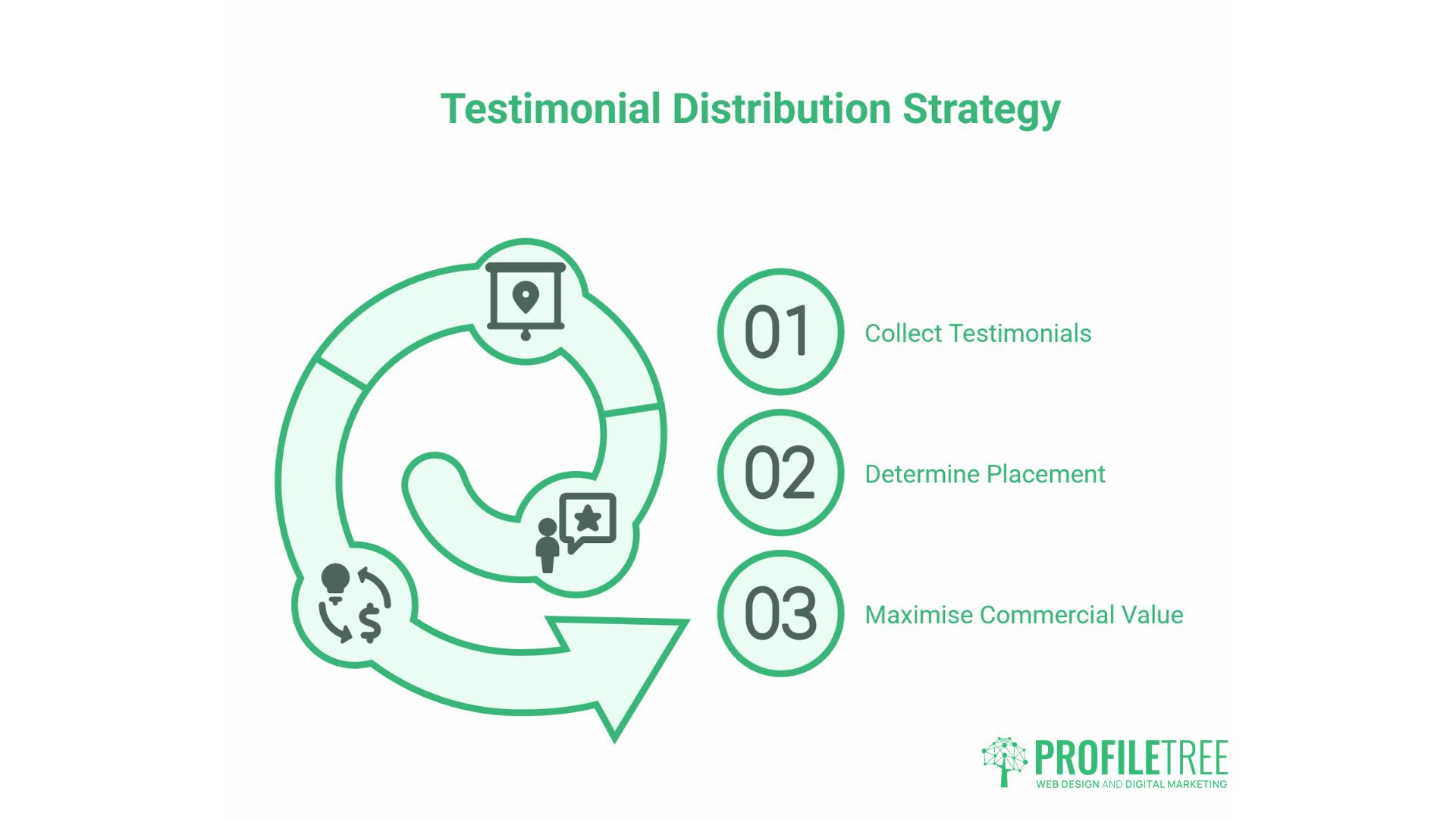
Collecting testimonials is only half the work. Where you place them determines how much commercial value they deliver.
Your homepage is the first and most important location. A rotating quote carousel or a fixed featured testimonial near the top of the page addresses trust concerns before a visitor has even scrolled to your services. If your homepage was built some time ago and doesn’t prominently surface testimonials, that’s worth raising with your web design team: it’s usually a straightforward content update.
Individual service pages benefit from testimonials that are specific to that service. A testimonial from a client about your SEO results belongs on your SEO service page, not just on a general reviews page. Match the testimonial to the intent of the page.
Proposals and pitch documents. For agencies and B2B service businesses, a well-chosen two or three-sentence testimonial dropped into a proposal can do more than three pages of capability statements. It answers the question the prospect is actually asking: “Has this worked for someone like me?”
Social media. A strong testimonial, particularly a short video, makes content that performs better than almost any promotional post. Pull a single sentence from a longer testimonial and pair it with the client’s name and photograph (with their permission) as a standalone post. This is also a legitimate part of any social media marketing strategy.
Google Business Profile. Beyond encouraging Google reviews, you can post a testimonial as a Google Business Profile update. This surfaces in local search results and adds fresh content to your profile.
Testimonial Health Check
Before publishing any testimonial, check it against this list:
- Client has given written consent for the specific uses intended (website, social, print, etc.)
- The testimonial is specific: it references a real outcome or experience, not a vague compliment
- If incentivised, this has been disclosed appropriately
- A named individual is attributed with their job title and company, not just a first name
- For video: GDPR consent for the use of their image has been obtained
- For LinkedIn recommendations reused on your website: direct permission has been confirmed
- The testimonial has not been materially altered from what the client wrote or approved
Conclusion: Requesting Testimonials
Asking for a testimonial feels awkward until you have a system for it. The templates above remove the blank-page problem. The timing framework removes the guesswork about when to ask. And the B2B guidance removes the most common reason corporate testimonials stall.
If you want to go further, turning testimonials into case studies, video content, or social media assets, that’s where a structured content strategy makes the difference. ProfileTree works with SMEs across Northern Ireland, Ireland, and the UK on exactly this kind of content infrastructure. Talk to our team about what that might look like for your business.
FAQs
How do you politely ask for a testimonial without sounding pushy?
Reference a specific moment (a completed project or a result they mentioned) rather than making a general request. Keep the ask brief and make clear there’s no pressure if it’s not convenient.
Is it legal to offer a discount in exchange for a testimonial in the UK?
Incentivised reviews are not illegal, but the UK’s Competition and Markets Authority requires them to be disclosed. The safest approach is to make any thank-you gesture unconditional and ask the client to include a disclosure when posting publicly.
Can I write a testimonial draft and ask a client to approve it?
Yes: draft it based on things they’ve actually said and send it for their editing and approval. Only publish the version they sign off on.
What are the best questions to ask a client for a strong testimonial?
Ask three things: what problem they were trying to solve, what made them choose you, and what specific result they’ve seen since. Those three answers give you context, intent, and a quotable outcome.