
How Blockchain Technology Is Transforming UK Digital Marketing
Table of Contents
Blockchain technology is no longer a fringe concept reserved for cryptocurrency traders. For marketing teams managing programmatic budgets, customer loyalty schemes, and supplier relationships, it has become a practical infrastructure question worth understanding now.
Ciaran Connolly, founder of Belfast digital agency ProfileTree, puts it plainly: “Businesses in Northern Ireland and across the UK are asking us about blockchain not because of hype, but because they’re losing money to ad fraud and losing customer trust through data breaches. Those are concrete problems, and blockchain offers concrete answers to both.”
This guide covers how blockchain marketing strategy works in practice, where UK businesses are seeing real returns, and how to navigate the genuine legal tensions this technology creates under UK GDPR.
Why Blockchain Is Back on the Marketing Agenda
The NFT wave distracted a lot of marketing leaders from blockchain technology’s more useful application layer. Strip away the speculative asset side, and what remains is a distributed ledger: a shared record that multiple parties can read but nobody can quietly alter.
That property turns out to be genuinely useful for marketing. The two biggest trust problems in digital advertising are publishers and intermediaries inflating impression counts, and brands making claims about their products that consumers can’t verify. Blockchain technology addresses both at the source level, not by adding another monitoring layer on top of the existing system.
UK adoption is moving in one direction. The UK Government’s digital strategy, updated in 2024, explicitly identifies blockchain technology as infrastructure for financial services, supply chain provenance, and identity verification. Irish and Northern Irish businesses with cross-border supply chains, particularly in agri-food, have direct commercial incentives to explore this now.
Solving Ad Fraud with Blockchain Verification
Global ad fraud costs the industry an estimated $100 billion annually, according to the World Federation of Advertisers. UK programmatic budgets are not immune. A significant portion of display and video ad spend is captured by bots generating fake impressions before a human ever sees the creative.
The blockchain technology solution works by creating an immutable log of every ad impression at the point of delivery. Each transaction, from the advertiser’s DSP through the supply chain to the publisher, is recorded on a shared ledger that no single party controls. Fraudulent activity, such as bot-generated clicks or domain spoofing, leaves traces that the consensus mechanism in the network flags automatically.
How the ad verification loop works:
- Advertiser commits budget to a smart contract with defined delivery criteria (verified human impressions, above-the-fold placement, approved domain list).
- Each impression is logged as a transaction on the blockchain.
- The smart contract releases payment only when the verified criteria are met.
- Both advertiser and publisher see the same ledger in real time.
The practical outcome is that payment is conditional on verified delivery, not claimed delivery. For businesses spending more than £5,000 per month on programmatic advertising, the potential recovery from fraud reduction alone can justify a pilot within months.
ProfileTree’s digital marketing services include programmatic strategy and media oversight. If you’re running paid campaigns and haven’t audited your supply chain for fraud exposure, that’s a reasonable starting point before exploring blockchain verification tooling.
Blockchain and UK GDPR: Navigating the Privacy Paradox
This is where most competitor content goes quiet, because the problem is real and the answer is not simple.
UK GDPR, aligned with the EU’s General Data Protection Regulation post-Brexit, gives individuals the right to erasure: the right to have their personal data deleted. Blockchain technology’s core property is immutability: data recorded on the ledger cannot be altered or removed. These two principles appear to be in direct conflict.
The UK Information Commissioner’s Office (ICO) has acknowledged this tension. Its guidance on distributed ledger technology notes that personal data should not be stored directly on a public blockchain if you intend to comply with erasure rights. The reconciliation is technical rather than legal.
Two approaches that work under UK law:
Off-chain storage with on-chain pointers. Personal data is held in a conventional, deletable database. What goes on the blockchain is a cryptographic hash, a unique fingerprint of the data. The hash proves the data existed and hasn’t been tampered with, without the personal data itself sitting on an immutable ledger. When an individual requests erasure, the personal data is deleted from the off-chain database. The hash becomes an orphan pointer, which satisfies blockchain’s audit function without retaining personal data.
Zero-knowledge proofs (ZKPs). This more technically advanced approach allows one party to prove a fact about a dataset to another party without revealing the underlying data. A retailer can verify that a customer meets a loyalty tier threshold without seeing the customer’s purchase history directly. ZKPs are particularly relevant for UK businesses targeting audiences with consent-based restrictions.
Neither approach is trivial to implement. If you’re considering blockchain as part of your marketing data infrastructure, legal counsel familiar with the ICO’s current guidance is a prerequisite, not an afterthought.
Four Practical Use Cases for Marketing Teams
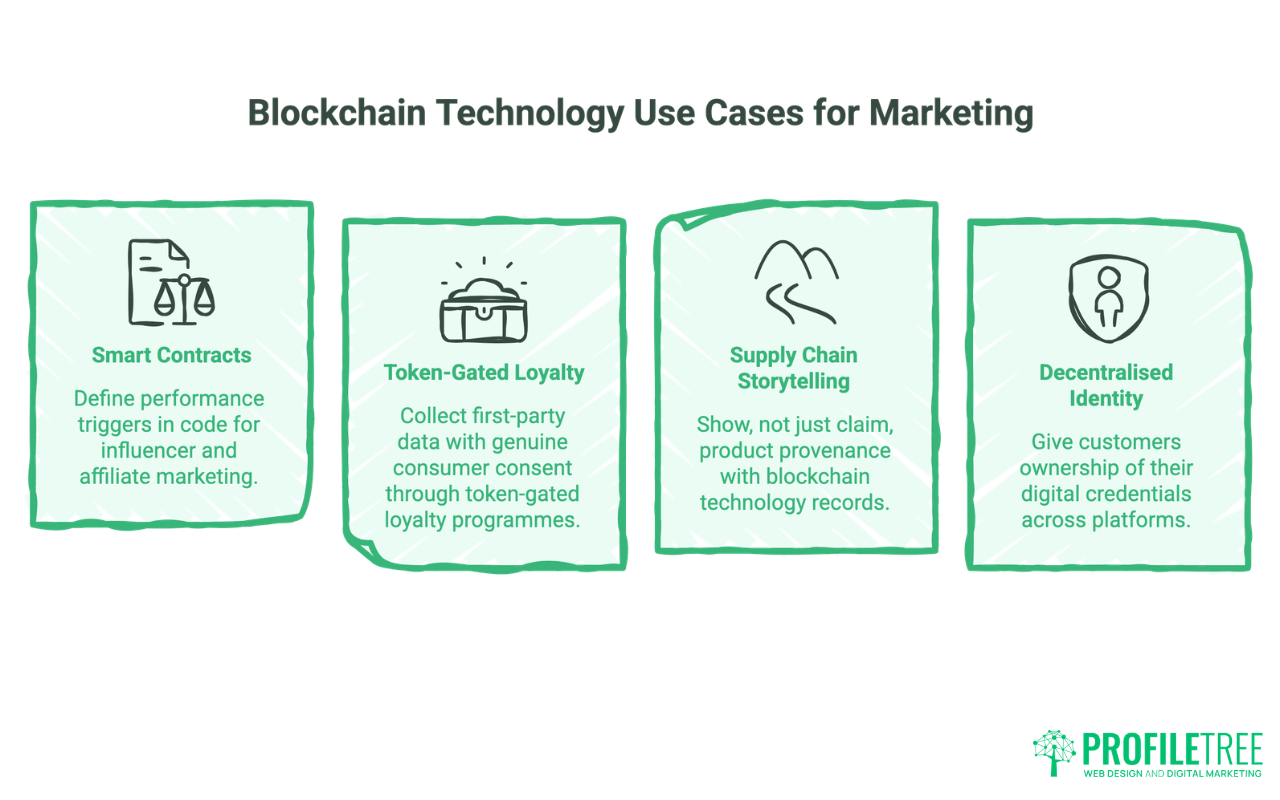
Each of the following use cases is deployable independently. Most businesses start with one, prove the model, then expand.
Smart Contracts for Influencer and Affiliate Deliverables
Influencer marketing disputes are common: the brand says the content underperformed, the creator says they delivered. Smart contracts remove that ambiguity by defining performance triggers in code.
An influencer campaign smart contract might specify: payment releases when a post achieves 10,000 verified impressions within 72 hours of publication, based on verified platform API data. The creator knows exactly what they’re working toward. The brand knows payment is conditional on delivery, not on whether an invoice arrived. Neither party needs to trust the other’s spreadsheet.
The same logic applies to affiliate programmes: commission releases when a verified conversion is recorded, not when a claim is submitted.
Token-Gated Loyalty Programmes and First-Party Data
With third-party cookies now deprecated across major browsers, first-party data collection has become the central challenge in retention marketing. Token-gated loyalty programmes offer a way to collect that data with genuine consumer consent.
The structure: customers earn digital tokens for purchases or engagements. Those tokens give customers access to exclusive content, early releases, or tiered discounts. Because the customer controls their token wallet, they actively choose to share identity data in exchange for access. This shifts the data relationship from passive tracking to active opt-in, which both improves GDPR compliance and increases data quality.
UK retailers including some in the food and beverage sector have piloted this model. The infrastructure is available at a lower cost than most brands assume, particularly on proof-of-stake networks where transaction fees are minimal.
Supply Chain Storytelling for B2B and Retail
Northern Irish businesses in agri-food, textiles, and manufacturing operate supply chains where provenance genuinely matters to buyers and end consumers. A blockchain technology record of the supply chain allows a brand to show, not just claim, where a product came from and how it was handled at each stage.
The marketing value is significant. When a food brand can provide a scannable QR code that pulls up a verified blockchain technology record of its farm-to-shelf journey, that’s a more credible claim than a logo badge on the packaging. In a post-AI content world where consumers are increasingly sceptical of brand claims, verifiable proof carries more weight than assertion.
ProfileTree’s content marketing services can help structure supply chain stories for digital channels once the underlying blockchain infrastructure is in place. The content strategy question is how to surface verified data in ways that buyers actually find and trust.
Decentralised Identity for Customer Logins
Decentralised identity (DID) is a W3C standard that allows individuals to own and control their digital credentials across platforms, without relying on a central authority like Google or Facebook as the authentication layer.
For marketers, DID matters because social login via major platforms creates data dependency on those platforms. If a user logs into your site via Google Sign-In, Google holds the relationship. A DID-based login gives the customer ownership of their identity data and gives the brand a direct relationship that isn’t mediated by a third party.
Adoption is still early, but the infrastructure is maturing. The Microsoft Entra Verified ID product, now in general availability, is one enterprise implementation worth tracking.
Blockchain’s Impact on SEO and Search
This is a question that comes up in practical terms but rarely gets a direct answer.
Blockchain technology does not directly change how Google crawls or ranks pages. PageRank, Core Web Vitals, and content quality signals operate independently of whether blockchain technology is mentioned or used in your business infrastructure.
The indirect effects are worth understanding. Brave Browser, which uses blockchain-based advertising (Basic Attention Token), has over 60 million monthly active users. Presearch, a decentralised search engine, operates on blockchain rails. Neither currently represents meaningful search market share, but both indicate a direction of travel where users have more control over what data they share with search providers.
The more immediate SEO implication is reputational. Blockchain-verified content provenance, a growing use case as AI-generated content floods the web, could become a quality signal in future search algorithms. Google’s Search Central documentation already emphasises original, author-attributed content. A blockchain provenance system that proves publication date and authorship provides exactly the kind of verifiable trust signal that fits that direction.
For the majority of UK SMEs, this remains a watch-and-prepare issue rather than an action-now priority. ProfileTree’s AI transformation services include horizon-scanning for precisely this kind of emerging signal, particularly as generative AI changes the content authentication environment.
The Sustainability Challenge
One legitimate objection to blockchain technology in marketing is energy consumption. Bitcoin’s proof-of-work consensus mechanism uses as much electricity annually as some mid-sized countries. For UK brands with ESG commitments, associating with that energy profile is a reputational risk.
The answer is that not all blockchain technology is Bitcoin. Ethereum moved to proof-of-stake in 2022, reducing its energy consumption by approximately 99.95%. Most enterprise blockchain technology applications, including Hyperledger Fabric used by IBM and major retail chains, run on private or permissioned networks that consume a fraction of public blockchain energy.
When evaluating blockchain for a marketing application, the first question to ask a technology vendor is which consensus mechanism their network uses. Proof-of-stake and permissioned ledger solutions are entirely compatible with credible ESG reporting.
Is Your Brand Ready? A Practical Starting Point
Before committing budget to blockchain infrastructure, work through these questions:
- Are you spending more than £5,000 per month on programmatic advertising? If yes, ad fraud verification has an identifiable ROI case.
- Do you run an influencer or affiliate programme with recurring payment disputes? Smart contract automation is worth scoping.
- Does product provenance matter to your customers or buyers? Supply chain storytelling via blockchain has direct commercial value.
- Are you rebuilding a loyalty programme? Token-gated first-party data collection solves the post-cookie problem more elegantly than most alternatives.
If the answer to any of these is yes, the next step is not a full blockchain implementation. It’s a focused pilot on one use case, with clear success metrics defined before you start.
ProfileTree provides digital marketing strategy and AI and technology implementation guidance for SMEs across Northern Ireland, Ireland, and the UK. If you’re working through the business case for blockchain in your marketing stack, talk to the team.
Conclusion
Blockchain technology in marketing is past the hype phase. The practical value sits in four areas: reducing ad fraud through verified impression ledgers, building compliant first-party data via token loyalty schemes, proving supply chain provenance to buyers and consumers, and automating influencer and affiliate payments through smart contracts.
The UK regulatory context matters here. Navigating blockchain technology under GDPR requires a technical architecture decision, not just a business one, and that’s where many UK businesses get stuck. ProfileTree works with SMEs across Northern Ireland, Ireland, and the UK on digital strategy, AI implementation, and the kind of content that connects blockchain-verified proof points to audiences that care about them.
If you’re ready to explore what blockchain technology could do for your marketing, get in touch with the team for a straightforward conversation about where it fits and where it doesn’t.
Frequently Asked Questions
How is blockchain technology used in digital marketing?
The main applications are ad fraud prevention through verified impression ledgers, token-based loyalty programmes for first-party data collection, smart contracts for influencer and affiliate payment automation, and supply chain provenance marketing. Adoption is growing fastest in programmatic advertising and B2B retail supply chains.
Can blockchain technology improve data privacy in marketing?
Yes, with the right architecture. Blockchain technology itself doesn’t store personal data in a privacy-compliant way; the solution is off-chain storage combined with on-chain cryptographic hashes, or zero-knowledge proof systems that verify audience facts without exposing individual data. Both approaches satisfy UK GDPR requirements.
How does blockchain technology prevent ad fraud?
By creating an immutable shared ledger of every ad impression. When payment is tied to a smart contract with verified delivery criteria, fraudulent impressions from bots or domain-spoofed publishers fail the verification check. The ledger is visible to all parties simultaneously, removing the possibility of unilateral inflation.
Is blockchain technology legal under UK GDPR?
It can be, but personal data must not sit directly on a public blockchain. The ICO’s guidance on distributed ledger technology recommends off-chain storage with on-chain hashing. This preserves audit function while keeping personal data in a deletable system that satisfies the right to erasure.
What is a smart contract and how is it used in advertising?
A smart contract is a self-executing programme that releases payment automatically when pre-defined conditions are verified on the blockchain. In advertising, it means an influencer or publisher is paid only when delivery criteria are met by verified data, removing invoice disputes and reducing the need for intermediary verification services.
Does blockchain technology affect SEO or Google rankings?
Not directly. Google’s ranking signals are independent of whether blockchain technology is used in a business. The indirect case is that blockchain-verified content provenance could become a trust signal in future algorithms as AI-generated content becomes harder to authenticate, but this is a medium-term watch rather than an immediate action.
Is blockchain technology compatible with ESG commitments?
Yes, provided the right network is chosen. Bitcoin’s proof-of-work mechanism has high energy costs, but Ethereum’s proof-of-stake uses approximately 99.95% less energy. Enterprise platforms like Hyperledger Fabric run on permissioned networks with negligible energy overhead. ESG-conscious brands should confirm consensus mechanism before selecting a blockchain provider.
How much does blockchain technology cost to implement in a marketing context?
It depends entirely on the use case. Smart contract automation for influencer campaigns can be scoped for a few thousand pounds on low-fee proof-of-stake networks. Supply chain provenance implementations range from £20,000 upwards. Ad fraud verification is typically accessed through third-party platforms at a cost based on verified ad spend, rather than custom builds.