
How to Use Instagram for Social Commerce: A Guide for UK SMEs
Table of Contents
Instagram for social commerce has moved well beyond posting product photos and hoping for clicks. The platform now gives UK and Ireland businesses a complete sales infrastructure: shoppable posts, native checkout, product-tagged Reels, and live shopping events, all within an app that a significant portion of your target customers already use daily.
For SMEs, that represents a genuine opportunity, but also a more demanding set-up process than most guides acknowledge. Getting approved for Instagram Shopping, building a product catalogue, connecting it to a website that can handle the traffic, and producing content consistently enough to satisfy the algorithm all take planning. This guide covers each of those steps in practical terms, with specific attention to compliance and logistics considerations affecting UK and Northern Ireland sellers.
What Is Instagram Social Commerce?
Instagram social commerce is the practice of selling products directly through the Instagram platform, using built-in features such as Instagram Shop, product tags in posts and Reels, and native checkout. The customer discovers a product through organic content or a paid ad, taps the product tag, views pricing and details, and can complete a purchase without visiting an external website.
For UK SMEs, this matters because it removes friction from the buying journey. Every additional step between discovery and payment loses a percentage of potential buyers. Instagram’s native commerce tools significantly reduce those steps.
The channel works best for product-based businesses with visual appeal, such as fashion, homeware, food and drink, beauty, and gifts, though service businesses can use Instagram’s lead-generation tools to achieve a comparable outcome.
Why the UK and Ireland Market Is Distinct
The UK has one of the highest e-commerce penetration rates in Europe, with mobile shopping accounting for a significant proportion of that activity. Instagram’s user base skews heavily towards mobile, making alignment between the platform and buying behaviour particularly strong for UK sellers.
For businesses based in Northern Ireland, there is an added operational consideration. Cross-border selling to Great Britain, the Republic of Ireland, and the EU involves different VAT and customs requirements depending on the destination and the nature of goods. Northern Ireland occupies a specific position under the Windsor Framework, meaning goods moving between NI and GB follow different rules from goods moving between NI and the EU. Social sellers dispatching from Northern Ireland should confirm their VAT registration status and understand which goods fall under the Windsor Framework’s “green lane” arrangements before scaling Instagram commerce operations.
Ireland-based businesses selling into the UK post-Brexit face similar considerations around customs declarations and VAT thresholds. This is not specific to Instagram, but Instagram commerce scales quickly once set up, and the logistics infrastructure needs to keep pace with that growth from the start.
Setting Up Your Instagram Shop: Step-by-Step
Getting a UK business account approved for Instagram Shopping requires several steps, and the process can stall if details are missing. Here is the setup sequence.
Step 1: Convert to a Business Account
Go to Settings, tap Account, and select “Switch to Professional Account.” Choose “Business” and complete the profile with a trading name, contact details, and category.
Step 2: Connect to a Facebook Page
Instagram Shopping is managed through Meta’s commerce infrastructure, which requires a linked Facebook Business Page. If you do not have one, create it before attempting shop setup.
Step 3: Upload a Product Catalogue
A catalogue can be uploaded directly through Meta Business Manager or connected via an integrated e-commerce platform. Shopify, WooCommerce, and BigCommerce all support direct catalogue sync with Meta. For businesses without an existing e-commerce setup, this is the point at which a proper product website becomes necessary. Catalogue data needs to be hosted somewhere, and the product page the customer lands on after clicking through from Instagram needs to be fast, clear, and functional. A poorly built or slow-loading product page undermines the conversions the Instagram content drives.
Step 4: Submit for Review
Meta reviews accounts for compliance with its merchant agreement and commerce policies. This can take a few days. Accounts with incomplete business information or policy violations are rejected at this stage.
Step 5: Enable Shopping Features
Once approved, Shopping features are activated through Settings under Business. Product tags can then be added to posts, Stories, and Reels.
Content That Sells: What Actually Works on Instagram
Instagram’s algorithm rewards content that generates engagement quickly after posting. For social commerce, that means content needs to do two things at once: stop the scroll and make the product worth investigating.
Reels for Reach, Feed Posts for Conversion
Reels consistently achieve higher organic reach than static feed posts, especially for accounts without large followings. A product demonstration in a 15-30-second Reel with a product tag embedded gives a new audience a reason to tap through. Feed posts, by contrast, tend to perform better for audiences already following the account, as they serve as reminders and closer looks.
Short-form video is one of the most significant shifts in product marketing over the past three years. For SMEs without in-house video capability, this presents a practical barrier. Professional short-form video production for Instagram Reels and Stories can deliver this consistently without requiring the business owner to appear on camera or manage post-production.
User-Generated Content and Trust
Products shown being used by real customers consistently outperform studio-shot product imagery in conversion rate, particularly for audiences who do not yet know the brand. Encouraging customers to tag the business in their posts and then reposting that content with credit builds a library of authentic social proof that costs nothing to produce.
This approach works especially well for Northern Ireland and Ireland-based businesses with a local community angle. A Belfast gift shop or a Co. Down food producer reposting customer content builds local credibility in a way that polished brand photography cannot replicate.
The Role of a Content Calendar
Inconsistent posting damages reach. Instagram’s algorithm is partly a recency signal, as accounts that post irregularly see their content distributed less widely. A planned content calendar, aligned to seasonal buying moments and promotional windows, keeps posting consistent without requiring the owner to improvise daily.
Building and maintaining that calendar is part of a broader content marketing strategy. For SMEs without a dedicated marketing resource, this is where working with a digital agency makes a measurable difference to output volume and consistency.
“The businesses that see real traction on Instagram commerce are not necessarily producing the most polished content,” says Ciaran Connolly, founder of ProfileTree. “They’re the ones posting consistently, responding to comments, and building a real community around their product. That takes a plan, not just good intentions.”
Instagram Advertising for Social Commerce
Organic reach on Instagram has contracted significantly over the past few years. For most product-based SMEs, a combination of organic content and paid advertising produces better results than either alone.
Building a Targeted Campaign
Instagram’s ad targeting draws on Meta’s audience data, allowing businesses to reach users based on interests, behaviours, demographics, and location. For UK SMEs, location targeting is particularly useful. A Belfast homeware retailer can target Instagram users within a defined radius or reach UK-wide audiences segmented by home décor interest.
The most effective ad formats for social commerce are Shopping ads (which pull directly from the product catalogue) and Reels ads (which appear in the Reels feed and carry product tags). Both allow the viewer to move from ad to purchase with minimal friction.
Reading Instagram Insights
Instagram’s built-in analytics tool provides data on reach, impressions, profile visits, and website taps. For shopping-enabled accounts, it also shows product page views and purchases. Reviewing this data weekly helps identify which content types drive the most product engagement and which ad spend is generating a return.
Ad budget allocation should follow performance. Pausing underperforming ads and redirecting spend to formats and audiences that convert is a basic discipline that many small businesses skip because they lack the time to monitor it. A digital marketing strategy engagement covers ongoing management, ensuring ad spend is reviewed and adjusted rather than left to run on autopilot.
Influencer and Creator Partnerships
Working with creators who have established, engaged audiences in your category can significantly accelerate growth, particularly for new brands without large followings.
For UK and Ireland businesses, micro-influencers (typically 5,000 to 50,000 followers) tend to produce stronger engagement rates and more authentic endorsements than larger accounts. A Northern Ireland food producer partnering with a Belfast-based food creator, for example, can reach a highly targeted local audience with content that feels genuinely personal rather than sponsored.
The mechanics: agree on a deliverable (a Reel, a Story sequence, a feed post), provide the product, agree on disclosure language that complies with ASA guidelines, and track the engagement and click-through data after posting. The UK’s Advertising Standards Authority requires influencer content to be clearly labelled as paid or gifted. This applies regardless of platform or business size.
Regulatory Considerations for UK and Ireland Sellers
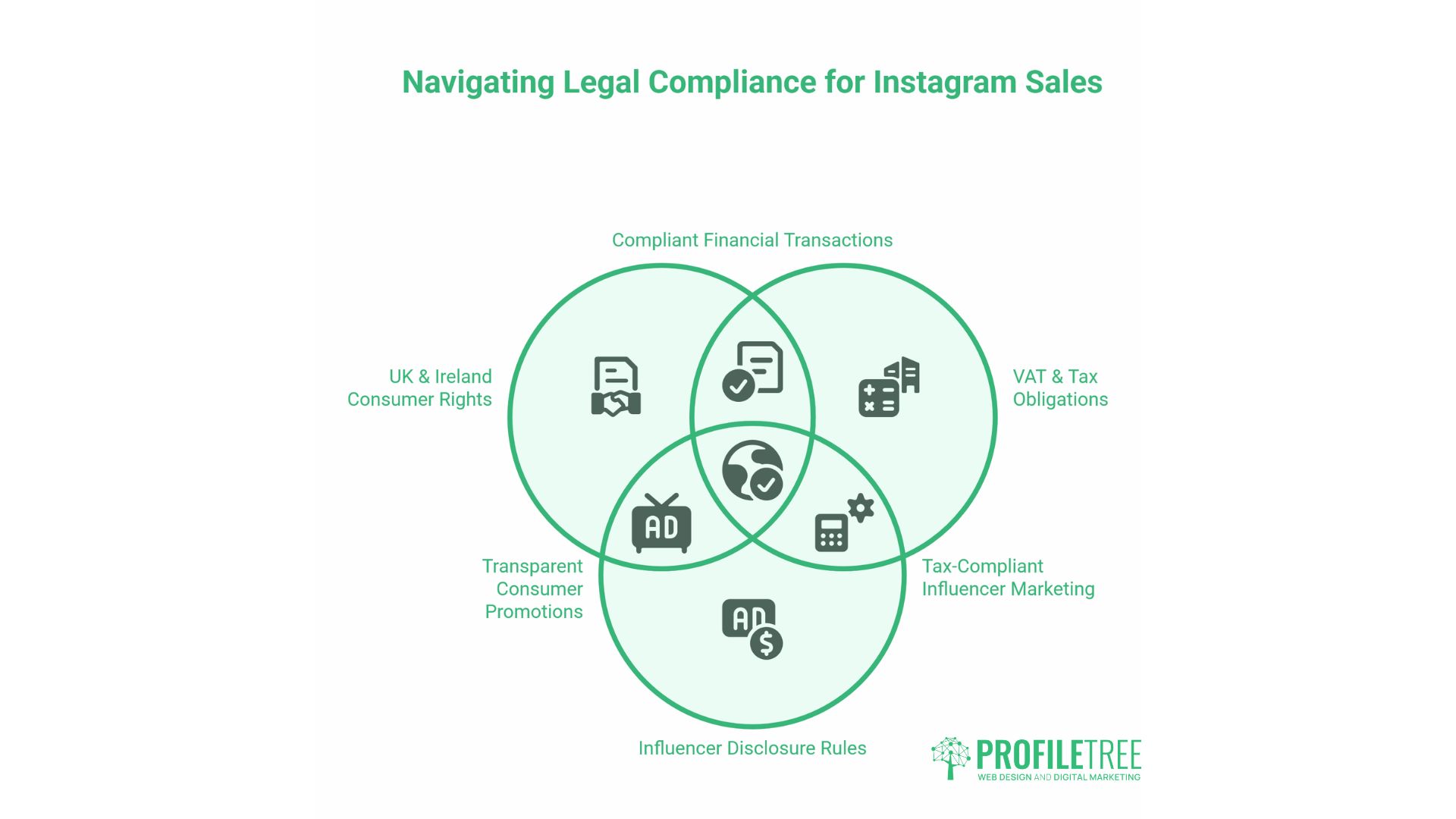
Selling through Instagram does not remove the legal obligations that apply to any other online sales channel. UK and Ireland businesses need to account for consumer rights law, VAT, influencer disclosure rules, and, for Northern Ireland sellers in particular, the cross-border implications of the Windsor Framework. The sections below cover the main areas to review before scaling up.
UK Consumer Rights and the DMCC Act
The Digital Markets, Competition and Consumers Act 2025 introduced new requirements around subscription services and “dark patterns” design choices that push users towards purchases or renewals they did not intend. For Instagram commerce specifically, any checkout process using pre-selected add-ons, auto-renewal subscriptions, or misleading urgency signals (fake countdown timers, inflated “was” prices) now carries legal risk. UK businesses selling through Instagram’s native checkout or a linked website should review their checkout flows to ensure compliance.
VAT and Commission
Instagram does not currently charge a transaction fee for purchases processed through Instagram Checkout in the UK, but this can change, and sellers should check Meta’s current commerce policies before setting up. UK businesses are responsible for accounting for VAT on sales through Instagram in the same way as any other sales channel. For businesses above the £90,000 VAT threshold, this means including VAT in displayed prices and accounting for it correctly. For Northern Ireland sellers, the applicable VAT rules depend on whether goods are being sold to GB, EU, or international customers.
Returns Policy
UK Consumer Contracts Regulations give buyers the right to cancel online purchases within 14 days and return goods within a further 14 days. This applies to Instagram commerce in the same way as any other remote selling channel. A clearly displayed returns policy accessible from the product page or Instagram profile is both a legal requirement and a conversion driver. Buyers are more likely to purchase when the return process is clearly explained upfront.
B2B and Service Businesses on Instagram
Most guides to Instagram social commerce assume a B2C, product-based business. Service businesses and B2B companies have a different but equally valid use case.
Instagram’s lead-generation tools enable service businesses to capture enquiry details directly on the platform. A lead generation ad with a native form asking for name, email, and a brief description of requirements can generate qualified enquiries for agencies, consultancies, tradespeople, and professional service firms. The product being sold is the service engagement, not a physical item.
For agencies and professional service providers, Instagram commerce in this sense is about positioning the business as an expert and accessible, then converting that positioning into conversations. Content that demonstrates the process, results, and behind-the-scenes work does the heavy lifting; the lead form converts intent into contact.
How a Professional Website Supports Instagram Commerce
A well-built product website and an active Instagram shop work together, not in competition. Instagram drives discovery and initiates purchase intent. The website handles fulfilment, post-purchase communication, and repeat business.
Businesses that sell exclusively through Instagram’s native checkout hand over control of the customer relationship to Meta. They do not own the customer’s email address, cannot run re-engagement campaigns, and cannot cross-sell through their own channels after the first purchase. A standalone e-commerce site, connected to Instagram via catalogue sync, captures that customer data and opens up email marketing, retargeting, and loyalty programmes.
For SMEs considering their first e-commerce build, or upgrading an existing site to handle Instagram-referred traffic properly, the web design and development brief needs to account for page speed, product page structure, and catalogue feed compatibility with Meta Business Manager.
Measuring Success in Instagram Social Commerce
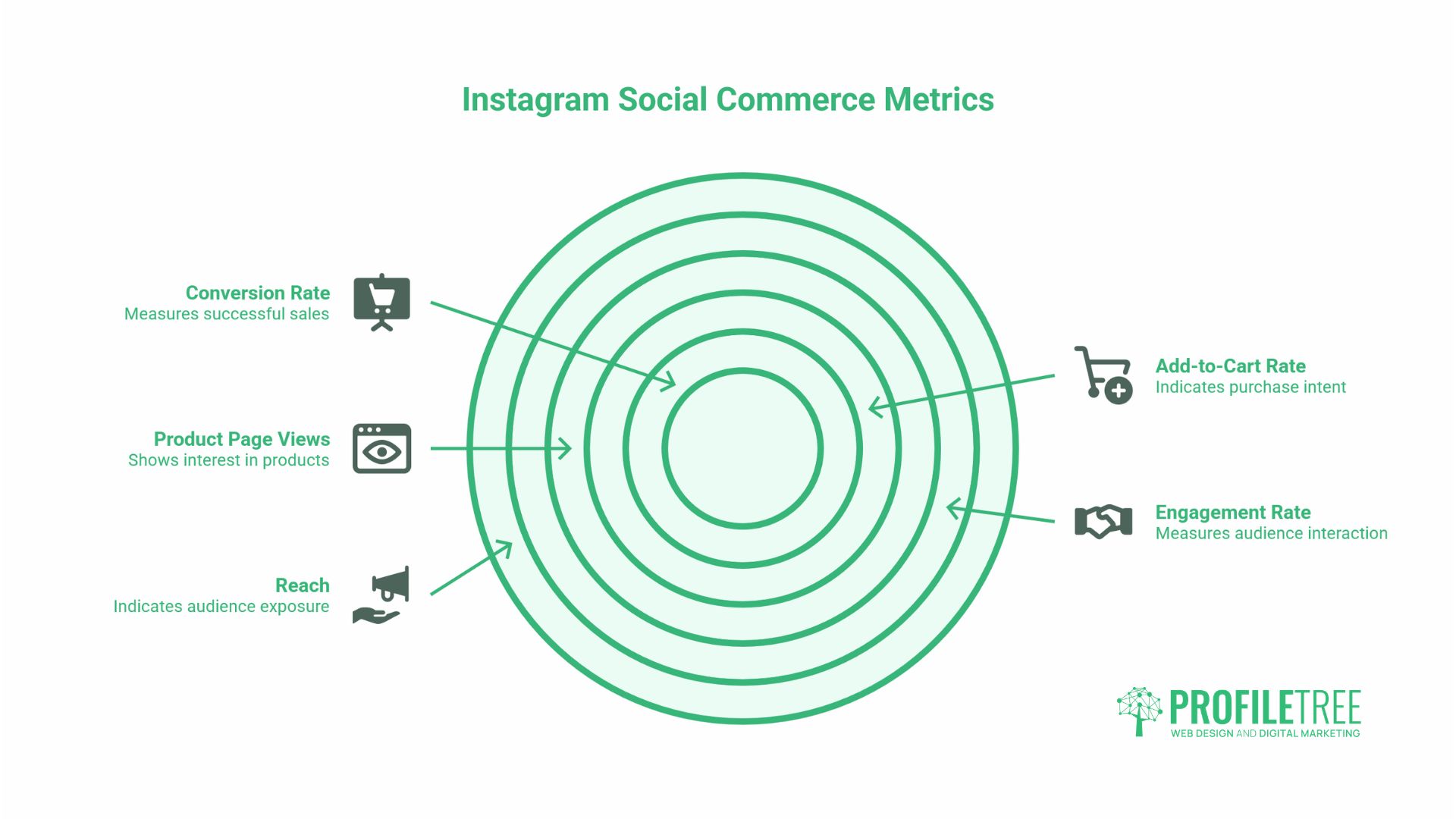
The metrics that matter most depend on the strategy’s stage. In the first three months, reach and engagement rate are the primary indicators that show whether the content is connecting with the right audiences. As the shop matures, the focus shifts to product page views, add-to-cart rate, and conversion rate.
Key metrics to track:
- Reach and impressions — how many people are seeing the content
- Engagement rate — likes, comments, shares, and saves as a proportion of reach
- Profile visits — whether the content is prompting interest in the business
- Product page views — how many people are tapping through to product detail
- Purchases — direct revenue from Instagram commerce
- Return on ad spend (ROAS) — revenue generated per pound spent on Instagram ads
Reviewing these monthly and adjusting content mix and ad allocation accordingly is the basic discipline that separates growing social commerce operations from those that plateau after an initial burst.
Instagram vs TikTok Shop for UK SMEs
Both platforms now offer native social commerce tools, and the choice between them (or the decision to run both) depends on product type and target audience.
Instagram’s user base skews towards Millennials and Gen X, with strong penetration among 25 to 44-year-olds in the UK. It performs particularly well for homeware, fashion, beauty, gifts, and food. TikTok Shop reaches a younger demographic and benefits from a discovery algorithm that can drive viral product moments, but the audience skews Gen Z, and the purchasing intent is less consistent.
For most UK SMEs starting out in social commerce, Instagram is the lower-risk entry point. The platform is more established, the tools are more mature, and the compliance framework around UK commerce is better defined. TikTok Shop is worth considering as a secondary channel once Instagram commerce is producing consistent returns.
Conclusion: Instagram for Social Commerce
Instagram social commerce gives UK and Ireland SMEs a direct route from product discovery to purchase, without requiring large budgets or complex infrastructure. The fundamentals are the same for a Belfast gift retailer or a Dublin homeware brand: a properly configured shop, consistent content, a realistic ad budget, and an understanding of the compliance obligations that apply to your customer base. Get those foundations right, and the platform becomes a measurable sales channel, not just a brand-building exercise. If you need support building the strategy, the website infrastructure, or the content behind it, ProfileTree’s team works with SMEs across Northern Ireland, Ireland, and the UK at every stage of that process.
FAQs
How do I start social commerce on Instagram in the UK?
Convert to a Business account, link a Facebook Business Page, upload a product catalogue through Meta Business Manager, and submit for Instagram Shopping review. The process typically takes a few days to two weeks.
What is the difference between social commerce and e-commerce?
E-commerce sells through a website. Social commerce uses social platforms, such as Instagram, TikTok, and Pinterest, as the point of discovery and purchase. The key difference is intent: social buyers were not actively searching when they found the product.
Is Instagram better than TikTok for social commerce in 2026?
For UK businesses targeting 25 to 45-year-olds with visual products, Instagram is the stronger starting point. TikTok reaches a younger audience and can generate viral sales moments, but Instagram’s commerce tools and compliance framework are more mature.
What are the legal requirements for selling on Instagram in the UK?
UK sellers must comply with Consumer Contracts Regulations (14-day return rights), ASA influencer disclosure rules, VAT obligations above the £90,000 threshold, and the DMCC Act 2025 regarding checkout practices. A visible returns policy and UK business address are also expected.