
Big Data and MarTech Strategies: A Practical Guide for SMEs and Mid-Market Marketing Teams
Table of Contents
Big data has stopped being a buzzword and started behaving like infrastructure. For most SMEs, the shift has crept up rather than arrived in a single moment. A few new tools here, a CRM upgrade there, a customer data platform conversation that suddenly feels overdue. The cumulative effect is that MarTech strategies built three years ago no longer match the volume, variety or velocity of data flowing through a typical business today.
At ProfileTree, we work with marketing teams across Northern Ireland, Ireland and the UK on web design, SEO, AI training and digital strategy, and the same pattern keeps recurring. Companies have data; they just cannot use it. Their MarTech strategies are stitched together from tools that do not talk to each other and produce dashboards no one trusts. The fix is rarely more software. It is a clearer plan for how data, people and platforms work together.
This guide explains how big data is reshaping MarTech strategies in practice, what to change this year, and how to audit your current stack before adding anything new. It is written for marketing leaders, founders and operations managers in SMEs who want a working knowledge of the territory, not a vendor pitch.
Big Data, MarTech and AI: Sorting the Terms
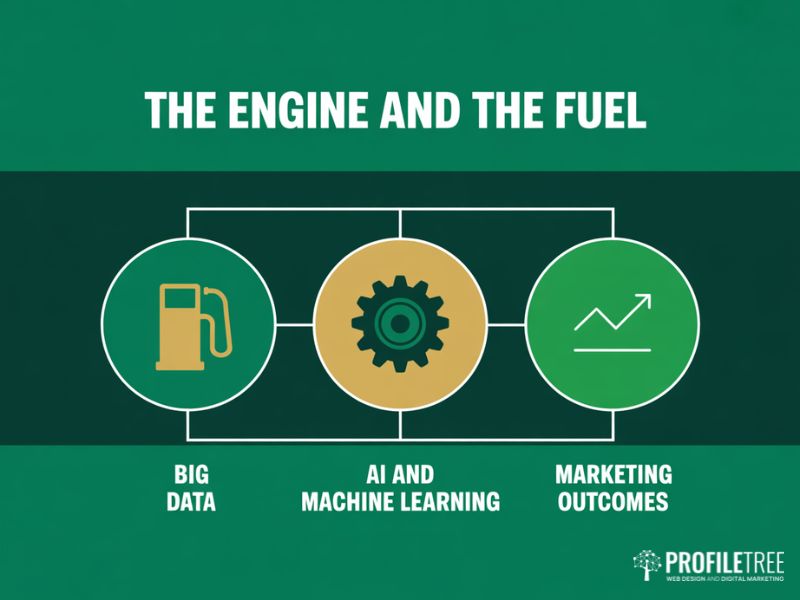
Before any audit or planning exercise, it helps to be precise about what big data, MarTech strategies and artificial intelligence actually mean inside a marketing operation. The three are connected, but they are not the same thing, and conflating them is a common reason MarTech investment fails to pay back.
What Big Data Means in a MarTech Context
Big data, in marketing terms, is the volume, variety and velocity of information generated by customer interactions across every channel a business uses. It includes structured data such as transactions, form submissions and email opens, and unstructured data such as session recordings, chat transcripts, social comments and phone call notes. The defining feature is not size alone. It is that the data arrives faster, in more formats, and from more sources than any single platform can sensibly hold.
This matters for MarTech strategies because traditional tools were built for tidy, structured records. A CRM expects fields. An email platform expects a list. When data exceeds what these tools can ingest cleanly, marketing teams either lose the data, store it badly, or duplicate it across systems that then disagree.
How AI and Machine Learning Fit In
Artificial intelligence and machine learning are the engines that process the fuel. They sit inside MarTech tools, often invisibly, and turn raw data into outputs marketers actually use: predictive lead scores, dynamic content recommendations, send-time optimisation, churn forecasts. ProfileTree’s digital training programmes for SMEs cover this ground because most teams are using these features without understanding what is happening underneath.
The practical point for MarTech strategies is that AI features are only as good as the data they read. A predictive lead score built on incomplete or stale records will produce confident-sounding nonsense. Clean data first, then model. Our AI marketing and automation services start with that data audit before any model is configured.
Why the Distinction Matters for Strategy
When a vendor sells you “AI-powered” anything, the question to ask is which data it draws from, how that data is kept current, and what happens when records conflict. MarTech strategies that skip this question end up paying for capability the underlying data cannot support. The investment that actually moves the needle is usually further down the stack: integration, hygiene, governance. A clear digital strategy framework earns its keep by sequencing those foundations before the visible features.
“Most of the MarTech failures I see are not technology failures. They are data failures dressed up as software problems. Fix the plumbing and the platforms start earning their keep.” Ciaran Connolly, ProfileTree founder.
Reshaping Your MarTech Stack: Four Practical Shifts
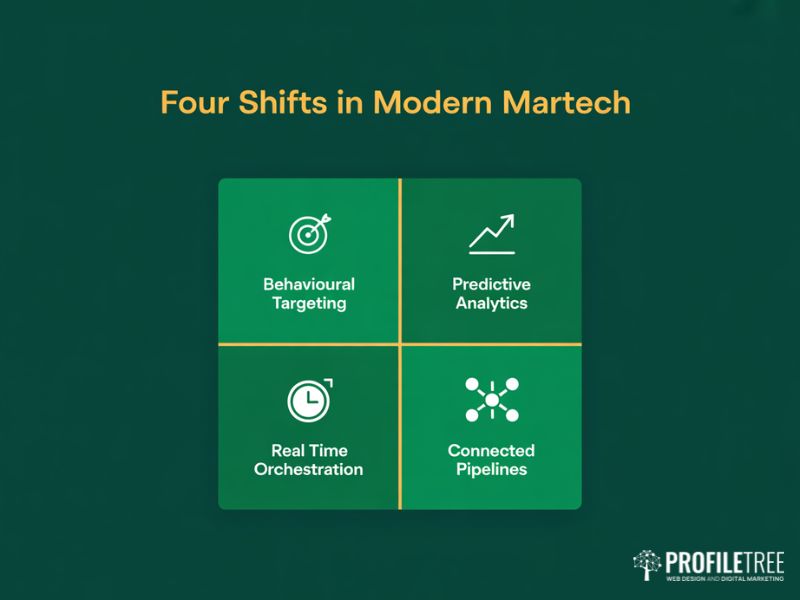
Big data is forcing four concrete changes in how MarTech strategies are built. None are theoretical. Each is already happening in the stacks we audit weekly.
From Personalisation Tokens to Real Behavioural Targeting
Personalisation used to mean inserting a first name into a subject line. That bar has moved. Modern MarTech strategies use behavioural data, recency of activity, content consumed, products viewed, support tickets raised, to shape what each customer sees on the website, in email, and in remarketing.
The volume of data required to do this properly is the reason CDPs (customer data platforms) have become central. A CDP holds a unified profile per customer, drawn from every system the business uses, and pushes that profile into the activation tools that need it. The same is true at the website layer; behavioural personalisation only works if the website development build supports the events, tags and integrations a CDP needs.
A practical example: a B2B services company we worked with had three lead-source records for the same prospect across HubSpot, an event platform and their accounting system. Every campaign treated the contact as three separate people. Once consolidated through a single source of truth, conversion on follow-up sequences improved noticeably.
From Reactive Reporting to Predictive Analytics
Big data lets marketing teams move from reporting on what happened last quarter to predicting what is likely to happen next. Predictive analytics, applied sensibly, helps teams answer three questions that traditional reporting cannot:
- Which leads are most likely to convert in the next 30 days?
- Which customers are showing early signs of churn?
- Which channels are generating revenue, not just traffic?
The tooling for this is increasingly built into mid-market platforms. The bottleneck is rarely the algorithm. It is the quality and connectedness of the data feeding it. Predictive analytics on a fragmented stack predicts the fragmentation. The same logic applies on the publishing side: well-targeted content marketing services depend on knowing which topics, formats and channels actually convert.
From Batch Campaigns to Real-Time Journey Orchestration
Customer journeys do not happen on a weekly schedule. A user browses a service page on Tuesday morning, abandons a form on Tuesday afternoon, and books a discovery call on Wednesday because a salesperson followed up. Stacks that wait for the next batch send miss the moment.
Real-time orchestration uses streaming data to trigger the right message in the right channel at the right time. This is where big data and MarTech strategies meet most visibly. The stack has to ingest events as they happen, evaluate rules instantly, and act in the channel the customer is actually using. SMEs often assume this is enterprise-only territory. It is not. Several mid-market tools now offer this functionality at SME budgets, provided the data foundation is in place. The same data feeds search engine optimisation services, where session-level behaviour informs which pages need depth and refresh.
From Data Silos to Connected Pipelines
The biggest structural change big data has forced on the marketing stack is the move away from data silos. Every tool used to hold its own copy of the customer. Email platforms had a list. CRMs had contacts. Analytics had users. None of them agreed.
Modern MarTech strategies treat data movement as a first-class problem, not an afterthought. Two patterns are worth knowing:
- ETL and reverse-ETL. ETL (extract, transform, load) moves data into a central store, typically a cloud data warehouse. Reverse-ETL pushes that unified data back out to the tools marketing uses. The combination keeps every platform working from the same record.
- Zero-copy architectures. A newer approach where MarTech tools read directly from the warehouse without duplicating data. The principle (one source of truth, multiple readers) is sound at any size.
For SMEs, the practical version of this is simpler. Pick one system as the master record for each data type, document which fields flow where, and stop relying on manual CSV exports. That alone closes most of the silo problem.
Privacy, First-Party Data and GDPR
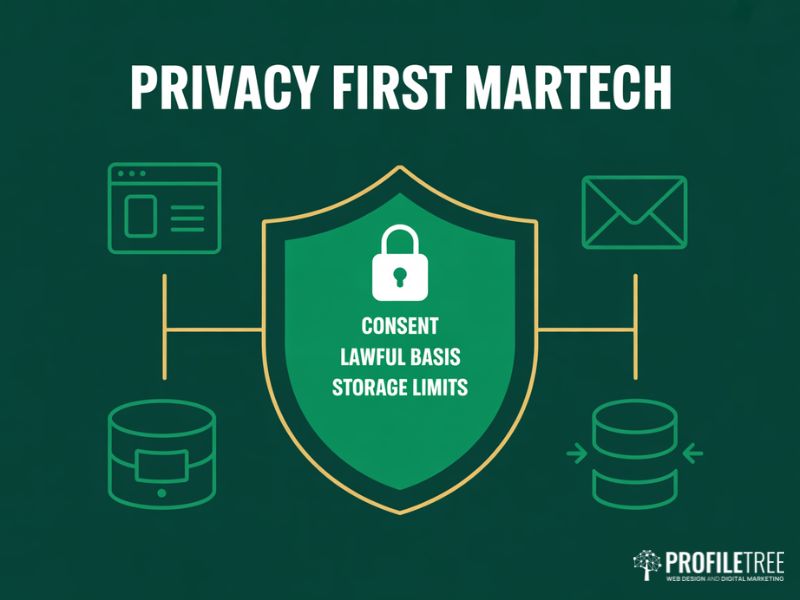
Big data and MarTech strategies in the UK or Ireland always sit alongside data protection law.
The First-Party Data Pivot
Third-party cookies are effectively gone. Browser-level restrictions, regulatory pressure and platform policies have made third-party tracking unreliable. The replacement is first-party data, information collected directly from your audience, with their consent, on properties you control.
First-party data is harder to gather but more useful when you have it. It comes from your website, your forms, your email engagement, your purchase records, your customer service interactions. It belongs to your business in a way third-party data never did. For SMEs, the shift is actually a levelling. You compete on how well you capture and use the data your own customers give you. Our guide to first-party data collection for SMEs covers the practical capture mechanics.
GDPR and UK Data Protection Law in Practice
GDPR (the General Data Protection Regulation), supplemented in the UK by the Data Protection Act 2018 and the UK GDPR following Brexit, sets the rules for how any of this data can be collected, stored and used. The principles that matter most:
- Lawful basis. You need a legal reason to process personal data. For most marketing activity, this is consent or legitimate interests; the choice has consequences for what you can do.
- Purpose limitation. Data collected for one purpose cannot quietly be repurposed for another.
- Storage limitation. You should not keep personal data longer than you need it. Stacks that hoard records for years without a defensible reason are increasing risk, not capability.
- Right to access, correct and erase. Customers can ask what you hold, ask you to fix it, and ask you to delete it. Your stack needs to be able to do all three.
The Information Commissioner’s Office (ICO) publishes detailed guidance on direct marketing and PECR (Privacy and Electronic Communications Regulations), which sit alongside GDPR and govern email and SMS marketing specifically. We have written separately on GDPR compliance for digital marketing for teams who want a step-by-step view.
Practical Steps for Compliant MarTech Strategies
In practice, GDPR-aligned MarTech strategies share a few features:
- A consent management platform that captures, records and respects user preferences across every channel.
- A documented data flow showing where personal data enters the business, where it moves, and when it is deleted.
- Clear records of lawful basis for each type of processing.
- A process for handling data subject requests within statutory timeframes.
These are the cost of operating a data-driven marketing function in the UK or EU. Getting them right also produces cleaner data and better-performing campaigns, because consent-based audiences engage more than scraped ones.
Auditing Your Current Stack: A Practical Framework
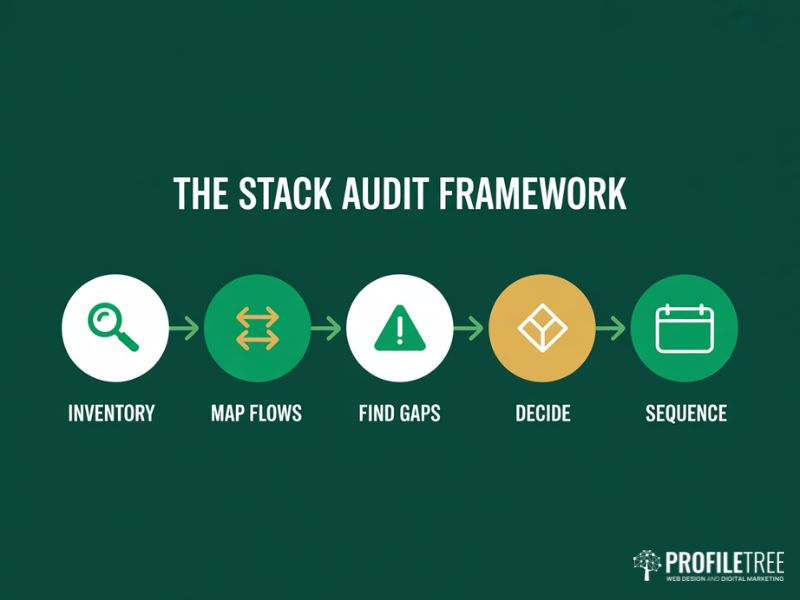
Before adding any new tools, audit the ones you already have. Most SMEs we work with are paying for capability they do not use, while missing capability they need. The audit below is the same one we run with clients during digital strategy engagements.
Step One: Inventory Every Tool
List every piece of software touching customer data. Include the obvious (CRM, email, analytics, advertising platforms, website CMS) and the less obvious (event tools, scheduling software, support helpdesk, accounting system, spreadsheets people actually use). For each, record:
- What data it collects
- Where that data comes from
- Where that data goes
- Who in the team uses it
- What it costs annually
The inventory alone often surfaces tools no one remembers buying.
Step Two: Map the Data Flows
For each customer record type (lead, customer, subscriber, account), map the journey of that record through the stack. Draw it on paper if you have to. The questions strong MarTech strategies always answer:
- Where does this record first appear?
- Which system is the master?
- Which systems receive copies, and how do they stay in sync?
- Where does the record disagree with itself across systems?
This is where silos become visible. Most teams discover at this step that no one system is actually the master, which means none of them can be trusted on their own.
Step Three: Identify Critical Gaps
With the inventory and data flow in hand, identify the gaps that are costing you most. Common ones in SME stacks:
- No unified customer view across sales and marketing
- Manual data movement (CSV exports) where automation would pay back quickly
- Consent records held inconsistently or not at all
- Reporting that nobody uses because nobody trusts it
- Two or three tools doing the same job because of historic decisions
Rank the gaps by business impact. Fix the ones that affect revenue or compliance first. For teams without a senior data lead in-house, our overview of digital transformation for small businesses explains how to prioritise.
Step Four: Decide Build, Buy or Consolidate
For each gap, the question is whether to fix it with a tool you already own, replace a tool with something better, or consolidate two tools into one. The default answer for SMEs should usually be consolidate. The stacks that work in mid-market settings tend to involve fewer tools, used more thoroughly, rather than more tools used shallowly.
A useful rule: if a tool is used by fewer than half the people it was bought for, or if its data is not feeding any decision, consider whether it earns its place. Our breakdown of how to choose marketing technology gives transparent criteria for shortlisting.
Step Five: Sequence the Work
Once the audit is complete, plan the order of changes. Three principles tend to apply:
- Foundations before features. Fix data quality, integration and consent before adding personalisation, AI or predictive analytics.
- One change at a time. Stacks break when teams replace three tools simultaneously. Pace the work.
- Measure before and after. Set baseline metrics for each change so you know whether the new tool actually improved anything.
Most SME audits we run produce a 12 to 18 month plan of phased work. Companies that try to do everything in one quarter end up with a worse stack than they started with.
Where to Go From Here
Big data has changed what MarTech strategies have to do, but it has not changed what makes them work. The teams that benefit treat data as a discipline, not a deliverable; they audit before they buy; and they train their people to use what they have.
If your current stack is producing dashboards no one trusts, the answer is not another tool. It is the audit you have been putting off. The strongest MarTech strategies start there, and the rest of the plan usually writes itself.
For a structured walkthrough across web, SEO, content and AI training, our website design services and supporting team handle the rebuild stage when an audit produces one.
FAQs
How do MarTech strategies need to change for SMEs without an enterprise budget?
SME MarTech strategies should prioritise integration over breadth. A small stack of well-connected tools beats a large stack of disconnected ones at any budget. Start with one master record per data type and automate the flows between systems.
What is the difference between a CDP, a CRM and a data warehouse?
A CRM holds structured sales records. A CDP holds unified customer profiles across every channel and pushes them into activation tools. A data warehouse stores all business data centrally for analysis. SME MarTech strategies usually need a CRM and either a CDP or a lightweight equivalent.
How does big data improve marketing ROI in practice?
Through attribution. The MarTech strategies that work let you see which channels, campaigns and content actually convert, rather than relying on last-click reporting. Cleaning what you already have usually outperforms collecting more.
Are MarTech strategies still relevant if AI Overviews reduce clicks?
Yes, and arguably more so. AI Overviews reduce informational clicks but not engagement once a prospect arrives. MarTech strategies built on first-party data become more valuable as the open web sends fewer, better-qualified visitors.
How long does a MarTech audit and consolidation project take?
A thorough audit takes two to four weeks for a 10 to 20 tool stack. Consolidation typically runs 12 to 18 months, with data hygiene, master records and consent fixes in the first quarter.
Should we use AI tools in our MarTech strategies right now?
Yes, but on clean data. The MarTech strategies that benefit from AI fix the foundations first, introduce features one at a time, measure their impact, and train the team to interrogate outputs. Our AI chatbot services sit on the same data principles.