
Headless Commerce Architecture: What Business Owners Need to Know Before Committing
Table of Contents
Headless commerce architecture separates a website’s customer-facing design from the backend systems that manage products, orders, and payments. For SMEs and growing e-commerce businesses, this separation can mean faster websites, more control over customer experience, and the ability to sell across multiple channels without rebuilding your entire platform. Whether it’s the right choice depends on your current setup, your growth plans, and your development budget.
If you’re weighing up a website rebuild or e-commerce upgrade, ProfileTree’s web design and development services cover both traditional and headless builds for businesses across Northern Ireland, Ireland, and the UK.
What Headless Commerce Architecture Actually Means
The word “headless” refers to removing the “head” from a traditional e-commerce platform. The head is the frontend: the pages, product listings, and checkout flow your customers interact with. In a standard platform like WooCommerce or Shopify, the frontend and backend are built together and dependent on each other. Change one, you often affect the other.
In a headless setup, the frontend is built separately using modern web frameworks. It connects to the backend (which handles stock, pricing, payments, and customer data) through an API. This means your developers can update how the site looks and behaves without touching the systems that process orders.
The Components Every Business Owner Should Understand
You don’t need to understand the code, but you do need to understand what you’re buying. A headless commerce setup typically involves three parts:
- The backend commerce engine manages your products, inventory, pricing rules, customer accounts, and payment processing. Platforms like BigCommerce and Commerce Layer are built specifically for headless use.
- The frontend presentation layer is what your customers see and interact with. Built with frameworks like React or Next.js, it can be designed to your exact specifications without platform limitations.
- The API layer connects the two. Every time a customer searches for a product, adds something to their basket, or checks out, the frontend sends a request to the backend through the API and receives data back in real time.
Why This Matters for Your Business (Not Just Your Developers)
The reason business owners care about this distinction is performance and control. Traditional platforms bundle the frontend and backend together for simplicity. That’s fine for most businesses. The trade-off is that you’re often constrained by the platform’s design templates, checkout flows, and page speed limitations.
With a headless setup, your developers build the frontend exactly as you specify. Page load speeds are typically faster because the frontend serves pre-built pages rather than generating them dynamically for every visitor. And if you want to sell through a mobile app, a voice assistant, or a digital kiosk alongside your website, the same backend can power all of them through the same API.
Traditional vs Headless: Which Suits Your Business?
Most SMEs don’t need headless architecture. A well-built WooCommerce or Shopify store handles the majority of e-commerce requirements at a fraction of the cost and complexity. The question is whether your specific situation makes headless worth the investment.
| Factor | Traditional Platform | Headless Architecture |
|---|---|---|
| Setup cost | Lower (£2,000 to £15,000 typical range) | Higher (£15,000 to £60,000+) |
| Time to launch | 4 to 12 weeks | 3 to 6 months |
| Design flexibility | Template-based with customisation limits | Fully custom, no platform constraints |
| Performance | Good, depends on platform and hosting | Excellent, pre-built pages load faster |
| Multichannel selling | Limited to platform’s native channels | Any channel that supports an API |
| Ongoing maintenance | Managed by platform updates | Requires dedicated development resource |
| Best for | Most SMEs and growing retailers | High-volume retailers, custom UX requirements |
“The businesses that benefit most from headless commerce are those who have genuinely outgrown their current platform, not those who simply want the latest technology. The architecture should solve a real commercial problem,” says Ciaran Connolly, founder of ProfileTree.
Signs Your Business Might Be Ready for Headless
These are the situations where headless architecture delivers genuine commercial value:
Your platform’s checkout or product page templates are limiting conversion rates and you’ve exhausted the available customisation options. You’re selling across multiple channels (website, app, wholesale portal) and managing separate systems for each is creating inefficiency. Your site’s page speed is affecting rankings and conversions and the platform itself is the bottleneck. You’re handling thousands of SKUs and your current platform struggles with catalogue management at that scale.
If none of these apply, a well-built traditional store with strong SEO and content strategy will almost certainly deliver better commercial returns for less investment. ProfileTree’s digital marketing services help businesses get more from their existing platforms before considering expensive rebuilds.
Signs You Should Stay on a Traditional Platform
Your current platform handles your catalogue and order volume without issues. Your primary challenge is driving traffic and converting visitors, not platform limitations. You don’t have an in-house development team or ongoing development budget. Your product range and customer base are relatively straightforward.
For most businesses in Northern Ireland and Ireland, a fast, well-optimised WooCommerce store with strong content and SEO strategy will outperform a poorly executed headless build.
The Real Business Benefits (and the Honest Trade-offs)
Headless commerce gets promoted heavily by platform vendors because it generates larger development contracts. The benefits are real, but so are the costs. Here’s an honest assessment of both.
What Headless Architecture Genuinely Delivers
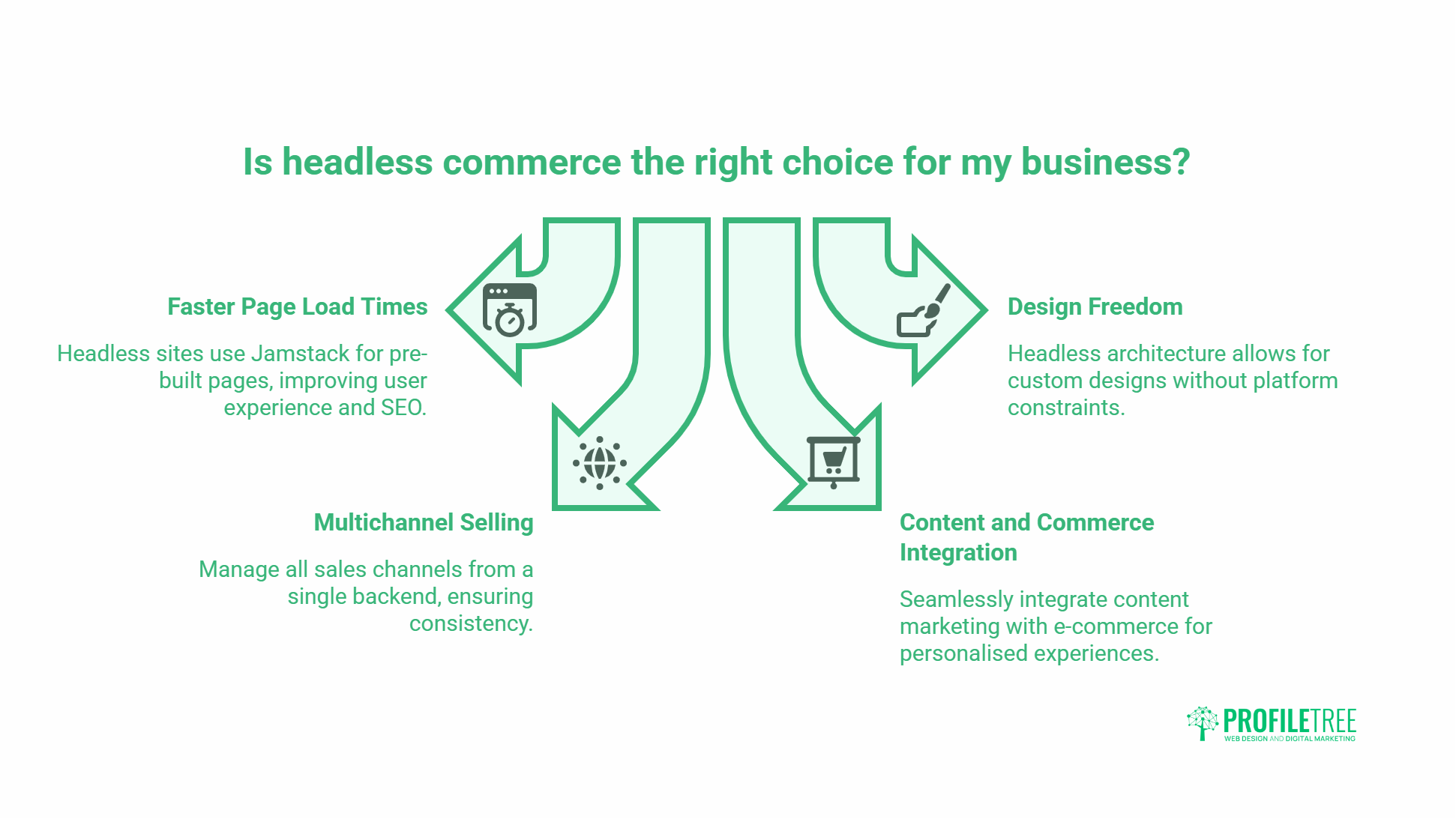
- Faster page load times. Headless sites typically use a Jamstack approach, where pages are pre-built and served from a content delivery network. This means pages load from a server geographically close to the visitor rather than being generated on demand. Google’s Core Web Vitals research consistently shows that faster sites convert better and rank higher in search results.
- Design without platform constraints. Every major e-commerce platform has design limitations. Templates, checkout flows, and product page structures are often fixed or difficult to customise beyond a certain point. A headless build starts from a blank canvas. Your design team and developers build exactly what your customers need without working around platform restrictions.
- Multichannel selling from a single backend. If you sell through your website, a branded app, a wholesale portal, or any emerging channel, a headless approach means one set of products, prices, and stock levels feeds all of them. Changes made in one place appear everywhere.
- Content and commerce working together. Headless architecture pairs well with a dedicated content management system. Your marketing team can update content, create campaigns, and personalise experiences without needing developer involvement for every change. This is particularly valuable for businesses that invest in content marketing as a core channel.
The Trade-offs Business Owners Often Underestimate
- Higher upfront costs. A traditional WooCommerce build might cost £5,000 to £15,000 for a mid-size retailer. A headless equivalent with the same functionality starts at around £20,000 to £30,000 and can go significantly higher. The frontend build alone often costs more than an entire traditional site.
- Ongoing development dependency. Traditional platforms handle updates and security patches automatically. Headless setups require a development team to maintain the frontend, update dependencies, and manage API integrations. Budget for ongoing development costs, not just the initial build.
- Longer time to market. A traditional e-commerce site can go live in six to twelve weeks. A headless build typically takes three to six months minimum, and complex projects can run longer. If speed to market matters, this is a significant consideration.
- The platform ecosystem gets thinner. Traditional platforms have thousands of plugins and integrations built specifically for them. With headless, you often need to build or source custom integrations for payment providers, loyalty programmes, and marketing tools.
Security and Data Considerations
Headless architecture introduces more components, and more components mean more potential points of vulnerability. The API layer, in particular, needs careful security planning. Key areas to address with your development team include:
API authentication to prevent unauthorised access to your backend data. Rate limiting to protect against automated attacks that try to scrape your catalogue or brute-force your checkout. HTTPS across all data transfers. Compliance with GDPR requirements for customer data, which apply regardless of the architecture you choose.
None of these are insurmountable, but they need to be designed in from the start rather than added later. If you’re also considering AI-powered features alongside your headless build, ProfileTree’s AI transformation services cover implementation for SMEs across Northern Ireland and the UK.
Platforms, Costs, and What to Budget For
Not every e-commerce platform supports headless architecture well. These are the main options worth considering for SMEs and mid-market retailers:
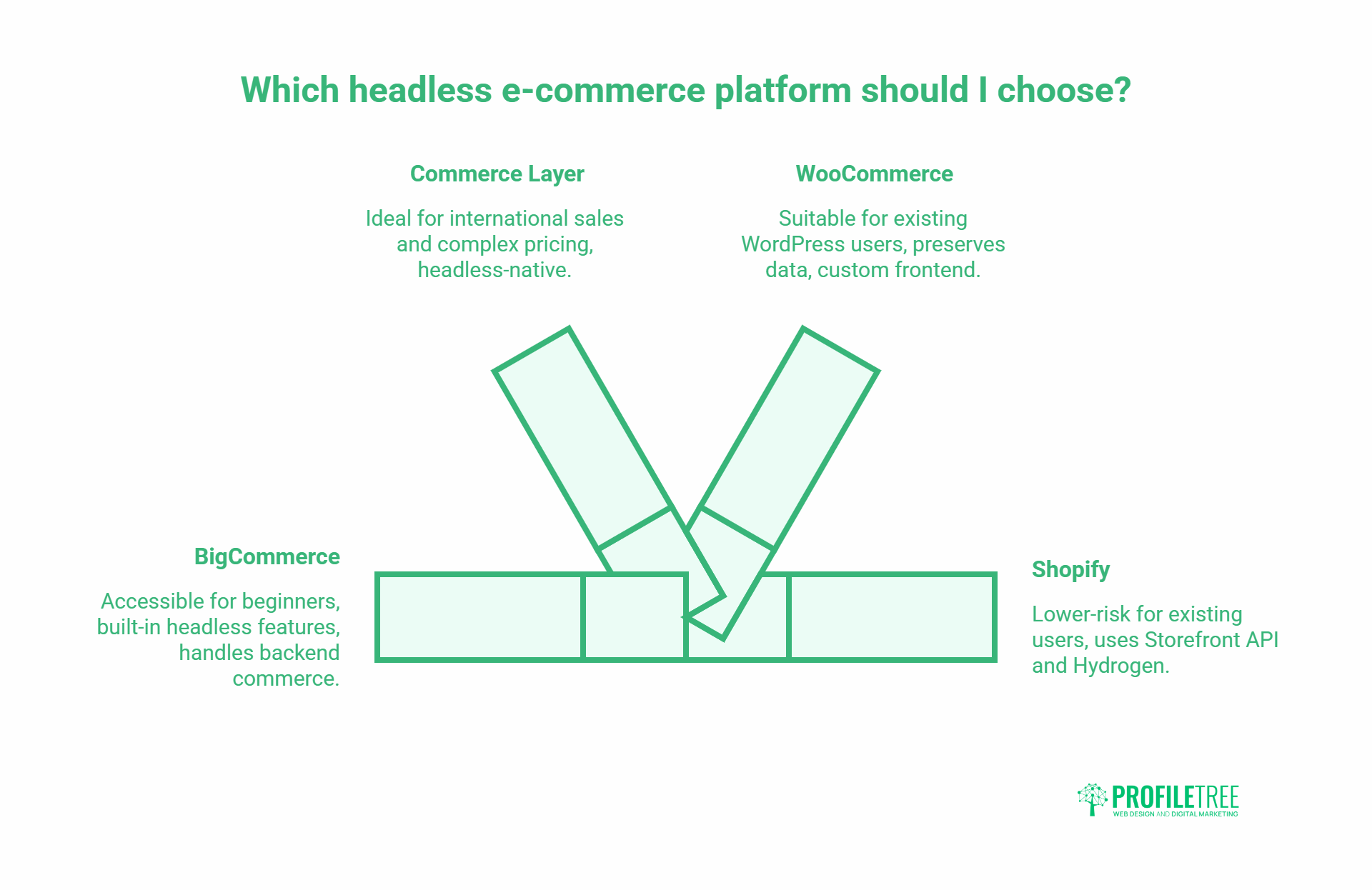
- BigCommerce has headless architecture built into its core product. It handles the backend commerce functions (catalogue, checkout, payments) while giving development teams complete freedom over the frontend. It’s one of the more accessible options for businesses moving to headless for the first time.
- Commerce Layer is a headless-native platform designed for businesses that need to sell across multiple markets and channels. It’s particularly strong for brands with international operations or complex pricing structures.
- WooCommerce with a headless setup is an option for businesses already on WordPress. Using WooCommerce as a backend and building a custom frontend via its REST API preserves your existing product data and order history while giving you more control over the frontend experience.
- Shopify offers a headless option through its Storefront API and Hydrogen framework. For businesses already on Shopify, this can be a lower-risk path to headless than switching platforms entirely.
How to Evaluate a Platform Before Committing
Before choosing a platform, ask these questions:
Can the platform handle your current product volume and the volume you expect in three years? What does the total cost of ownership look like over two years, including platform fees, development costs, and hosting? How does the platform handle tax, currency, and compliance for UK and Irish markets? What payment providers does it support, and are there additional fees for your preferred gateway? What does the onboarding and migration process involve for your existing product catalogue and customer data?
A conversation with a development agency before you commit to a platform can save significant cost later. Most experienced agencies have a view on which platforms suit which business models based on real project experience.
Realistic Budget Ranges
These figures reflect what businesses in the UK and Ireland typically spend on headless e-commerce projects:
- Entry-level headless build (existing platform as backend, custom frontend, standard features): £15,000 to £30,000.
- Mid-range build (new headless platform, custom design, integrations with CRM and marketing tools): £30,000 to £60,000.
- Complex build (multiple channels, international markets, custom AI or personalisation features): £60,000 and above.
Annual ongoing development and maintenance typically adds 15% to 25% of the initial build cost per year. Factor this into your business case before committing.
Frequently Asked Questions
Is headless commerce suitable for small businesses?
For most small businesses, headless architecture is unnecessary. A well-built WooCommerce or Shopify store handles typical e-commerce requirements at much lower cost and complexity. Headless becomes worth considering when your business is generating significant revenue, you’ve genuinely outgrown your current platform’s capabilities, or you need to sell across multiple channels from a single backend. If your primary challenge is attracting more customers rather than platform limitations, investing in SEO and digital marketing will deliver better returns than a headless rebuild.
What is the difference between headless commerce and traditional e-commerce?
Traditional e-commerce platforms bundle the customer-facing design and the backend commerce functions together in one system. Changing the design can affect backend functions and vice versa. Headless commerce keeps these two systems separate, connecting them through an API. This gives development teams more control over the customer experience and makes it easier to update the frontend without touching order processing systems. The trade-off is higher cost and greater technical complexity.
How long does a headless commerce build take?
A standard headless build for an SME typically takes three to six months from initial brief through to launch. This is significantly longer than a traditional platform build, which can go live in six to twelve weeks. Complex projects with multiple channel integrations or large product catalogues can take longer. Your timeline will depend on the complexity of your product catalogue, the number of integrations required, and how quickly your team can provide content, product data, and sign-off at each stage.
Does headless commerce improve SEO?
Headless architecture can improve SEO, primarily through faster page load speeds and better control over technical elements like structured data and page structure. However, the improvement is not automatic. A poorly built headless frontend can perform worse in search than a well-optimised traditional platform. The key factors are Core Web Vitals performance, proper implementation of structured data, clean URL structures, and strong content. The architecture is one part of SEO performance, not the whole picture.
What ongoing costs should I budget for after a headless build?
After launch, budget for frontend maintenance (updating dependencies, fixing bugs, implementing new features), platform subscription fees for your headless backend, hosting costs for your frontend, and integration maintenance as third-party tools release updates. As a general guide, annual ongoing costs run at 15% to 25% of the initial build cost. Some businesses also retain a development agency on a retainer to handle ongoing changes and additions.
Can I migrate my existing e-commerce store to a headless architecture?
Yes, migration is possible. The process involves exporting your product catalogue, customer data, and order history from your current platform, setting up the new headless backend, and building the new frontend. The complexity depends on the size of your catalogue and how many integrations your current store uses. Most businesses run the old and new systems in parallel during a testing period before switching over. A development agency with headless migration experience can assess your specific situation and outline the migration path.
What technical team do I need to manage a headless commerce site?
At minimum, you need access to a frontend developer familiar with the framework your site is built on (typically React or Next.js) and someone who can manage the backend platform. Many SMEs achieve this through a retained development agency rather than hiring in-house. You’ll also need someone on your marketing team who can manage content in the CMS without requiring developer involvement for every change. If you don’t have in-house technical resource, factor agency retainer costs into your business case.
Working With ProfileTree on Your E-Commerce Project
ProfileTree is a web design and digital marketing agency based in Belfast, Northern Ireland, serving businesses across Northern Ireland, Ireland, and the UK. We have delivered over 1,000 website projects since 2011, including e-commerce builds across a range of platforms and sectors.
If you’re evaluating whether headless architecture is the right choice for your business, the first step is an honest assessment of your current platform, your growth objectives, and your development budget. Our team can review your current setup and give you a straightforward view of whether a headless approach makes commercial sense for your specific situation, or whether there’s a more cost-effective path to the performance and flexibility you’re looking for.
Our web design and development services cover traditional and headless builds, and we work closely with clients on the broader digital strategy that turns a website into a consistent source of leads and sales.