
Passive Income UK: 12 Proven Streams and How to Get Started
Table of Contents
For most people, the appeal of passive income is straightforward: build something once, earn from it repeatedly. The reality is slightly less neat. Every income stream in this guide requires either real upfront work or real upfront money. What makes them passive is that the ongoing effort drops significantly once the foundation is in place.
This guide covers twelve income streams that UK residents can realistically pursue, along with the HMRC rules you need to know, a comparison of each stream by effort and capital required, and practical starting points for the most accessible options. For specific financial or tax advice, speak to a qualified accountant. This guide covers the mechanics, not personalised recommendations.
What Counts as Passive Income in the UK?
HMRC does not use the term “passive income” as a formal tax category. What it recognises are distinct income types: employment income, self-employment income, savings and investment income, property income, and other miscellaneous income. Most of what people call passive income falls into the last three categories.
The practical distinction is between income that requires ongoing active involvement and income that flows from an asset you have already built or bought. A blog post that ranks on Google and earns affiliate commissions while you are not working is passive. A blog that needs three new articles a week to maintain its traffic is content production work with deferred payment — a meaningful difference.
Active vs semi-passive vs fully passive
Most income streams sit in the middle ground. Rental income requires property management. YouTube ad revenue requires video publishing. Dividend income requires portfolio management. The honest picture is a spectrum:
- Fully passive: dividend income from a Stocks and Shares ISA, interest from savings accounts, REIT distributions once invested
- Semi-passive: affiliate income from established content, print-on-demand products, digital templates
- Requires sustained effort to become passive: YouTube channel, blog, online course (passive only once the audience and content library are large enough)
Understanding where a stream sits on that spectrum is more useful than the label “passive income” alone.
The HMRC Factor: Tax-Free Allowances You Should Know
Before starting any income stream, it is worth understanding the allowances that protect small earnings from immediate tax liability. These figures apply to the 2025/26 tax year; check HMRC’s website directly for updates, as thresholds can change with each Budget.
The Trading Allowance
If your total income from self-employment or trading, including freelance work, selling online, or monetising a blog, is below £1,000 in a tax year, you do not need to report it to HMRC. Once you exceed £1,000, you must register for Self Assessment, even if the total falls below the Income Tax Personal Allowance.
The Property Allowance
A separate £1,000 allowance applies specifically to property income. If your gross rental income before expenses is under £1,000, you do not need to declare it. Above that threshold, standard property income rules apply.
The Rent-a-Room Scheme
Homeowners who let a furnished room in their main residence can earn up to £7,500 per year tax-free through the Rent-a-Room Scheme. This is one of the most underused tax-free income sources available to UK residents and applies only to your primary home, not investment properties.
Do you pay National Insurance on passive income?
In most cases, no. Dividends, rental income, and savings interest do not attract National Insurance contributions. The exception is if HMRC determines that your activity constitutes a trade — for example, running a commercial content business at scale. If your digital income stream is growing into a business, clarify its classification with an accountant before assuming it sits outside NI rules.
When to register for Self Assessment
You must register if your total income from outside PAYE exceeds £1,000 in a tax year. The notification deadline is 5 October following the end of the relevant tax year. Missing this can result in penalties even if no tax is ultimately owed.
The Passive Income Matrix
The table below compares twelve income streams across four dimensions. Startup cost and time-to-first-income are approximate and assume no prior audience or platform.
| Income Stream | Startup Cost | Upfront Effort | Time to First Income | Passivity Once Running |
|---|---|---|---|---|
| Stocks and Shares ISA (dividends) | Medium–High | Low | 1–3 months | High |
| REITs | Medium | Low | 1–2 months | High |
| Savings accounts (interest) | Low–High | Very low | Immediate | Very high |
| Rent-a-Room | None (if you own) | Medium | 1–4 weeks | Medium |
| Driveway or storage rental | None | Low | 1–2 weeks | High |
| Affiliate marketing via blog | Low | Very high | 6–18 months | Medium once ranked |
| YouTube ad revenue | Low | Very high | 3–12 months | Medium once established |
| Online courses | Low–Medium | Very high | 2–6 months | Medium |
| Digital templates and ebooks | Low | High | 1–4 months | High once selling |
| Print-on-demand | Very low | Medium | 2–8 weeks | Medium |
| Peer-to-peer lending | Medium | Low–Medium | 1–2 months | Medium |
| Membership site | Low–Medium | Very high | 4–12 months | Medium |
Digital Passive Income Streams
Digital income streams attract the most interest because startup costs are low. The trade-off is time: building an audience through content, SEO, or a YouTube channel takes months, often considerably longer. The people who succeed with digital passive income treat it as a long-term infrastructure project, not a quick side hustle.
Affiliate marketing
Affiliate marketing works by embedding unique tracked links in your content. When a reader clicks and makes a qualifying purchase, you earn a commission. Programmes range from Amazon Associates, which offers low commission rates but an enormous product range, to specialist networks like Awin, which covers a wide range of UK and Irish brands across retail, finance, and software.
The income is only as stable as your search traffic. A blog post that ranks on page one of Google for a commercial keyword, such as “best accounting software for sole traders,” can earn commissions for years with minimal maintenance. A post on page four earns nothing.
This is where the technical foundation matters. Affiliate income from organic search depends on a website that loads quickly, is structured correctly for SEO, and publishes content that Google considers authoritative for its topic. Many small business owners who pursue affiliate income as a side project underestimate how much the quality of their underlying website affects results.
Blog and content-based income
A blog generates passive income through a combination of display advertising, affiliate links, digital product sales, and occasionally sponsored content. The mechanics require three things to align: a topic with genuine search demand, content that ranks for relevant queries, and enough traffic to generate meaningful revenue.
“The mistake most people make is treating a blog like a diary and expecting it to earn like a business,” says Ciaran Connolly, founder of ProfileTree. “The blogs that build real passive income are built around keyword research, clear audience intent, and a publishing plan that compounds over time.”
YouTube ad revenue
YouTube pays creators through AdSense once a channel meets the monetisation thresholds: 1,000 subscribers and 4,000 watch hours in the past 12 months for the standard tier. Once a channel qualifies, ad revenue accrues from older videos as long as they continue to attract genuine views, and passive income from content that has already been published.
The income per view is highly variable. Finance, technology, and business channels command higher CPMs than entertainment or lifestyle channels. A Northern Irish or Irish business owner publishing useful, specific content on an industry topic can earn meaningfully from a relatively modest subscriber base if the audience has commercial intent.
Production quality affects viewer retention directly. A poorly lit, inaudible video loses viewers in the first 30 seconds, regardless of content quality. For businesses considering YouTube as a long-term channel, professional production makes the difference between content people watch and content they skip.
Online courses and digital products
Online courses monetise expertise. Once recorded and uploaded to a platform like Teachable, Thinkific, or directly through a WordPress membership plugin, a course earns from each new enrolment without requiring repeat delivery. The challenge is distribution: without an existing audience or paid advertising, discovery is slow.
Digital products templates, spreadsheets, design assets, and written guides are a lower-effort entry point. A well-designed social media template pack or a business document bundle can sell repeatedly on Etsy, Creative Market, or directly from your own website. Margins are high because there are no production or shipping costs after the initial creation.
AI tools have significantly changed the creation process here. Business owners who know how to use AI for content drafting, design assistance, and course scripting can produce digital products faster and at lower cost than was possible a few years ago. ProfileTree’s digital training programme, delivered through Future Business Academy, includes practical AI skills modules for SME owners who want to build these capabilities in-house.
Membership sites and subscription content
Membership models generate recurring income by putting content or community access behind a paywall. The clearest examples are Substack newsletters, Patreon pages, and private membership sites built on WordPress. Recurring revenue is appealing on paper; in practice, it requires a strong and specific reason for people to pay monthly. The businesses and creators who sustain healthy memberships usually have either a large existing audience, highly specialised knowledge, or both.
Investment-Based Passive Income
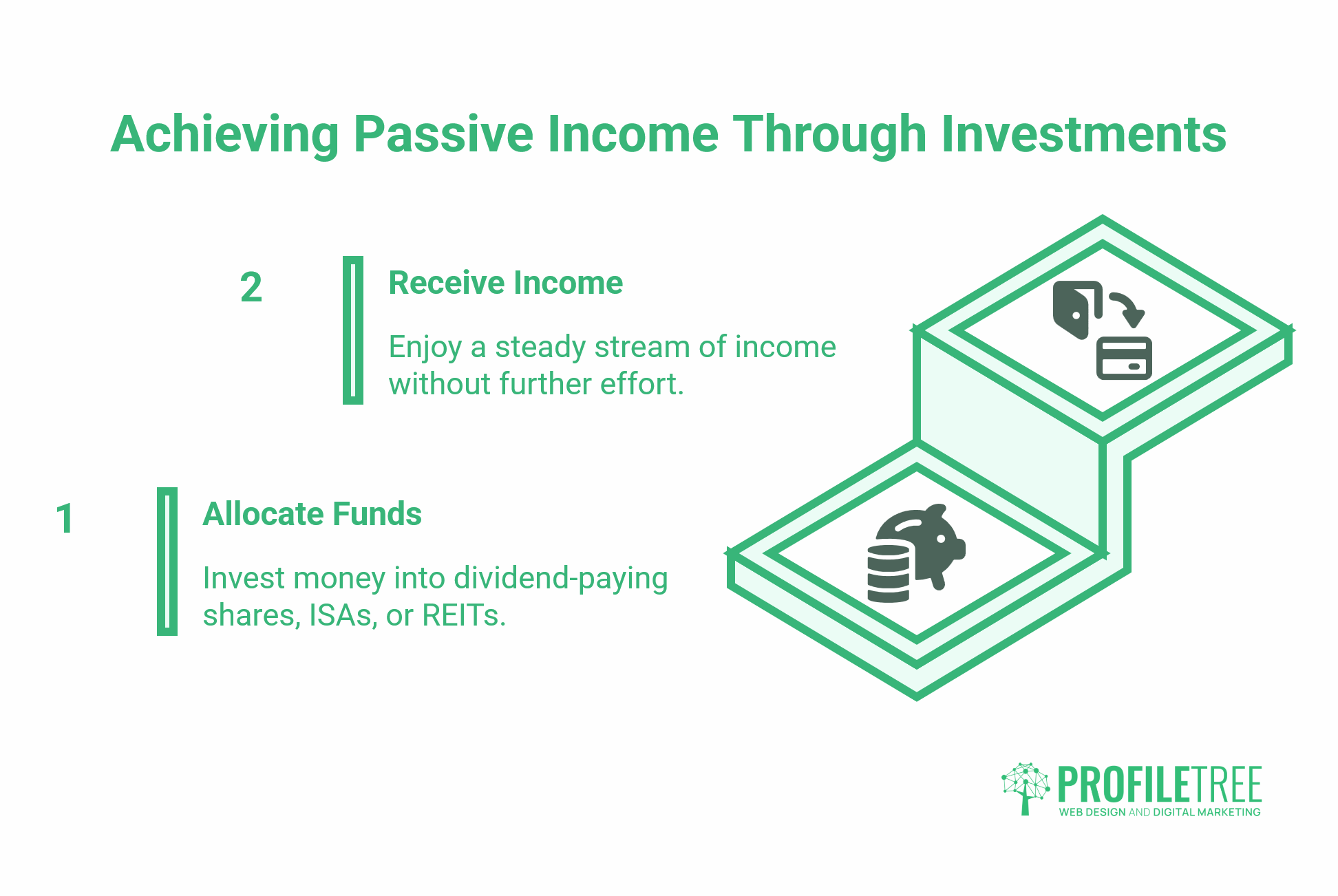
Investment-based income is the most genuinely passive category in this guide. Once money is allocated to dividend-paying shares, a Stocks and Shares ISA, or a REIT, income flows without ongoing creative or operational work.
This section covers the mechanisms in general terms only. For decisions about specific investment vehicles, speak to a regulated financial adviser. All investments can fall in value as well as rise.
Stocks and Shares ISAs
A Stocks and Shares ISA allows UK residents to invest up to £20,000 per tax year in stocks, bonds, and funds, with all returns — income and capital gains — free from UK tax. For passive income purposes, dividend-focused funds or investment trusts held within an ISA can produce a regular income stream without triggering tax on the distributions.
REITs
Real Estate Investment Trusts pool investor money to buy and manage property portfolios. UK-listed REITs are required to distribute at least 90% of their property income to shareholders, making them a more predictable income source than growth-focused equities. The key advantage over direct property ownership is liquidity: you can buy and sell REIT shares on a stock exchange without the legal and practical complexity of a property transaction.
Savings accounts and fixed-rate bonds
With interest rates elevated through 2024 and into 2025, fixed-rate savings accounts and cash ISAs have regained relevance as income sources. A fixed-term bond locks money away for one to five years in exchange for a guaranteed interest rate. It is the most genuinely passive income available, with no ongoing decisions required after the initial deposit.
Asset-Based Passive Income
Asset-based income is income earned from things you already own. It requires less build time than digital income and less capital than investment income.
The Rent-a-Room Scheme
As noted in the tax section, the Rent-a-Room Scheme allows homeowners to earn up to £7,500 per year tax-free from letting a furnished room. It applies only to your main residence, not to investment properties. For homeowners in Belfast, Derry, Dublin, or any UK and Irish city with strong rental demand, this is one of the highest-return, lowest-barrier income streams in this guide.
Landlord and tenancy law in Northern Ireland is governed separately from England and Wales. The Private Tenancies Act (Northern Ireland) 2022 introduced changes to tenancy deposit rules and notice periods. Anyone letting property in Northern Ireland should confirm compliance with the Rent Assessment Panel and their local council rather than assuming UK-wide guidance applies directly.
Renting driveways, garages, and storage space
Platforms like JustPark and Stashbee allow property owners to rent unused driveways, parking spaces, garages, and storage spaces. For homeowners near city centres, airports, or busy event venues, driveway rental can generate several hundred pounds per month with minimal ongoing involvement. Setup takes a few hours; income is largely automated once the listing is live.
Peer-to-peer lending
Peer-to-peer lending platforms connect borrowers with individual lenders, who earn interest on the money they lend. Returns are typically higher than those of savings accounts but carry credit risk that savings accounts do not. FCA-regulated UK platforms must follow consumer duty rules, but P2P loans are not covered by the Financial Services Compensation Scheme. This suits a diversified approach rather than as a standalone strategy.
How to Choose Your First Income Stream
The most common mistake is starting multiple streams at once and building none of them properly. The better approach is to match one stream to your current situation, build it until it genuinely earns, and then diversify.
Three questions narrow it down:
Do you have capital to invest? If so, and you have a long-term horizon, a Stocks and Shares ISA with dividend-focused funds is the most straightforward path. If you have capital and property, Rent-a-Room or driveway rental are low-complexity options with fast payback.
Do you have existing expertise or an audience? If yes, an online course or digital product is a faster route to income than building SEO traffic from scratch. You are converting existing trust into a product rather than building trust from nothing.
Do you have time but limited capital? A blog or YouTube channel built around a specific topic you know well is the lowest-cost entry point, but it requires patience. Treat the first six months as an infrastructure investment with no income expectation.
“The people who build sustainable passive income are usually the ones who went deep on one thing first,” says Ciaran Connolly of ProfileTree. “A single well-built affiliate site or a well-run YouTube channel outperforms three half-finished projects every time.”
Conclusion
Passive income in the UK is real, but it is rarely quick. Every stream in this guide involves a genuine trade-off: capital for the investment-based routes, sustained effort for the digital ones, and an existing asset for the property and rental options.
Pick one stream that matches your current situation, build it properly, and only diversify once it is actually working. The one consistent thread across every digital route is that the underlying platform determines the ceiling. A slow website will not rank. A YouTube channel with poor production will not retain viewers. Getting the technical and content foundations right is what makes everything else possible.
For SME owners in Northern Ireland, Ireland, and the UK who want support building those foundations, ProfileTree works with businesses on web design, SEO, content strategy, video production, and digital training, the building blocks that keep working long after the initial effort is done.
FAQs
What is the best passive income stream in the UK?
It depends on what you have available. If you have capital, a Stocks and Shares ISA or fixed-rate bond starts earning immediately with no ongoing effort. If you have expertise and time, affiliate marketing or an online course offers higher long-term returns but takes considerably longer to build.
How can I make £1,000 a month passive income in the UK?
Most people who reach this figure combine streams: room or driveway rental, ISA dividends, and affiliate commissions from an established blog, for example. Each piece is achievable, but building the combination realistically takes 12 to 24 months.
Do I have to pay National Insurance on passive income?
Generally no. Dividend income, rental income, and savings interest do not attract NI contributions. The exception is if HMRC classifies your activity as a trade, which can apply to commercial content businesses at scale.
Do I need to tell HMRC about my passive income?
Yes, once your income from outside PAYE exceeds £1,000 in a tax year. Register for Self Assessment by 5 October following the end of the relevant tax year, even if no tax is ultimately owed.