
How to Do SEO for International Websites
Table of Contents
Ranking in one country is hard enough. Ranking in five, each with its own language, search engine behaviour, and content expectations, is a different challenge entirely. Most businesses get international SEO wrong in the same three ways: they translate content without localising it, they set up URL structures that confuse search engines, and they skip hreflang entirely or implement it incorrectly.
This guide covers what actually matters: how to signal geographic targeting to search engines, which URL structure to choose and why, how to handle content localisation properly, and how to build the kind of backlink profile that supports rankings across multiple markets.
SEO for international websites requires three things working together: the correct technical setup (hreflang tags and URL structure), genuinely localised content for each target market, and region-specific link building. Get one wrong and the other two will underperform. The technical foundations are where most projects need the most work first, and this guide focuses on the decisions that determine whether your international expansion gains traction or stalls at launch.
What SEO for International Websites Actually Involves
International SEO is the process of making a website visible in search results across different countries or languages. It differs from standard SEO because you are not just optimising for one set of users, you are telling search engines which version of your content to show to which people, and why each version is relevant to its intended audience.
The core tasks fall into three categories. First, technical setup: making sure search engines understand your geographic and language targeting through hreflang tags, URL structure, and geo-targeting settings in Google Search Console. Second, content: producing pages that genuinely serve each market rather than pages translated through a machine with no cultural adaptation. Third, authority: building backlinks from within each target region so that local search engines see the site as a credible result.
Who Needs International SEO?
Not every business with overseas customers needs a full international SEO strategy. A Northern Ireland manufacturer that occasionally ships to Europe may need only a well-optimised English-language site with clear geographic information. A SaaS business targeting France, Germany, and Spain will need separate localised versions of core pages, hreflang implementation, and region-specific content.
The test is simple: are people in a specific country searching in their own language for what you offer? If yes, you need localised content. If they are searching in English and finding you already, technical signals and link building may be enough without full translation.
International SEO vs Local SEO
Local SEO targets customers within a specific physical area, typically using Google Business Profile, local citations, and location-based keywords. International SEO targets customers across country borders, often in different languages, and relies on technical signals and content strategy rather than proximity. Both matter for businesses with physical locations, but they require different approaches and different tools. If you are working on visibility in Belfast or Dublin first, start with local SEO foundations before layering in international targeting. ProfileTree’s SEO services cover local SEO strategy.
URL Structure: ccTLD, Subdomain, or Subdirectory?
This decision affects how search engines attribute authority to your international pages and how complex your site management becomes. There is no single right answer, but there are clear trade-offs.
Country Code Top-Level Domains (ccTLDs)
A ccTLD is a domain that ends with a country-specific extension: .fr for France, .de for Germany, .ie for Ireland. Search engines treat these as strong geographic signals, a .fr domain is very likely intended for French users. The trade-off is that each ccTLD is treated as a separate site, meaning domain authority does not transfer between them. You are building backlink profiles from scratch for each market.
ccTLDs make sense for large businesses with significant budgets for each market, or where brand credibility in a specific country justifies the investment. For most SMEs, they are overkill.
Subdomains
Subdomains place country or language versions under a prefix: fr.example.com for French, de.example.com for German. Search engines can geotarget subdomains in Google Search Console, but they behave similarly to separate sites in terms of link equity. They are easier to manage than ccTLDs but share the same drawback: links to the main domain do not automatically strengthen the subdomain.
Subdirectories (Recommended for Most SMEs)
Subdirectories use folders within the main domain: example.com/fr/ for French content, example.com/de/ for German. This keeps all authority consolidated under one domain. Every backlink to any page strengthens the overall domain, which benefits all regional sections. Google Search Console allows geo-targeting at the subdirectory level, and hreflang works cleanly with this structure.
For SMEs expanding internationally, subdirectories are the practical starting point. They are easier to set up, cheaper to manage, and concentrate the ranking power you have already built.
| Structure | Authority | Management | Best For |
|---|---|---|---|
| ccTLD (.fr, .de) | Separate per domain | Complex, expensive | Large businesses, market-specific branding |
| Subdomain (fr.example.com) | Mostly separate | Moderate | Mid-size businesses with separate teams per region |
| Subdirectory (example.com/fr/) | Shared, consolidates | Simplest | SMEs starting international expansion |
Hreflang Tags: How to Implement Them Correctly
Hreflang is the technical signal that tells search engines which language and geographic version of a page to show to which users. Get it wrong, and you will either see no benefit or actively harm rankings by confusing Google about your page relationships.
What Hreflang Does
An hreflang tag links versions of a page together and tells search engines: “This page in French is the equivalent of this page in English, and it should be served to French-speaking users.” Without it, Google may index one version and ignore others, or serve the wrong language to users who would have converted to the correct one.
Hreflang does not directly affect rankings in the traditional sense. It affects which version ranks, not how high. If you have an English-language page about your services ranking well in the UK, the hreflang tag connects it to your French version so that French users see the right page rather than the English one.
Implementation Basics
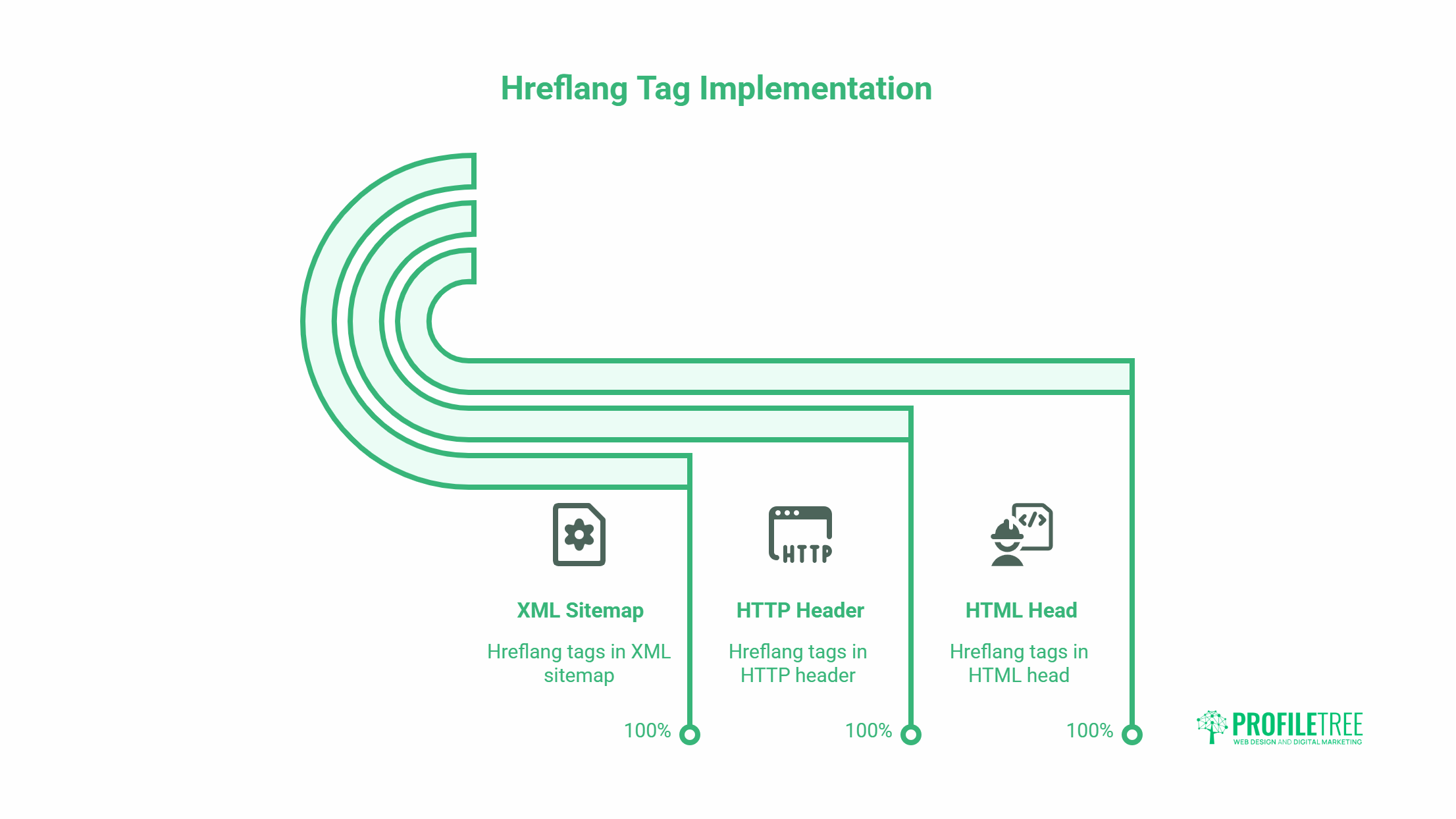
Hreflang can be implemented in three ways: in the HTML <head>, in the HTTP header, or in an XML sitemap. For most WordPress sites, the HTML head approach via an SEO plugin is the most practical.
Each hreflang tag must include the ISO language code and, where relevant, the country code. en-GB for British English, en-IE for Irish English, fr-FR for French in France. Every language version must reference all other versions, including itself, and there must be a default x-default tag for users who do not match any specific region.
A common error is implementing hreflang in one direction only, adding it to the English page but not to the French page. If the French page does not reciprocate by pointing back to the English version, search engines may ignore the tags entirely.
Common Hreflang Mistakes
The most frequent errors are: missing the x-default tag, inconsistent URL formats (some with trailing slashes, some without), pointing hreflang to pages that redirect rather than to the final URL, and failing to update hreflang when pages are moved or deleted. A poorly implemented hreflang setup is worse than no hreflang at all because it actively sends conflicting signals.
“The technical foundations of international SEO are what most SMEs underestimate. Hreflang errors alone account for the majority of international visibility problems we diagnose in new client projects, and they are almost always fixable within a day once the audit has been run.”, Ciaran Connolly, Founder, ProfileTree
Content Localisation vs Translation
Translating content is not the same as localising it. Translation converts words from one language to another. Localisation adapts content so that it reads naturally, references local context, and serves the search intent of users in that market.
Why Translation Alone Fails
Search engines have learned to identify machine-translated content, and users in the target market will sense immediately when content has been translated without being written for them. Beyond that, the keywords that work in one market may not map directly to how users in another market phrase the same search. A direct translation of an English keyword phrase into French may have low or no search volume in France because French users phrase the same intent differently.
What Localisation Involves
Proper localisation means adapting currency formats, date formats, units of measurement, cultural references, and legal information for each market. It means identifying the actual search terms used in that language through local keyword research, not just translating your English keyword list. It means reviewing the tone: some markets expect formal language in business communications; others expect conversational directness.
It also means creating locally relevant examples. A guide to digital marketing for UK businesses that references GDPR, ICO guidelines, and UK funding schemes is more useful to a UK audience than a generic guide covering no specific territory. The same principle applies to every market you target.
Content Prioritisation
You do not need to localise everything. Start with the pages that directly drive enquiries or sales: service pages, landing pages, and the homepage. Blog content can follow once the commercial pages are in place. Content localisation works best when it is planned alongside your keyword research rather than treated as a post-production step.
Technical SEO for International Sites
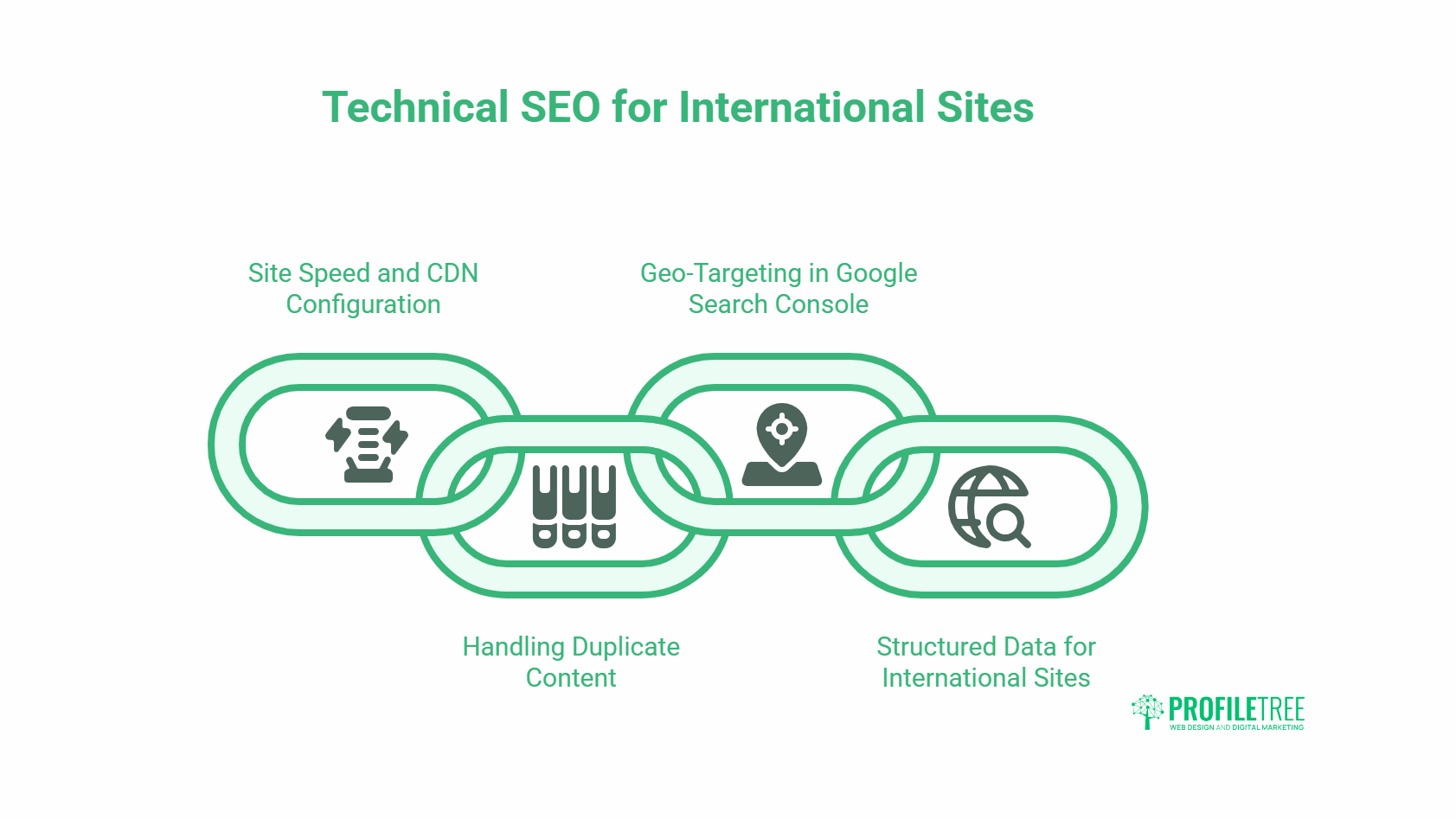
Beyond hreflang and URL structure, several other technical factors affect international search performance. These are worth addressing in sequence once the foundations are in place.
Site Speed and CDN Configuration
Page load speed is a ranking factor globally, but it becomes particularly important when your server is physically distant from your audience. A site hosted in Belfast serving users in Tokyo will load more slowly than a locally hosted site. A Content Delivery Network (CDN) distributes static assets (images, CSS, JavaScript) to servers closer to each user’s location, reducing load times regardless of where the user is.
For SMEs starting international expansion, a CDN is one of the higher-return technical investments. Most major hosting platforms include CDN capabilities, but configuration for international audiences requires checking that edge nodes exist in target regions.
Handling Duplicate Content Across Regions
A common problem with international sites is duplicate or near-duplicate content across language versions. Google may see pages with identical structure and only minor copy changes as thin content, particularly if machine translation has been used without significant adaptation.
Hreflang helps signal that pages are intentional regional variants rather than duplicates. Beyond that, each language version needs genuinely differentiated content. If two pages cover the same topic in the same language (for example, a British English and Australian English version), the content differences need to be substantial enough to justify separate URLs. Where they cannot be, consolidating into one page with a broader geographic scope is usually the better choice.
Geo-Targeting in Google Search Console
If you are using subdirectories or subdomains, you can set geographic targeting in Google Search Console at the property level. This gives Google an additional explicit signal about which country or region each section of the site is intended for. It supplements hreflang rather than replacing it.
ccTLD domains do not need manual geo-targeting — the domain extension provides that signal automatically.
Structured Data for International Sites
Schema markup helps search engines understand the entity relationships on your pages. For international sites, LocalBusiness schema on location-specific pages should reference the correct country, address format, and currency. WebPage A schema can include inLanguage to reinforce language signals. These are secondary to getting hreflang and URL structure right, but contribute to overall entity clarity. ProfileTree’s web design and development services include technical schema implementation as part of site builds.
Link Building for International Markets
Building backlinks from within each target country remains one of the strongest signals for regional ranking performance. A French website ranking well on Google.fr will typically have more backlinks from French domains than a competitor with only international links.
Regional Link Building Strategies
The most effective regional link building follows the same principles as domestic link building: earn links through content worth referencing, not through low-quality directory submissions or paid placements on irrelevant sites. In practice, this means producing content that serves the local market, building relationships with local publications and industry bodies, and contributing expert commentary to regional media.
For many SMEs, localised content itself attracts regional links over time. A guide to tax incentives for businesses in the Republic of Ireland, written accurately and in detail, will attract links from Irish business publications in a way that a generic English-language guide never would.Digital PR for International Markets
Digital PR, placing expert commentary, original research, or contributed articles in regional publications, builds both link equity and brand recognition in target markets. It is also one of the better ways to build entity associations in AI systems that are being trained on regional content. ProfileTree’s digital marketing services include digital PR and outreach as part of authority-building programmes. ProfileTree’s AI transformation services can also help businesses understand how AI-driven search is changing international visibility and how to adapt content strategy accordingly.
Measuring International SEO Performance
Tracking international SEO requires separating data by country and language to see what is actually working in each market.
Google Search Console Setup
Google Search Console’s country filter shows which countries your traffic comes from and which queries drive that traffic. For sites using subdirectories, you can create separate Search Console properties for each regional section to get granular data per market. For ccTLDs, each domain needs its own property.
The key metrics to track per market are: impressions (are your pages appearing in that country’s search results?), click-through rate (are users in that market choosing your result?), and average position (where are you ranking for priority queries?). A page with high impressions and near-zero clicks in a target market typically has a title or meta description that does not match local search intent.
Analytics Segmentation
In Google Analytics, segmenting traffic by country reveals which markets generate genuine engagement versus which generate traffic that bounces immediately. High bounce rates in a specific country often indicate a localisation problem: users are landing on content that is not adapted for them. Time on page and pages per session by country give a clearer picture of whether localised content is actually serving its intended audience.
Conclusion
International SEO rewards businesses that get the technical foundations right and then invest seriously in localisation rather than treating it as a translation job. The URL structure decision, hreflang implementation, and content localisation strategy all need to align before you will see meaningful movement in regional rankings.
If your business is planning to expand into new markets and you want a structured approach to local SEO from the technical audit through to content and link building, speak to the ProfileTree team.
Frequently Asked Questions
What is hreflang, and do I need it?
Hreflang is an HTML attribute that tells search engines which language and country a specific page is intended for. You need it if your site has multiple language versions or country-specific versions of the same content. Without it, Google may show the wrong language version to users or treat regional variants as duplicate content. For a site with only one language version targeting multiple English-speaking countries, hreflang is less critical but can still be used to specify regional preferences (for example, en-GB for UK users and en-AU for Australian users.
Should I use a ccTLD or a subdirectory for international SEO?
For most SMEs, subdirectories are the better starting point. They keep all domain authority consolidated, are simpler to manage, and allow geo-targeting through Google Search Console. ccTLDs make sense when you are building a market-specific brand identity and have the budget to develop separate link profiles for each domain. The decision should be driven by your budget, team capacity, and how distinct each regional version of your site needs to be.
How long does international SEO take to show results?
Expect three to six months before seeing meaningful movement in a new market, assuming the technical setup is correct and localised content is in place. Link building for a new regional presence takes longer — typically six to twelve months before a strong enough profile exists to compete with established local sites. The timeline shortens considerably if your site already has a strong overall domain authority and the regional content is genuinely well localised.
What is the difference between international SEO and local SEO?
Local SEO targets customers searching within a specific geographic area, typically for services with physical proximity (a restaurant, a plumber, a solicitor). It relies heavily on Google Business Profile, local citations, and map pack visibility. International SEO targets customers in different countries, often in different languages, and relies on hreflang, URL structure, and localised content rather than local citations. A business can need both: local SEO for its home market and international SEO for expansion into other countries.
Does machine translation hurt international SEO?
Yes, if used without significant human editing and localisation. Search engines have improved substantially at identifying machine-translated content, and they tend to treat it as low-quality or thin. Beyond the algorithmic issue, users in the target market can usually tell the difference, which increases bounce rates and reduces conversions. At a minimum, machine translation output should be reviewed and rewritten by a native speaker before publication.
How do I find the right keywords for international markets?
Do not simply translate your English keywords into the target language. Conduct keyword research directly in the target language using tools that have local search data for that market. Search volume, competition, and the way users phrase queries all differ by country and language. A phrase that drives significant traffic in UK English may have no direct equivalent search demand in French; users may phrase the same intent completely differently. Native-speaker input at the keyword research stage is worth the investment.