
Revenue Cycle Management: How Healthcare Businesses Get Paid
Table of Contents
For private clinics, dental practices, and independent healthcare providers across the UK and Ireland, the gap between delivering a service and actually receiving payment is rarely straightforward. Delayed reimbursements, denied insurance claims, and administrative bottlenecks are not just frustrating — they represent real financial pressure on organisations that are already stretched.
Revenue cycle management (RCM) is the process that bridges that gap. It covers everything from the moment a patient books an appointment to the point where the final payment clears. Get it right, and cash flow is predictable. Get it wrong, and you are chasing invoices, appealing rejections, and haemorrhaging admin time on work that should have been prevented upstream.
This guide explains what RCM is, how the process works in a UK and Irish context, and what private healthcare businesses can do to improve performance — including where digital tools and staff training make a measurable difference.
What Is Revenue Cycle Management (RCM)?
Revenue cycle management is the financial process that healthcare organisations use to track patient care episodes from registration through to final payment. It is not simply medical billing. Billing is one step within a wider cycle that includes patient registration, insurance eligibility checks, clinical coding, claims submission, payment posting, denial management, and patient collections.
The distinction matters. A business that focuses only on billing — sending invoices and chasing payments — is reactive. An organisation that manages the full revenue cycle is proactive: it prevents errors before they cause denials, catches eligibility issues before appointments, and monitors performance data to identify patterns that are costing money.
“Revenue cycle management” and “RCM in healthcare” are terms used interchangeably, but both refer to the same end-to-end process. Understanding what it covers — and where your organisation sits within it — is the starting point for any meaningful improvement.
The 7 Steps of the Revenue Cycle Management Process
Each stage of the revenue cycle connects directly to the next. A weakness at any point creates problems downstream, which is why the process needs to be managed end to end rather than stage by stage.
Patient Registration and Scheduling
The revenue cycle starts before a clinician sees the patient. At registration, the practice collects demographic details, contact information, and insurance data. Errors introduced at this stage — a misspelt name, an incorrect policy number, an outdated address — will cause problems at every step that follows.
For UK private healthcare providers, this means checking PMI membership numbers and pre-authorisation requirements at the point of booking, not after the appointment. Bupa, AXA Health, and Aviva all have specific pre-authorisation procedures for consultations and procedures. Missing these steps is one of the most common causes of avoidable denials.
Insurance Eligibility Verification
Before treatment begins, the practice needs to confirm that the patient’s policy is active and that the proposed service is covered. This sounds straightforward, but in practice, policies change, coverage limits vary by insurer, and patients do not always know what their plan includes.
Automated eligibility verification tools, integrated with your practice management software, can run these checks in real time at the point of booking. Without automation, staff run manual checks by phone or via the portal — a time-consuming process that is also prone to human error.
Charge Capture and Clinical Coding
After the appointment, the services delivered need to be documented and translated into medical codes. In the UK, private healthcare providers primarily use OPCS-4 for procedure coding and ICD-10 for diagnostic coding. These are not the same coding systems used in the United States, which means US-produced RCM guidance is often only partially applicable to UK practice.
Coding errors are one of the leading causes of claim denials. A procedure coded incorrectly or a diagnosis code that does not match the clinical documentation will result in a rejection. Investing in staff training on current coding standards is not a nice-to-have; it directly affects how much revenue the practice recovers.
Claims Submission and Clearinghouse Management
Once coded, claims are submitted electronically to the relevant insurer. In the UK private market, Healthcode is the primary clearinghouse for transmitting claims between providers and private medical insurers. It standardises submission formats and provides a record of what has been sent and when.
A clean claim — one submitted with all required fields completed accurately, with the correct codes and valid authorisation references — is processed faster and rejected less often. The goal at this stage is zero rework. Every claim that requires correction adds cost and delays payment.
Remittance Processing and Payment Posting
When the insurer processes a claim, it sends back a remittance advice detailing what has been paid, what has been adjusted, and what has been denied. This needs to be matched against the original claim and posted to the patient’s account.
Manual payment posting is slow and error-prone. Practices handling a high volume of claims — even relatively small ones with fifty to a hundred consultations per week — find that manual remittance processing becomes a bottleneck. Automated posting, which reconciles remittances against outstanding claims, significantly reduces the time to close out accounts.
Denial Management and Appeals
A denied claim is not necessarily a lost payment, but it requires action. The practice needs to identify why the claim was denied, correct any errors, and submit an appeal within the insurer’s stated timeframe.
The most effective denial management is retrospective: analysing denial patterns by insurer, coder, procedure type, or clinician to identify where the same errors recur. A single recurring coding error across fifty claims a month represents significant lost revenue. Identifying it allows the practice to correct the training or system issue that is causing it, rather than continuing to appeal individual claims.
Patient Collections and Final Settlement
The final step covers any amount the patient owes directly — excesses, co-payments, or costs not covered by their insurance. This is also the stage where the patient experience matters most. Unclear billing statements, unexpected charges, and difficulty making payments are the most common sources of patient complaints about private healthcare.
Offering patients clear itemised statements, online payment options, and straightforward communication about what they owe and why improves both collection rates and patient satisfaction. A well-designed patient portal, built around clear UX principles, makes a real difference here.
RCM vs. Medical Billing: What Is the Difference?
| Medical Billing | Revenue Cycle Management | |
|---|---|---|
| Scope | Sending and following up on claims | End-to-end financial process from registration to final payment |
| Focus | Claim submission and payment collection | Prevention, accuracy, and performance monitoring across all stages |
| Staff involved | Billing team | Billing, coding, admin, clinical, and management teams |
| Performance metrics | Days in accounts receivable, collection rate | Denial rate, clean claim rate, days in AR, net collection rate, cost per claim |
Medical billing is one component of RCM. A practice can have an efficient billing team and still have a poor RCM system if errors occur upstream in registration, coding, or authorisation.
RCM in the UK and Ireland: Private and Public Pathways
Most RCM guidance is written for the US market. The UK and Irish private healthcare landscape operates under different insurer relationships, coding standards, and regulatory obligations — and those differences matter when you are trying to reduce denials and improve collection rates.
Working with Private Medical Insurers in the UK
The UK private healthcare market is dominated by a small number of insurers — Bupa, AXA Health, Aviva, Vitality, and Cigna being the most significant. Each has its own submission formats, pre-authorisation requirements, fee schedules, and appeals processes.
Practices that work across multiple insurers need staff who understand the specific requirements of each. A claim submitted correctly under Bupa’s system may be formatted differently from one submitted to AXA. This is not something a generic billing guide covers; it requires insurer-specific knowledge developed through training and experience.
For smaller independent clinics, this complexity is one of the strongest arguments for investing in practice management software that automates insurer-specific submission rules, rather than relying on staff to hold that knowledge individually.
GDPR and Data Security in Financial Workflows
Revenue cycle management involves the transfer of clinical and financial data between providers, clearinghouses, and insurers. Under the UK GDPR and the Data Protection Act 2018, this data must be handled with appropriate security measures in place.
This is not simply a compliance concern. Data breaches in healthcare settings carry significant reputational and financial consequences. Any digital tool introduced into the RCM process — whether a payment portal, a practice management system, or a clearinghouse integration — must be assessed for data security during implementation.
For healthcare businesses in Northern Ireland, there is an additional layer of consideration given the cross-border nature of healthcare delivery and the different regulatory frameworks that apply in the Republic of Ireland under the Health Service Executive (HSE).
HSE and Private Healthcare in Ireland and Northern Ireland
Healthcare businesses operating in the Republic of Ireland work within a system that includes both the HSE public pathway and a private insurance market dominated by VHI Healthcare, Laya Healthcare, and Irish Life Health. The coding standards, claim formats, and reimbursement timelines differ from those used in the UK private market.
For providers in Northern Ireland working across both systems, or for all-island healthcare businesses, the administrative complexity multiplies. Separate staff training, separate system configurations, and careful management of which insurer rules apply to which patient cohort are necessary.
Common RCM Challenges for Private Healthcare Businesses
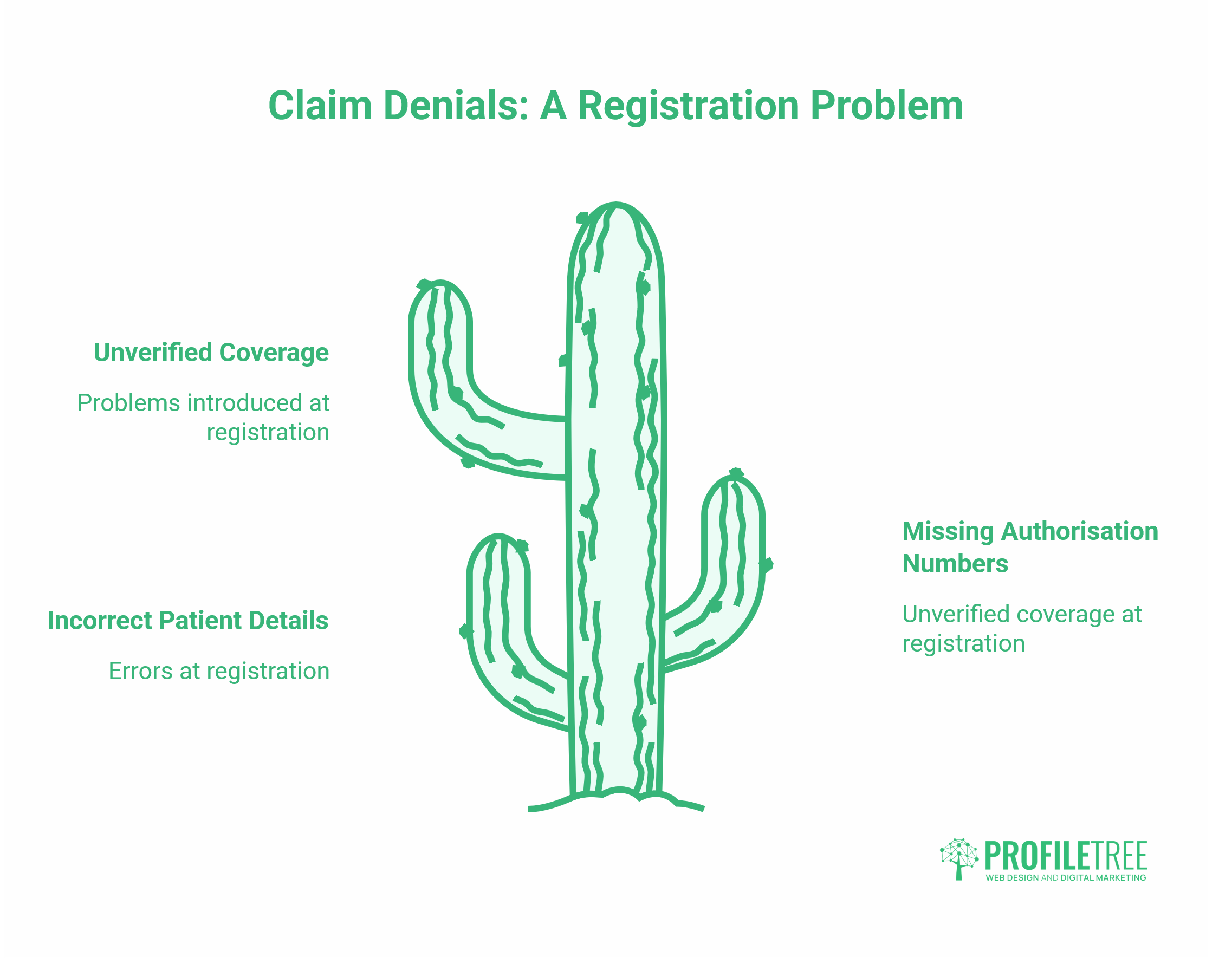
Front-end data errors. The majority of claim denials trace back to problems introduced at registration: incorrect patient details, missing authorisation numbers, or unverified coverage. Solving denial problems at the appeals stage is expensive; preventing them at registration is not.
Underpayments. Insurers do not always pay the full contracted rate. Underpayments — when a claim is paid at a lower amount than the agreed schedule — are easy to miss in high-volume practices, especially when remittance processing is manual. Monitoring for underpayments requires either dedicated audit processes or software that automatically flags discrepancies.
Staff turnover and knowledge loss. RCM relies heavily on institutional knowledge: which insurer requires which format, which codes apply to which procedures, and where the edge cases are. When experienced staff leave, that knowledge walks out with them. Documented processes and structured training programmes are the only reliable mitigation.
Legacy software. Older practice management systems that lack insurer integrations, automated eligibility checks, or real-time analytics create manual workarounds that cost time and introduce errors. The cost of upgrading is often lower than the cost of the inefficiencies the legacy system creates.
The hidden cost of denied claims. Reworking a denied claim takes staff time. For a busy practice processing a significant volume of claims, even a modest denial rate can represent hundreds of hours of administrative work per year. The financial case for investing in better front-end processes, coding training, or integrated software is straightforward when denial rates and rework time are tracked accurately.
AI and Automation in Revenue Cycle Management
Automation is already well-established in RCM, particularly in larger healthcare organisations. Robotic process automation (RPA) tools can handle repetitive, rules-based tasks — eligibility checks, claim status follow-ups, payment posting — with higher accuracy and lower cost than manual processing.
Artificial intelligence is being applied at the more complex end of the cycle: predictive denial management (flagging claims likely to be rejected before they are submitted), automated coding assistance, and pattern analysis across large claim datasets to identify systematic errors.
For smaller private practices and independent clinics in the UK and Ireland, the entry point is usually integrated practice management software rather than standalone automation tools. The key is choosing software that connects with your clearinghouse, your main insurers’ portals, and your clinical records system, so that data does not have to be re-entered at each stage.
Digital transformation in healthcare administration follows the same principles as digital transformation in any business sector. The starting point is understanding your current process, identifying where errors or delays are occurring, and selecting tools that address those specific problems rather than adopting technology for its own sake. ProfileTree’s AI implementation and training work with SMEs covers exactly this diagnostic approach — helping organisations map their workflows before selecting tools, rather than after.
Improving Your RCM System: Practical Steps
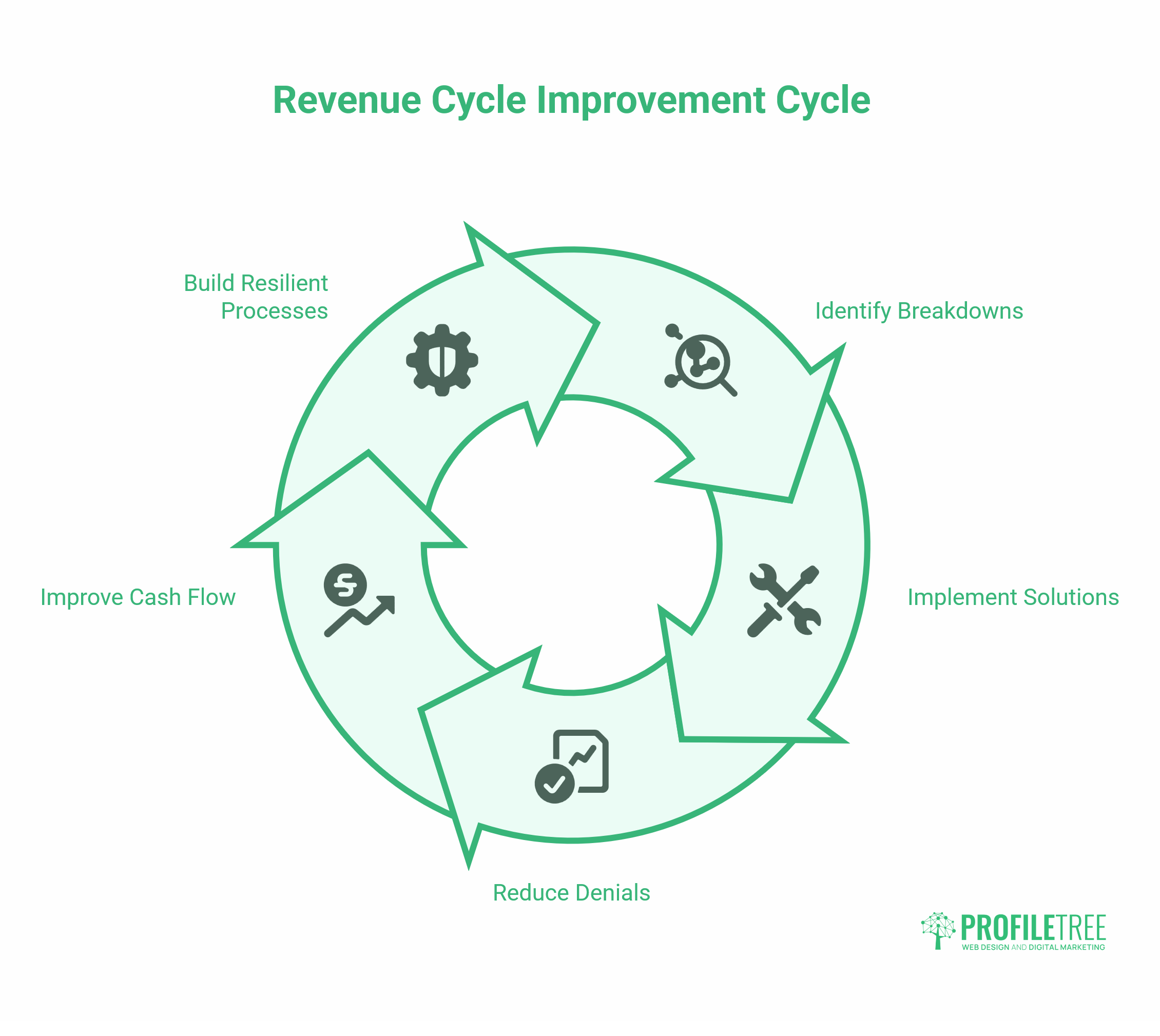
Knowing where the cycle breaks down is one thing; fixing it is another. These practical steps give practice managers a starting point for reducing denials, improving cash flow, and building processes that hold up under pressure.
Audit Your Denial Rate First
Before investing in any new system or process, establish your current baseline. What percentage of claims are being denied? Which insurers are generating the most denials? Which procedure types or coders are associated with higher denial rates? Without this data, you are making changes without knowing whether they are working.
Most practice management systems can generate this data. If yours cannot, it is worth treating that limitation as a problem in its own right.
Standardise Front-End Processes
Registration and eligibility verification should follow a written checklist, not individual staff habits. Who checks pre-authorisation for which insurers? At what point in the booking process? What happens when eligibility cannot be confirmed before the appointment? Standardised processes remove the dependency on individual knowledge and make training new staff significantly easier.
Invest in Coding Training
Coding standards change. OPCS-4 is updated periodically, and ICD-10 codes are revised. Staff who were trained on the current codes two years ago may be working with outdated knowledge. A structured annual training programme — rather than ad hoc updates — maintains coding accuracy. For smaller practices without in-house coders, outsourcing to a specialist medical coding service is worth evaluating against the cost of denial rework.
Healthcare businesses looking to build broader digital capability in their teams, including working with digital admin tools and data systems, can find relevant support through ProfileTree’s digital training programmes for business teams.
Build a Patient-Facing Payment Experience
Patient collections are the final stage of the cycle, and they are often the most neglected. Patients who receive confusing statements, do not know what they owe, or find it difficult to pay are less likely to settle promptly. A clear, straightforward online payment process reduces the time to collect patient balances and reduces the volume of queries your admin team has to handle.
This is fundamentally a web and UX problem as much as a billing one. A healthcare business that invests in professional web development for its patient portal is investing in its own cash flow.
Track the Right KPIs
RCM performance is measurable. The metrics that matter most for private healthcare businesses include:
| KPI | What It Measures | Target |
|---|---|---|
| Clean claim rate | % of claims accepted on first submission | 95%+ |
| Denial rate | % of claims denied by insurers | Below 5% |
| Days in accounts receivable (AR) | Average time to collect payment | Below 30 days for PMI |
| Net collection rate | % of collectible revenue actually collected | 95%+ |
| Cost per claim | Admin cost of processing each claim | Track trend over time |
Reviewing these monthly reports gives practice managers early warning of problems before they compound.
In-house RCM vs. Outsourcing: How to Choose
For smaller practices, the question of whether to manage RCM internally or outsource to a specialist provider comes down to volume, complexity, and staff capacity.
In-house RCM gives you direct control, immediate access to data, and the ability to integrate billing with clinical workflows. It works well when you have dedicated, trained staff and a manageable claim volume.
Outsourced RCM transfers the administrative burden to a specialist and can improve denial rates where the provider has deep insurer knowledge. It makes financial sense when your in-house denial rate is high, when staff turnover is disrupting continuity, or when the time your team spends on billing is displacing other work.
A hybrid approach — handling routine submissions internally while outsourcing appeals and complex denials — is also a viable option for mid-sized practices.
Whatever approach you take, the underlying principle is the same: the more accurate and standardised your front-end processes are, the less rework you need at the back end, whether that work is done internally or by a third party.
Conclusion
Revenue cycle management is, at its core, a process problem before it is a technology problem. Private healthcare businesses across the UK and Ireland that see persistent denial rates, slow collections, or high admin overhead almost always trace those issues back to inconsistent front-end processes, outdated coding knowledge, or disconnected systems. The good news is that each of those problems is fixable with the right combination of process discipline, staff training, and appropriate digital tools. If your practice is ready to improve how it manages data, systems, and team capability, ProfileTree’s digital training and AI implementation services are a practical starting point.
FAQs
What is revenue cycle management in healthcare?
Revenue cycle management is the end-to-end process healthcare organisations use to track and collect payment for services delivered. It runs from patient registration and insurance verification through clinical coding, claims submission, payment posting, denial management, and final patient collections.
What are the 7 steps of revenue cycle management?
The seven core stages are: patient registration, insurance eligibility verification, charge capture and coding, claims submission, remittance processing, denial management, and patient collections. Each new patient episode restarts the sequence, which is why the process is described as a cycle rather than a linear workflow.
What is the difference between RCM and medical billing?
Medical billing refers specifically to the creation and submission of claims to insurers or patients. RCM is the broader process covering every stage from registration to final payment. Billing is one component within the revenue cycle, not a synonym for it.
What does RCM mean in healthcare?
RCM stands for revenue cycle management. It describes the administrative and financial processes healthcare organisations use to manage the financial journey from patient appointment through to payment receipt.