
Understanding Your Data: Why Averages Mislead Your Marketing
Table of Contents
Most business owners reviewing their digital marketing reports are making decisions based on a single number. That number is almost always a mean average, and in many cases, it gives them a distorted picture of what is actually happening.
Understanding your data starts with knowing which summary figure your reporting tool is giving you and whether that figure is the right one for the decision you are making. For SMEs across Northern Ireland, Ireland, and the UK, the difference between mean and median is not an academic question. It is the difference between cutting a campaign that is actually working and scaling one that only looks like it is.
Understanding your data properly means knowing when an average tells the truth and when it conceals it. The good news is that you do not need a data science background to get this right. You need a clear framework and the discipline to apply it before acting on any report.
The Mean vs Median Trap: A Digital Marketing Perspective
Before getting into the practical applications, it is worth being clear on what these two measures actually do.
The mean is calculated by adding all values in a dataset and dividing by the number of entries. It is the figure most reporting tools display by default, and it is the one most people mean when they say “average.”
The median is the middle value when all data points are arranged in order. Half the values sit above it, half below it. Unlike the mean, it is not pulled by extreme values at either end of the dataset.
The table below is a practical starting point for understanding your data across the metrics that matter most to SME marketing teams.
| Metric | Mean (Average) | Median (Middle Value) |
|---|---|---|
| What it measures | Mathematical centre | Positional centre |
| Affected by outliers | Yes, significantly | No |
| Best used for | Financial totals, symmetrical data | Performance analysis, skewed data |
| Risk in marketing | Masks poor typical performance | May understate occasional peaks |
| Common in | GA4 default reports, ad dashboards | Manual exports, Excel analysis |
“One of the most common mistakes we see when businesses review their own data is treating the mean as a reliable benchmark for typical performance,” says Ciaran Connolly, founder of ProfileTree. “When your data contains outliers, which in digital marketing it almost always does, understanding your data means knowing which measure to reach for first.”
Why the Mean Often Lies About Website Performance
Consider a straightforward example. A small e-commerce business in Belfast checks its average order value in GA4 and sees £68. That looks healthy. It uses that figure to justify its current paid traffic spend and keeps the campaign running.
What the mean does not show is that one wholesale order worth £1,100 was placed that month, which pulled the figure upward. Strip that single transaction out, and the typical customer is spending £12. The campaign is, in reality, generating low-value orders that do not cover the cost of acquisition.
This is not a contrived scenario. It is exactly the kind of distortion that happens when bot traffic spikes inflate average session duration, when a single viral piece of content skews average time on page across an otherwise low-engagement site, or when one high-performing keyword makes average keyword position look stronger than it is across a campaign.
Understanding your data in these situations means recognising that the mean is a useful summary for totals and symmetrical distributions. For performance analysis on skewed datasets, which is most of digital marketing, the median gives a more reliable picture of what the typical value looks like.
ProfileTree’s digital marketing strategy work includes reviewing how clients are reading their own reports before making any recommendations, precisely because misread metrics lead to misallocated budgets.
When to Use the Median to Protect Your Marketing Budget
There are three specific areas where switching from mean to median changes decisions for UK and Irish SMEs.
Keyword Position Reporting
GA4 and Google Search Console both report average keyword position across a campaign. If you are tracking 200 keywords and ten of them are branded terms sitting at position one, those terms pull the mean position downward and make overall performance look stronger than it is for non-branded commercial queries. The median position across your non-branded terms is a more honest indicator of where your SEO is actually performing for people who do not already know your name.
Cost Per Click Analysis
Paid campaigns often include a small number of keywords with unusually high CPCs, which inflate the account’s mean CPC. A single competitor term bidded aggressively can make average spend per click look significantly higher than what most of your traffic is actually costing. Median CPC gives a more stable benchmark for budget planning and is less likely to trigger unnecessary bid adjustments.
Session Duration and Engagement
Average session duration is one of the most widely misread metrics in website analytics. A small number of users who land on a page and leave the browser tab open can inflate the mean substantially, particularly on low-traffic pages. Median session duration, which requires an export to Excel or BigQuery since GA4 does not surface it natively, tells you what a typical visit actually looks like. That is the figure that should inform decisions about content length, page structure, and calls to action during a web design or development project.
ProfileTree’s SEO services include regular reporting that surfaces median alongside mean figures for keyword performance, so clients are not making strategic decisions based on figures skewed by outliers.
5 Steps to Properly Understanding Your Business Data
The following five steps give any business owner a repeatable process for understanding your data before acting on it. Applied consistently, they reduce the risk of decisions being driven by a misleading average.
Step 1: Identify Outliers Before You Summarise
Before reading any average figure, check whether the dataset contains extreme values. In GA4, segment by channel or device to see whether a single traffic source is distorting the overall picture. In a paid campaign, sort keywords by spend to see whether one term is pulling the mean.
Step 2: Choose the Right Measure for the Question
Use the mean when you need a total-based calculation, such as average revenue per month for forecasting purposes. Use the median when you want to understand typical performance on a metric that is likely to contain outliers, such as session duration, CPC, or page load time. Understanding your data means matching the measure to the question rather than defaulting to whichever figure the platform displays.
Step 3: Segment Before You Conclude
A mean or median calculated across an entire dataset can obscure significant variation between segments. A Northern Ireland business serving both local and international customers may find that the median order value differs substantially between those two groups. Reporting a single figure across both audiences produces a number that accurately represents neither. Segmenting by region, channel, device, or customer type before summarising gives a more actionable picture.
Step 4: Visualise the Distribution
A single summary statistic, whether mean or median, tells you where the centre of your data sits. It does not tell you how spread out the values are. Plotting a simple histogram in Excel or Google Sheets, even for a small dataset, often reveals whether you are dealing with a broadly consistent distribution or one where a small number of extreme values are doing most of the work. ProfileTree’s digital training programmes for SMEs in Northern Ireland cover exactly this kind of practical analytics work, without assuming access to enterprise-level BI tools.
Step 5: Act on Typical Performance, Not Exceptional Performance
The temptation when reviewing reports is to focus on peaks: the best-performing day, the highest-converting campaign, the page with the longest session time. Those peaks matter, but strategy should be built around what typically happens, not what occasionally happens. The median is the practical tool for grounding decisions in typical performance rather than exceptional performance. Understanding your data at this level is what separates reactive marketing from genuinely strategic decision-making.
The UK SME Context: Data, Privacy, and Regional Nuance
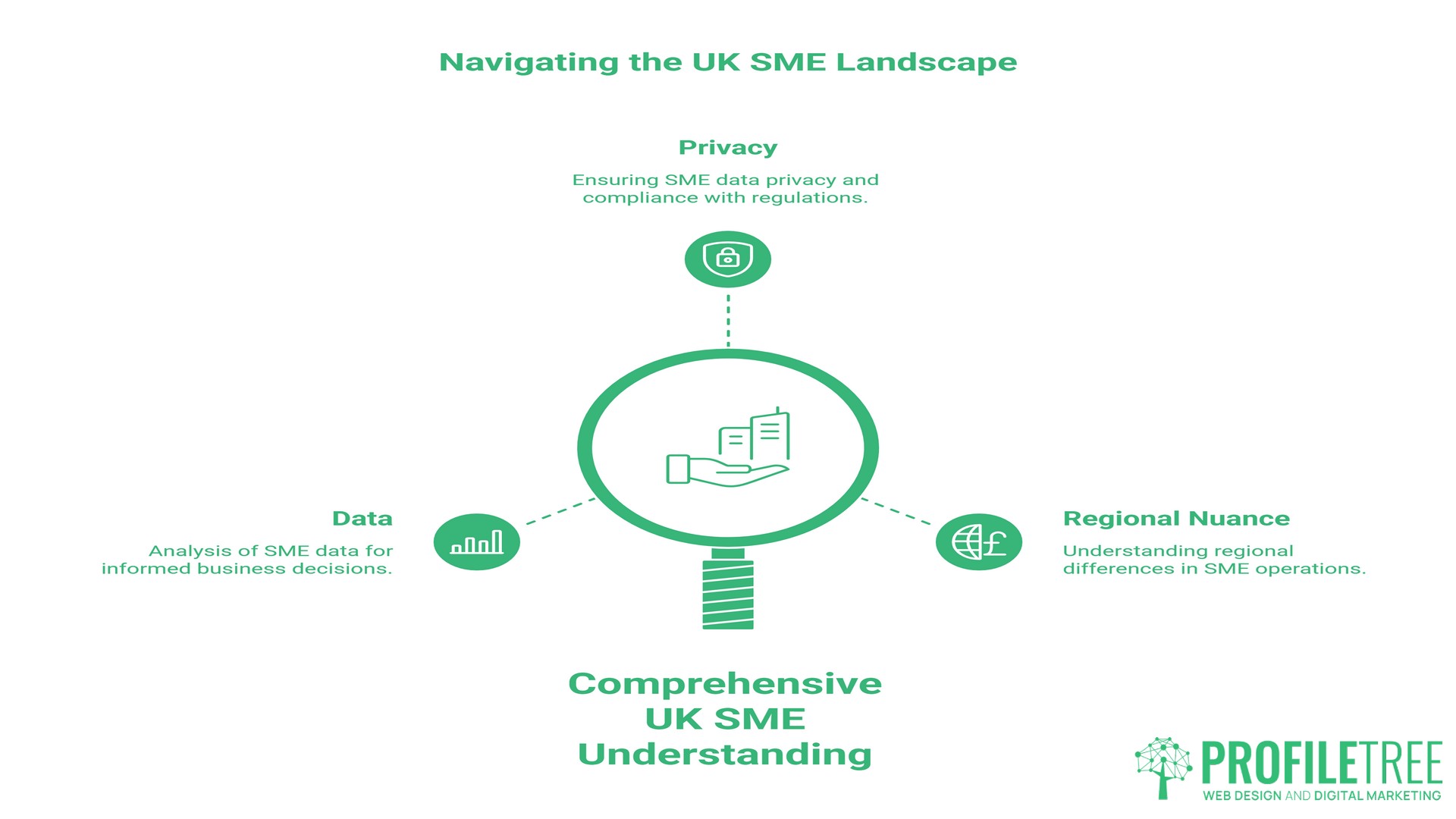
There is a specific challenge for businesses operating in Northern Ireland, Ireland, and across the wider UK that most data literacy guides overlook entirely: small dataset volatility.
The statistical guides produced by US enterprise software companies assume large datasets where means and medians converge because outliers become proportionally less significant. For a Belfast retailer with 300 monthly website sessions or a Derry-based service business running a modest Google Ads account, a single unusual week can move the mean dramatically. Smaller datasets are inherently more sensitive to outliers, which makes understanding your data through the median even more important at the SME scale.
There is also a regulatory dimension. UK GDPR and the Data Protection Act 2018 affect how businesses collect and retain customer data, which in turn affects the sample sizes available for analysis. An SME that has applied strict cookie consent settings, as most should under current ICO guidance, may be working with significantly smaller analytics datasets than they realise. Decisions made from a dataset of 50 sessions rather than 500 carry substantially more statistical risk, regardless of whether the mean or the median is used.
ProfileTree’s AI implementation and transformation work with UK and Irish SMEs includes helping businesses understand the limitations of their data before applying any automated analysis, because AI-generated insights are only as reliable as the data going in.
Making Better Decisions With Your Digital Reports

Understanding your data is not about becoming a statistician. It is about knowing which questions to ask before acting on a number. For most SMEs reviewing digital marketing performance, that means checking for outliers before trusting a mean, reaching for the median when the data is likely skewed, and segmenting before concluding.
The businesses that get the most from their digital marketing investment are not necessarily those with the most data. They are the ones who know how to read what they have. If you want support interpreting your analytics and building reporting that reflects what is actually happening in your campaigns, ProfileTree’s digital marketing team works with SMEs across Northern Ireland, Ireland, and the UK to do exactly that.
Frequently Asked Questions
Why is my average session duration so different from my median session duration?
The gap between mean and median session duration is almost always caused by outliers. A small number of users who land on a page and leave their browser open, or bot traffic that registers extended sessions without genuine engagement, can pull the mean substantially higher than the median. The median reflects what a typical visit looks like. If those two figures are significantly different, that gap itself is telling you something important about the quality of your traffic.
Is mean or median better for tracking SEO keyword rankings?
For day-to-day performance analysis, the median is the more reliable measure. A small number of branded or navigational keywords at position one will pull the mean position downward, making overall performance look stronger than it is for the commercial queries that matter most. Track median position for non-branded terms separately to get an honest picture of where your SEO is performing.
How do I calculate the median in Google Analytics 4?
GA4 does not surface median figures natively in its standard reports. To calculate the median for metrics like session duration or revenue, you need to export the raw data to Google Sheets or Excel and use the MEDIAN function, or connect GA4 to BigQuery for more advanced analysis. ProfileTree’s digital training covers this process for SME teams who want to go beyond default dashboard figures.
Why should UK SMEs care about data distribution?
Smaller datasets, which most SMEs are working with, are more sensitive to outliers than the large datasets that enterprise-level guides assume. A single unusual week, one viral post, or one large order can move the mean significantly and produce a misleading picture of typical performance. Understanding your data distribution, rather than relying on a single summary figure, is particularly important when you are making budget decisions from a limited data pool.
When is the mean actually useful in marketing?
The mean is the right measure when you need a total-based calculation. Average revenue per month for annual forecasting, total ad spend divided by total conversions for blended cost per acquisition, and overall return on investment calculations all use the mean appropriately because you are working with symmetrical aggregates rather than trying to understand typical individual behaviour. The problem arises when the mean is applied to skewed performance data, where it does not accurately represent what most users, sessions, or transactions look like.