
Digital Transformation Misconceptions: The Truth UK Leaders Need in 2025
Table of Contents
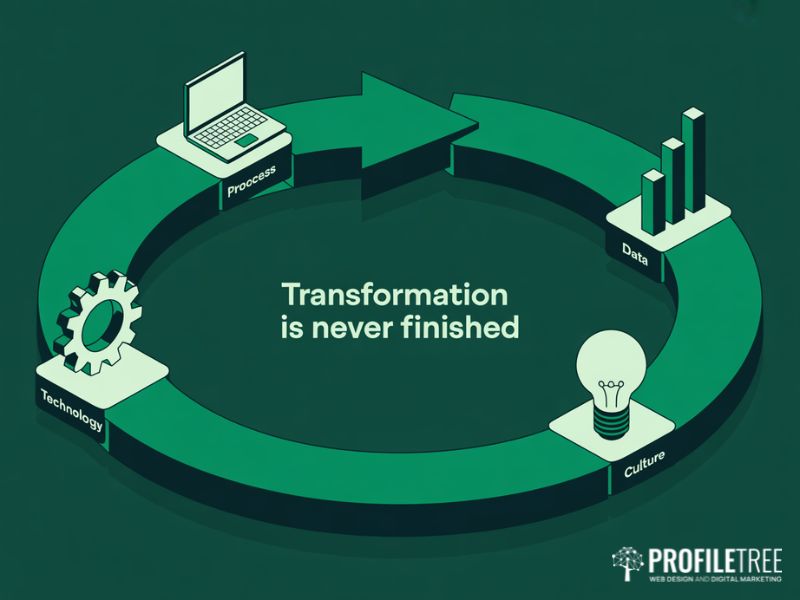
The digital transformation misconception that causes the most damage inside UK businesses is not the obvious one. It is not the belief that technology alone solves everything, although that one is plenty destructive. The deepest digital transformation misconception is the idea that transformation is something you complete, like a project, rather than something you maintain, like a capability. For over a decade, digital transformation has been sold to boardrooms across the country as a destination. Billions have been spent. Yet, as of 2025, approximately 70% of digital transformation initiatives still fail to deliver their intended results.
ProfileTree, a Belfast-based web design and digital agency, works with SMEs and mid-market businesses across Northern Ireland, Ireland, and the UK. That frontline experience makes one thing very clear: the organisations that struggle are rarely short of ambition or budget. What holds them back is a cluster of deeply embedded misconceptions about what digital transformation actually involves. This article names them, explains the damage they cause, and sets out what genuine progress looks like.
Recognising a digital transformation misconception early is significantly cheaper than correcting the consequences of acting on one for two years.
What Is Digital Transformation?
Before addressing each digital transformation misconception, it is worth establishing a shared definition. Digital transformation refers to the use of digital technologies to fundamentally change how a business operates, delivers value to customers, and competes in its market. It is not a software purchase. It is not a new website. It is a sustained process of integrating digital thinking into every layer of the organisation. Building that thinking starts with a clear digital strategy for your business, which defines priorities before any technology decision is made.
The Core Components of Real Transformation
Genuine digital transformation covers several interconnected areas, and any strategy that addresses only one or two of them is incomplete. The components below represent the full scope of what is involved.
- Search engine optimisation services: ensuring the business is discoverable by the right audiences as digital channels become the primary route to market.
- Technology integration: cloud computing, AI tools, automation, data analytics, and IoT adoption.
- Data-driven decision making: using real-time insight rather than historical assumption to guide strategy.
- Customer experience: delivering seamless, personalised interactions across every channel.
- Content marketing strategy: producing authoritative, useful content that builds trust with customers and supports organic search performance.
- Business model evolution: identifying new revenue streams and service models enabled by digital capability.
- Workforce development: investing in continuous upskilling so people can work effectively in a digital environment.
Each of these areas is equally important. The digital transformation misconception that it is primarily about technology adoption collapses when you recognise that culture and people are consistently where transformation programmes stall, not the technology itself.
The Most Costly Digital Transformation Misconceptions
The following digital transformation misconceptions are the ones we encounter most frequently when speaking with UK business leaders. Each one represents a genuinely held belief that leads to real and measurable failures. Working through them honestly is the first step toward a strategy that actually delivers.
Misconception 1: Digital Transformation Is Primarily About Technology
This is the most common digital transformation misconception of all, and arguably the most expensive. When businesses frame transformation as a technology project, they naturally delegate it to the IT department and treat adoption as the end goal. A well-considered web design and development foundation is a meaningful enabler, but it does not constitute transformation on its own. What follows from that misframing is investment in platforms and tools that the organisation is not culturally or structurally prepared to use effectively.
Technology is an enabler. It is not the transformation itself. A business that installs a new CRM system without changing how its sales team thinks about customer relationships has purchased software. It has not transformed. The organisations that achieve lasting digital change are those that treat cultural alignment, leadership buy-in, and process redesign as primary investments, with technology serving those goals rather than driving them.
When ProfileTree audits a client’s digital maturity, the most common finding is not that they lack tools. It is that the tools they already have are being used at a fraction of their capability because the organisation has not changed the behaviours and processes around them.
Misconception 2: Digital Transformation Is a One-Time Project
Another widely held digital transformation misconception is that transformation has a finish line. Organisations invest in a 12 to 18 month programme, declare it complete at the end, and then wonder why the benefits erode within two years. Digital transformation is not a project with a clear start and end date. It is an ongoing operational state that requires continuous adaptation.
Markets change. Technologies evolve. Customer expectations shift. The businesses that maintain competitive advantage are those that build the internal capability to keep adapting. The moment an organisation believes it has finished transforming is typically the moment it begins falling behind.
Misconception 3: Digital Transformation Is Only for Large Enterprises
Many SMEs operate under the digital transformation misconception that transformation is a resource available only to organisations with significant capital and dedicated technology teams. This is no longer true. Cloud-based tools, SaaS platforms, and accessible social media marketing services have fundamentally changed the cost and complexity of implementing digital capability at any scale.
Smaller businesses often carry a structural advantage in transformation. They have less legacy infrastructure, fewer internal politics to navigate, and can implement change more quickly than large corporations burdened by decades of accumulated systems. The digital transformation misconception that size is a prerequisite for participation actively prevents SMEs from capturing competitive advantage that is available to them right now.
Misconception 4: Digital Transformation Must Be Disruptive
There is a persistent digital transformation misconception, often amplified by technology press and consultancy marketing, that real transformation must be bold and disruptive. The implication is that incremental progress is a form of failure. This is wrong. It leads businesses to pursue dramatic overhauls when measured, sequenced improvements would deliver significantly better outcomes.
Not every organisation needs to reinvent its business model. Many need something less dramatic: better data visibility, a more efficient customer journey, or improved internal collaboration. The digital transformation misconception that disruption is a prerequisite for success has derailed many well-funded initiatives that would have succeeded with a more measured approach.
Misconception 5: The IT Department Owns Digital Transformation
This digital transformation misconception is structural rather than conceptual, but the damage it causes is equally serious. When transformation is classified as an IT initiative, it loses the cross-functional ownership it requires to succeed. Marketing, sales, operations, HR, and customer service all need to be active participants in a transformation strategy, not recipients of technology implemented by another department.
The IT team plays a vital role in implementation and infrastructure, but decisions about process change, customer experience, and workforce development need to involve the people doing the work and the leaders setting strategy. Communicating change effectively across the organisation, including through video marketing and internal communications, is one practical way to build shared understanding across departments.
Misconception 6: Results Should Arrive Quickly
The final digital transformation misconception in this section is the expectation of rapid return on investment. Businesses invest in transformation and expect measurable results within months. When results are slower to materialise, confidence in the programme collapses and investment is withdrawn before the strategy has had time to work.
Digital transformation builds capability over time. Some benefits arrive relatively quickly, such as improved process efficiency. Others, such as stronger customer loyalty, expanded market share, or sustainable cost reduction, take considerably longer to appear. Setting realistic expectations is not a sign of weak ambition. It is good strategic discipline.
| Digital Transformation Misconception | The Reality | The Risk If Uncorrected |
|---|---|---|
| It is primarily about technology | Culture, process, and people drive outcomes | Low adoption, wasted investment |
| It is a one-time project | It is a permanent operational capability | Capability atrophies after launch |
| Only large enterprises can do it | SMEs have structural advantages | Missed competitive opportunity |
| It must be disruptive | Incremental change often delivers better ROI | Overreach leads to failure |
| IT owns it | Every department must participate | Siloed systems, unused platforms |
| Results arrive quickly | Long-term capability builds gradually | Abandonment before benefits arrive |
The AI Mirage: When the Digital Transformation Misconception Gets Expensive
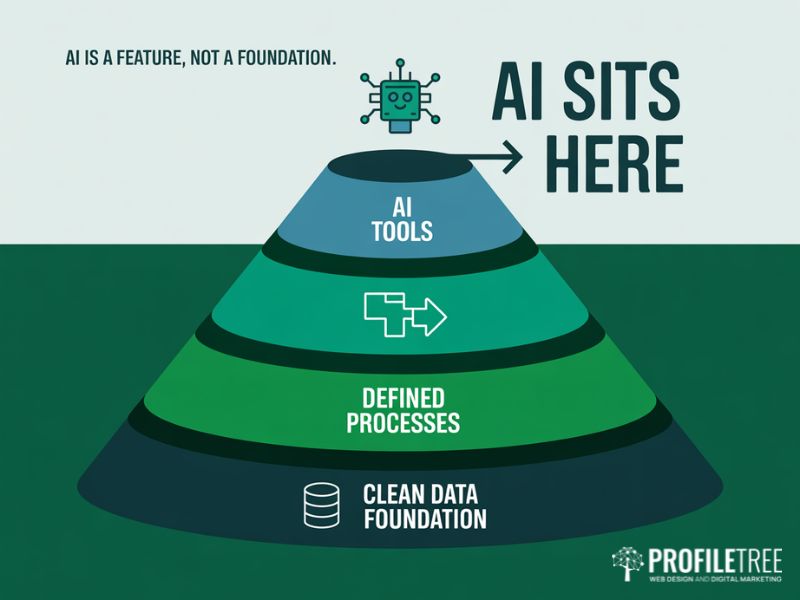
The most dangerous digital transformation misconception circulating in UK business in 2025 is specific to artificial intelligence. There is a widespread belief that implementing generative AI tools is a shortcut to digital maturity. The problem is the assumption that AI can be layered on top of fragmented data, disconnected systems, and underdeveloped processes to produce immediate transformation.
It cannot. AI is a feature, not a foundation. Introducing a sophisticated AI interface on top of a disconnected legacy data architecture produces impressive demonstrations and underwhelming operational results. The AI amplifies whatever the underlying data and processes allow. If those are poor, the AI outputs are poor, delivered faster. According to McKinsey’s research on digital transformation, organisations that invest in data foundations before AI deployment are twice as likely to report sustained performance gains.
According to McKinsey’s research on digital transformation, organisations that invest in data foundations before AI deployment are twice as likely to report sustained performance gains.
“We see businesses rush into AI pilots that stall within six months, not because the AI technology failed them, but because they had never addressed the data architecture underneath it. True digital transformation is the prerequisite for effective AI adoption, not the consequence of it.” Ciaran Connolly, Founder of ProfileTree
What AI-Ready Digital Transformation Actually Looks Like
Achieving meaningful AI adoption requires a specific set of foundations to be in place before any tool is implemented at scale. Each of these represents the practical opposite of the digital transformation misconception that AI is a starting point rather than a destination.
- Unified, clean data: AI systems require structured, accessible, and accurate data to produce reliable outputs.
- Clear process design: AI works best when the process it supports is already well-defined and documented.
- Staff readiness: people need to understand how to interpret and act on AI-generated outputs, not just receive them.
- AI chatbots for business: deploying conversational AI works best when customer journeys are already mapped and data capture is consistent.
- AI marketing and automation: integrating automated workflows into marketing and sales requires a well-governed data layer first.
- Governance and compliance: UK GDPR and sector-specific regulatory requirements must be built into any AI deployment from the outset.
At ProfileTree, our digital training programmes for businesses are designed to address exactly this sequence. We work with leadership teams to build the understanding and infrastructure that makes AI adoption sustainable, rather than delivering a tool and leaving the organisation to work out how to use it.
UK Business Realities: The Digital Transformation Misconception Meets Local Conditions
Global frameworks for digital transformation are typically built around the experience of large American corporations with greenfield technology environments. UK businesses, particularly those operating in the mid-market, face a different set of conditions. Recognising those conditions is important for any organisation trying to build a credible transformation strategy.
The Technical Debt Challenge
Many UK businesses are operating on systems that were built 10 to 20 years ago. The digital transformation misconception that these systems can simply be replaced is common, and it leads to catastrophically scoped projects that overrun budgets and timelines. The reality is that transformation in established UK businesses is often an exercise in careful integration: connecting modern website development solutions to legacy infrastructure without collapsing the operational processes that depend on it.
Working through technical debt incrementally, prioritising the systems that create the most friction or carry the highest risk, is a more effective strategy than attempting to replace everything simultaneously.
The UK Skills Gap
The digital skills shortage in the UK is well-documented and directly affects the pace at which businesses can transform. The digital transformation misconception that you can implement new technology without developing the people who will use it creates a specific failure pattern: investment in platforms combined with no investment in capability, resulting in expensive systems used poorly.
Addressing the skills gap requires more than sending staff on a one-day course. It requires sustained investment in digital literacy at every level of the organisation. ProfileTree’s business digital training courses are built specifically for this challenge, providing practical, applied learning that organisations in Northern Ireland, Ireland, and the UK can implement without disrupting day-to-day operations.
Regulatory Complexity
UK businesses operating post-Brexit face a distinct regulatory environment. The digital transformation misconception that cloud adoption automatically means compliance is particularly dangerous. UK GDPR, sector-specific data regulations, and evolving rules around AI use all need to be accounted for in any transformation strategy. Maintaining secure website hosting and management is one practical step that directly supports compliance, ensuring data is handled on infrastructure that meets current UK regulatory standards.
| UK Business Challenge | Common Misconception | Effective Approach |
|---|---|---|
| Legacy systems | Replace everything at once | Incremental integration with modern tools |
| Skills gap | Technology adoption is sufficient | Sustained digital training at all levels |
| Regulatory complexity | Cloud-first means compliant | Compliance built in from the outset |
| Budget constraints | Transformation requires huge capital | Phased investment with measurable milestones |
Building a Future-Ready Organisation: Beyond the Digital Transformation Misconception
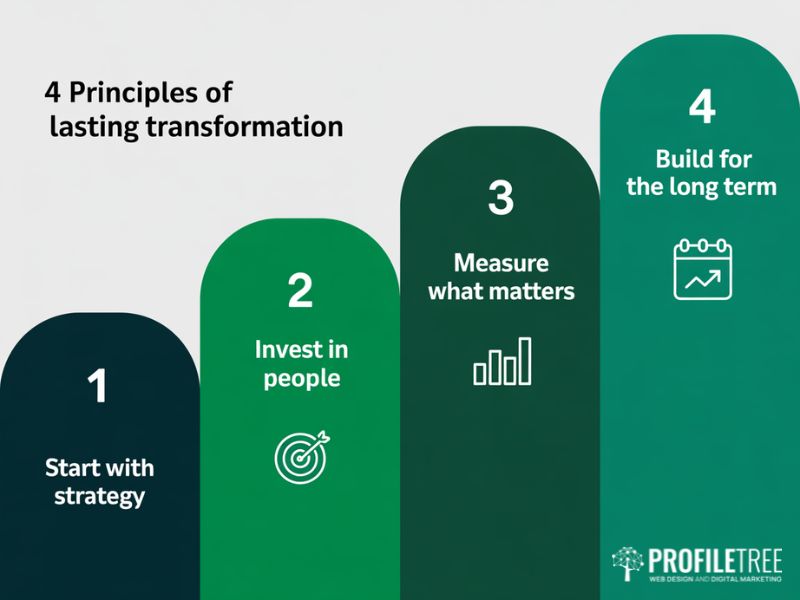
Correcting a digital transformation misconception is only useful if it leads to better decisions. The following principles reflect what the organisations that successfully navigate transformation actually do differently from those that repeat common mistakes.
Start With Strategy, Not Software
Every successful transformation begins with a clear articulation of what the business is trying to achieve and why digital change will help it get there. The digital transformation misconception that the choice of technology platform is the most important early decision delays this strategic work. The most important early decision is defining what success looks like, for the business, for customers, and for the people doing the work. Once that clarity exists, technology selection becomes straightforward.
Invest in People First
Culture is the hardest part of digital transformation, and it is the part that technology cannot substitute. Organisations that invest seriously in change management, leadership alignment, and workforce development consistently outperform those that treat people as the implementation challenge rather than the transformation driver. ProfileTree’s digital training programmes for businesses are structured around this principle: practical, applied learning that builds genuine capability rather than surface-level familiarity.
Measure What Matters
The digital transformation misconception about rapid ROI is compounded by poor measurement. When businesses track the wrong metrics, they either declare success prematurely or abandon programmes that are actually working. Building a clear measurement framework at the outset, one that tracks both leading indicators such as adoption rates and lagging indicators such as revenue and cost efficiency, gives leadership the information needed to make informed decisions about pace and investment.
Build for the Long Term
The businesses best positioned for the next wave of digital change are those that have already built the capability to adapt. They have clean, accessible data. They have digitally literate people at every level. They have processes designed around flexibility rather than fixed workflows. Digital transformation done well is not about achieving a particular technology state. It is about building an organisation that can continuously evolve its use of technology in response to changing conditions.
Advantages and Disadvantages of Digital Transformation
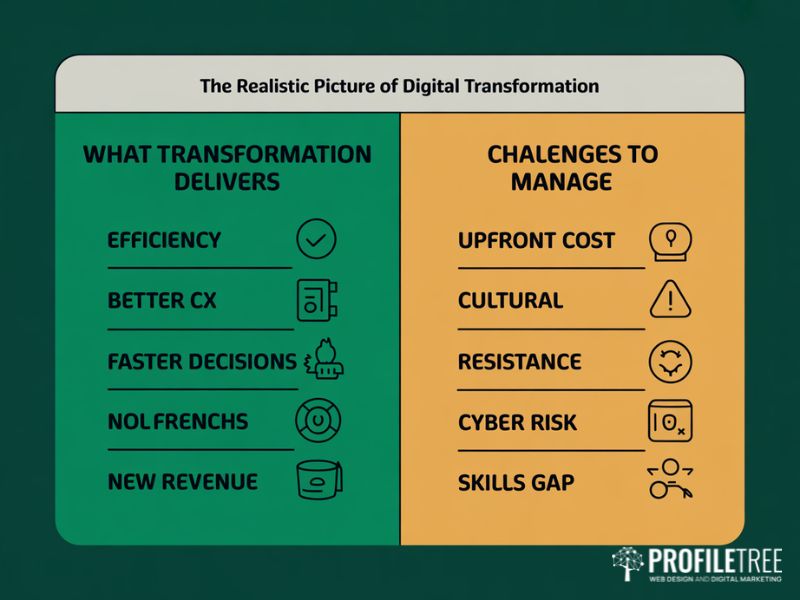
Understanding the realistic upsides and genuine challenges of digital transformation helps organisations avoid both the false optimism of the digital transformation misconception and the paralysis that comes from over-focusing on risk.
What Genuine Transformation Delivers
- Improved operational efficiency through process automation and better data visibility.
- Stronger customer experience across every channel and touchpoint.
- Faster, more accurate decision making through real-time data and analytics.
- Greater agility to respond to market changes and customer needs.
- New revenue opportunities through digital products, services, and platforms.
The Challenges That Must Be Managed
- Implementation cost and resource intensity, particularly for organisations with legacy infrastructure.
- Cultural resistance from staff accustomed to established ways of working.
- Cybersecurity risk as digital footprint and data exposure increases.
- The digital skills gap, which can slow adoption and reduce returns on technology investment.
- Regulatory complexity, particularly in the UK where data governance requirements continue to evolve.
None of these challenges are reasons to avoid transformation. They are reasons to plan it properly, invest in the right capabilities, and resist the digital transformation misconception that the journey will be straightforward.
The Future of Digital Transformation for UK Businesses
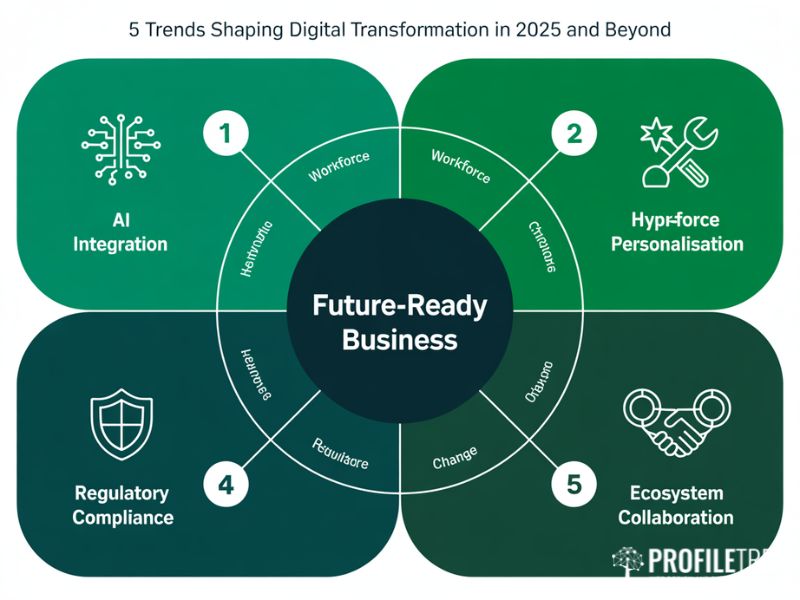
The trajectory of digital transformation is not slowing down. AI capability is advancing faster than most organisations can absorb it. Customer expectations around digital experience continue to rise. The businesses that build genuine digital capability now are positioning themselves well for the conditions that will define the next five years of competition in UK markets.
Key Trends Shaping the Next Phase
- AI integration will become a standard operational expectation. Businesses using AI-enhanced marketing and automation today are building the muscle memory that will be essential to compete in the next three to five years.
- Hyper-personalisation at scale, using data to deliver genuinely individual customer experiences, will separate effective digital businesses from those still delivering generic interactions.
- Workforce transformation will accelerate as automation handles more routine tasks and the economic value of human contribution shifts toward judgement, creativity, and relationship management.
- Regulatory frameworks around AI use and data governance will become more detailed and more stringently enforced, making compliance architecture a strategic priority.
- Ecosystem collaboration will grow as businesses recognise that transformation is accelerated by working within networks of complementary capabilities rather than building everything internally.
The digital transformation misconception that any of these trends can be addressed with a one-time technology investment will remain as damaging in 2026 and beyond as it is today. The businesses that prosper are those that build the ongoing capability to learn, adapt, and integrate new tools as the environment changes around them.
Replacing the Misconception With a Practical Framework
Every digital transformation misconception outlined in this article has a practical antidote. Technology serves strategy, not the other way around. Transformation is a capability, not a project. SMEs have access to tools that were previously reserved for large enterprises. AI requires a foundation of clean data and capable people to deliver real results. The IT department cannot own what every department must participate in. Results take time to build, and that is a feature of how sustainable change works, not a flaw in the strategy.
The digital transformation misconception is not a minor obstacle. It is the primary reason that the majority of transformation programmes underdeliver. Correcting these beliefs at the leadership level, before investment decisions are made and strategies are locked in, is the single most cost-effective thing a business can do to improve its chances of success.
ProfileTree works with businesses across Northern Ireland, Ireland, and the UK to build the practical digital capability that organisations need to grow, without the wasted investment that follows from acting on a digital transformation misconception. If your business is planning a transformation initiative or reviewing one that has not delivered as expected, our team is well-placed to help you identify where the gap lies and what to do about it.
FAQs
What is the most common digital transformation misconception in UK businesses?
That transformation is primarily a technology project. The real work is cultural and strategic. Technology without aligned people and processes does not transform a business.
How long does digital transformation take?
Meaningful results rarely arrive in under 18 months. The digital transformation misconception that ROI should appear within a quarter causes organisations to abandon strategies that are actually working. Set phased milestones and track both short-term and long-term indicators.
Can small businesses in Northern Ireland afford digital transformation?
Yes. Cloud tools and accessible platforms have made digital transformation viable at any scale. SMEs often have less legacy complexity to navigate than large enterprises, which is a genuine structural advantage.
Is AI a shortcut to digital transformation?
No. AI requires clean data, well-designed processes, and capable people to deliver real results. Implementing AI before those foundations exist consistently produces disappointing outcomes. The digital transformation misconception that AI replaces foundational work is one of the most expensive beliefs in circulation.
What role does digital training play in transformation?
It is central, not supplementary. The digital transformation misconception that people simply adapt to new tools without structured support leads to low adoption and wasted investment. Sustained training at every level is one of the highest-return investments a business can make.
What services does ProfileTree offer to support digital transformation?
ProfileTree provides web design, web development, SEO, digital marketing strategy, content writing, video production, AI training, and digital transformation consultancy for businesses across Northern Ireland, Ireland, and the UK.