
SEO for Hotels: Driving Direct Bookings Through Search Visibility
Table of Contents
ProfileTree provides SEO services for hotels, helping accommodation providers attract more direct bookings through improved search engine visibility. When travellers search for hotels in your destination, your property needs to appear prominently in search results—SEO makes that happen.
The hotel industry faces a fundamental challenge: Online Travel Agents (OTAs) like Booking.com, Expedia, and Hotels.com dominate search results and charge commissions of 15-25% per booking. Every direct booking you win through your own website keeps that commission in your business. Hotel SEO is the strategy for reducing OTA dependency and building a sustainable direct booking channel.
Why SEO for Hotels Matters?
Understanding the business case for hotel SEO:
The Direct Booking Imperative
OTA Commission Impact:
| Booking Channel | Typical Commission |
| Booking.com | 15-20% |
| Expedia | 15-25% |
| Hotels.com | 15-25% |
| Direct booking | 0% (your own website) |
Revenue Impact Example:
| Factor | OTA Booking | Direct Booking |
| Room rate | £150 | £150 |
| Commission (18%) | £27 | £0 |
| Net revenue | £123 | £150 |
| Annual rooms (1,000) | £123,000 | £150,000 |
| Additional revenue | – | £27,000 |
SEO Investment Context: Shifting even 10-20% of bookings from OTAs to direct channels can generate tens of thousands in saved commissions annually.
How Guests Find Hotels
Discovery Channel:
| Channel | Search Behaviour |
| Google Search | “Hotels in [destination],” “[hotel name],” “boutique hotel [city]” |
| Google Maps | Local hotel search, “hotels near me” |
| OTAs | Price comparison, reviews, availability |
| Metasearch | Google Hotels, Trivago, Kayak |
| Direct to brand | Returning guests, brand awareness |
The Search Journey: Travellers typically search multiple times before booking. Even guests who book via OTA often search the hotel name directly first—and can be captured if your direct website appears prominently.
Competition Landscape
Who You’re Competing Against:
| Competitor Type | SEO Strength |
| OTAs | Massive SEO investment, dominate generic terms |
| Metasearch (Google Hotels) | Integrated into search results |
| Chain hotels | Brand recognition, corporate SEO resources |
| Other independent hotels | Variable SEO investment |
| Review sites (TripAdvisor) | Strong domain authority |
The Opportunity: While OTAs dominate generic searches, hotels can compete for brand searches, long-tail queries, destination content, and local visibility.
Guest Decision Journey
How Guests Choose Hotels:
- Inspiration (where to travel, destination research)
- Research (what’s available, comparing options)
- Comparison (prices, reviews, amenities)
- Decision (which hotel and which channel)
- Booking (completing the reservation)
- Post-booking (pre-arrival research, activities)
SEO Role: SEO captures guests at multiple journey stages—from destination inspiration to brand searches just before booking.
Core Components of Hotel SEO
Comprehensive SEO strategy for accommodation providers:
Local SEO for Hotels
Local visibility is essential for hotels:
Google Business Profile Optimisation:
Profile Completion:
- Accurate property name, address, phone
- Correct business categories
- Complete amenity list
- Comprehensive description
- Check-in/check-out times
- Direct booking link
Category Selection:
| Primary Category | Additional Categories |
| Hotel | Boutique hotel |
| Bed and breakfast | |
| Resort hotel | |
| Inn |
Visual Content:
- Professional exterior photography
- Room photography (all room types)
- Amenity photos (restaurant, spa, pool)
- Local area imagery
- 360° virtual tours are available
Google Posts:
- Special offers and packages
- Seasonal promotions
- Events and activities
- Local attractions highlights
- Property updates
Attributes: Complete all relevant attributes:
- Amenities (WiFi, parking, pool, gym)
- Accessibility features
- Pet policies
- Check-in options
- Health and safety measures
Reviews: Review management is critical—discussed in detail below.
Website Optimisation
Your direct booking platform must perform:
Essential Hotel Website Pages:
| Page Type | SEO Focus |
| Homepage | Brand + destination targeting |
| Room pages | Individual room type optimisation |
| Amenities | Facility-specific searches |
| Location/area | Destination content |
| Offers/packages | Deal-seeking searches |
| Dining | Restaurant/dining searches |
| Events/weddings | Event venue searches |
| Contact/directions | Navigation queries |
Room Page Optimisation:
Each room type deserves individual optimisation:
Page Elements:
- Unique, compelling room descriptions
- High-quality room photography
- Amenity lists
- Size and capacity information
- View descriptions
- Direct booking integration
- Schema markup (HotelRoom)
Keyword Targeting:
- “[Hotel name] [room type]”
- “[Room type] room [destination]”
- “[Feature] hotel room [city]” (e.g., “sea view hotel room Brighton”)
Destination Content Strategy
Content that captures travellers during research:
Destination Content Types:
Area Guides:
- “Things to do in [destination]”
- “[Destination] travel guide”
- “Best restaurants in [destination]”
- “[Destination] nightlife guide”
- “Family activities in [destination]”
Attraction Content:
- Guides to nearby attractions
- “How to get to [attraction] from [hotel]”
- “[Attraction] visitor guide”
- Day trip suggestions
Practical Information:
- Getting to [destination]
- Best time to visit [destination]
- [Destination] weather guide
- Local transport information
Event Content:
- [Destination] events calendar
- Conferences and exhibitions
- Festivals and celebrations
- Seasonal events
SEO Value: Destination content captures travellers earlier in the journey, builds authority, and creates opportunities for internal linking to booking pages.
Long-Tail Keyword Targeting
Competing beyond generic “hotels in [city]”:
Long-Tail Opportunities:
| Keyword Type | Examples |
| Feature-specific | “Hotel with pool [city],” “pet-friendly hotel [destination]” |
| Occasion-specific | “Romantic hotel [area],” “family hotel [destination]” |
| Location-specific | “Hotel near [landmark],” “hotel [specific neighbourhood]” |
| Experience-specific | “Spa hotel [region],” “golf hotel [area]” |
| Event-specific | “Hotel near [venue],” “wedding venue [destination]” |
Strategy: Create landing pages targeting specific long-tail queries where your hotel genuinely fits the criteria.
Technical SEO for Hotels
Foundation for search visibility:
Technical Priorities:
| Element | Requirement |
| Site speed | Fast loading (high-image sites need optimisation) |
| Mobile design | HTTPS is required for booking trust |
| Security | HTTPS required for booking trust |
| Booking engine integration | Seamless, fast booking process |
| Schema markup | Hotel, HotelRoom, LodgingBusiness, Review |
Image Optimisation:
Hotel websites are image-heavy. Optimisation is critical:
- Compress images without quality loss
- Use modern formats (WebP with fallbacks)
- Implement lazy loading
- Provide appropriate image dimensions
- Include descriptive alt text
- Consider CDN for global visitors
Schema Implementation:
Structured data helps search engines understand your property:
LodgingBusiness schema:
– Property name and description
– Address and contact
– Star rating
– Price range
– Amenities
– Check-in/check-out times
– Reviews
Review Management

Reviews significantly impact hotel visibility and bookings:
Why Reviews Matter:
| Impact | Effect |
| Local rankings | Review signals affect search visibility |
| Click-through | Star ratings influence clicks |
| Booking decisions | Reviews heavily impact conversion |
| Trust building | Social proof for accommodation choice |
Review Strategy:
Generation:
- Post-stay email requests
- Check-out reminders
- In-room information
- Staff mentions during positive interactions
Platforms:
- Google (primarily for SEO)
- TripAdvisor (major influence)
- Booking.com (where bookings occur)
- Industry-specific platforms
Response:
- Respond to all reviews (positive and negative)
- Personalised responses
- Address concerns professionally
- Demonstrate guest care
Review Volume: Hotels should aim for substantial review volumes. Properties with hundreds of reviews significantly outperform those with few.
Brand Protection SEO
Capturing searches for your hotel name:
Brand Search Importance: Many guests search your hotel name before booking—even if they discovered you on an OTA. Ranking #1 for your own name captures these guests directly.
Brand SEO Elements:
- Homepage optimised for brand name
- Google Business Profile fully optimised
- Consistent NAP across all platforms
- Brand name in title tags
- Strong internal linking
- Review presence on Google
Competing with OTAs: OTAs bid on hotel brand names in paid search. Strong organic visibility for your brand helps capture guests without paying for clicks.
Hotel Type-Specific SEO Strategies
Different properties require different approaches:
Boutique Hotel SEO
Differentiators:
- Unique character and design
- Personalised service
- Local authenticity
- Experiential focus
Keyword Focus:
- “Boutique hotel [destination]”
- “Unique hotel [city]”
- “Design hotel [area]”
- “Independent hotel [location]”
Content Strategy:
- Design and story content
- Local experience guides
- Behind-the-scenes content
- Character-focused imagery
B&B and Guesthouse SEO
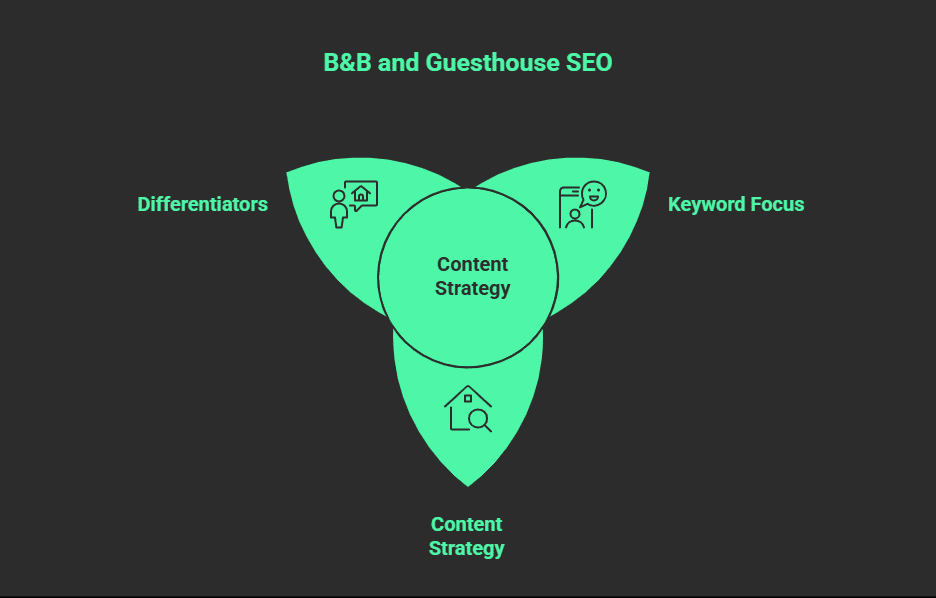
Differentiators:
- Personal hosting
- Local knowledge
- Homely atmosphere
- Breakfast experience
Keyword Focus:
- “B&B [destination]”
- “Bed and breakfast [city]”
- “Guesthouse [area]”
- “Guest house near [attraction]”
Content Strategy:
- Host personality content
- Local insider guides
- Breakfast feature content
- Homely atmosphere imagery
Resort Hotel SEO
Differentiators:
- On-site facilities
- Destination-in-itself
- Multiple activities
- Package experiences
Keyword Focus:
- “Resort [destination]”
- “Spa resort [region]”
- “Family resort [area]”
- “All-inclusive [destination]”
Content Strategy:
- Facility-focused content
- Activity guides
- Package promotion
- Experience imagery
City Hotel SEO
Differentiators:
- Location convenience
- Business facilities
- Transport links
- City exploration base
Keyword Focus:
- “Hotel [city centre]”
- “Hotel near [station/landmark]”
- “Business hotel [city]”
- “City centre hotel [destination]”
Content Strategy:
- Location convenience content
- City guides
- Transport information
- Business traveller content
Measuring Hotel SEO Success
Performance tracking for accommodation providers:
Key Performance Indicators
Visibility Metrics:
| Metric | What It Shows |
| Rankings | Positions for destination and brand terms |
| Local pack presence | Map visibility |
| Organic impressions | Search visibility volume |
| Organic traffic | Website visitors from search |
Business Metrics:
| Metric | What It Shows |
| Direct bookings | Reservations through website |
| Booking revenue | Revenue from organic traffic |
| OTA ratio shift | Proportion of direct vs OTA bookings |
| Cost per acquisition | SEO investment per booking |
Attribution
Tracking Booking Sources:
- Analytics goal tracking for bookings
- Booking engine source reporting
- “How did you find us?” post-booking surveys
- Revenue attribution by channel
ROI Calculation
Hotel SEO ROI Example:
| Factor | Values |
| Monthly SEO investment | £2,000 |
| Annual investment | £24,000 |
| Direct bookings attributed to SEO | 400 |
| Average booking value | £200 |
| Booking revenue | £80,000 |
| Commission saved vs OTA (18%) | £14,400 |
| Net return on SEO investment | £14,400 – £24,000 = investment in future growth |
Long-Term View: Hotel SEO builds compounding returns. Content assets, authority, and review accumulation deliver increasing value over time.
Why Choose ProfileTree for Hotel SEO
ProfileTree offers distinct advantages for hotels:
Tourism and Hospitality Understanding
Knowledge of accommodation sector requirements:
- Guest journey understanding
- Seasonal patterns recognition
- OTA competition awareness
- Booking behaviour insights
Local and Destination SEO Expertise
Strong focus on location-based visibility:
- Local SEO specialisation
- Google Business Profile optimisation
- Destination content strategy
- Multi-location capabilities
Full-Service Capability
SEO supported by broader services:
- Website design for hotels
- Content marketing for destination content
- Video production for property videos
- Digital strategy for comprehensive planning
Results Focus
Measurement tied to business outcomes:
- Direct booking tracking
- Revenue attribution
- OTA ratio monitoring
- ROI demonstration
Track Record
Our 5-star rating from over 450 Google reviews demonstrates consistent delivery across service businesses.
Conclusion
Hotel SEO provides a path to reducing OTA dependency and building a sustainable direct booking channel. Every guest captured through organic search rather than OTA advertising saves commission and builds your direct relationship with travellers.
ProfileTree provides specialist SEO services for hotels, helping accommodation providers across the UK and Ireland improve search visibility and drive more direct bookings.
Ready to improve your hotel’s search visibility? Contact ProfileTree to discuss how SEO can drive direct booking growth for your property.
FAQs
How much does SEO cost for hotels?
Hotel SEO typically ranges from £1,000-£2,500/month for smaller properties to £3,000-£8,000+/month for larger hotels or competitive destinations. Investment depends on destination competitiveness, property size, and direct booking goals. ROI should be measured against commission savings from shifted OTA bookings.
How long does SEO take to work for hotels?
Initial improvements often appear within 3-6 months, with significant results at 6-12 months. Brand protection (ranking for your hotel name) can improve quickly. Competitive destination terms take longer. Content marketing builds compounding returns over time.
Can SEO really compete with OTAs?
Not for generic “hotels in [major city]”—OTAs invest billions in SEO. However, hotels can compete for brand searches, long-tail queries, destination content, and local visibility. The goal isn’t to beat Booking.com—it’s to capture guests searching specifically for you or for specific features you offer.
How important are reviews for hotel SEO?
Extremely important. Reviews impact local rankings, click-through rates, and booking decisions. Hotels with substantial positive review volumes significantly outperform those with few. Review generation and response should be systematic parts of guest relations.
Should we create destination content?
Yes. Destination content captures travellers during the research phase, builds site authority, and creates internal linking opportunities to booking pages. Guides, attraction information, and local content establish your hotel as a destination authority.
How do we measure SEO success for hotels?
Primary metrics include direct booking volume and revenue, organic traffic growth, ranking improvements for key terms, and changes in OTA vs direct booking ratios. Commission savings from shifted bookings provide a clear ROI demonstration.
Do we need a booking engine for SEO?
You need a booking capability on your website to convert SEO traffic into direct bookings. Whether through an integrated booking engine or connecting to your PMS, seamless direct booking is essential. A website without booking capability wastes SEO investment.