
How to Maintain Brand Humanisation in an Era of Synthetic Media
Table of Contents
Synthetic media has become commonplace in business communication. AI generates text, creates images, produces videos, and automates customer interactions at scales previously impossible. This technological shift presents a paradox: brands can communicate more efficiently whilst risking the loss of an authentic human connection that builds lasting customer relationships.
Business owners face a critical decision. Adopting AI tools offers competitive advantages through speed and efficiency. Rejecting them entirely means falling behind competitors who move faster and operate at lower costs. The solution lies not in choosing between technology and humanity but in combining both thoughtfully.
UK businesses must navigate this balance carefully. Customers increasingly recognise AI-generated content, yet still crave genuine human interaction. They want efficiency but resent feeling like transactions rather than people. This guide examines how small and medium businesses can use synthetic media whilst maintaining the authentic human qualities that differentiate brands.
ProfileTree helps SMBs across Northern Ireland, Ireland, and the UK integrate AI tools responsibly through our AI training programmes and digital strategy services. We work with business owners to implement technology that increases efficiency without sacrificing the human elements that build customer loyalty.
Understanding Synthetic Media and Its Business Impact
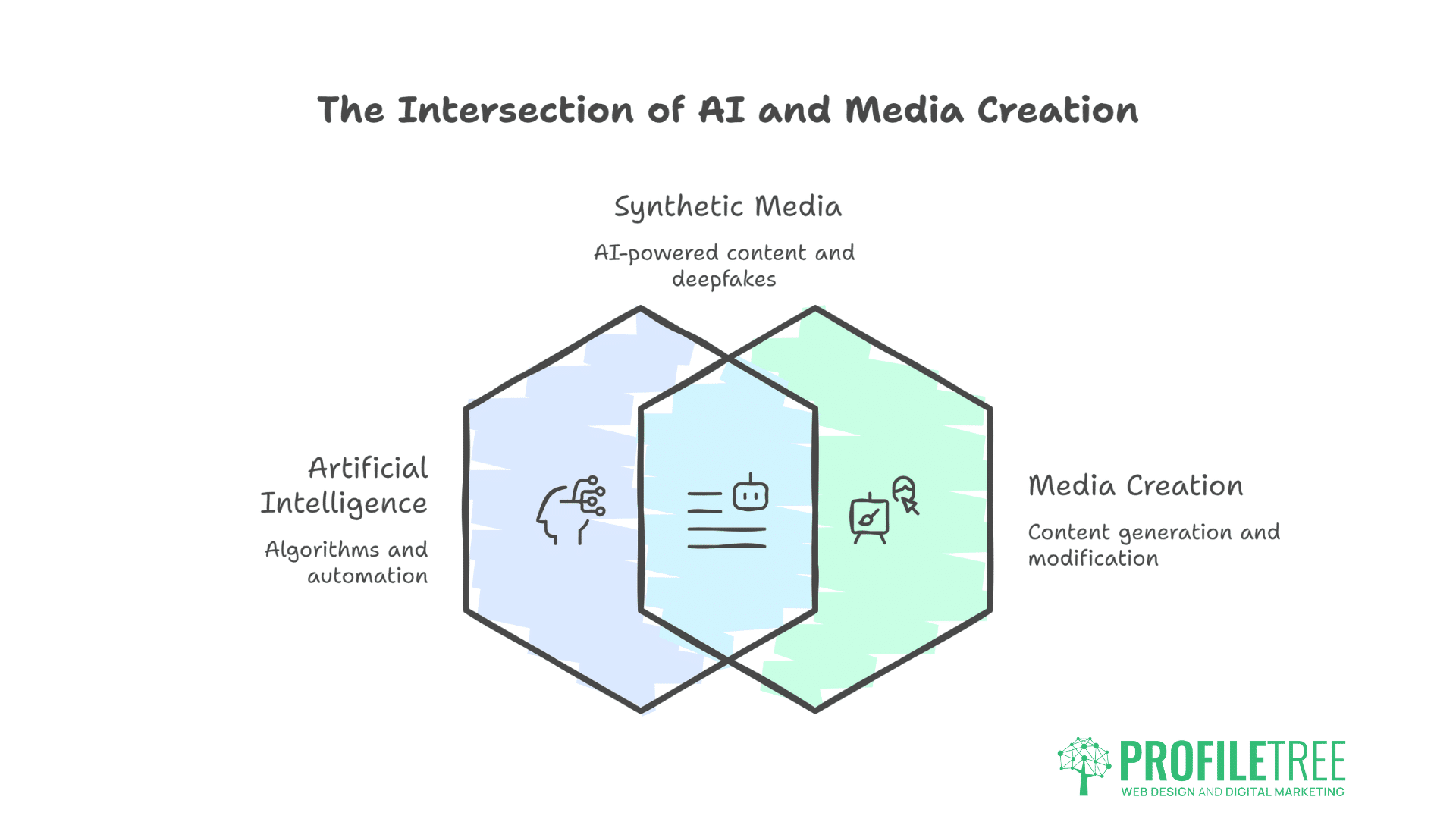
Synthetic media encompasses any content created or modified using artificial intelligence. This includes AI-generated text, images created by tools like DALL-E or Midjourney, deepfake videos, chatbot conversations, and automated social media posts.
The technology has improved dramatically. Early AI-generated content was obviously artificial, riddled with errors and lacking nuance. Current systems produce text indistinguishable from human writing, create photorealistic images that never existed, and generate voices that sound like real people. Businesses adopt these tools for practical reasons: they reduce costs, increase output, and operate 24 hours a day.
UK businesses report significant efficiency gains from AI implementation. A Belfast retailer might use ChatGPT to draft product descriptions in minutes rather than hours. An Irish service provider could deploy chatbots to handle common customer questions, freeing staff for complex issues. A Manchester marketing agency might generate social media content variations automatically.
These benefits come with risks. Customers notice when communication feels automated. Social media followers spot generic AI-generated posts. Service users resent chatbots that cannot handle their specific problems. Reviews mention “robotic” customer service or “soulless” brand communication. The efficiency gains mean nothing if customers disengage.
The challenge intensifies as synthetic media becomes more sophisticated. When customers cannot distinguish AI from human communication, trust becomes central. Will they feel deceived if they later discover AI involvement? How should businesses disclose AI usage without undermining the content’s effectiveness?
Why Brand Humanisation Matters More Than Ever
Brand humanisation means presenting your business with recognisable human qualities: personality, values, empathy, and authentic interaction. It transforms companies from faceless entities into relatable organisations that customers connect with emotionally.
This approach has always mattered, but it becomes critical when technology threatens to eliminate human connection. As more businesses automate communication, those maintaining genuine human qualities gain a competitive advantage. Customers gravitate towards brands that treat them as individuals rather than data points.
Research shows clear patterns. Customers pay more for products from brands they feel personally connected to. They forgive mistakes from companies they trust. They recommend businesses that communicate authentically with friends and family. These behaviours directly impact revenue, customer lifetime value, and acquisition costs.
Small businesses actually hold advantages here over larger corporations. Customers expect personal service from SMBs. They want to know the business owner, understand the company’s values, and feel part of a community. Large enterprises struggle to deliver this personalised experience at scale. Small businesses can, if they preserve it while adopting efficiency tools.
The UK market particularly values authenticity. British consumers show scepticism towards overly polished corporate messaging. They appreciate honesty, self-deprecating humour, and genuine communication. An Irish business owner speaking directly to customers on social media builds more connections than perfectly crafted corporate posts, even if the latter are more technically accomplished.
Synthetic media usage risks destroying these connections if implemented carelessly. A business replacing personal email responses with AI-generated templates might gain efficiency but lose the relationship quality that differentiated them. The question becomes how to gain efficiency without sacrificing humanity.
Transparency: The Foundation of Trust with AI Content
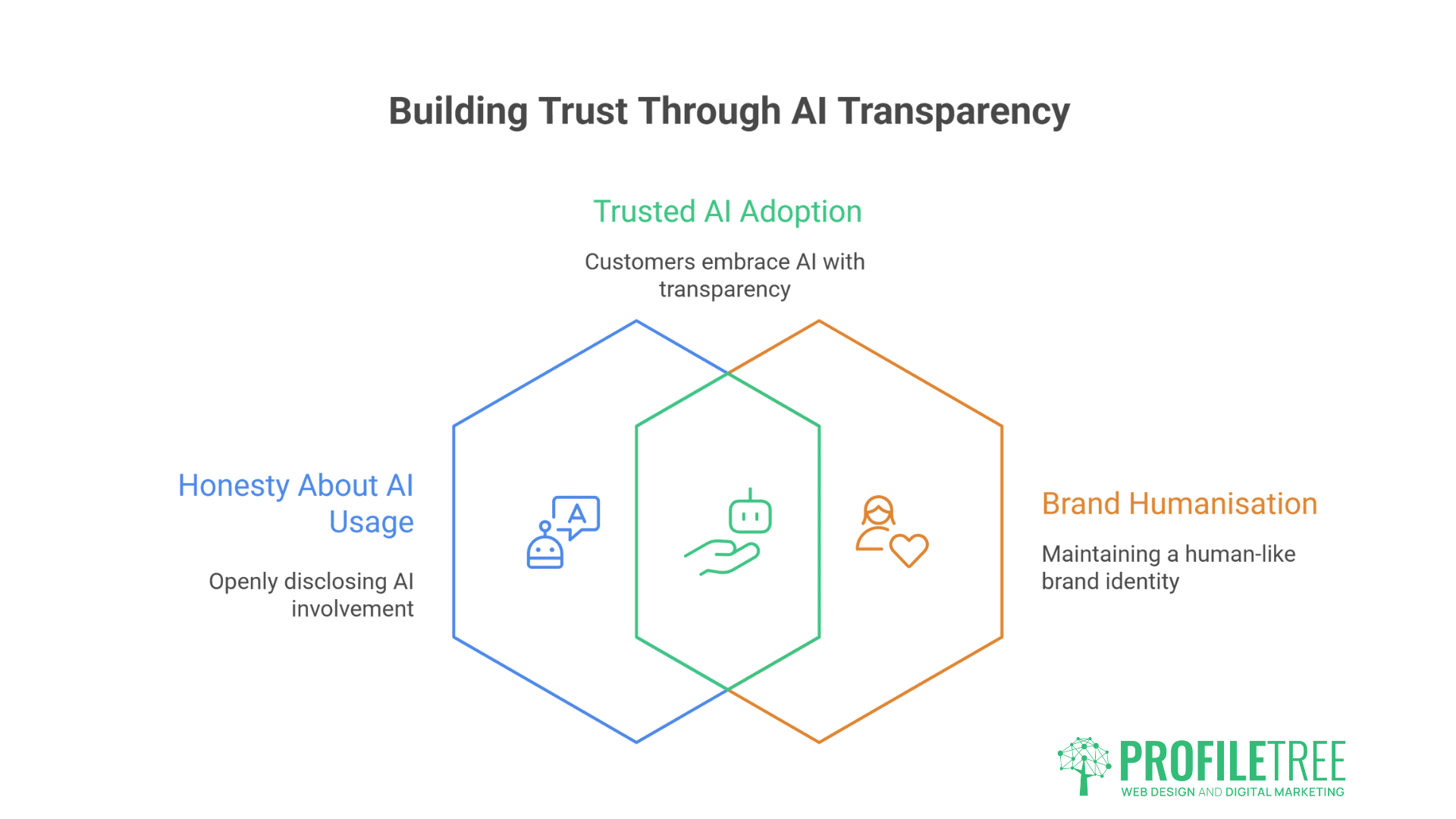
Honesty about AI usage protects brand humanisation whilst allowing technology adoption. Customers accept AI involvement when businesses communicate it clearly. They resent deception but respect transparency.
The disclosure approach matters. Overtly announcing “This content was AI-generated” on every piece feels awkward and unnecessary. Instead, businesses should establish clear policies about where and how they use AI, then communicate these naturally.
A service business might state on its website that chatbots handle initial enquiries, but human staff manage complex issues. An e-commerce company could explain that AI helps draft product descriptions, which staff then review and personalise. A marketing agency might note that they use AI tools to generate content ideas, whilst humans create final versions.
This transparency actually becomes a competitive advantage. Businesses open about AI usage demonstrate confidence and trustworthiness. They show they are not trying to deceive customers but instead using technology responsibly. This honesty differentiates them from competitors hiding AI involvement.
Implementation requires clear guidelines. Staff need to know when to disclose AI usage and how to explain it to customers. Customer-facing materials should explain your approach to technology. About pages can describe how your team uses AI tools whilst maintaining quality and personal service.
Some businesses worry that transparency will undermine credibility. The opposite proves true in practice. Customers appreciate knowing how you operate. They understand AI has legitimate uses. What they dislike is feeling manipulated or discovering deception. Honesty prevents both, whilst allowing technology adoption.
ProfileTree’s AI training programmes help SMBs develop transparent AI policies that build rather than erode trust. We work with businesses to identify where AI adds value without compromising authenticity, then help communicate this approach effectively to customers.
Identifying Where Humans Must Stay Visible
Not all business communication requires human involvement, but certain touchpoints demand it. Recognising these preserves brand humanisation whilst allowing automation elsewhere.
Customer complaints and complex problems need human responses. Frustrated customers want to speak with someone who can actually help, not navigate automated systems. AI chatbots might gather initial information, but humans must handle resolution. A business routing all complaints through automation risks catastrophic damage to customer relationships.
Personal milestones and relationship-building moments require human touch. Congratulating a long-term customer on their business anniversary feels meaningful when genuine. An AI-generated message feels hollow. Similarly, reaching out after major life events, acknowledging customer loyalty, or simply checking in personally builds connections that automation cannot replicate.
Creative strategy and brand voice development need human input. AI generates content effectively, but cannot define what makes your brand unique. Humans must establish voice, values, and positioning. AI then helps execute this vision at scale whilst maintaining consistency.
Sensitive communications demand human involvement. Addressing controversial topics, responding to crises, or handling delicate customer situations requires judgment that AI lacks. A poorly worded automated response to a serious issue can destroy brand reputation immediately.
First-time customer interactions benefit from human attention. The initial contact shapes entire relationships. Taking time to personally welcome new customers, understand their needs, and demonstrate genuine interest creates a foundation that automation cannot. Later interactions might involve AI support, but that first impression should be authentically human.
Build a framework identifying which touchpoints require human involvement in your business. Map your customer experience from first contact through ongoing relationship. Mark points where human interaction matters most. Allow AI to handle routine tasks but preserve human connection at critical moments.
A Belfast retailer might use AI to answer “What are your opening hours?” whilst ensuring staff personally respond to product recommendations. An Irish professional services firm might deploy chatbots for appointment scheduling but have partners conduct discovery calls. A UK-based training company might use AI to generate course outlines while delivering sessions personally.
Creating AI-Generated Content That Feels Human
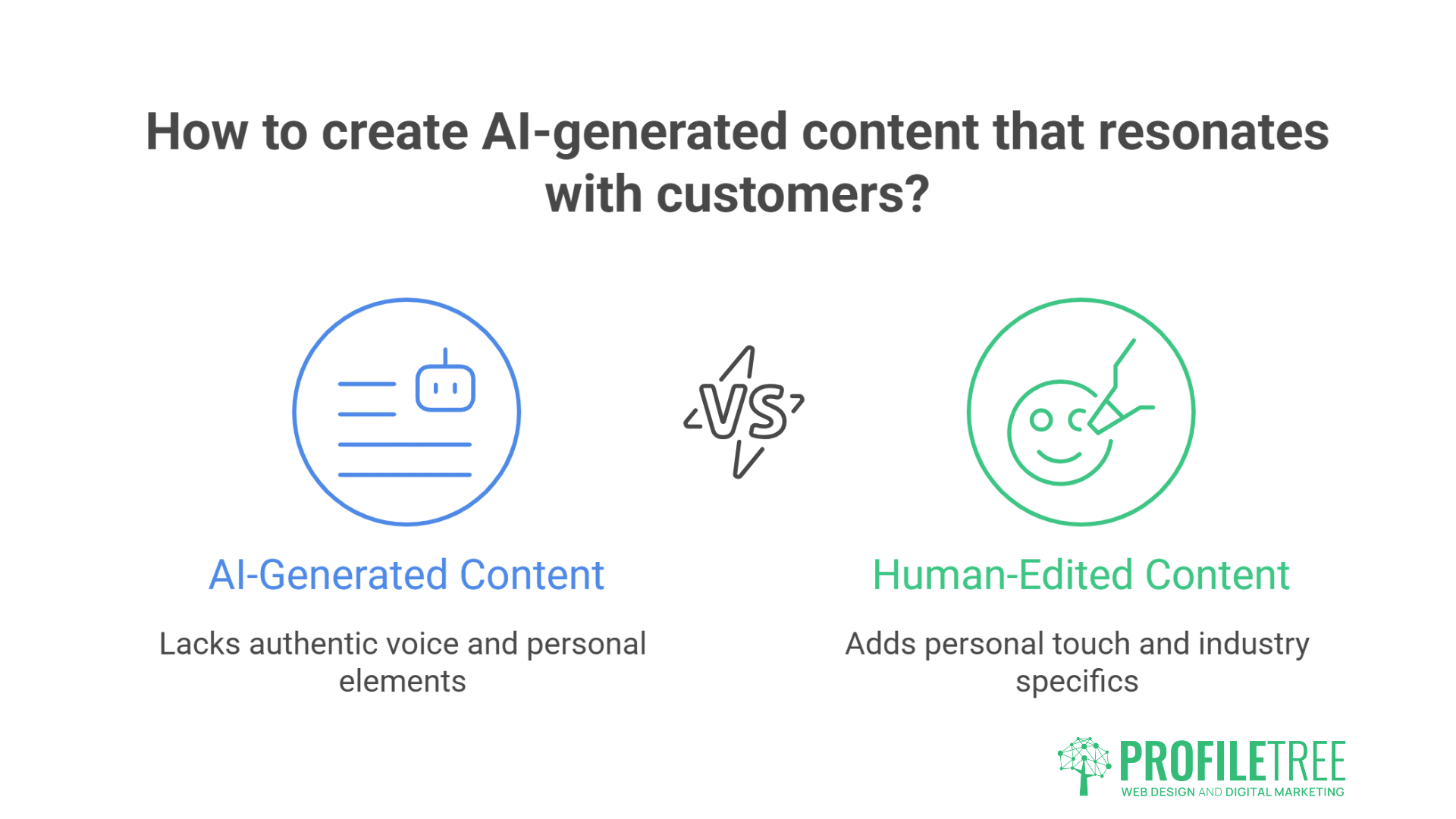
When using AI to create content, the goal is not to perfect output but to maintain human qualities that resonate with customers. This requires careful prompting, extensive editing, and adding personal elements that AI cannot provide.
Start by recognising AI limitations. Current systems produce competent content but lack authentic voice, specific experiences, and nuanced judgment. AI writes like someone educated but unfamiliar with your business, customers, or industry specifics. Your role is adding what AI misses.
Develop detailed prompts that inject personality. Rather than asking AI to “write a blog post about our services,” provide context: your brand voice, customer pain points, specific examples, and desired tone. The more direction given, the more human the output feels. Generic prompts produce generic content that readers immediately recognise as artificial.
Edit extensively before publishing. AI-generated first drafts need significant human refinement. Add personal anecdotes, specific customer examples, and unique perspectives. Remove repetitive phrasing AI commonly uses. Inject humour, personality, or emotional resonance. The result should feel like you wrote it, with AI merely speeding the process.
Include real human elements that AI cannot replicate. Customer quotes from actual conversations, photos of your team, specific project examples, and honest reflections on challenges all signal authentic human involvement. These details transform AI-assisted content into genuinely valuable material.
Avoid AI-generated images for customer-facing brand materials when possible. AI art has improved, but often includes telltale signs: unrealistic hands, odd proportions, or generic composition. Customers increasingly recognise these markers. Real photography of your team, workspace, and customers builds more authentic connections.
When AI imagery is necessary, edit it significantly or use it only for non-critical purposes. Header images for blog posts matter less than photos of your team on your about page. Prioritise genuine imagery where human connection matters most.
Ciaran Connolly, Director of ProfileTree, notes: “AI should amplify your human voice, not replace it. Use the technology to work faster whilst keeping your business’s personality intact. Customers connect with people, not algorithms.”
Test content with actual customers before broad deployment. Ask whether it sounds like your brand. Does it address their real concerns? Would they find it helpful or generic? This feedback prevents publishing content that feels artificially generated despite human editing.
Balancing Automation with Personal Interaction
Automation increases efficiency but cannot fully replace human interaction. The businesses succeeding with AI find the right balance for their specific context.
When to Automate
Use automation for repetitive tasks that consume time without building relationships. Scheduling social media posts, sending appointment reminders, categorising support tickets, and generating first-draft content all work well automatically. These tasks need doing, but do not require human judgement or relationship-building.
When to Stay Human
Reserve human time for high-value interactions. Personal consultations, strategic planning, creative problem-solving, and relationship-building all generate more value than routine tasks. Automation frees time for activities only humans can do well.
Creating Hybrid Systems
Create hybrid systems where AI handles initial steps and humans take over when necessary. Chatbots can answer basic questions, then seamlessly transfer complex issues to staff. AI can draft responses to common enquiries, which staff then personalise before sending. This approach combines efficiency with authentic human service.
Monitoring Customer Response
Monitor customer sentiment about automated interactions. Track whether customers express frustration with chatbots, request human support more frequently, or leave negative feedback about automated systems. These signals indicate when automation has gone too far.
Finding Your Balance
Some businesses automate too much, losing the personal connection that attracted customers originally. Others refuse automation entirely, wasting staff time on repetitive tasks. The right balance depends on your business model, customer expectations, and resource constraints.
Service businesses typically require more human interaction than pure e-commerce. Professional services selling expertise need personal consultation, which automation cannot provide. Retail businesses selling commodities can automate more without losing essential connections.
Accommodating Customer Preferences
Consider customer preferences explicitly. Some customers prefer self-service options and appreciate efficient automated systems. Others want personal service and resist automation. Offering both paths lets customers choose their preferred experience.
A Northern Ireland dental practice might offer online booking (automated) whilst ensuring human staff make follow-up calls for complex cases. An Irish consulting firm might use AI to generate initial project proposals but handle all client meetings personally. A UK-based online retailer might deploy chatbots for tracking orders while having staff personally handle complaints.
Building Human Connection Through Brand Storytelling
Storytelling remains uniquely human and impossible for AI to replicate authentically. Your business story, customer success stories, and behind-the-scenes content create connections that automation cannot.
Share genuine stories about your business origins. Why did you start the company? What challenges did you overcome? What drives your mission? These narratives help customers understand your values and connect emotionally with your brand. AI cannot create authentic founding stories because it did not experience them.
Feature real customers and their experiences. Case studies, testimonials, and customer spotlights show real people benefiting from your products or services. These stories resonate far more than generic claims about quality or service. Ensure you use actual customer names, photos, and quotes rather than fabricated examples.
Show your team as real people. Introduce staff members, share their expertise, highlight their personalities. Customers prefer buying from businesses where they know the people behind the brand. Team photos, staff bios, and behind-the-scenes content humanise your company.
Document your process and values in action. How do you make decisions? What standards do you maintain? Why do you operate the way you do? This transparency builds trust and differentiates your business from competitors. AI can help communicate these stories, but cannot create them.
Create content formats that inherently require human involvement. Podcasts featuring genuine conversations, video tours of your workspace, live Q&A sessions, and personal blog posts from your team all signal an authentic human connection. These formats are difficult to fake, and customers recognise them as genuinely human.
ProfileTree’s content marketing and video production services help businesses create authentic storytelling content that builds emotional connections with customers. We work with SMBs to identify and share stories that differentiate their brand whilst using technology appropriately to increase production efficiency.
Implementing Clear Communication Guidelines
Your team needs clear guidelines about using AI and maintaining brand humanisation. Without explicit policies, some staff might automate everything, whilst others refuse technology entirely.
Creating Decision Frameworks
Document where AI is appropriate and where human involvement is mandatory. Create a decision tree showing which customer interactions require personal handling. Define content types that can be AI-assisted versus those requiring full human creation. Make these guidelines specific and actionable.
Setting Quality Standards
Establish quality standards for AI-generated content. Set minimum editing requirements before publishing. Require specific human elements like personal anecdotes, customer examples, or unique insights. Define what “sounds like our brand” means concretely.
Training Your Team
Train staff on effective AI tool usage. Many employees either over-rely on AI, publishing first drafts without editing, or avoid it entirely due to unfamiliarity. Training helps staff use the AI productively whilst maintaining quality. Cover prompting techniques, editing requirements, and when to bypass AI entirely.
Establishing Approval Processes
Create approval processes for sensitive AI applications. Require review before deploying chatbots in customer service, sending AI-generated marketing emails, or publishing AI-created social media content. This prevents problems before they reach customers.
Monitoring and Quality Control
Monitor content quality regularly. Review AI-assisted content periodically to verify it maintains brand voice and meets standards. Check customer feedback about automated interactions. Adjust guidelines based on results.
Onboarding New Staff
Include AI usage in onboarding for new staff. Explain your philosophy about balancing technology with human service. Show examples of good AI usage versus inappropriate applications. Set expectations about maintaining personal customer connections.
Keeping Guidelines Current
These guidelines evolve as technology improves and customer expectations change. Review and update policies quarterly to reflect new capabilities and emerging best practices.
Measuring Brand Humanisation Alongside Efficiency
Tracking both efficiency gains from AI and brand humanisation metrics prevents optimising for speed at the expense of customer relationships.
Monitor traditional customer satisfaction metrics: Net Promoter Score, customer satisfaction ratings, review sentiment, and customer retention rates. If these decline after implementing AI tools, technology might be eroding relationships. Stable or improving metrics suggest a successful balance.
Track customer feedback specifically mentioning automated interactions. Note when reviews mention chatbots, AI responses, or feeling like “just a number.” These comments signal where automation harms brand perception. Conversely, positive comments about personal service indicate successful human touchpoints.
Measure customer effort scores. How difficult is it for customers to get help, complete purchases, or resolve issues? AI should reduce effort, not increase it. Rising effort scores despite automation implementation indicate poor system design.
Analyse customer interaction patterns. If customers increasingly bypass chatbots to reach human staff, automation might frustrate rather than help. If customers complete self-service tasks successfully, automation works well.
Monitor engagement with human-created versus AI-assisted content. Compare social media posts, blog articles, and marketing emails. Do customers engage more with obviously human content? This indicates where automation might reduce effectiveness.
Track employee satisfaction alongside customer metrics. Staff forced to work entirely through automated systems often become disengaged. Burned-out employees deliver poor customer service despite AI assistance. Balanced approaches where staff focus on meaningful work whilst AI handles routine tasks improve morale and customer experience simultaneously.
Calculate the business value of maintaining human connection. Compare customer lifetime value, referral rates, and repeat purchase behaviour between customers receiving highly personalised service versus those experiencing primarily automated interactions. This analysis quantifies the worth of brand humanisation.
ProfileTree’s digital strategy services help businesses implement balanced measurement frameworks that track both efficiency and relationship quality. We work with SMBs to identify the right metrics for their specific business model and customer base.
Practical Steps for Small Businesses
SMBs can implement brand humanisation strategies without large budgets or dedicated AI teams. Start with these practical steps.
Audit Your Customer Touchpoints
Audit current customer touchpoints. Map every way customers interact with your business. Identify which points currently involve humans and which could be automated. Mark interactions where human involvement matters most for relationship-building.
Start Small with Automation
Test automation gradually. Rather than implementing AI across all channels simultaneously, start with low-risk applications. Automate appointment reminders before chatbots. Use AI to draft internal documents before customer-facing content. Learn from early implementations before expanding.
Define Your Brand Voice
Create a brand voice document. Define your business personality, values, and communication style in writing. Use this to guide both human staff and AI tool configuration. Clear voice guidelines help AI-generated content sound more like your brand.
Budget for Quality Control
Invest time in content editing. Schedule regular editing time for AI-assisted content. Plan for AI to reduce drafting time but require human refinement. Budget staff time accordingly rather than expecting immediate publication of AI output.
Prioritise Key Relationships
Maintain high-touch programmes for valuable customers. Identify your most important customers and give them extra personal attention. AI might handle routine interactions with most customers, but key accounts deserve human relationship management.
Free Time for What Matters
Use AI to enable more human interaction paradoxically. AI handling routine tasks frees staff time for relationship-building activities. A business owner spending less time scheduling appointments has more time for customer consultations.
Learn from Your Market
Monitor competitor approaches. Note how other businesses in your industry balance AI and human service. Learn from their successes and failures. Differentiate by offering a better balance than competitors who over-automate or refuse technology entirely.
Listen to Customer Preferences
Seek customer input directly. Ask customers about their preferences for human versus automated service. Some want efficiency through self-service. Others value personal attention. Design systems accommodating both preferences rather than forcing one approach.
Getting Professional Support
Many SMBs lack internal expertise for implementing AI whilst maintaining brand humanisation. Professional support accelerates successful implementation.
ProfileTree’s AI training programmes teach business owners and staff how to use AI tools effectively without sacrificing authentic customer relationships. We cover practical skills like prompting AI for better results, editing AI content to match brand voice, and identifying where human involvement remains essential.
Our digital strategy services help businesses develop comprehensive approaches, balancing technology adoption with relationship preservation. We work with companies to audit current practices, identify opportunities for responsible AI implementation, and create frameworks that maintain brand humanisation whilst improving efficiency.
Through content marketing services, we help businesses create authentic storytelling content that AI cannot replicate. Our video production and animation capabilities enable businesses to show real human faces behind their brands, building connections that automation cannot match.
We work with SMBs across Northern Ireland, Ireland, and the UK to implement these strategies at scales matching their resources. Whether you need training to build internal capability or ongoing support to refine your approach, we provide practical guidance that improves business performance without sacrificing customer relationships.
Conclusion
Synthetic media offers real business benefits through efficiency and scale. Rejecting it entirely means a competitive disadvantage. Adopting it carelessly risks destroying the authentic human connections that build customer loyalty and drive sustainable growth.
ProfileTree helps businesses across Northern Ireland, Ireland, and the UK navigate this balance through training, strategy development, and implementation support. We work with SMBs to adopt technology responsibly whilst maintaining the human qualities that make their brands unique.