
Low-Code and No-Code Development: An SME Guide
Table of Contents
Building a website or business app no longer means hiring a full development team from day one. Low-code and no-code development platforms let business owners and marketing managers create working websites, internal tools, and customer-facing apps without writing code line by line. For SMEs across Belfast, Northern Ireland, and the wider UK, this shift matters: it changes who can build, how fast a project ships, and what it costs to get something live.
ProfileTree, a Belfast-based digital agency, works with SMEs choosing between low-code, no-code, and fully custom builds every month. This guide sets out what each approach actually offers, where the limits sit, and how to choose a platform that will still make sense in two years, not just at launch.
What Is Low-Code and No-Code Development?
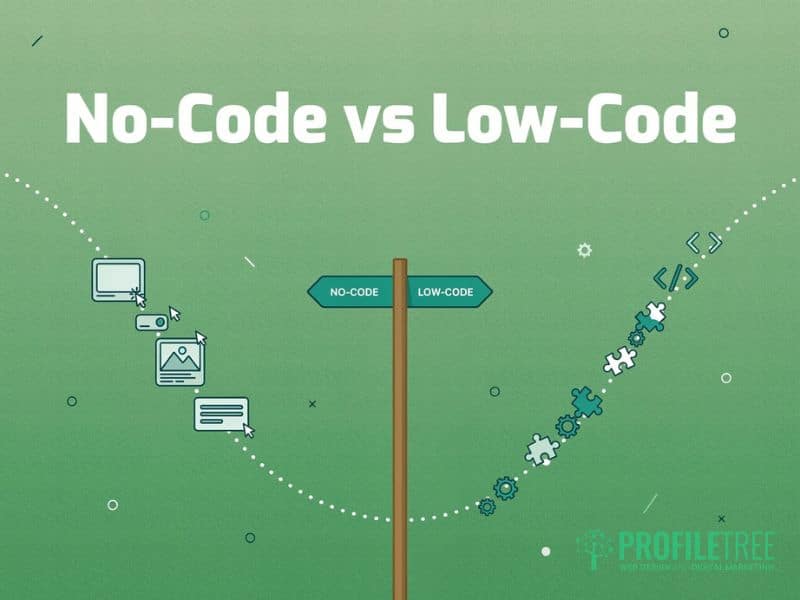
Low-code and no-code development covers two related but distinct approaches to building digital products with less manual programming. Both rely on visual interfaces rather than lines of code, but they’re aimed at different users and different levels of complexity, and mixing the two up is a common source of wasted budget.
What Is No-Code Development?
No-code development lets people with no programming background build fully working websites and apps. Users select templates, drag components into place, and configure logic through visual workflows rather than scripts. Platforms such as Webflow, Bubble, and Wix fall into this category. No-code suits SMEs that need a working site or a simple internal tool quickly, without hiring a developer for every small change afterwards.
What Is Low-Code Development?
Low-code development still uses visual building blocks, but it gives developers room to add custom code where the platform’s defaults fall short. Tools such as Microsoft Power Apps, OutSystems, and Mendix are aimed at technical teams who want to move faster than traditional development while keeping the option to extend functionality with real code. Low-code suits SMEs with more complex workflows, existing systems to connect to, or plans to scale a tool well beyond its first version.
Low-Code vs No-Code: A Comparison for SMEs
Choosing between low-code and no-code development isn’t just about upfront cost. It depends on who’ll be building and maintaining the site or app once it launches, and how the business expects to use it a year from now.
| Factor | No-Code | Low-Code |
|---|---|---|
| Typical user | Marketing or operations staff | Developers or technical staff |
| Coding required | None | Minimal, where needed |
| Customisation | Limited to template options | Higher, with custom code |
| Best fit | Simple sites, landing pages, and small internal tools | Complex apps, system integrations |
| Typical timeframe | Days to a few weeks | Weeks to a few months |
Neither column is inherently better. A five-page brochure site rarely needs low-code’s flexibility, while a booking system that has to talk to existing stock or accounts software usually does. The mistake most SMEs make isn’t picking the wrong category outright; it’s picking a platform within the right category that doesn’t match how the business actually plans to grow.
How AI Is Changing Low-Code and No-Code Development
Artificial intelligence has moved low-code and no-code development further from templates and closer to natural language. Many current platforms let a user describe what they want in plain English and generate a first working version of a page, form, or workflow from that description.
This doesn’t remove the need for good decision-making. Someone still has to decide what the app should do, how it stores data, and who can access it, and that judgment doesn’t come from the AI feature itself.
For SMEs, the practical effect is a shrinking gap between no-code and low-code. A no-code user with an AI assistant can now attempt tasks that used to need a developer, such as connecting a form to a database or building a basic automation between two tools. This doesn’t mean low-code and no-code development platforms replace developers altogether. It means the easier, more repetitive parts of a build move faster, while genuinely custom work, integrations with legacy systems, and security decisions still need someone who understands the trade-offs involved.
A common mistake is treating AI-generated output as finished work. AI suggestions inside these platforms still need testing, particularly around data handling and edge cases that the AI wasn’t asked about. Business owners exploring low-code and no-code development platforms with AI features should budget time for a human review pass before anything customer-facing goes live, not just for the initial build. Skipping that review is where most avoidable problems creep in.
This shift also changes what to look for when comparing platforms. A platform that markets itself heavily on AI features is worth testing against a real task from the business, not the demo scenario the vendor chose. Ask what happens when the AI gets something wrong, whether it’s a form field mapped incorrectly or a workflow that skips a step, and how visible that failure is to whoever is checking the work. A platform that surfaces its own mistakes clearly is more useful long-term than one that hides them behind a polished interface.
Benefits of Low-Code and No-Code Development for UK and NI SMEs
The appeal of low-code and no-code development for SMEs comes down to three things: speed, cost, and who gets to make changes once the site or tool is live.
Faster Time to Market
Traditional development projects can take months between an agreed brief and a live site. Low-code and no-code development compresses that timeline considerably, because much of the underlying structure already exists inside the platform. A business can have a working prototype within days rather than weeks, then refine it based on real feedback instead of guesswork. For time-sensitive projects, such as a seasonal promotion or an event microsite, this speed can be the difference between catching a window of demand and missing it. It also means testing an idea doesn’t require committing months of budget before finding out whether it works.
Lower Development Costs
Because no-code and low-code platforms reduce the amount of custom development work needed, they typically lower the upfront cost of getting a working product live compared with a fully bespoke build. The exact saving varies by project complexity and platform, so any specific figure should be checked against a like-for-like quote rather than assumed from general marketing claims. What tends to hold across most projects is lower training overhead for staff, since visual builders need less specialist knowledge than a full codebase, and lower ongoing maintenance costs where the platform handles hosting and updates centrally rather than through a separate contract.
More Control for Non-Technical Teams
Perhaps the most practical shift is who can make changes once a site or app is live. Marketing staff can update content and landing pages without waiting for a developer’s schedule. Business analysts can adjust a workflow when a process changes. This doesn’t remove the need for oversight; it changes where that oversight sits, moving from gatekeeping every change to reviewing changes after they’re made. For a small team, that difference alone can save weeks a year.
Common SME Use Cases
Low-code and no-code development show up differently depending on the sector. Independent retailers use no-code tools to add click-and-collect functionality or a simple loyalty scheme without commissioning a full e-commerce rebuild. Professional services firms, including accountants and consultants, use low-code platforms to build client portals for document exchange or basic appointment booking, often connecting to systems they already run. Hospitality and tourism businesses lean on both categories for booking pages, event microsites, and feedback forms that need to go live quickly around a specific date. None of these examples needs the most advanced platform on the market; they need the platform that matches the task, which is exactly why the five questions below matter more than any single product recommendation.
Limitations and Risks to Manage

Low-code and no-code development isn’t the right fit for every project, and ignoring its limits creates problems later rather than avoiding them. Two areas deserve particular attention: data protection and the platform’s own constraints.
Data Protection and Governance
Business users building apps outside the usual review process is sometimes called shadow IT: tools that handle real customer data but were never checked against the organisation’s data protection obligations. Under UK GDPR, a business is still responsible for how personal data is collected, stored, and processed, regardless of which platform built the tool that handles it.
Before using a no-code or low-code platform for anything that touches customer data, check where that platform stores data, what its data processing agreement says, and whether it meets the standards the business already commits to under UK GDPR. A simple approval step before any customer-facing build goes live, even just one person checking data handling, catches most of this risk without slowing down every small internal project.
Vendor Lock-In and Hidden Costs
Moving a site or app off a low-code or no-code platform once it’s built can be difficult and expensive, because the platform’s structure rarely translates cleanly to another system. Subscription costs can also rise as usage grows, and some platforms charge per user or per workflow rather than a flat fee. Before committing, check what happens to the business’s data and design if it needs to leave the platform later, and read the pricing structure closely enough to model what it would cost at double the current usage, not just today’s.
How to Choose the Right Low-Code or No-Code Platform
Choosing between low-code and no-code development, and between the individual platforms within each category, comes down to five practical questions. Working through them before signing up saves far more time than researching platform features first.
- Who will build and maintain it? If it’s marketing or operations staff with no coding background, no-code is the realistic starting point.
- What does it need to connect to? Existing stock systems, booking software, or a CRM usually point towards low-code, which allows custom integration where templates fall short.
- Does it handle personal data? If so, confirm data residency and the platform’s data processing agreement before writing a single page.
- How complex will this get in a year? A tool that will stay simple suits no-code. One expected to grow into something more central to the business usually needs low-code’s flexibility.
- What’s the real cost at scale? Model pricing at double the current usage and check what leaving the platform would involve, not just the sign-up cost.
None of these questions has a universally right answer. They exist to stop a business from choosing a platform based on the demo alone, and to surface the decisions that are expensive to reverse once real customer data or a live workflow depends on the answer.
How ProfileTree Supports Your Low-Code and No-Code Development Project
Choosing a platform is only the first decision. ProfileTree works with SMEs across Belfast, Northern Ireland, and the wider UK to make sure a low-code or no-code build actually supports the business goals behind it, not just the initial brief.
Our team starts with a straightforward assessment of whether low-code and no-code development is the right fit for a specific project, based on the five questions above and the business’s own systems and growth plans. Where it is, we support platform selection, initial setup, and template customisation so the finished site reflects the brand rather than looking like every other site built on the same template. Our website design and website development teams handle the build itself, while our digital strategy work makes sure the platform choice fits the wider plan rather than being decided in isolation from everything else the business is doing.
For SMEs concerned about search visibility, our search engine optimisation work applies within the constraints of whatever platform is chosen, since template-based sites often need extra attention to rank well against custom-built competitors. Where AI features are part of the platform, our AI transformation support helps teams use them without treating AI-generated output as finished work, and our digital marketing services team can then build on whatever’s launched.
We also help businesses decide when it’s time to move on from a platform altogether. A site that started as a quick no-code build sometimes reaches the point where its growth is limited by the platform itself rather than by the business. Recognising that point early, rather than after months of working around a platform’s limits, usually saves more money than the original build did.
FAQs
1. What is the difference between low-code and no-code development?
No-code development needs no programming knowledge at all, using templates and visual builders for the entire build. Low-code development uses a visual approach but allows developers to add custom code when the platform’s built-in options aren’t enough. In practice, no-code suits simple sites and small tools, while low-code suits more complex apps that need to connect to existing systems or handle unusual business logic that a template can’t accommodate.
2. Will low-code and no-code development replace professional developers?
No. These platforms shift where developer time goes rather than removing the need for it. Routine, repetitive build work moves to visual tools and, increasingly, AI assistance inside them. Complex integrations, security decisions, and anything handling sensitive data still need a developer who understands the trade-offs. Most SMEs that scale past a certain point end up combining a low-code or no-code front end with custom development somewhere in the stack, rather than choosing one path exclusively.
3. Is no-code development compliant with UK GDPR?
It can be, but compliance depends on the platform and how it’s configured, not on the no-code label itself. Check where the platform stores data, what its data processing agreement covers, and whether it allows the data residency and access controls the business already commits to elsewhere. This matters most for tools handling customer or employee personal data. A platform that works fine for an internal task list may not be suitable for a customer-facing form collecting personal details.
4. Can a no-code platform handle a complex business application?
Some can handle more than expected, particularly with AI features that extend what a non-technical user can configure. But genuinely complex logic, high-traffic performance needs, or deep integration with existing business systems usually outgrow pure no-code fairly quickly. Low-code platforms exist specifically to bridge that gap, offering the same visual building approach with room for custom code where the business justifies it.
5. What is shadow IT, and why does it matter for SMEs?
Shadow IT describes tools and apps built by business teams outside the usual oversight of whoever manages the company’s systems and data. Low-code and no-code development make this easier to do, for better and worse. The upside is faster problem-solving without waiting in a queue. The risk is a tool handling real customer data, payments, or business logic that nobody responsible for compliance or security has ever reviewed.