
SEO Stats for Irish Marketers: 50 Data Points to Shape Your Strategy
Table of Contents
SEO Stats Every Irish Marketer Should Know: Search engine optimisation remains one of the most misunderstood investments Irish businesses make. Some treat it as a one-time project. Others chase algorithm updates without understanding what those changes actually mean for their websites. A surprising number still view SEO as separate from their broader digital strategy—disconnected from web design, content creation, and the AI tools reshaping how marketing teams work.
The statistics in this guide reveal how Irish consumers actually search, what technical factors determine whether your site appears in results, and where gaps exist between what businesses think works and what data confirms. For a deeper look at how search algorithms evaluate content, see our guide to Google’s E-E-A-T algorithm updates.
Whether you run an e-commerce operation in Dublin, a professional services firm in Belfast, or a hospitality business anywhere on the island, these 50 statistics provide the evidence base for smarter decisions. Each data point connects to real implications for web design, content strategy, video production, and AI implementations that separate high-performing marketing teams from the rest.
ProfileTree is a Belfast-based digital agency helping businesses across Northern Ireland, Ireland, and the UK translate SEO data into practical improvements across web design, content, video, and AI implementation.
The businesses getting the best results from SEO aren’t chasing rankings—they’re building websites and content systems designed to earn visibility naturally. The stats simply confirm what good digital strategy has always required: understanding your audience better than your competitors do,” says Ciaran Connolly, Director of ProfileTree.
Global and European SEO: The Broader Context
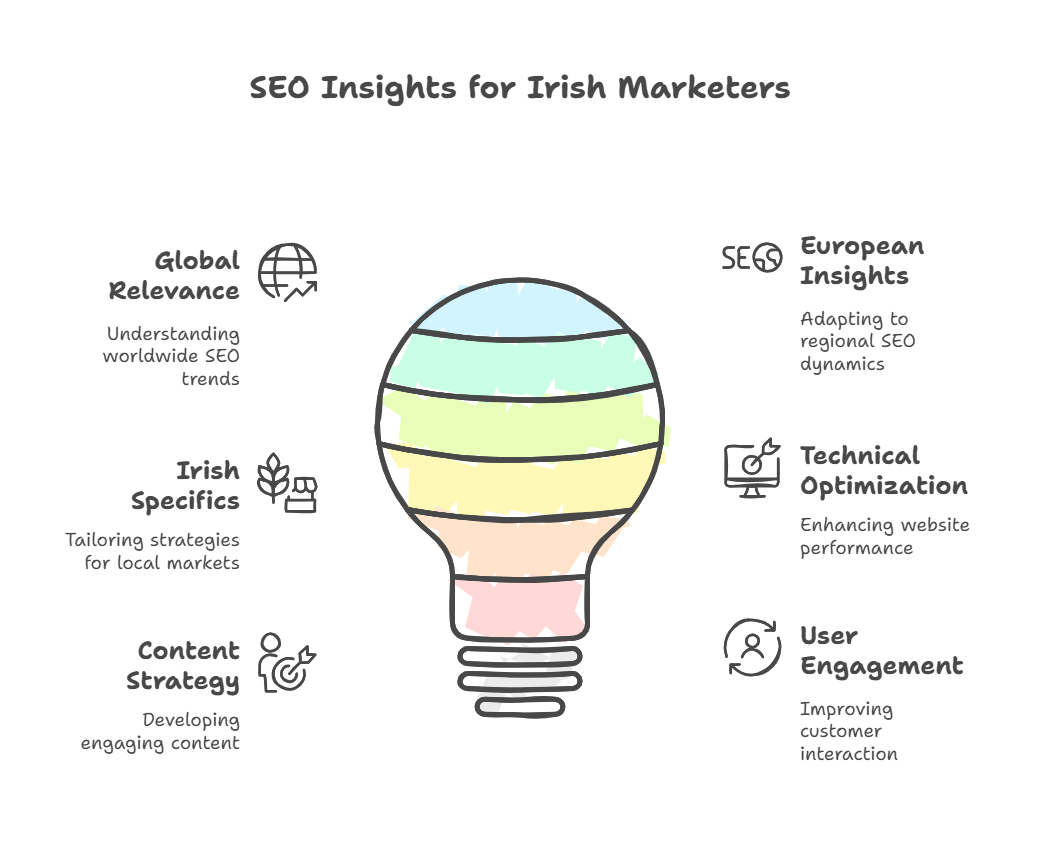
Organic search drives 60% of global web traffic—more than paid ads and direct visits combined. This section covers the European and global patterns that shape what works for Irish businesses.
Organic Search Dominance
Around 60% of global internet traffic comes from organic search, surpassing both direct visits and paid advertising channels. This statistic alone justifies why SEO should sit at the centre of digital marketing strategy rather than as an afterthought.
For Irish SMEs working with limited marketing budgets, organic visibility offers compounding returns that paid campaigns cannot match. Every piece of content you create continues working long after publication.
Search Engine Market Share
Approximately 92% of online experiences begin with a search engine, with Google commanding the vast majority of traffic.
Key patterns to note:
- Bing usage is slowly rising, but remains modest in Ireland at around 4%
- 46% of European SMEs now consider SEO a “core marketing priority” (EU Commission, 2024)
- Irish businesses delaying serious SEO investment increasingly compete against organisations with years of built domain authority.
Click Distribution by Position
The value of search positions follows a steep curve, with dramatic drop-offs after the top three results.
| Position 1 | ~22% | ~28% |
| Positions 1-3 | ~55% combined | ~50% combined |
| Position 10 | ~2% | ~1.5% |
| Page 2 | <1% | <1% |
Featured snippets appear in roughly 12% of EU-based queries and about 15% of queries from Irish users. These “position zero” results present opportunities for businesses willing to structure content specifically for snippet capture.
Voice and Mobile Usage
Voice search accounts for approximately 20% of mobile searches across the EU, with Ireland tracking slightly lower at around 18%. Adoption skews heavily toward younger demographics.
Mobile usage patterns demand attention:
- 68% of global site visits come from mobile devices
- 65% of Irish site visits are mobile
- Any website that doesn’t perform well on mobile is effectively invisible to most potential visitors.
Long-Tail Query Patterns
Long-tail queries make up 70% of total web searches. These are searches like “best accountant for small businesses in Galway” rather than simply “accountant.”
These longer, more specific searches capture highly engaged audiences with clearer intent. For Irish business owners, this creates opportunities to rank for location-specific and service-specific combinations that larger competitors often overlook.
Technical Performance Impact
Technical SEO improvements deliver measurable results:
- Faster site speed, proper schema markup, and clean architecture boost rankings by 15–20%
- SERP features (local packs, image carousels, knowledge panels) appear in 45% of Irish local service searches
- Most Irish business websites still run on outdated platforms with unoptimised code.
Ireland-Specific Search Patterns
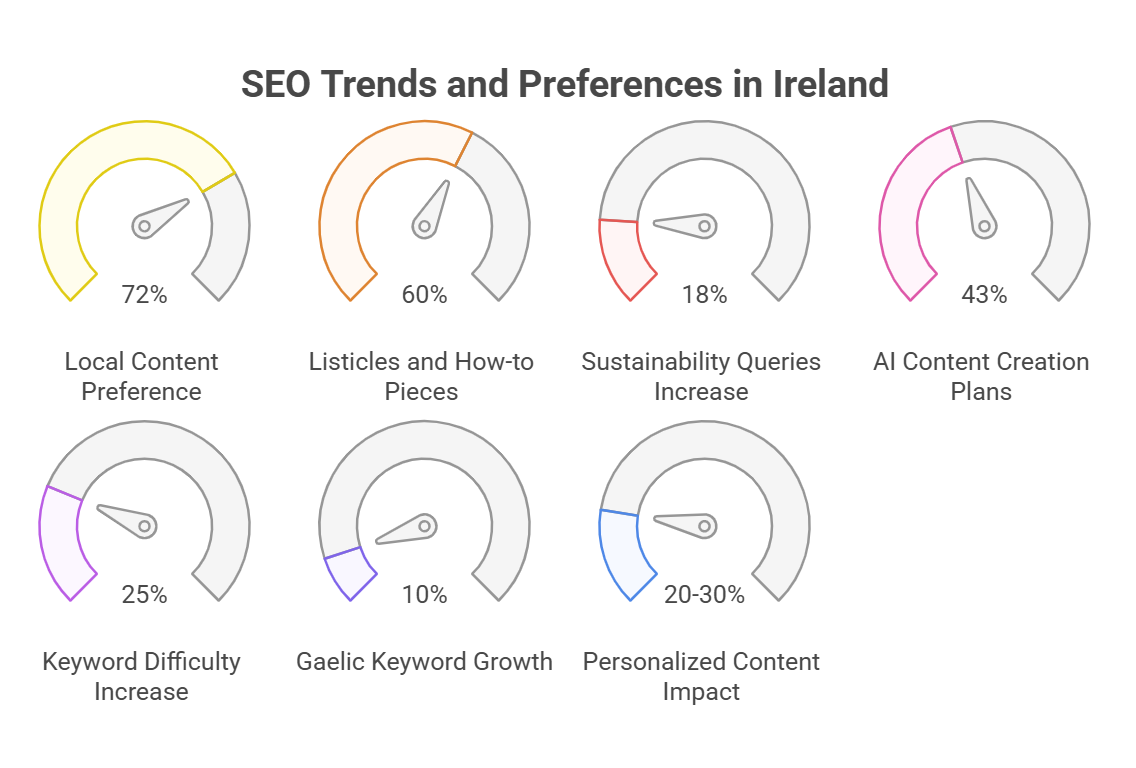
77% of Irish consumers research local businesses online weekly—56% do so daily. These Ireland-specific patterns shape what SEO approaches work for businesses targeting this market.
Local Research Frequency
About 77% of Irish consumers research local businesses online weekly, with 56% doing so daily. This frequency underscores why local SEO isn’t optional for businesses serving geographic markets.
Your Google Business Profile, local citations, and location-specific content directly influence whether potential customers find you during these daily research sessions. For retailers targeting specific areas, our guide to local SEO for Irish businesses provides detailed implementation guidance.
First Page Competition
Among Irish SMEs, 39% identify “ranking on Google’s first page” as their top digital priority for 2026. The challenge: everyone wants page one positions, while few invest in the sustained effort required to achieve them.
Businesses reaching those positions typically combine:
- Solid technical foundations
- Consistent content production
- Strategic link building over months or years, rather than weeks
E-commerce Traffic Sources
Around 80% of Irish e-commerce retailers cite organic traffic as their primary top-of-funnel source. This outperforms both paid advertising and social media referrals.
E-commerce SEO requires specific technical considerations:
- Product page optimisation
- Category structure planning
- Internal linking patternsWE5
- Schema markup for products and reviews
The WordPress and Shopify implementations powering most Irish e-commerce sites can deliver excellent SEO results when properly configured. Default configurations rarely deliver optimal performance.
Geographic Search Volume
Dublin-based businesses see up to 30% higher search volume for local queries compared to other counties. This concentration creates intense Dublin competition, but businesses outside the capital face less competitive conditions for location-specific searches.
Investment Trends
SEO spending among mid-sized Irish companies rose 25% in 2024, with a projected 15% increase in 2026. Typical local link-building services range €500 €2,000 monthly.
Technical Compliance Reality
Around 72% of Irish marketers find it challenging to meet Core Web Vitals thresholds, particularly Largest Contentful Paint (LCP) requirements for image-heavy sites.
This widespread technical shortfall creates a competitive opportunity for businesses investing in proper web development. Our detailed guide on Core Web Vitals optimisation explains the specific technical interventions required.
The Northern Ireland Dimension
Belfast businesses and those operating across Northern Ireland face a unique challenge: competing for visibility in both Northern Ireland and the Republic of Ireland search markets simultaneously.
This dual-market dynamic requires SEO strategies accounting for:
- Subtle differences in search behaviour between jurisdictions
- Currency preferences affecting e-commerce
- Spelling conventions (UK English vs. Irish variations)
- Location pages need different optimisation for Belfast versus Dublin.
For businesses serving both markets, content strategy must address these distinctions without creating duplicate content issues.
Content and Keyword Trends
72% of Irish online users prefer content with local references—generic content underperforms. These trends show what content types and formats drive results in Irish search.
Local Relevance Impact
About 72% of Irish online users prefer content with local references or examples. Generic content that could apply anywhere underperforms articles that demonstrate a specific understanding of Irish markets, regulations, and conditions.
This preference has direct implications: rather than repurposing international content for Irish audiences, businesses see better results from content created specifically for Irish readers.
Format Performance Data
Content format performance varies by intent. The data shows clear patterns:
| Listicles | ~30% of organic blog traffic | Quick-reference content |
| How-to guides | ~30% of organic blog traffic | Procedural information |
| Long-form guides | Higher dwell time | Complex topics |
Optimal length depends on competition and intent:
- 700–1,200 words for quick-answer content
- 2,000+ words for guides covering complex topics (higher engagement metrics)
- Users frequently append “2025” or “2026” to searches, indicating a preference for freshness.
Visual Content Performance
Infographics and short data visualisations are particularly popular in Ireland. They deliver 2–3 times more shares than text-only articles.
The sharing advantage translates into broader reach and, potentially, natural backlinks that strengthen domain authority. Video content embedded within blog posts increases average time on page by 2–3 minutes—a significant engagement signal to search engines.
AI Content Adoption
43% of Irish marketers plan to use AI-driven content creation for blog outlines or first drafts by 2026—double the rate in 2023.
The businesses getting results from AI content tools aren’t using them to replace human expertise. They’re using them to:
- Accelerate research and overcome blank-page syndrome.
- Handle routine drafting tasks.
- Free human writers to focus on adding genuine knowledge, local context, and brand voice.
The distinction between AI-assisted content and AI-generated content matters enormously for quality and search performance. Our article on AI adoption rates in UK SMEs provides additional context on how entrepreneurs are implementing these tools.
Keyword Difficulty Trends
Keyword difficulty for popular city-based queries like “things to do in Cork” climbed approximately 25% between 2023 and 2024. This inflation reflects both increased competition and Google’s improving ability to identify low-quality content.
Sustainability-related queries jumped 18% in Ireland in 2024, and 40% of Irish SMEs now integrate environmental messaging into their content strategies.
Technical SEO: The Foundation Most Sites Lack
Only 40% of Irish websites meet Core Web Vitals standards—meaning 60% of your competitors have a technical disadvantage you can exploit. This section covers the technical factors that determine whether good content gets discovered.
Core Web Vitals Compliance
Core Web Vitals compliance among Irish websites stood at approximately 40% in mid-2024. This leaves the majority below Google’s recommended thresholds.
The three Core Web Vitals metrics measure different aspects of user experience:
| LCP (Largest Contentful Paint) | Loading performance | Under 2.5 seconds |
| FID (First Input Delay) | Interactivity | Under 100ms |
| CLS (Cumulative Layout Shift) | Visual stability | Under 0.1 |
For decision makers investing in web development, meeting these standards provides an immediate competitive advantage over 60% of competitors.
Speed and Conversion Link
Each second above a 3-second load time can reduce conversions by approximately 12%. This statistic connects technical SEO directly to business outcomes.
Quick wins for speed improvement:
- Image compression can reduce load times by 20–40% for media-heavy sites.
- Hosting in Ireland or the UK improves time-to-first-byte for local visitors.
- Proper caching configuration reduces server response times.
Schema Markup Opportunity
Schema markup remains underutilised despite clear benefits:
| Only ~25% of Irish business sites use schema | 20–30% CTR boost in search results |
| Gap represents clear opportunity | Rich results stand out from standard listings |
Schema tells search engines explicitly what your content contains. It enables enhanced results, including star ratings, FAQ dropdowns, and event details.
Mobile-First Indexing
Roughly 95% of Irish websites now operate under mobile-first indexing. This means Google primarily uses the mobile version of content for ranking decisions.
HTTPS usage reaches nearly 88% among Ireland’s top sites. The remaining sites operating on HTTP face both ranking penalties and user trust issues—browsers now actively warn visitors about insecure connections.
Site Architecture Impact
Reorganising site architecture and improving internal linking can yield a 10–15% increase in visibility. This represents one of the most underutilised technical SEO tactics.
The average bounce rate for Irish B2C sites is approximately 45%. Better above-the-fold content, clearer calls to action, and engaging headlines can reduce bounce rates by up to 10%.
Link Building and Off-Page Factors
78% of Irish marketers consider link building important—but Google penalises 5–10% of Irish SME sites annually for low-quality link schemes. This section covers what works and what creates risk.
Backlink Importance
78% of Irish marketers consider link building “important” to their SEO strategy. Google’s link spam updates typically penalise 5–10% of Irish SME sites each year, often catching those who pursued low-quality link schemes.
Local Pack Requirements
Over 80% of local businesses in Google’s top local pack maintain consistent NAP (Name, Address, Phone) data across at least 5 major directories.
Local SEO requirements:
- Consistent business information across all platforms
- Local .ie domains provide a slight advantage for Irish queries.
- 30% of Irish businesses still operate on .com domains
Effective Link Approaches
PR campaigns deliver approximately 30% higher ROI from backlinks than standard outreach. Relationship-based approaches outperform template requests:
- Partnerships and brand collaborations serve as link sources for 35% of Irish SMEs
- 25% of Irish marketers use influencer marketing for mentions and backlinks
- Collaborations with environmental or community organisations gain authoritative links.
E-E-A-T Signals
About 40% of Irish marketers emphasise E-E-A-T (Experience, Expertise, Authoritativeness, Trustworthiness) when pursuing high-quality editorial links. Publishers increasingly evaluate whether linking to a source enhances their own credibility.
AI-Powered SEO: Current Capabilities
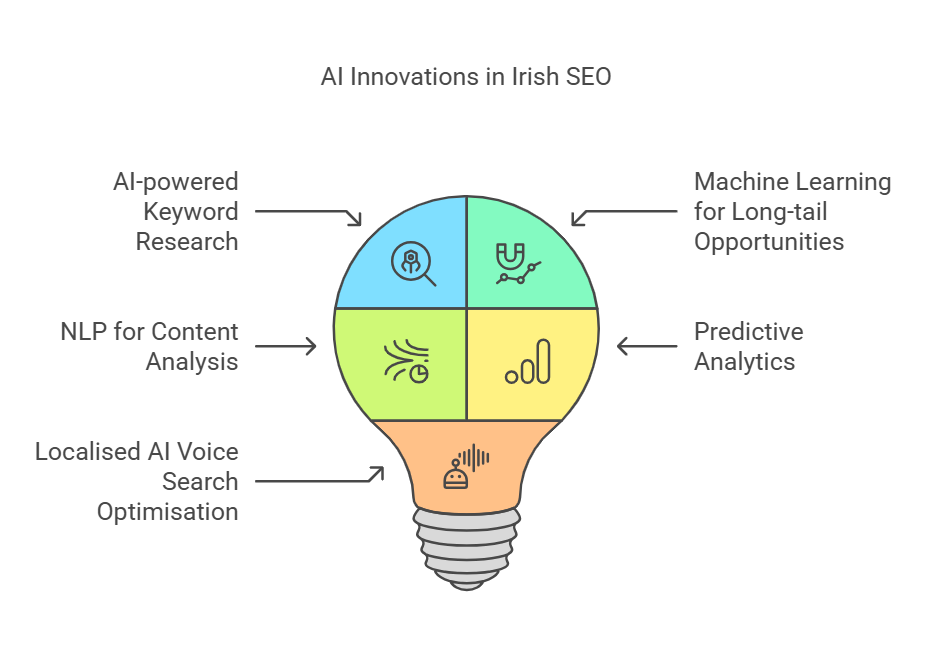
AI keyword research tools reduce manual workflow time by 40%—but human expertise remains required for strategy, accuracy, and brand voice. This section covers how to balance AI efficiency with human judgment.
Efficiency Gains
AI-powered tools deliver measurable efficiency improvements:
- Keyword research tools reduce manual workflow time by up to 40%
- Machine learning reveals “hidden” long-tail opportunities for hyper-local Irish niches.
- Natural language processing detects gaps in topical coverage.
- Predictive analytics help anticipate ranking shifts.
Human-AI Balance
43% of Irish marketers plan to use AI for content creation by 2026. But businesses getting results treat AI as an assistant rather than a replacement.
AI handles effectively:
- Research compilation
- First drafts and outlines
- Meta description drafting
- Data analysis
Humans remain required for:
- Strategy and judgment
- Accuracy verification
- Brand voice consistency
- Local knowledge and context
Google’s helpful content updates specifically target content created primarily for search engines rather than human readers. AI-generated content lacking human oversight often falls into this category.
Training Requirements
“The efficiency gains from AI-powered SEO tools are real, but they compound rather than replace human expertise. A marketer who understands search intent, content strategy, and technical SEO will get dramatically better results from AI tools than someone who treats AI as a replacement for that knowledge,” notes Ciaran Connolly.
Video SEO: The Underutilised Channel
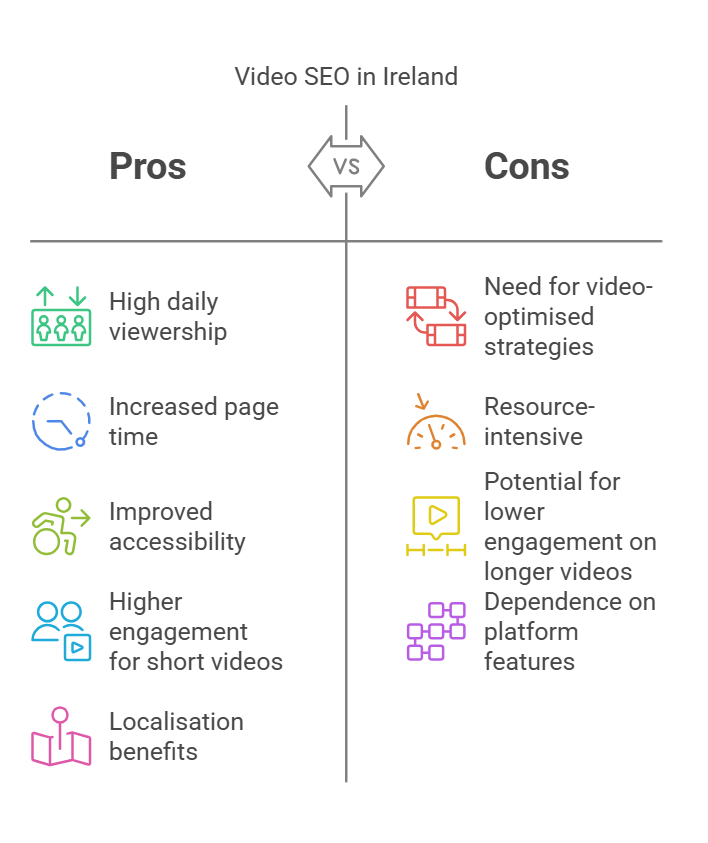
64% of Irish internet users watch online video daily, yet most businesses treat video as optional. Videos embedded in blog posts increase page time by 2–3 minutes—a significant ranking signal.
Consumption Patterns
Nearly 64% of Irish internet users watch online video content daily. This consumption level positions video as a primary content format rather than a supplementary channel.
Video engagement statistics show clear patterns:
| Embedded in blog posts | +2–3 minutes page time |
| Short-form (<60 seconds) | 50% higher engagement on social |
| With transcripts/captions | 10–15% visibility boost |
YouTube Opportunities
YouTube functions as both a hosting platform and the world’s second-largest search engine. YouTube’s localisation features—including language settings and region tags—help Irish-based content stand out in relevant SERPs.
For Irish businesses, the YouTube strategy involves:
- Video format and length decisions
- Thumbnail design optimisation
- Metadata and description optimisation
- Playlist organisation for topic clusters
The connection between video production quality and viewer retention directly links production investment to SEO outcomes.
For detailed guidance on video performance measurement, see our guide to video marketing metrics.
Practical Action Framework
Five steps to translate these 50 statistics into measurable improvements—starting with technical foundations before investing in content or links.
Step 1: Technical Foundation Assessment
Before investing in content or link building, complete these checks:
- Test Core Web Vitals performance using PageSpeed Insights
- Check mobile responsiveness across devices.
- Verify schema implementation with Google’s Rich Results Test.
- Confirm crawl issues aren’t blocking search engines.
- Review site architecture for internal linking opportunities
If your site fails these basics, technical remediation should precede other SEO investments.
Step 2: Content Gap Analysis
Follow this sequence to identify content opportunities:
- Export your current keyword rankings from Google Search Console.
- Compare existing content against target audience search queries.
- Identify gaps where you have expertise but limited content.
- Find long-tail opportunities competitors haven’t addressed.
- Flag existing content needing updates for freshness.
Prioritise based on business value and achievability rather than search volume alone.
Step 3: Video Baseline
If you currently produce no video content, start here:
- Begin with low-complexity formats (screen recordings, talking-head videos)
- Focus on consistent publication over production polish.
- Add transcripts for accessibility and search visibility.
- Optimise titles and descriptions for YouTube search
- Scale production quality as video becomes more central.
Step 4: AI Tool Integration
Implement AI tools systematically:
- Identify specific workflows where AI improves efficiency.
- Select tools appropriate for your team’s technical comfort level.
- Establish quality review processes for AI-assisted content.
- Train team members on effective AI usage and limitations
- Document prompts and processes that produce good results.
Step 5: Measurement Framework
Establish tracking for metrics that matter:
- Set up Google Search Console and Analytics 4 properly.
- Track organic traffic trends (overall and by page)
- Monitor keyword position changes for priority terms.
- Measure engagement metrics (time on page, bounce rate)
- Connect to conversion outcomes from organic search.
FAQs: Irish SEO Statistics
How long does SEO take to show results for Irish businesses?
3–6 months for most Irish businesses, though competitive industries may require longer. Initial gains typically appear in long-tail keywords before more competitive terms improve. The 25% increase in keyword difficulty for city-based queries means timelines have lengthened compared to previous years.
What’s the minimum SEO investment for an Irish SME?
€1,000–€1,500 monthly for meaningful results, covering link building (€500–€2,000 range), content creation, and technical optimisation. Businesses investing below this threshold typically see slower or inconsistent progress.
Should Irish businesses focus on local or national SEO?
Local SEO for businesses serving specific geographic areas; national for those serving Ireland-wide markets. The 30% higher search volume for Dublin queries means competition there is more intense than in regional markets. Prioritise Google Business Profile optimisation, local citations, and location-specific content for local focus.
How much does video affect Irish SEO performance?
Significantly. 64% of Irish users watch videos daily, and videos increase page dwell time by 2–3 minutes. The 10–15% visibility boost from transcripts makes video content discoverable through traditional search while serving the growing video-preferring audience.
What technical factors matter most for Irish websites?
Core Web Vitals compliance, mobile performance, and schema markup implementation provide the clearest advantages. With only 40% of Irish sites meeting Core Web Vitals standards and only 25% using schema, businesses addressing these basics immediately outperform most competitors.
How should Irish businesses approach AI in their SEO strategy?
Use AI tools for research, outlining, and routine tasks while maintaining human expertise for strategy, quality control, and brand voice. AI reduces workflow time by 40% but Google’s helpful content updates penalise content created primarily for search engines rather than for genuine user benefit.
Do .ie domains help Irish SEO?
Slightly. Local .ie domains provide a modest ranking advantage for Irish queries, though this effect is smaller than that of content quality, technical performance, and backlink authority. 30% of Irish businesses still use .com domains successfully.
What role does social media play in Irish SEO?
Indirect but measurable. Businesses with strong social presence see approximately 10–12% higher CTR on brand searches and 25% higher brand-keyword search volume. Social media supports SEO by boosting brand visibility and content distribution, rather than directly affecting ranking factors.
Conclusion
These 50 statistics reveal where SEO opportunities exist in Ireland, where competition has intensified, and what separates businesses gaining organic visibility from those losing ground. The technical data shows most Irish websites fail to meet basic performance standards—creating an opportunity for those who invest properly. The content patterns confirm that locally relevant material outperforms generic alternatives, while video numbers make clear that text-only strategies miss how Irish audiences actually consume information. For Irish businesses, the direction is clear: invest in technical foundations, create content with genuine local relevance, integrate video into your strategy, and develop AI capabilities that improve rather than replace human expertise.
ProfileTree is a Belfast-based digital agency helping businesses across Northern Ireland, Ireland, and the UK implement the improvements these statistics point toward. Our SEO services translate this data into practical results. “SEO statistics are useful for setting direction, but they don’t replace the fundamental work of building something worth finding. Every successful SEO strategy ultimately rests on having genuine value to offer—expertise, solutions, information that actually helps people. The technical work makes that value discoverable; it doesn’t create it,” concludes Ciaran Connolly.