
AI Literacy for SME Owners in Ireland and Northern Ireland
Table of Contents
If you run a small business in Belfast, Cork, or anywhere across the island, you have probably been told that artificial intelligence will change everything. What few people explain is the practical part: which skills you actually need, what you can safely ignore, and how to build that knowledge without hiring a data scientist.
AI literacy is the working ability to judge where these tools help, spot where they do not, and lead their adoption responsibly. It sits alongside reading a cash-flow forecast or understanding your marketing numbers as a core leadership skill for 2026.
This guide covers the five core literacy pillars, the cross-border regulatory split between the Republic and Northern Ireland, sector-specific applications, funding routes, and a practical 90-day plan you can start this week.
Why AI Literacy Has Become a Leadership Skill
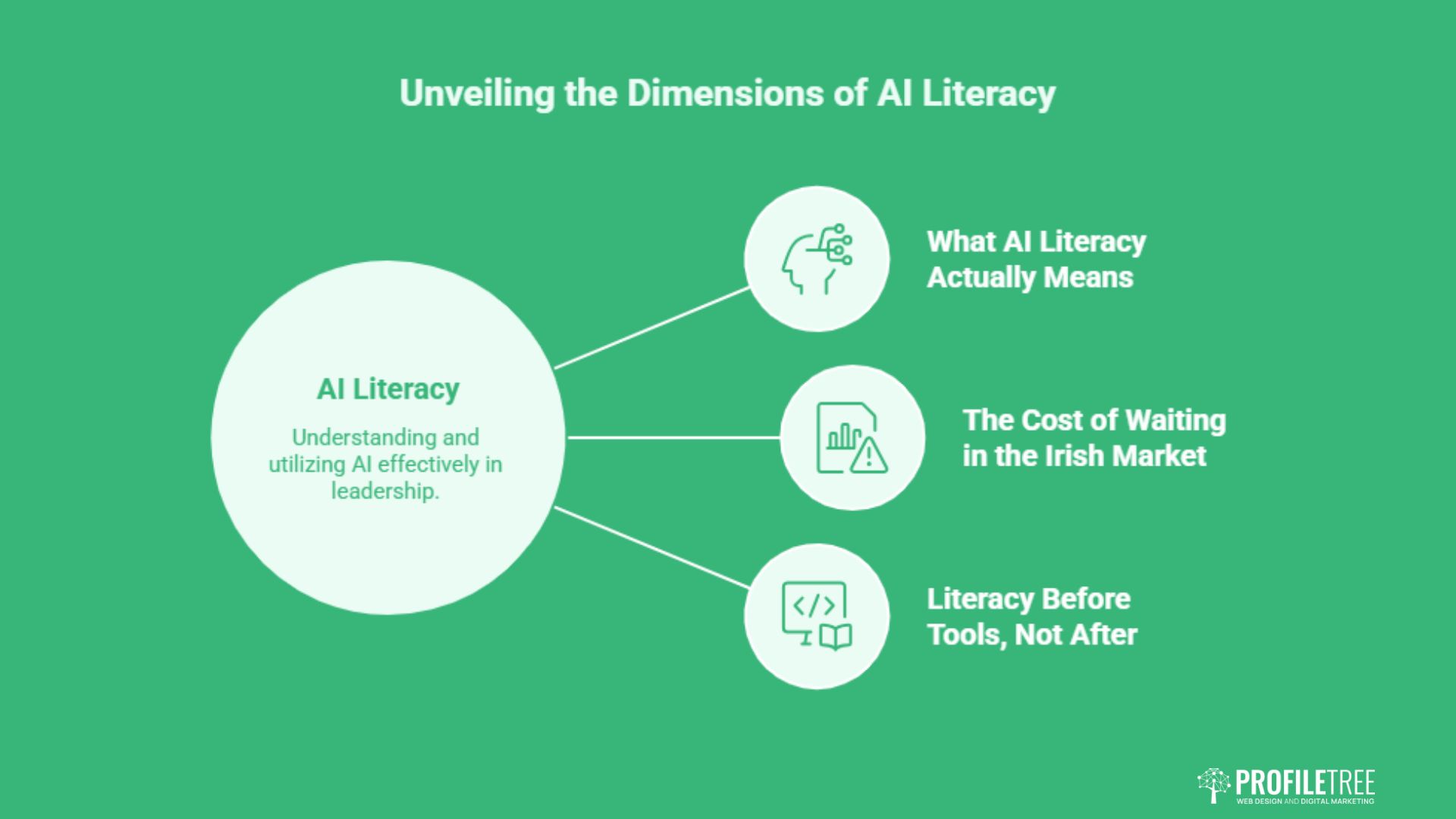
AI literacy is no longer a technical specialism reserved for your IT supplier. It is a decision-making skill, and the owner who understands it makes faster, cheaper, and safer choices than one who delegates the whole question. The gap between businesses that grasp this and those that wait is widening, and it shows up in margins long before it shows up in headlines.
What AI Literacy Actually Means
Being AI literate does not mean writing code or training models. It means understanding what these systems can and cannot do, recognising a genuine use case from a sales pitch, and knowing how to test a tool before committing budget to it.
For a time-poor owner, the practical version is simpler still: can you describe a real problem in your business, judge whether AI is a sensible fix, and ask a supplier the three or four questions that separate a useful product from an expensive distraction? If you can, you are most of the way there. The deeper technical work can be bought in or built up later.
The Cost of Waiting in the Irish Market
The “wait and see” approach carries a hidden price. While one retailer keeps handling routine customer queries by hand, a competitor two towns over has automated the first response and freed staff for higher-value work. The difference compounds quietly over a trading year.
Irish and Northern Irish SMEs face the same competitive pressure as larger UK and European firms, but with leaner teams. That makes literacy more valuable here, not less. A small business cannot afford a wasted twelve-month experiment, so the owner who can evaluate options well protects both time and capital. ProfileTree’s breakdown of common adoption challenges sets out where most firms stumble first.
Literacy Before Tools, Not After
Many owners buy the software first and learn what it does afterwards. That order is backwards and expensive. Understanding the concepts before you spend means you choose tools that fit a real workflow rather than chasing whatever was demonstrated most slickly.
Building that understanding early is the foundation of a wider digital strategy, where AI sits as one capability among several rather than a bolt-on bought in a panic.
The Five Core Pillars of AI Literacy
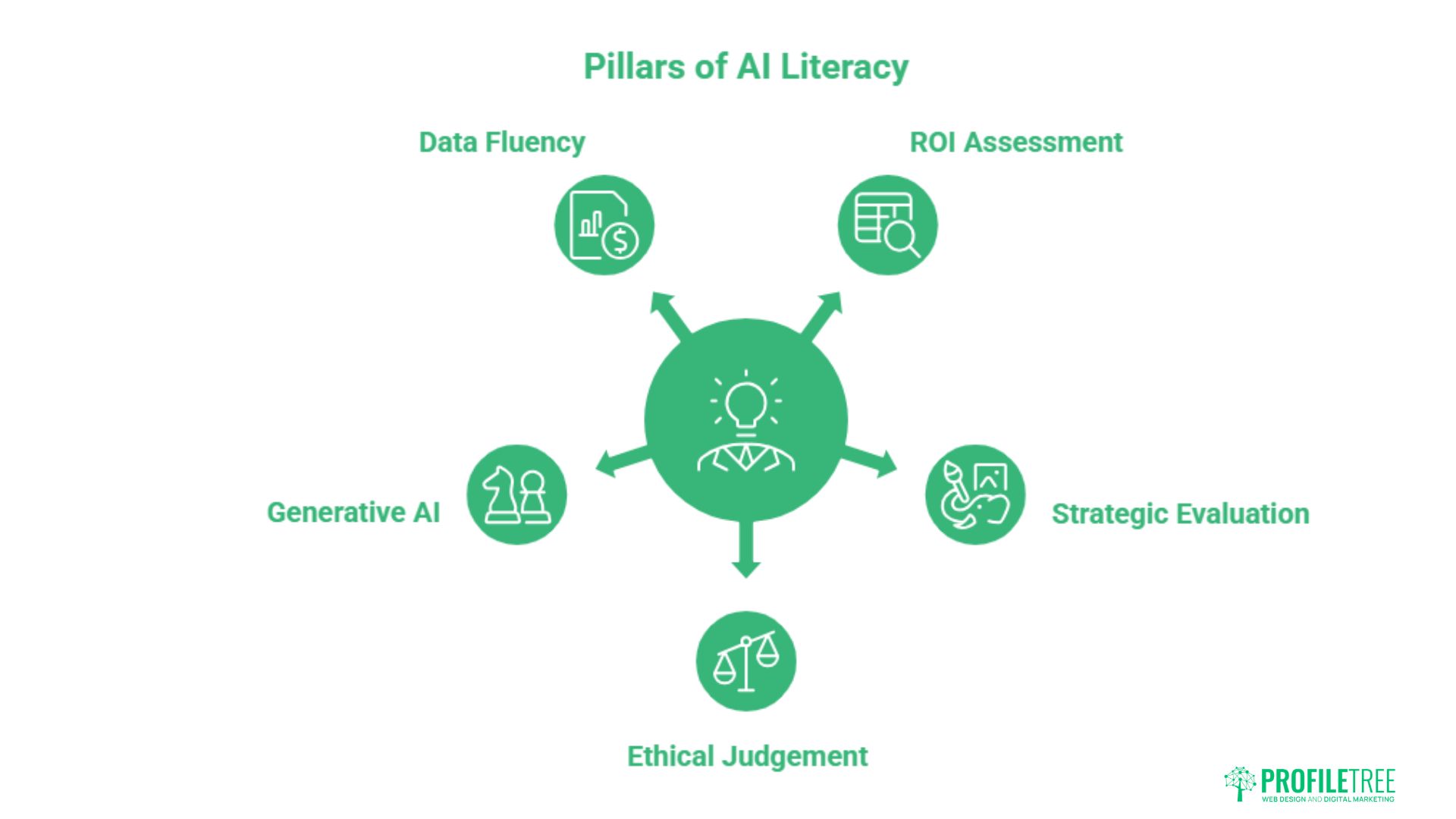
Useful AI literacy breaks into five learnable pillars. None requires a technical background, and most owners already hold pieces of several. Treating them as distinct skills makes the gaps visible and gives you a clear order in which to close them.
Data Fluency and Tool Selection
Every AI tool runs on data, so the first pillar is knowing what data your business holds, whether it is clean enough to be useful, and where the gaps sit. A customer list riddled with duplicates will produce poor results, no matter how capable the software is.
Tool selection follows from this. Once you know your data and your problem, choosing between a chatbot, an analytics tool, or a content assistant becomes a practical comparison rather than a guess. A ProfileTree guide on low-cost AI implementation shows how to match modest tools to real needs.
Prompting and Working With Generative AI
Generative tools respond to the quality of your instructions. A vague request returns a vague answer; a specific, well-framed prompt with context and examples returns something you can use. This skill is learnable in an afternoon and improves with practice.
The skill compounds quickly because it transfers across tools. An owner who has learned to frame a clear request for one assistant can apply the same habit to the next, regardless of which product is in front of them. That portability is what makes prompting worth teaching early rather than leaving it to chance.
Prompting matters most where staff use these tools daily, which is why structured practice beats occasional tinkering. Hands-on familiarity across a team turns generative AI from a novelty into a dependable part of the working day.
Ethical Judgement and Responsible Use
The third pillar is knowing where to keep a human in the loop. AI can draft, summarise, and suggest, but it should not make final decisions about people, money, or safety without review. Bias, privacy, and transparency are not abstract concerns; they surface the moment a tool touches customer data.
A short internal policy covering what staff may and may not feed into AI tools prevents most problems before they start. This judgement is inseparable from data protection, a point the regulatory section below returns to.
Strategic Evaluation of Opportunities
The fourth pillar is spotting where AI genuinely fits your business and where it does not. That means looking across your operation for tasks that are repetitive, rule-based, or data-heavy, then judging which would benefit most from automation or assistance. Not every problem needs an AI solution, and recognising that is part of the skill.
Owners who weigh this well avoid the trap of adopting tools for their own sake. Strong evaluation keeps spending pointed at real pain points rather than whatever was demonstrated most convincingly.
Judging Return on Investment
The final pillar closes the loop: can you tell whether a project actually paid off? That means setting a measurable goal before you start, tracking the real cost, including staff time and setup, and being willing to stop a pilot that is not delivering.
Without this discipline, AI spending drifts. A clear-eyed read of cost-benefit analysis is what separates a sound investment from a fashionable one.
The Cross-Border Regulatory Split
This is the issue most national guides skip, and it matters enormously for businesses trading across the border. A firm in Donegal selling to customers in Derry, or a Newry supplier serving Dublin clients, sits across two regulatory systems at once. Getting this wrong is a compliance risk; getting it right is a genuine advantage.
How the Republic and Northern Ireland Diverge
The Republic of Ireland falls under the European Union’s AI Act, a single overarching law that classifies AI uses by risk level. Northern Ireland follows the United Kingdom’s approach, which spreads oversight across existing sector regulators rather than one central statute. The two systems share goals but differ in structure and obligations.
| Consideration | Republic of Ireland (EU AI Act) | Northern Ireland (UK framework) |
|---|---|---|
| Legal structure | Single overarching AI regulation | Sector regulators apply existing law |
| Approach to risk | Tiered by risk category, with banned and high-risk uses defined | Principles-based, interpreted per sector |
| Data protection base | EU GDPR | UK GDPR and Data Protection Act |
| Practical effect for SMEs | Clear categories, more documentation for higher-risk uses | More flexible, but obligations vary by industry |
For most small firms, everyday uses such as drafting marketing copy or running a customer chatbot sit in the low-risk band on both sides. The caution applies when AI touches recruitment, credit, or anything affecting people’s rights.
What This Means for Border-County Businesses
If you serve customers on both sides, the safest path is to meet the stricter of the two standards across your whole operation. Building to EU AI Act expectations generally keeps you compliant in Northern Ireland as well, which simplifies the work rather than doubling it.
Keeping your data governance current is the practical first step, since both regimes rest on sound data handling. Reading the official EU regulatory framework for AI directly is worth an hour of any owner’s time.
Keeping Compliance Manageable
None of this requires a legal department. A simple record of which AI tools you use, what data they touch, and who reviews their output covers most of what either regulator expects from a small business. The Republic’s national position is set out plainly in the government’s national AI strategy.
Treat compliance as a light, ongoing habit rather than a one-off project. Reviewing it once a quarter, alongside your other business housekeeping, keeps it from ever becoming a crisis.
Practical AI Applications Across Irish Sectors
Literacy becomes real when applied to your own trade. Generic advice helps less than a concrete example from a sector you recognise, so this section moves through several that shape the Irish and Northern Irish economy. The aim is to show what a sensible first project looks like in each.
Retail and Hospitality
For shops, cafes, and small hotels, the strongest early wins are in customer interaction and stock. An AI chatbot can field opening hours and availability questions around the clock, freeing staff during busy periods. Demand forecasting helps a kitchen order the right amount and waste less.
These are low-risk, high-frequency tasks, which makes them ideal first projects. A well-scoped AI chatbot often pays for itself simply by capturing enquiries that would otherwise be missed after hours.
Professional Services and Agri-Food
Accountants, solicitors, and consultancies handle large volumes of documents, and AI summarising and drafting tools cut hours from routine work, provided a qualified person reviews every output. The efficiency is real; the human check is non-negotiable in regulated fields.
Agri-food, a backbone of the rural economy on both sides of the border, gains from prediction. Tools that forecast yield, monitor herd health, or track supply conditions turn scattered data into decisions. The pattern across both sectors is the same: AI handles the repetitive groundwork, and the professional makes the judgment.
Marketing and Content for Smaller Firms
Marketing is where most SMEs feel the benefit first, because the tasks are frequent and the stakes are manageable. AI speeds up first drafts, suggests campaign variations, and analyses which messages land, letting a one-person marketing function punch above its weight.
The skill is editing what the tool produces so it sounds like your business rather than generic filler. Used well within a considered digital strategy, AI extends a small team’s reach without diluting its voice. For a sense of the region these businesses serve, Connolly Cove’s overview of the top cities to visit in Northern Ireland captures the local market well.
Building the Skills: Training, Funding and a 90-Day Plan
Knowing what to learn is half the task; the other half is a route to learn it without stalling. This section covers where the skills come from, how to fund them, and a simple sequence that takes an owner from curious to capable in three months.
Choosing How to Develop AI Skills
Owners broadly face three routes: self-directed learning through online courses, structured training led by a specialist, or upskilling one existing staff member into an internal AI champion. Each suits a different budget and pace, and many firms combine them.
Structured training tends to move a whole team faster than scattered self-study, because it targets your actual tools and workflows. ProfileTree, a Belfast-based digital agency, delivers AI training built around the practical needs of SMEs across Ireland and the UK rather than abstract theory. The choice between building skills in-house and bringing them in is itself worth weighing carefully, and the comparison of training options sets out the trade-offs.
Funding and Support on Both Sides of the Border
Cost need not be a barrier. The Republic offers support through Local Enterprise Offices, Enterprise Ireland, and Skillnet Ireland, while Northern Ireland firms can look to Invest Northern Ireland programmes. These schemes change their terms periodically, so check current eligibility directly with each body before planning around them.
The common mistake is treating funded training as the finish line. Skills fade without use, so the value comes from embedding what you learn into daily work once the funded sessions end. Wider digital training keeps that momentum going across a team.
As Ciaran Connolly, founder of ProfileTree, puts it: “The businesses that get real value from AI are not the ones chasing every new tool. They are the ones whose owners learned enough to ask sharp questions, test things properly, and stop what was not working. In our market, that judgement paired with strong local knowledge is worth more than any single piece of software.”
Your First 90 Days
A practical plan beats good intentions. In the first month, focus on foundations: complete an introductory course, list the repetitive tasks in your business, and pick one as a candidate for a first project. Keep it small and low-risk.
In the second month, run that pilot. Set a clear measure of success, test a tool against it, and record what happens, including the staff time involved. In the third month, judge the result honestly, decide whether to expand, keep, or stop, and choose your next target. Training your team properly through this stage matters, and a practical guide to staff AI training covers how to bring people with you. For a fuller transformation across the business, ProfileTree’s AI transformation work picks up where literacy leaves off.
Conclusion
AI literacy has become a core leadership skill for SME owners across Ireland and Northern Ireland, not a technical luxury. The owners who learn enough to evaluate tools, respect the cross-border rules, and run small, disciplined pilots will pull ahead of those who wait. Start with one problem, one tool, and one clear measure of success, then build from there. The skill compounds, and so does the advantage.
Ready to build practical AI skills in your team? ProfileTree’s AI training is designed for SME owners in Ireland and Northern Ireland who want results, not jargon. Talk to our team about AI training.
FAQs
What are the core pillars of AI literacy for business?
AI literacy for owners rests on five learnable skills: data fluency, generative AI prompting, ethical and responsible use, strategic evaluation, and return-on-investment judgement. None requires a technical background. Together,r they let you choose tools wisely, use them safely, and tell whether a project paid off, which is the practical core of leading AI adoption in a small business.
Do I need a data scientist to use AI in my small business?
No. Most SME AI uses, such as chatbots, drafting tools, and analytics, run on off-the-shelf or no-code products that need no in-house data scientist. Many firms instead upskill one existing staff member into an AI champion or bring in a fractional consultant for specific projects. The owner’s own literacy, knowing what to ask and how to test a tool, matters far more than a specialist hire.
Does the EU AI Act apply to small businesses in Ireland?
Yes. The EU AI Act applies in the Republic of Ireland regardless of company size, but obligations scale with risk. Every day, our low-risk uses, such as marketing content or customer chatbots, carry light requirements. Heavier duties apply only to higher-risk uses affecting people’s rights, such as recruitment or credit decisions, where documentation and human oversight become important.
How do cross-border SMEs handle AI compliance in Northern Ireland?
Businesses trading across the border sit under two regimes: the EU AI Act in the Republic and the UK’s sector-led approach in Northern Ireland. The simplest path is to build to the stricter standard across the whole operation, which usually means meeting EU AI Act expectations. Sound data governance underpins both, so keeping your data handling current covers most requirements on either side.
What is the best way for an Irish SME owner to start learning AI?
Start with one real problem rather than a broad course. Pick a repetitive task, learn enough to judge whether AI suits it, and run a small pilot with a clear measure of success. Structured training built around your own tools usually moves a team faster than scattered self-study. Funded support through Local Enterprise Offices, Skillnet, or Invest Northern Ireland can reduce the cost.