
Digital Transformation for Rural Businesses in Ireland and the UK
Table of Contents
Rural development across Ireland, Northern Ireland, and the UK is increasingly shaped by one factor: whether a business has a credible digital presence. A farm shop in County Tyrone, a glamping site in County Clare, or a food producer in the Scottish Highlands is competing online with businesses that have full marketing teams and established digital channels.
The gap is real, but it is closable. This guide covers the practical steps rural SMEs can take to build a strong digital presence, attract the right customers, and leverage tools such as SEO, web design, and AI to compete on an equal footing regardless of their postcode.
Why Rural Businesses Face Distinct Digital Challenges
Rural businesses are not a homogeneous group. They include agri-food producers, farm diversification enterprises, rural tourism operators, craft businesses, and professional services firms working in areas with limited footfall. What most share is a dependence on customers who are not walking past their doors, which makes digital presence the single most important factor in their growth.
Three barriers consistently affect rural SMEs in their digital development.
Connectivity still holds some areas back
Despite significant investment through the UK’s Project Gigabit and Ireland’s National Broadband Plan, reliable high-speed connectivity remains patchy in parts of Northern Ireland, rural Wales, the Scottish Highlands, and the west of Ireland. This affects not just how businesses operate internally, but how they can use cloud-based tools, video conferencing, and digital platforms.
The situation is improving. Ofcom’s 2024 Connected Nations report found that gigabit-capable coverage reached 70% of UK premises, but rural coverage lagged significantly behind that in urban areas. For businesses in areas still waiting for full connectivity, mobile broadband and satellite options such as Starlink have become practical short-term alternatives.
Digital skills gaps are wider in rural areas
Business owners in rural areas are often doing everything themselves. The person managing the farm is also managing the website, social media accounts, online bookings, and customer enquiries. Without access to local digital training or affordable specialist support, these businesses frequently operate with outdated websites, little to no SEO, and social media accounts that have not been updated in months.
This is where structured digital training makes a practical difference. ProfileTree’s digital training programmes are designed for exactly this kind of time-poor, multi-role business owner, covering the fundamentals of SEO, content marketing, and digital tools in a format that can be applied immediately without a large team.
Geographic invisibility online
A business located in a rural area can struggle to appear in local search results if its digital presence is not set up correctly. Google’s local search algorithm relies on accurate business information, consistent NAP (Name, Address, Phone) data, structured data, and location-specific content. Without these, a rural business that serves customers within a 50-mile radius can be effectively invisible to those customers when they search online.
Getting this right is not complicated, but it requires deliberate effort. The fundamentals of a well-structured Google Business Profile, location pages on the website, and content that reflects the geographic area served can make a significant difference to a rural business’s organic visibility.
Building a Web Presence That Works Beyond Your Postcode
For most rural businesses, the website is the only shop window a potential customer will ever see before making a decision. A poorly built site, or no site at all, costs these businesses visitors and sales every single day.
What rural business websites actually need
The requirements are not fundamentally different from any other small business website, but the priorities shift. For a rural tourism operator, high-quality photography and a frictionless booking process matter more than almost anything else. For a food producer selling direct to consumers, clear product information, provenance storytelling, and a straightforward checkout matter most. For a professional services firm operating remotely, credibility signals such as testimonials, accreditations, and case studies carry the weight.
What consistently undermines rural business websites is the same set of problems: slow loading times, no mobile optimisation, outdated content, and no clear call to action. In areas where some visitors may be on mobile connections rather than fast broadband, page speed is not just a ranking factor; it is a direct conversion factor.
The case for a professional build over DIY platforms
There is a reasonable temptation for rural business owners to use DIY website builders to keep costs down. For very early-stage businesses with limited content needs, this can be a workable start. But for any business that relies on search traffic, bookings, or e-commerce, the limitations of drag-and-drop platforms quickly become apparent.
WordPress-built sites, professionally developed and maintained, give rural businesses full control over their SEO, faster page performance, and the flexibility to add functionality as the business grows, whether that is a booking system, an online shop, or a member portal. The upfront investment is higher, but the long-term capability is incomparably greater.
E-commerce for rural producers and farm diversification
The agri-food and farm diversification sectors, in particular, have seen significant growth in direct-to-consumer online sales since 2020. Meat boxes, artisan food products, floristry, craft goods, and farm experience bookings are all being sold successfully online by rural businesses across Ireland and the UK.
For these businesses, e-commerce is not a nice-to-have; it is a revenue channel that extends their reach from a local market to a national one. Building and optimising that channel properly, including product pages written for search as well as for conversion, is one of the most direct ways a digital agency can support rural business growth. ProfileTree’s web development work for small businesses in Northern Ireland and Ireland includes this kind of e-commerce setup, built for businesses that want to sell, not just showcase.
SEO for Rural Businesses: Getting Found by the Right People
Search engine optimisation for rural businesses requires a slightly different approach than for urban commercial businesses. The keyword volumes are lower, the geographic targeting is more granular, and the competition often includes a mix of national brands and local directories. Done well, SEO provides a rural business with a durable, organic source of qualified traffic that does not depend on advertising spend.
Local SEO is the priority
The starting point for any rural business is local SEO. This means ensuring that the business appears correctly in Google Maps and local search results for relevant queries in its area. The essentials are: a fully completed and verified Google Business Profile, consistent NAP information across all online directories, and genuine customer reviews.
Beyond the basics, location-specific content on the website plays a significant role. A rural accommodation business in County Fermanagh is not competing with every hotel in the UK it is competing for searches like “lakeside glamping Northern Ireland” or “self-catering Fermanagh.” Content built around those specific, intent-driven queries converts at a higher rate than generic content aimed at broad keywords.
Content that reflects the place, not just the product
Rural businesses have a genuine content advantage that many urban businesses do not: a strong sense of place. The landscape, the heritage, the product’s provenance, and the business’s story are all content assets that attract organic search traffic and engage visitors in ways that generic product descriptions cannot.
A food producer that writes about its farming practices, its location in the Glens of Antrim, and the seasonal nature of its products is building content that earns links, ranks for long-tail searches, and differentiates the brand from commodity competitors. This is content marketing working at its most natural. The challenge is doing it consistently enough to compound over time.
Building authority through digital PR and backlinks
One underused route for rural businesses is digital PR appearing in regional news outlets, food and travel publications, and sector-specific media. Every mention that links back to the business website builds domain authority and improves search rankings. A glamping site featured in a travel guide, or a food producer covered by a regional newspaper, gains not just exposure but a durable SEO asset.
“The businesses we see gaining the most traction in rural and regional search are the ones combining strong on-page SEO with a genuine story that earns them press coverage,” says Ciaran Connolly, founder of ProfileTree. “It is not just about technical optimisation, it is about giving search engines and journalists something worth citing.”
Digital Marketing for Rural and Agri-Food Businesses
Digital marketing for rural businesses is most effective when it reflects what genuinely differentiates them: provenance, authenticity, place, and story. The channels and tactics that work best are those that can carry that kind of content, primarily social media, email marketing, and video.
Social media for tourism and food businesses
Social media, particularly Instagram and Facebook, remains the most accessible entry point for rural businesses with limited marketing budgets. For tourism and food businesses, visual content photography and short videos perform well because they can convey the appeal of a place or product in a way that text alone cannot.
The businesses that get the most from social media are those that post consistently, use local and sector-specific hashtags, and engage genuinely with their audience rather than broadcasting at them. A short reel showing the process of making an artisan product, or a morning shot of a glamping site, will outperform a promotional graphic almost every time.
ProfileTree’s social media marketing work for Northern Ireland businesses is built around this content-first approach, establishing a consistent presence that builds audience trust before it asks for a sale. You can explore more about this approach to social media for tourism and destination businesses in our tourism marketing strategies guide.
Email marketing for repeat customers and seasonal bookings
For rural businesses with a strong repeat customer base, such as farm shops, accommodation providers, and CSA box schemes, email marketing is one of the highest-return digital channels available. A well-maintained email list gives direct access to people who have already chosen to buy from the business, without the algorithm dependency of social media.
Seasonal messaging works particularly well here. A farm shop announcing the arrival of new-season produce, or an accommodation business sending early-access booking availability to previous guests, generates a response that no paid advertising can replicate. The barrier is usually the initial setup: choosing a platform, building the list, and establishing a sending rhythm. It’s here that professional support makes the difference.
Video marketing for provenance and place storytelling
Video is the most effective format for rural businesses that want to communicate the story behind their product or place. A two-minute farm tour, a chef talking about sourcing ingredients locally, or a time-lapse of a harvest season does more to differentiate the brand than any amount of written content.
For businesses new to video, the barrier feels high, but production costs for short, authentic social media videos have dropped significantly. A short-form smartphone video, well-lit and with clear audio, will outperform a polished but generic corporate video for rural business audiences. For more substantial productions, ProfileTree’s video production services in Belfast help businesses across Northern Ireland create content that credibly and compellingly tells their story.
AI Tools for Rural Businesses with Small Teams
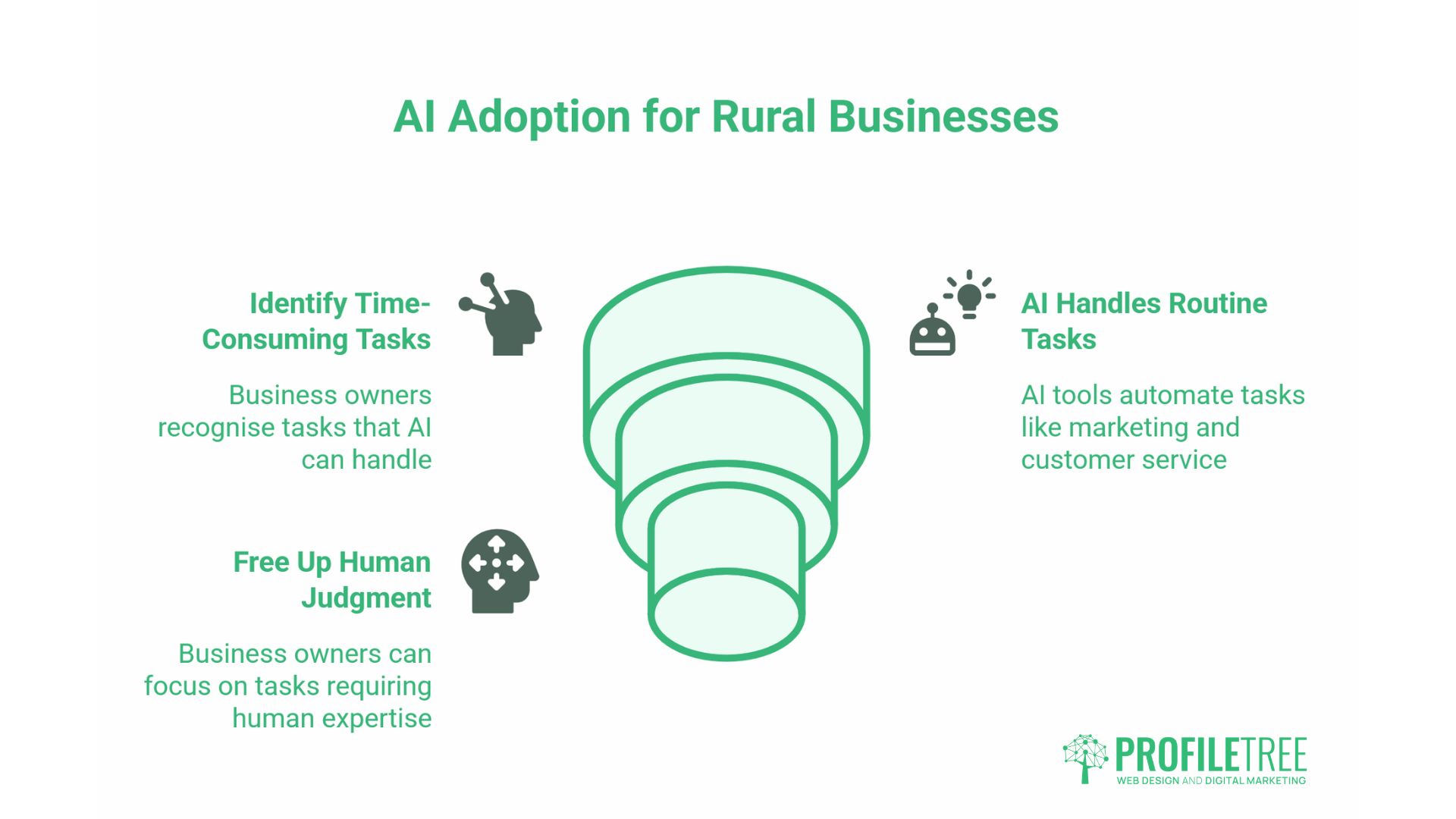
Artificial intelligence tools have moved from being a large-enterprise concern to something that a single-person rural business can practically use today. For business owners who manage operations, marketing, and customer service simultaneously, AI tools offer the greatest value for time-consuming tasks that do not require specialist human judgement.
AI for content creation and marketing copy
Writing product descriptions, social media posts, email newsletters, and website copy takes time that most rural business owners simply do not have. AI writing tools, used correctly, can produce a reliable first draft of this kind of content in minutes, freeing up time for the parts of the business that genuinely require the owner’s expertise.
The important caveat is that AI-generated copy requires editing and localisation. A generic AI description of a self-catering cottage will not capture what makes a specific property in Donegal different from every other property listed on a booking platform. The tool does the heavy lifting; the business owner adds the detail and personality that converts.
AI for customer communication and scheduling
For rural hospitality and tourism businesses, managing enquiries across email, phone, and multiple booking platforms can consume disproportionate time. AI chatbots and automated response tools can handle initial enquiries, answer frequently asked questions, and route more complex requests to the owner, reducing the administrative burden without removing the personal touch.
Similarly, AI scheduling tools can help rural businesses manage bookings, send automated confirmations and reminders, and reduce the back-and-forth that often accompanies phone or email booking management.
Getting started with AI: training and practical guidance
The most common barrier to AI adoption in rural businesses is not the cost of the tools, many of which are free or low-cost, but the lack of knowledge about which tools are useful, how to set them up, and how to integrate them into an existing workflow.
ProfileTree’s AI training programmes cover exactly this ground, with sessions designed for small business owners rather than technical specialists. Our guide on cost-benefit analysis of AI implementation in SMEs sets out a practical framework for evaluating which AI tools are worth the time investment. For teams that want structured training, our digital training services include modules covering AI tools for marketing, content, and operations.
Funding and Support for Rural Digital Development
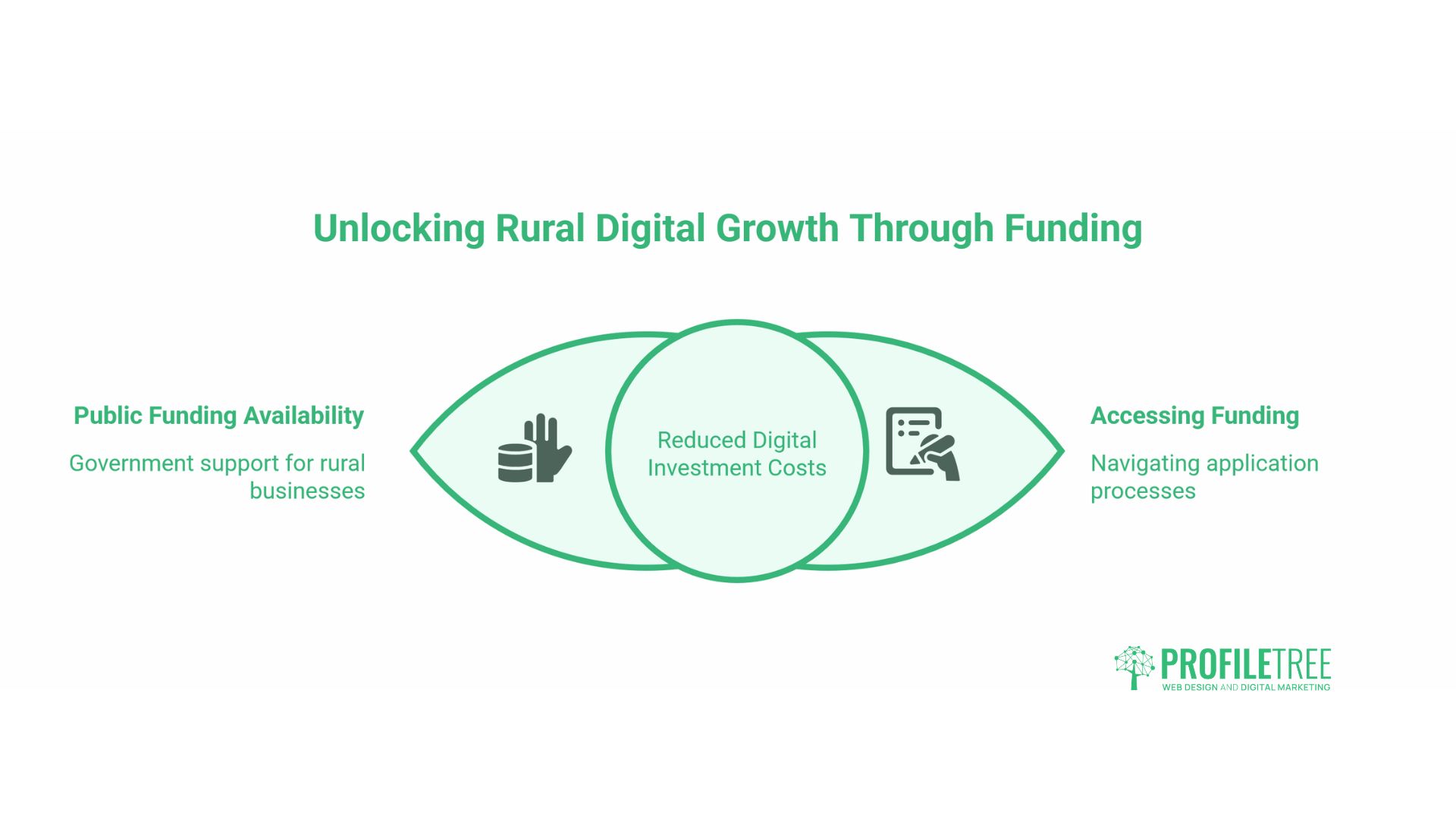
A significant amount of public funding is dedicated specifically to supporting rural business digitalisation across Ireland and the UK. Being aware of what is available and how to access it can significantly reduce the upfront cost of digital investment.
Northern Ireland: DAERA and Invest NI support
In Northern Ireland, rural business development is supported through the Department of Agriculture, Environment and Rural Affairs (DAERA) and through Invest NI’s range of support programmes. The Rural Business Development Grant, administered through Local Action Groups, has historically supported rural SMEs in areas including digital equipment, website development, and online marketing.
Businesses in Northern Ireland should also be aware of Invest NI’s Going Digital programme, which provides subsidised support for digital strategy, website development, and digital marketing. Availability and eligibility criteria change, so checking directly with Invest NI and the relevant Local Action Group is advisable before applying.
Republic of Ireland: Enterprise Ireland and Leader funding
In the Republic, Enterprise Ireland supports rural business digitalisation through its online trading vouchers and digital start schemes, available through Local Enterprise Offices (LEOs). These vouchers, typically covering up to €2,500 of eligible spend, can be used toward website development, digital marketing, and online selling platforms.
The LEADER programme, funded through the Rural Development Programme, provides broader grant support for rural businesses and community projects across eligible rural areas. Applications are handled through Local Action Groups, and the scope of eligible activity includes digital marketing, training, and equipment. Our overview of e-commerce opportunities and challenges in Ireland covers the digital context that informs many of these funding decisions.
England, Wales and Scotland: REPF and regional schemes
In England, the Rural England Prosperity Fund (REPF), delivered through local councils as part of the UK Shared Prosperity Fund, provides capital and revenue grants for rural businesses and communities. Eligible activities include digital infrastructure, equipment, and business support. Scotland and Wales operate equivalent schemes through their respective rural development programmes.
The common thread across all these programmes is that applications with a clear digital strategy and a demonstrable need are more likely to succeed than generic funding requests. Preparing a brief digital plan before approaching any funding body is time well spent.
Conclusion
Rural businesses in Ireland, Northern Ireland, and the UK are not disadvantaged by their geography; they are differentiated by it. The challenge is making sure that differentiation is visible online, where most buying decisions now begin. A properly built website, a local SEO strategy, and a consistent content presence are the foundations. AI tools and structured digital training can help lean teams maintain those foundations without being overwhelmed.
ProfileTree works with rural and regional businesses across Northern Ireland, Ireland, and the UK to build digital presences that reflect what genuinely makes those businesses worth choosing. If you would like to talk through what that looks like in practice, get in touch with the team in Belfast.
FAQs
What does digital transformation mean for a rural business?
For a rural SME, digital transformation means building a professional website, optimising local SEO, and introducing digital tools to reduce administrative time. The impact is most often felt in customer acquisition: businesses previously dependent on word of mouth or footfall can reach customers across a much wider area.
How can a rural business get found on Google?
The starting point is a verified Google Business Profile with an accurate name, address, phone number, and opening hours. A website with location-specific content pages that mention the geographic area and services offered in plain language gives Google the signals it needs to show the business in relevant local searches. Customer reviews are also a significant ranking factor.
Is SEO worth it for a small rural business?
Yes, particularly local SEO. Appearing in Google Maps and local search results is one of the most cost-effective ways to attract new customers, and unlike paid advertising, organic rankings do not stop when the budget runs out. Getting the basics right, an accurate Google Business Profile, a well-structured website, and some location-relevant content pays dividends for years.
What AI tools are most useful for rural business owners?
The most practical options are AI writing assistants for drafting marketing copy and product descriptions, scheduling tools that reduce booking admin, and AI-powered social media planners. Most are available at low or no cost, and structured AI training tends to produce faster results than independent experimentation.