
AI Micro-Credentials in Employee Training: A Strategy Guide
Table of Contents
AI micro-credentials are changing how businesses build a workforce fit for the age of automation. Rather than committing staff to multi-year degree programmes, organisations across the UK and Ireland are turning to short, modular qualifications that certify specific AI competencies quickly and cost-effectively.
The demand is real. Employers increasingly need staff who can work alongside AI tools, interpret data outputs, and apply ethical governance to algorithmic decisions. Traditional continuing professional development rarely addresses these needs with the speed or precision required.
This guide covers why AI micro-credentials are now a central workforce strategy, how to fund them in the UK and Irish markets, how to structure a credential stack for different roles, and how to measure the return on that investment. It also addresses the employer recognition question that L&D managers and HR directors consistently raise.
The Shift from Degrees to Modular AI Learning
The pace of AI development has exposed a fundamental limitation in traditional qualifications: they take years to design, validate, and deliver, while the tools they aim to address change every few months. A postgraduate course written in 2022 around neural network principles will not reflect how large language models are being applied in offices and production lines today. Micro-credentials respond to this by shortening the gap between skill need and skill acquisition to weeks rather than years.
Why Traditional CPD is No Longer Sufficient
Conventional CPD tends to be broad and attendance-based, awarding points for presence rather than verified competency. That model works well for regulatory compliance or professional licensing, but it does not produce staff who can work confidently with AI tools on day one of a project. Micro-credentials, by contrast, assess practical outputs: a completed prompt library, a data analysis task, a bias audit of a model output.
The shift also reflects how adults learn in practice. Most employees do not have the time or appetite for a 12-week evening course. A structured module that can be completed in 8 to 20 hours, on demand, fits around operational responsibilities without requiring extended absence from work.
The Role of Bite-Sized Competency Modules
A well-designed AI micro-credential targets a single, clearly defined capability: prompt engineering for content workflows, data literacy for non-technical managers, AI ethics and governance for team leaders, or machine learning fundamentals for developers moving into applied AI roles. Each module is narrow enough to be completed quickly but deep enough to produce a measurable change in how the learner approaches their work.
This specificity is what distinguishes micro-credentials from a watched webinar or a finished online course. The learner submits assessed work. The credential certifies a level of demonstrated ability, not just time spent. For businesses tracking skill development at the team level, that distinction matters considerably.
To understand how AI is already influencing how teams work together, AI team collaboration explores practical applications for SMEs across the UK and Ireland.
MOOCs and Blended Delivery
Massive Open Online Courses from providers such as Coursera, edX, and FutureLearn have been a significant vehicle for AI micro-credentials, particularly where cost is a primary constraint. These platforms host courses developed by universities, technology companies, and independent practitioners, covering everything from AI foundations to specialist topics such as computer vision and natural language processing.
Blended delivery, which combines self-paced online modules with live coaching or workplace application tasks, tends to produce stronger outcomes than fully asynchronous learning. The live element provides accountability and creates space to apply theory to actual business contexts. For organisations with more than a handful of staff to upskill, working with a specialist training partner to run blended cohorts is often more efficient than directing individuals to self-managed online programmes.
The UK and Ireland Funding Landscape: How to Pay for AI Upskilling
One of the most frequent barriers businesses cite when exploring AI micro-credentials is cost. What is less well understood is how much public funding is available to offset that cost, particularly for SMEs in Northern Ireland and the Republic of Ireland. Knowing where to look and what eligibility conditions apply can bring the net cost of a structured AI training programme down significantly.
England: The Apprenticeship Levy and Lifelong Learning
In England, employers with a payroll bill above £3 million pay into the Apprenticeship Levy at 0.5% of total payroll. These funds sit in a digital account and can be drawn down against apprenticeship standards, some of which now include AI and data roles. For levy-paying businesses with unused funds, applying these towards accredited AI training routes is a straightforward way to cover costs without additional budget allocation.
Smaller businesses not subject to the levy can access co-investment funding, covering 95% of training costs for approved apprenticeship standards. The Level 4 Data Analyst standard and the emerging AI Practitioner standards are directly relevant to workforce AI upskilling. All prices and figures in this guide are indicative UK examples and correct at the time of writing; use them as a benchmark rather than fixed quotations.
Northern Ireland: Skills Focus and InvestNI Support
Northern Ireland has its own distinct funding routes that many SMEs in the region are unaware of. The Department for the Economy’s Skills Focus programme provides matched funding for workforce development training, including digital and AI skills. InvestNI also runs skills development grants for eligible businesses, covering a proportion of training costs against defined productivity or capability goals.
The Bridge to Universities programme creates pathways between employers and Northern Ireland’s higher education institutions, enabling staff to undertake accredited short courses at Queen’s University Belfast and Ulster University with funding support.
These are not widely publicised outside the business support network, which means many eligible businesses simply do not apply. For a broader view of Northern Ireland’s business and innovation context, Northern Ireland’s key cities on Connolly Cove show the depth of the region’s commercial and educational ecosystem.
Republic of Ireland: SOLAS and Skills to Advance
In the Republic of Ireland, SOLAS administers the Skills to Advance initiative, which provides subsidised upskilling for employees in vulnerable or changing roles. Given how AI is restructuring administrative, analytical, and customer-facing functions, a significant proportion of the Irish workforce qualifies for this support. The programme covers a broad range of digital and AI topics at NFQ Levels 4 to 6, with delivery through Education and Training Boards across the country.
Enterprise Ireland and Skillnet Ireland provide complementary funding streams for businesses seeking more structured AI capability development. Skillnet networks operate sectorally, meaning that an SME in manufacturing, financial services, or professional services can access training cohorts designed specifically for their sector’s AI applications.
| Region | Funding Body | Eligibility | Typical Coverage |
|---|---|---|---|
| England | ESFA (Apprenticeship Levy) | Levy-paying employers; co-invest for SMEs | Up to 100% (levy) or 95% (co-invest) |
| Scotland | SDS / Flexible Workforce Development Fund | Levy-paying employers in Scotland | Up to £15,000 per year against college delivery |
| Northern Ireland | DfE / Skills Focus; InvestNI | NI-registered businesses, matched funding basis | Varies; typically 40–80% of eligible costs |
| Republic of Ireland | SOLAS / Skills to Advance; Skillnet Ireland | SMEs with employees in evolving roles | Heavily subsidised; often <30% employer contribution |
Identifying which funding route applies to your business requires a short eligibility assessment. ProfileTree’s AI training programme guide sets out how to evaluate what your organisation already has in place before approaching funders.
Building an AI Credential Stack: A Step-by-Step Framework
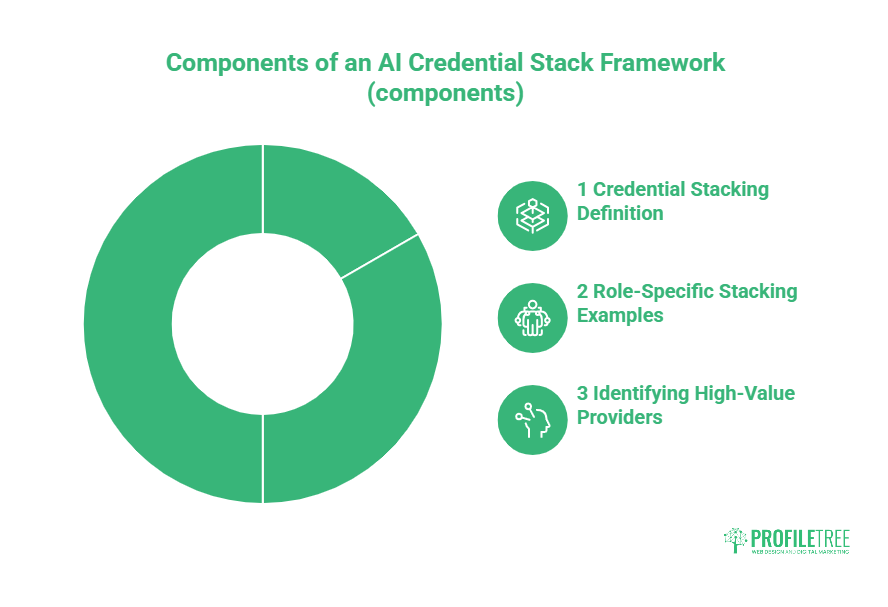
A single micro-credential demonstrates one specific capability. A credential stack is a planned sequence of three to five related micro-credentials that together build a defined role-specific AI competency profile. The distinction matters because it changes how L&D managers design programmes and how employers communicate the value of their training investment to staff.
What Credential Stacking Means in Practice
The stacking principle works by treating each micro-credential as a module within a broader role curriculum rather than a standalone achievement. A marketing manager might begin with an AI literacy foundation course, move to a module on AI-assisted content workflows, add a credential in data interpretation for campaign analytics, and complete the stack with training on AI governance and responsible use. Each credential builds on the last.
This approach has practical advantages beyond skill depth. Stacked credentials aligned to a national qualifications framework, whether the Regulated Qualifications Framework in the UK or the National Framework of Qualifications in Ireland, can often be aggregated towards a higher-level qualification. That portability makes them more credible with staff who worry about investing time in training that does not translate to a recognised outcome.
Role-Specific Stacking Examples
The right credential stack depends on the role, the organisation’s AI maturity, and the specific tasks the learner performs. Below are three role-based examples that illustrate how a stack might be structured for common business functions.
An operations manager might stack AI fundamentals, process automation principles, AI for supply chain decisions, and a module on change management for AI adoption. The aim is not to make the manager a technical expert but to give them enough fluency to commission, evaluate, and oversee AI-driven changes in their area.
A content or marketing professional would benefit from a stack covering prompt engineering, AI ethics in content creation, data analytics for audience insight, and AI-assisted SEO strategy. Given how much marketing work is already being shaped by AI generation and AI-powered search, these competencies are becoming table stakes rather than added advantages. AI prompts for business is a useful foundation module for anyone beginning this path.
A senior leader or board-level executive requires a different stack entirely: AI strategy and governance, responsible AI frameworks, workforce transition management, and AI investment appraisal. This is not a technical curriculum but a strategic one, and it is the stack most frequently neglected in corporate AI training plans despite being the one that most directly affects how well AI adoption goes across an organisation.
Identifying High-Value AI Micro-Credential Providers
Provider quality varies significantly, and not all AI micro-credentials carry the same weight with employers. When assessing a provider, check whether the credential aligns to a recognised qualifications level (QQI in Ireland, RQF in the UK), whether the assessment involves submitted work or only a multiple-choice quiz, and whether the credential issuer has standing in the industry being trained.
Microsoft, Google, and IBM each offer AI certification programmes, some of which map to formal qualification levels and are widely recognised by employers. University-backed programmes from institutions such as UCD, DCU, and Ulster University carry academic credibility and often attract public funding. For organisations that want sector-specific training rather than generic AI literacy, working with a specialist digital agency that also delivers training brings the additional benefit of grounding the credential content in real-world applications.
Understanding team AI training in operational terms helps managers frame the credential selection conversation with clarity before approaching providers.
Overcoming the Recognition Gap: Accreditation and Employer Trust
The most common objection to AI micro-credentials among HR directors and hiring managers is a straightforward one: will these be respected? It is a fair question. The digital badge market includes a wide spectrum of quality, from rigorously assessed university-backed credentials at Level 6 of the RQF to attendance certificates dressed up as qualifications. Understanding how accreditation frameworks work removes most of the uncertainty.
RQF and NFQ: What the Levels Mean
The Regulated Qualifications Framework in England, Wales, and Northern Ireland assigns a level from 1 to 8 to qualifications based on complexity and depth. Level 3 equates to A-level standard. Level 4 is the entry point for higher education and professional qualifications. Most meaningful AI micro-credentials for business sit at Level 4 or 5, meaning they carry the same notional weight as the first year of an undergraduate degree or a Higher National Certificate.
In Ireland, the National Framework of Qualifications uses a similar structure from Level 1 to Level 10. QQI (Quality and Qualifications Ireland) accredits programmes at Levels 1 to 6, covering further education and training. An AI micro-credential with QQI accreditation at NFQ Level 5 is a substantive qualification, not a participation award.
| RQF Level (UK) | NFQ Level (Ireland) | Equivalent Standard | Typical AI Module at This Level |
|---|---|---|---|
| Level 3 | Level 4 | A-level / Leaving Certificate | AI literacy and digital awareness |
| Level 4 | Level 5 | HNC / Higher Certificate | Applied AI for business functions |
| Level 5 | Level 6 | HND / Advanced Certificate | AI systems design; responsible AI governance |
| Level 6 | Level 7 | Bachelor’s degree (ordinary) | Machine learning fundamentals; AI strategy |
Digital Badges and Open Badge Standards
The Open Badge specification, originally developed by Mozilla and now maintained by IMS Global, provides a technical standard for digital credentials that embeds verifiable metadata within the badge itself. An employer or professional body can inspect a badge issued under this standard and confirm the issuing organisation, the assessment criteria, the competencies demonstrated, and the date of issue. This transparency addresses the primary employer concern: verifiability.
Where a credential does not use the Open Badge infrastructure, the issuing body should, at a minimum, provide a digital certificate with a unique verification code. Any credential that cannot be independently verified in less than two minutes should be treated with scepticism, regardless of the issuer’s name. AI in employee development examines how verified credentials are already shaping promotion and hiring decisions in UK and Irish organisations.
The Industry and Academia Partnership Model
The most credible AI micro-credentials are those developed jointly by industry practitioners and academic institutions. This model means the curriculum reflects actual workplace requirements rather than theoretical frameworks developed in isolation. Programmes built through this partnership also tend to be reviewed and updated more frequently, which matters in a field where the tools themselves evolve quarterly.
Organisations in Northern Ireland have an advantage here: the proximity of Queen’s University Belfast and Ulster University to the local business community, combined with the active role of Belfast Met in digital and AI training delivery, creates a cluster of credentialled provision that is more accessible than in many comparable-sized UK cities. Connecting with that provision does not require a large training budget.
Measuring ROI: Beyond Completion Rates
Completion rates are the metric most L&D platforms lead with, and they are among the least useful indicators of actual training value. A 90% completion rate tells you that the staff have finished a course. It tells you nothing about whether they are working differently as a result. Measuring the real return on AI micro-credential investment requires connecting training outputs to operational metrics.
Skills Development Metrics That Actually Matter
The most straightforward measure is task-level productivity: does the employee who completed a prompt engineering module produce the same output in less time, or better output in the same time? For roles where AI is being used to assist with drafting, analysis, or reporting, a before-and-after comparison of task completion time and output quality gives a direct read on value. This does not require complex measurement infrastructure; a line manager review at 30 and 90 days post-training is often sufficient.
A second useful measure is error rate and escalation frequency. Staff trained in AI ethics and governance should be escalating fewer model outputs for review and catching more instances of biased or inaccurate AI content before it is used. Tracking this over time shows whether the training has changed decision-making behaviour, not just awareness. Business automation data provides useful benchmarks for what productivity improvements are realistic after structured AI training.
Learner Engagement and Retention Indicators
Engagement metrics from a micro-credential programme can reveal more than completion data when they are read correctly. A learner who spends twice the expected time on an AI ethics module and then initiates a discussion with their manager is demonstrating active processing, not disengagement. Platforms that track time on task, assessment revision attempts, and post-course resource downloads give a richer picture of genuine learning versus passive compliance.
Retention indicators matter too. Organisations that invest in structured AI upskilling consistently report improved staff retention among the cohorts trained, particularly among mid-career professionals who value development investment as a signal of long-term commitment from their employer. This is not a soft benefit; replacing an experienced employee typically costs 50 to 200% of their annual salary when recruitment, onboarding, and productivity loss are factored in.
Building a CFO-Ready Business Case
For L&D managers who need to secure budget approval, the business case for AI micro-credentials rests on three figures: the cost of the programme (net of any public funding accessed), the productivity gain from reduced task time or improved output quality, and the avoided cost of external recruitment for AI-skilled roles. Where public funding covers 40 to 80% of training costs, the net investment is modest relative to even a conservative productivity estimate.
Ciaran Connolly, founder of ProfileTree, notes: “The businesses we work with that get the most from AI adoption are the ones that treat workforce development as infrastructure, not an optional extra. Micro-credentials give SMEs a way to build that infrastructure in stages without committing to high upfront costs.”
For organisations considering AI adoption alongside workforce development, ProfileTree’s AI training effectiveness framework provides a practical starting structure for internal evaluation.
Continuous Learning and the Recertification Question
A legitimate concern about AI micro-credentials is shelf life. A credential in large language model prompting earned in 2023 may describe tools and techniques that are already outdated. This is not an argument against micro-credentials; it is an argument for building recertification into the programme design from the start. The credential stack model helps here: because each module is a discrete unit, updating one component of the stack does not require rebuilding the entire curriculum.
Providers increasingly offer annual review modules or lightweight recertification assessments that allow credential holders to demonstrate continued currency without repeating the full course. When evaluating providers, ask specifically how they handle curriculum updates and what the recertification pathway looks like.
A provider that cannot answer that question clearly is not building programmes designed to last. Continuous AI learning explores how to build a culture where this kind of iterative upskilling becomes self-sustaining rather than dependent on occasional management intervention.
Conclusion
AI micro-credentials are now a practical, funded, and verifiable route to workforce readiness across the UK and Ireland. For SMEs in particular, the combination of public funding access, modular delivery, and measurable outcomes makes this a more proportionate response to the AI skills gap than traditional degree pathways.
Businesses that build structured credential stacks now will be better positioned to adopt AI tools efficiently and retain the staff who use them. Get in touch to discuss a training plan for your team.
FAQs
What is the difference between an AI micro-credential and an AI certificate?
An AI certificate typically confirms attendance or course completion without assessing a defined competency standard. An AI micro-credential involves assessed work and maps to a recognised qualifications level, such as RQF Level 4 in the UK or NFQ Level 5 in Ireland.
Are AI micro-credentials recognised by UK and Irish employers?
Recognition depends on the issuing body and the qualifications framework the credential aligns with. Credentials accredited through QQI, the RQF, or issued by established universities and technology companies such as Microsoft or Google carry broad employer recognition. Credentials from unaccredited or unverifiable providers do not.
Can I use the Apprenticeship Levy for AI micro-credentials in England?
Yes, where the training is delivered as part of an approved apprenticeship standard. The Level 4 Data Analyst standard and emerging AI Practitioner standards are directly applicable. Levy funds cannot be used for standalone short courses that fall outside an approved standard, so check the apprenticeship standard reference number with your provider before drawing down funds.
How long does it typically take to earn an AI micro-credential?
Most AI micro-credentials are designed for completion in 5 to 40 hours of learning time, depending on the subject’s depth and the qualification level. A foundational AI literacy credential might take a working week of self-paced study. A Level 5 applied AI module with assessed portfolio work could require four to six weeks of part-time commitment.
What are the best accredited AI micro-credential providers in Ireland?
QQI-accredited programmes delivered through Education and Training Boards under the SOLAS Skills to Advance initiative represent the most accessible subsidised route. University College Dublin and Dublin City University both offer short credentials in AI and data science. Skillnet Ireland networks provide sector-specific programmes with varying levels of subsidy depending on the business’s eligibility and network membership.