
Scottish Culture in Local Marketing: The Definitive Guide to Authentic Digital Engagement
Table of Contents
Scotland has one of the most distinct cultural identities in the world, and that identity shapes how people buy, who they trust, and which brands they welcome into their communities. For businesses operating in the Scottish market, understanding this is not a soft consideration sitting at the edges of strategy. It sits at the centre of it. Scottish culture in local marketing is the difference between a campaign that earns genuine loyalty and one that gets quietly ignored, or worse, called out for getting it wrong.
This guide is written for businesses and marketing teams that want to build real traction in Scotland, whether that means a Belfast-based agency helping a client expand northward, an Edinburgh SME trying to stand out in a competitive local market, or an international brand adapting its messaging for a Scottish audience. What follows is a practical, honest framework for integrating Scottish culture in local marketing in a way that is authentic, technically sound, and built to perform over the long term.
Why Scottish Culture in Local Marketing Demands a New Approach
Scottish culture in local marketing is no longer a matter of adding a splash of tartan to a campaign and calling it localised. Businesses that approach Scotland this way consistently underperform, and the reason is straightforward: Scottish consumers are digitally sophisticated, acutely aware of cultural tokenism, and increasingly loyal to brands that demonstrate genuine understanding of their identity. Whether you are a local SME or an international brand entering the Scottish market, the principles of authentic Scottish culture in local marketing must sit at the foundation of your digital strategy.
At ProfileTree, our work with businesses across Northern Ireland, Ireland, and the UK has shown us how cultural relevance transforms digital performance. The same principles that drive results in Belfast apply with even greater force in Scotland, where national identity is particularly strong and the gap between authentic engagement and shallow appropriation is immediately visible to local audiences.
This guide covers everything you need to build a genuinely effective approach to Scottish culture in local marketing: from understanding regional consumer personas and the psychology of Scottish identity, to technical local SEO strategies, culturally intelligent communication, and a seasonal planning framework.
Decoding the Scottish Consumer: Regional Personas and Cultural Values
Effective Scottish culture in local marketing begins with understanding that Scotland is not a single, uniform market. It is a collection of distinct regional identities with different values, communication styles, and relationships to national culture. Building a strong content marketing strategy for Scottish audiences requires this regional awareness as its foundation. Treating the Scottish market as monolithic is one of the most common and costly mistakes brands make.
The Myth of the Monolith: Why Regional Nuance Matters
Consumer research consistently shows that Scottish adults feel more loyal to brands that demonstrate genuine commitment to their local community. However, that community is increasingly defined by city-region identity rather than a national sense of Scottishness alone. Three broad personas help frame the regional landscape for Scottish culture in local marketing.
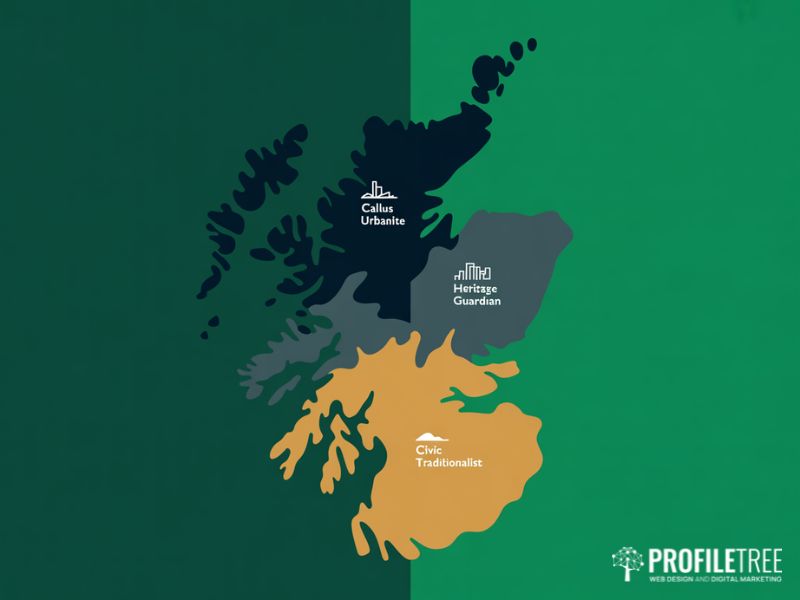
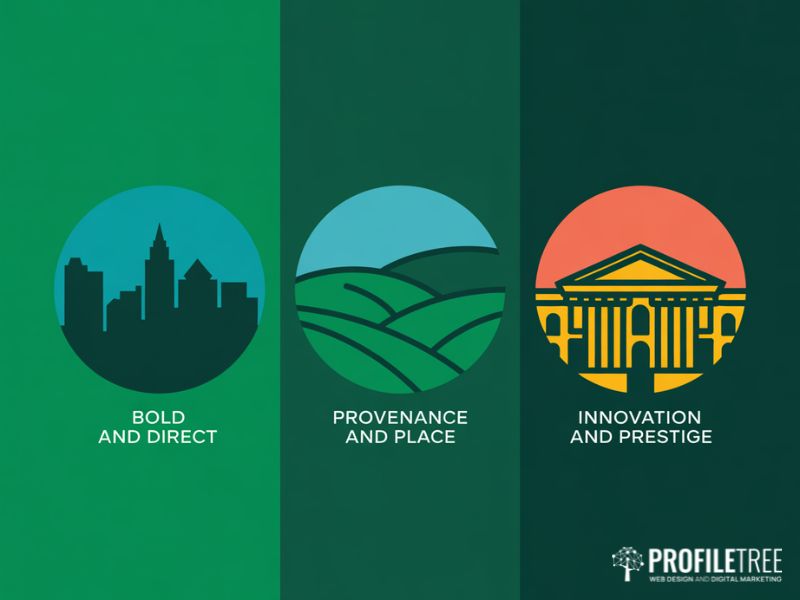
The Gallus Urbanite (Greater Glasgow and Clyde) values directness, humour, and self-deprecation. High-performing campaigns in this region use Scots dialect to build instant rapport, and marketing that is bold and unpretentious consistently outperforms more formal approaches. The Heritage Guardian (Highlands and Islands) cares about provenance, sustainability, and the stewardship of land and local industry. Scottish culture in local marketing for this audience should emphasise authenticity over aesthetics, and connect products to place in a meaningful way. The Civic Traditionalist (Edinburgh and the Lothians) has a more international outlook and responds to Brand Scotland through the lens of innovation, education, and global prestige.
Segmenting campaigns by these regional personas is not optional for serious Scottish culture in local marketing work. It is the difference between a campaign that feels locally written and one that feels nationally broadcast.
Scottish Values and What They Mean for Brand Strategy
Scotland’s cultural identity is built on a distinctive set of values that shape consumer behaviour: a deep sense of community, a commitment to egalitarianism rooted in historical and intellectual tradition, pride in innovation and resilience, and a healthy scepticism of marketing that oversells. A well-constructed digital strategy for local brands must account for these values from the outset. Scottish culture in local marketing that acknowledges them earns trust. Marketing that ignores them earns contempt.
Community matters: campaigns that demonstrate genuine investment in local life outperform those that merely reference it. Honesty matters: Scots appreciate directness and dislike corporate jargon. Modern Scottish identity matters: Scotland in 2025 is multi-cultural, urban, and internationally connected. Any representation of Scottish culture in local marketing that defaults to a 19th-century rural Scotland will alienate precisely the audiences it is trying to reach.
Ciaran Connolly, Founder of ProfileTree, puts it plainly: “The brands that get Scotland right are the ones that actually listen to Scottish people rather than projecting their assumptions onto them. Cultural intelligence is a strategic asset, not a nice-to-have.”
Technical Local SEO for the Scottish Market
Scottish culture in local marketing does not exist in isolation from technical search performance. The most culturally intelligent campaign in the world will underperform if the underlying SEO architecture does not reflect how Scottish users actually search. Our search engine optimisation services are designed to address exactly this challenge, ensuring that cultural relevance and technical performance work together rather than in isolation.
Geographic Keyword Intent: Targeting the Right Regions
One of the most significant gaps in current guidance on Scottish culture in local marketing is the failure to distinguish between national Scottish search intent and regional search intent. A locally optimised web design for Scottish businesses forms the technical foundation that makes regional keyword targeting possible.
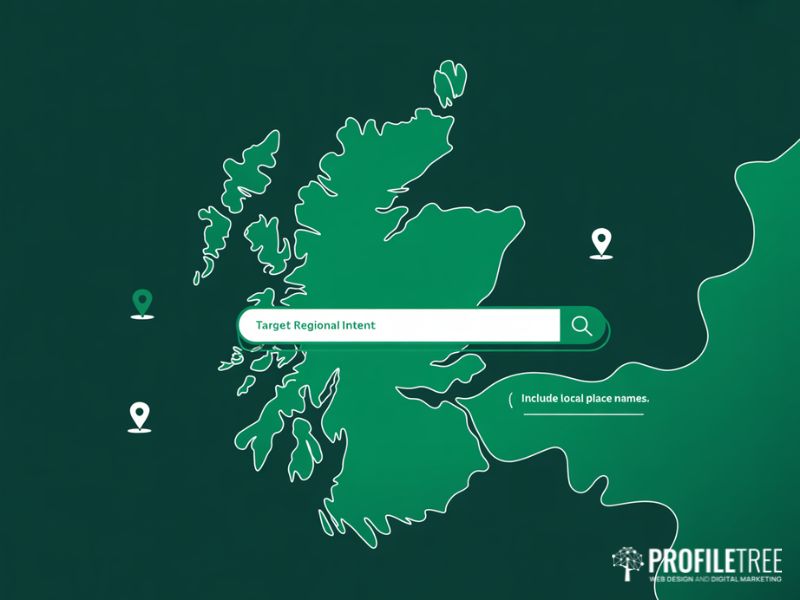
In the Highlands and Islands, users frequently include specific island names or geographic landmarks in their queries. Content that does not reflect this specificity will consistently lose out to more localised competitors. In the Central Belt, competition for Edinburgh and Glasgow keywords is intense, and winning requires targeting neighbourhood-level intent, such as “digital marketing Leith” rather than the broader “digital marketing Edinburgh.” In communities where Scottish Gaelic remains in active use, bilingual keyword targeting and metadata signals a genuine commitment to local culture that goes beyond most competitors.
For businesses working on Scottish culture in local marketing, building a strong local SEO strategy is the starting point for all regional targeting. Filtering Google Search Console data for queries with seven or more words is a reliable method for identifying natural language and voice search patterns, which are particularly prevalent in Scottish local searches.
Schema Markup and Scottish Provenance Signals
Technical structured data is an underused tool in Scottish culture in local marketing. Implementing LocalBusiness schema with precisely defined address and areaServed properties sends clear localness signals to search engines. A skilled website development team can implement this schema correctly using JSON-LD, ensuring your Scottish provenance signals reach Google’s Knowledge Graph effectively.
According to Google’s documentation on structured data, correctly marked-up LocalBusiness data can improve how your business appears in search results and in Knowledge Panels. For products with Protected Geographical Indication status, such as Scotch Lamb or Stornoway Black Pudding, Product schema can directly link a business to the cultural entity of Scotland in Google’s Knowledge Graph.
The .scot top-level domain has also grown significantly in adoption among Scottish local authorities, cultural institutions, and SMEs, providing an unambiguous localness signal for businesses where the Scottish market is central to their offering.
Google Business Profile for Local Community Trust
For any business integrating Scottish culture in local marketing into its strategy, Google Business Profile is a non-negotiable foundation. Ensure the profile includes accurate NAP data, categories that reflect the Scottish market context, and review responses that use natural, locally resonant language. Review responses that feel genuinely local, rather than templated, consistently outperform generic responses in local pack rankings.
| SEO Element | Standard Approach | Scottish-Optimised Approach |
|---|---|---|
| Keyword targeting | UK-level terms | Regional and neighbourhood-level intent |
| Schema markup | Generic LocalBusiness | areaServed with city/region specifics |
| Google Business Profile | Standard listing | Locally resonant review responses |
| Domain strategy | .com or .co.uk | Consider .scot for Scottish-first brands |
| Content localisation | Swap city names in templates | Genuinely differentiated regional content |
Authentic Communication: Language, Tone, and the Cringe Filter
The linguistic dimension of Scottish culture in local marketing is where many brands either build genuine connections or destroy them. Scotland’s communication culture has specific characteristics that reward authenticity and punish tokenism, and understanding the difference is a core skill for any marketer working in this market.
The Power of Scots Language and Gaelic
Scotland is proudly multilingual. While Standard English is the language of business, the emotional language of Scotland is often Scots or, in specific regions, Scottish Gaelic. Campaigns that include Gaelic in Highland contexts or Scots idioms in Lowland campaigns demonstrate cultural awareness that resonates deeply with local audiences.
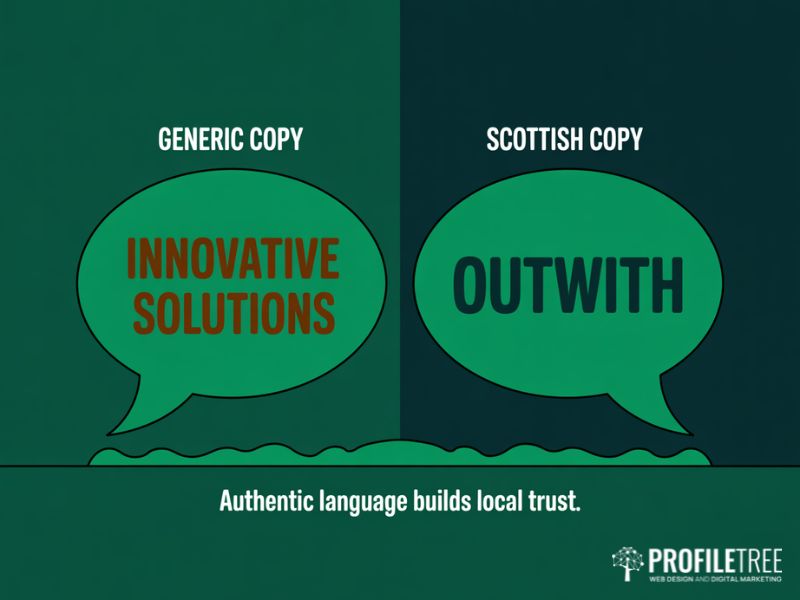
Evidence from social media advertising shows that using subtle Scotticisms in ad copy can meaningfully increase click-through rates among local audiences compared to standard British English copy. The key is subtlety. A campaign that uses one well-placed Scots word, such as “outwith,” “braw,” or “wee,” in otherwise standard copy tends to feel authentic. Saturating copy with dialect risks the opposite effect, landing as pastiche rather than genuine cultural fluency.
“Outwith” is worth specific attention for anyone working on Scottish culture in local marketing. It is a standard Scottish English term with no equivalent in other varieties of British English, and its presence in business copy immediately signals local authorship.
Direct Communication and Avoiding Corporate Jargon
The Scottish communication style is direct, pragmatic, and often laced with understated humour. Locals appreciate honesty and have a strong dislike of overblown marketing language. This applies with particular force to social media marketing in Scotland, where plain-language campaigns consistently outperform abstract corporate-speak.
Humour is a genuine asset in Scottish culture in local marketing, but it requires care. Wit and self-deprecation land well. Irony can work. Anything that pokes fun at cultural stereotypes risks offence. The rule of thumb is that humour should come from cultural understanding, not cultural observation from the outside.
The Cringe Filter: Avoiding Cultural Appropriation
The “Cultural Cringe” is a recognised sociolinguistic phenomenon in Scotland, describing the collective discomfort Scots feel when their culture is commodified in a shallow or exaggerated way. For marketers, triggering the Cringe is the fastest route to alienating a Scottish audience. Authentic Scottish culture in local marketing actively works to avoid this.
Before publishing any culturally themed campaign content, apply this audit: Is the cultural reference earned? Does it relate to the product’s origin or the campaign’s authentic story? Is it contemporary? Does it represent Scotland in 2025, or a version of Scotland from a heritage tourism brochure? Is it diverse? Modern Scotland is multi-cultural and multi-ethnic. Is it proportionate? Subtle cultural signals outperform saturated imagery every time.
Case studies bear this out. A Scottish oat milk brand that avoided Highland imagery entirely and instead focused on the quality of Scottish water and the straightforwardness of its farmers, using high-contrast photography and a no-nonsense tone, saw substantial uplift in brand recall among younger Central Belt consumers. In contrast, an international spirits brand that used exaggerated Scottish accents with no regional specificity saw significant social media backlash and a measurable drop in local sentiment scores, despite strong global sales.
Digital Marketing and Technology in Scottish Culture Campaigns
The intersection of Scottish culture in local marketing with digital tools and data creates powerful opportunities that traditional agencies consistently overlook. Modern digital marketing provides the means to deliver culturally resonant content with precision targeting, real-time performance measurement, and personalisation at scale.
Data-Driven Cultural Localisation
Digital analytics make it possible to track when Scottish cultural references generate the most engagement. Spikes around Burns Night, Hogmanay, St Andrew’s Day, and the Edinburgh Festivals indicate clear seasonal opportunities to align campaigns with cultural calendars. Using Google Search Console data to identify query patterns around these events allows content teams to develop targeted articles, social posts, and landing pages well ahead of peak demand.
Social Media Storytelling and Video
Platforms including Instagram, Facebook, and TikTok offer strong opportunities for visual Scottish culture in local marketing. Showcasing behind-the-scenes content from local suppliers, sharing customer-generated content featuring Scottish landscapes, or running competitions tied to cultural festivals are all effective tactics. Our video marketing and production services are built to help brands create this kind of authentic, location-specific content that resonates deeply with Scottish audiences.
Combining video with a structured social media strategy ensures culturally resonant content reaches the right regional audiences at the right moments, maximising the return on creative investment.
AI and Personalisation in Local Cultural Campaigns
AI-powered marketing tools allow businesses to deliver personalised Scottish culture in local marketing experiences at scale. Our AI marketing and automation services help businesses build personalised campaign architectures efficiently, without the overhead of manual segmentation. Whisky brands can tailor ads to users with demonstrated interest in heritage and tourism. Outdoor brands can target users engaging with Scottish hiking communities.
Building genuine internal capability is equally important. Our digital training for business teams helps organisations develop the skills to use these tools confidently, from interpreting Search Console data to building culturally targeted campaign briefs. Brands that serve Scottish communities online can also benefit from deploying AI chatbot solutions trained on locally relevant content, building cultural credibility at scale across every user interaction.
The Scottish Marketing Calendar: Timing Your Cultural Campaigns
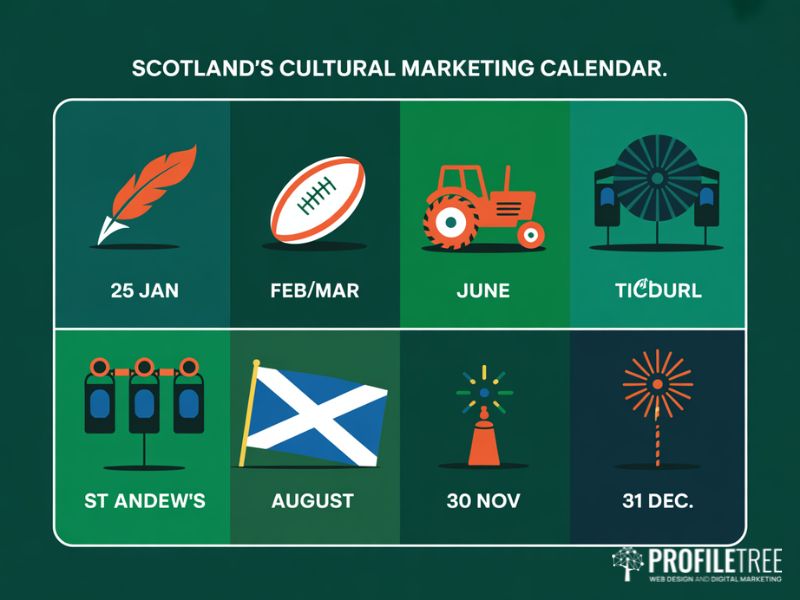
Timing is as important as tone in Scottish culture in local marketing. While global brands focus on universal commercial moments, Scottish brands can own the conversation during cultural windows that competitors either ignore or handle poorly. A well-planned cultural calendar is a significant competitive advantage.
| Date | Event | Marketing Opportunity | Recommended Tone |
|---|---|---|---|
| 25 January | Burns Night | Food, drink, poetry, and community storytelling | Earnest, celebratory, traditional |
| February/March | Six Nations Rugby | Hospitality and friendly rivalry | Humorous, high-energy, gallus |
| June | Royal Highland Show | Agriculture, provenance, and rural business | Practical, quality-focused, grounded |
| August | Edinburgh Festivals | Arts, tourism, and international audiences | Cosmopolitan, fast-paced, vibrant |
| 30 November | St Andrew’s Day | National identity, charity, and community | Altruistic, community-focused, proud |
| 31 December | Hogmanay | Hospitality and new beginnings | Social, energetic, forward-looking |
Planning content around this calendar does not mean simply adding a festive graphic to a standard post. Effective Scottish culture in local marketing uses these moments as genuine editorial opportunities to connect a brand’s story to the community event in a way that adds real value for the audience.
Building Long-Term Cultural Equity
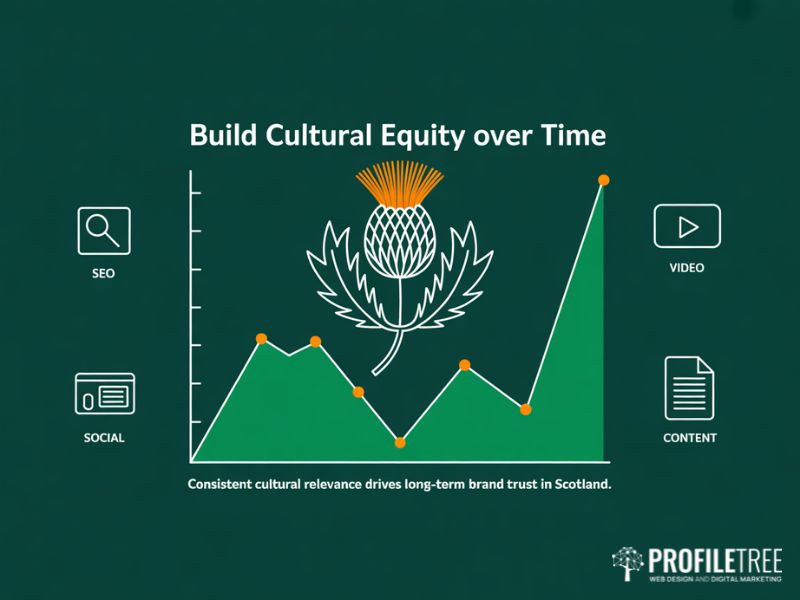
The most valuable outcome of consistent Scottish culture in local marketing is not a single campaign’s performance. It is the cumulative brand trust that builds over time when a business demonstrates genuine understanding of Scottish identity across multiple touchpoints and cultural moments.
ProfileTree’s approach to local marketing strategy for clients in Scotland centres on this long-term perspective. We help businesses build content architectures that weave cultural relevance through every layer of their digital presence, from service page copy and FAQ content to social media schedules and video strategy. The result is a brand that Scottish consumers recognise as genuinely local, not just locally targeted.
Building a Scottish Marketing Strategy That Lasts
Scottish culture in local marketing is one of the most rewarding areas of digital strategy when it is approached with genuine intelligence and respect. The combination of a strong national identity, sophisticated digital consumers, distinct regional variation, and a clear set of cultural values means that brands investing in genuine understanding consistently outperform those relying on surface-level localisation.
The practical framework is clear: understand your regional audience, build technical SEO foundations that reflect Scottish search behaviour, communicate with cultural authenticity, and plan your campaigns around Scotland’s cultural calendar.
ProfileTree’s digital marketing strategy, content writing, SEO, video production, and AI training services are built to help businesses navigate exactly this kind of culturally complex, technically demanding marketing environment. If you are working on Scottish culture in local marketing and want to build a strategy that earns genuine trust in this market, our team would be glad to help.
FAQs
What are the most effective strategies for integrating Scottish traditions into advertising?
Focus on cultural references that are genuinely earned by your brand rather than borrowed for aesthetic effect. Provenance, local community investment, and subtle use of Scots language consistently outperform campaigns that reach for heritage imagery without a real connection to it.
How does Visit Scotland use local culture to engage audiences?
Visit Scotland builds engagement around Scotland’s scenic and cultural diversity rather than relying on generic heritage imagery. Its campaigns promote specific events and places with authentic storytelling, which provides a useful benchmark for any brand developing Scottish culture in local marketing.
How can a digital agency support Scottish cultural marketing?
A specialist agency can develop culturally intelligent content marketing strategies, implement technically strong local SEO, produce authentic video content, and build the internal capability to sustain these efforts over time.
What role does dialect play in Scottish digital marketing?
Subtle use of Scots terms such as “outwith,” “braw,” or “wee” in otherwise standard copy signals local authorship and can improve engagement. Overuse risks feeling forced; one or two well-placed Scotticisms tend to work far better than copy saturated with dialect.
How do I avoid the Cultural Cringe in Scottish marketing campaigns?
Run every cultural reference through four checks: is it earned, contemporary, diverse, and proportionate? If the answer to any of those is no, remove or rework the reference before the campaign goes live.