
BigCommerce SEO: How ProfileTree Helps UK E-Commerce Stores Rank
Table of Contents
BigCommerce gives UK online retailers more built-in SEO control than most hosted platforms, but that control only pays off with the right configuration. ProfileTree provides BigCommerce SEO services for UK stores, covering technical audits, category and product page optimisation, structured data, and the platform-specific fixes that stop BigCommerce stores from losing rankings to duplicate URLs and slow themes.
As a BigCommerce SEO agency and BigCommerce SEO company working across Northern Ireland, Ireland, and the UK, we set out below exactly what that work involves.
Is BigCommerce Good for SEO?
BigCommerce is a strong platform for SEO when it’s configured properly. It ships with fully customisable URLs, an editable robots.txt file, automatic XML sitemaps, and product schema included by default, features that Shopify and WooCommerce store owners often need separate apps or plugins to match.
That native capability is also why so many BigCommerce SEO services exist. The platform gives retailers the tools, but the default settings rarely produce an ideal setup on their own. A new BigCommerce store, left untouched, will generate duplicate category URLs from its faceted search, thin auto-created category pages, and generic meta titles pulled straight from product names. None of that is a platform failing; it’s simply what happens before a proper BigCommerce SEO agency gets involved.
For UK retailers specifically, BigCommerce’s flexibility around URL structure and robots.txt access matters more than it might for a hosted rival, because UK stores frequently need to handle VAT-inclusive pricing, multi-currency checkout, and Ireland or Northern Ireland-specific delivery zones within their product data. Getting that right from the start avoids the kind of Merchant Centre and structured data errors that quietly suppress rankings for months before anyone notices them.
Businesses searching for a BigCommerce SEO company usually fall into one of two groups: stores that migrated to BigCommerce for its native features and now need someone to configure them properly, and stores already on the platform whose rankings have plateaued because the technical basics were never addressed. Both starting points lead to the same first step: a proper audit before any content work begins. Whether you’re searching for “BigCommerce SEO” or the two-word variant “big commerce SEO,” the underlying question and the fix are the same.
BigCommerce’s plans also affect how much SEO work is realistic at any given stage. Standard suits a business just starting out, with the core SEO features available but a smaller catalogue to manage. Plus and Pro add the customer segmentation and abandoned cart features that growing stores need, and Enterprise is built for the largest catalogues and the multi-storefront setups covered later in this guide. A BigCommerce SEO strategy for a Standard-plan store selling a few hundred products looks different to one for an Enterprise store running several regional storefronts, even though the underlying platform, whether you call it BigCommerce SEO or Big Commerce SEO, is the same.
BigCommerce Technical SEO for UK Stores
Most BigCommerce SEO problems live below the surface, in the way the platform generates URLs, handles variants, and serves pages, rather than in the copy on the page. A proper BigCommerce SEO audit starts here, and it’s the part of the work a BigCommerce SEO expert should always prioritise over on-page tweaks. Any BigCommerce SEO service provider worth hiring will start in exactly this order: technical foundations first, content second.
Faceted Navigation and Duplicate Content
BigCommerce’s faceted search is genuinely useful for shoppers filtering by size, brand, or price, but every filter combination can generate its own URL. Left unmanaged, a single category can spawn dozens of near-identical pages competing against each other in search results.
The fix is deciding, filter by filter, which combinations deserve their own indexable URL and which should canonical back to the parent category. A “colour” filter with genuine search demand might earn its own page. A “sort by price” parameter should never. This is one of the first things we review in any BigCommerce SEO engagement, because unmanaged facets are the most common cause of crawl budget waste we see on the platform.
Canonical Tags for Product Variants
BigCommerce lets you handle product options such as size and colour either as a single URL with selectable options, or as separate product pages. Both approaches are valid, but they need different canonical strategies.
Where variants share a single URL, no canonical work is needed. Where a business runs separate product pages per variant, common for stores that need SKU-level content or pricing, each variant page needs a clear canonical decision: either self-referencing if each variant has genuine unique demand, or pointing to a primary variant if the differences are cosmetic only. Getting this wrong is a common source of duplicate content flags on larger BigCommerce catalogues, and it tends to get worse as a catalogue grows rather than better.
BigCommerce CDN and Page Speed
BigCommerce includes a content delivery network on every plan, which gives UK stores a real speed advantage over platforms where CDN access is an added cost. That built-in CDN does not, on its own, guarantee good Core Web Vitals scores.
The usual culprits on BigCommerce stores are oversized hero images on the homepage, unoptimized theme code, and third-party apps loading scripts that were never audited for performance impact. We review image compression, lazy loading, and script loading order as standard, because a slow BigCommerce store loses both rankings and conversions regardless of how strong the underlying platform is. For stores running heavier themes, this review often turns up scripts loaded on every page that are only needed on one or two. A BigCommerce SEO company that skips this step is only doing half the job.
Structured Data for BigCommerce Product Pages
BigCommerce applies basic product schema automatically, covering the essentials like price and availability. That default markup rarely covers everything a competitive product page needs.
Extending it properly means adding review and rating markup where genuine reviews exist, breadcrumb markup that matches the visible navigation, and, for UK and Irish stores, making sure VAT-inclusive pricing is reflected correctly in the offer schema.
Mismatched pricing between the schema and the visible page is a common cause of Google Merchant Centre disapprovals, and it’s an easy fix once someone is actually looking for it. We also check that any AggregateRating markup reflects real, verifiable review counts rather than figures pulled from a template. This is exactly the sort of detail a specialist BigCommerce SEO agency catches, and a generalist website expert often misses.
How BigCommerce SEO Differs from Shopify and WooCommerce SEO
Businesses researching BigCommerce SEO services, or searching under the two-word spelling big commerce SEO, are often comparing platforms as much as comparing agencies, so it’s worth being direct about where BigCommerce sits relative to the alternatives. A BigCommerce SEO company and a Shopify-focused competitor will structure an audit differently for exactly this reason.
| Capability | BigCommerce | Shopify | WooCommerce |
|---|---|---|---|
| URL structure | Fully customisable | Fixed patterns (/products/, /collections/) | Fully customisable |
| Robots.txt access | Fully editable | Limited, append only | Full control via hosting |
| Built-in schema | Extensive by default | Basic | Requires a plugin |
| CDN included | Yes, on every plan | Yes | Depends on hosting |
| Faceted navigation control | Strong native settings | Usually needs an app | Plugin dependent |
| Redirect management | Built in | Built in | Plugin required |
BigCommerce’s advantage is its native capability. Features that need a paid app on Shopify, or a carefully chosen plugin on WooCommerce, are simply switches to configure on BigCommerce. That reduces compatibility issues and ongoing plugin costs, but it does not remove the need for someone who understands where those switches are and what to do with them.
Shopify’s counter-advantage is a larger app marketplace and, for many smaller UK retailers, a gentler learning curve. WooCommerce is completely controlled, since it sits on WordPress, at the cost of needing more hosting and development oversight. Which platform suits a given UK e-commerce business usually comes down to catalogue size, technical resource, and how much the store needs to do outside standard retail, rather than SEO capability alone. A BigCommerce SEO expert will usually ask about all three factors before recommending anything.
For a BigCommerce SEO service provider, the practical difference shows up in how much of the audit is spent on platform limitations versus configuration choices. A Shopify audit often surfaces things the platform simply won’t allow without an app. A BigCommerce audit more often surfaces settings that exist but were never switched on.
What a ProfileTree BigCommerce SEO Engagement Involves
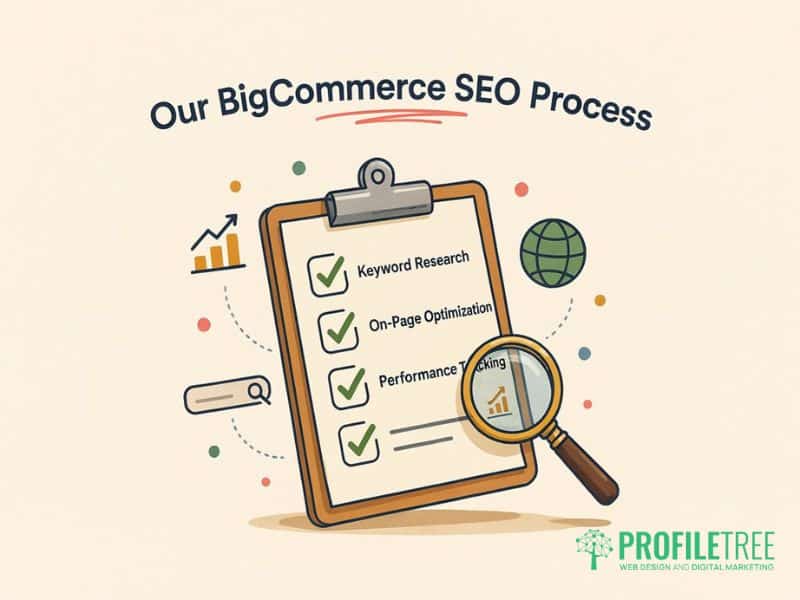
A BigCommerce SEO engagement with ProfileTree starts with an audit, not a template. We look at URL structure, indexation, duplicate content sources, Core Web Vitals, and existing schema before recommending anything. As a BigCommerce SEO service provider, we scope every engagement around what the audit finds rather than a fixed package.
From there, work typically covers technical fixes first (crawl blocks, duplicate URLs, speed issues), then on-page optimisation across product and category pages, then content: buying guides, comparison pages, and category descriptions that most BigCommerce stores leave blank. Where a business needs it, we also handle Google Shopping feed optimisation and the account structure behind Amazon or Google Merchant Centre listings. That order matters more than the individual tasks: fixing technical debt before writing new page content is what separates a properly scoped BigCommerce SEO service provider from one working through a generic checklist.
Reporting follows the same order of priorities. Rather than a single ranking number, clients see organic traffic and revenue attribution, indexation progress, and the technical issues resolved each month, so the connection between the audit findings and the commercial result stays visible throughout the engagement. It’s the standard we hold ourselves to as a BigCommerce SEO company, and worth asking any provider you’re evaluating to match.
This sits alongside ProfileTree’s wider website development and digital strategy services, since a BigCommerce store’s SEO performance is rarely separate from its theme quality, hosting setup, and how the wider marketing plan drives traffic to it. For stores comparing platforms before committing to BigCommerce, our BigCommerce vs Shopify comparison sets out the trade-offs in more detail.
Timelines vary with catalogue size and how much technical debt the store has built up, but the pattern is consistent across BigCommerce SEO services generally: technical fixes and quick indexation wins show up first, usually within the first couple of months, while rankings for competitive category and product terms take longer to move. A store with several thousand SKUs and years of unmanaged faceted navigation needs more time than one with a smaller, well-structured catalogue, and we set expectations accordingly at the audit stage rather than promising a single timeframe upfront.
BigCommerce SEO for UK E-Commerce Businesses
UK and Irish retailers on BigCommerce face a few recurring issues that generic, US-focused BigCommerce guidance tends to skip. VAT-inclusive pricing needs to match across the visible page, the schema markup, and any Google Shopping feed, or the Merchant Centre will flag inconsistencies. Multi-currency and multi-storefront setups, common for stores serving both the UK and Ireland from one BigCommerce instance, need clear canonical and regional targeting decisions so Google doesn’t treat the two storefronts as duplicate content.
Local delivery zones and click-and-collect options, increasingly common for UK stores with a physical presence, are also worth reflecting in structured data and on-page content where relevant. A store offering next-day delivery across Northern Ireland and standard delivery to Great Britain, for example, should surface that distinction clearly rather than leaving it buried in a shipping policy page that search engines rarely credit.
Retailers running a store alongside a bricks-and-mortar location may benefit from combining this with ProfileTree’s wider SEO services, which cover local search visibility alongside e-commerce SEO. A BigCommerce SEO services package built around a single UK or Irish market looks different to one built for a business selling across both, and a proper scoping call should establish which situation applies before any work begins.
Payment and delivery trust signals matter more to UK shoppers than generic BigCommerce guidance tends to acknowledge, too. Clear returns policies, recognisable UK payment options, and delivery estimates that reflect actual carrier performance all sit close to the point of purchase, and search engines increasingly reward pages that answer those practical questions directly rather than burying them in a separate policy page several clicks away. A BigCommerce SEO expert reviewing a UK store will usually check this before touching a single meta tag.
BigCommerce Enterprise SEO: Multi-Currency and Multi-Language Stores
Larger BigCommerce stores, particularly those on Plus, Pro, or Enterprise plans, tend to run multiple storefronts from a single backend: separate domains or subfolders for different currencies, languages, or regional catalogues. That setup introduces SEO questions a single-storefront store never has to answer.
The core decision is how each storefront relates to the others in Google’s eyes. Hreflang tagging needs to correctly signal which version serves which market, canonical tags need to avoid one storefront cannibalising another, and product feeds need separate configuration per currency to avoid pricing mismatches in Merchant Centre. For a BigCommerce enterprise SEO setup, getting this architecture right at the start is considerably easier than untangling it after several storefronts have already been indexed.
Businesses evaluating BigCommerce SEO services at this scale should also expect a heavier technical audit up front, since crawl budget, catalogue depth, and cross-storefront duplication all become larger factors as a store grows. A mid-market UK retailer running a single storefront and a large multi-region operation running four needs genuinely different scopes of work, not the same audit at a higher price, which is why a BigCommerce SEO expert should scope the two separately from the start.
Why Choose ProfileTree for BigCommerce SEO
ProfileTree has completed over 1,000 web projects for businesses across Northern Ireland, Ireland, and the UK since 2011, with BigCommerce SEO and wider e-commerce work sitting alongside our web design and development services rather than being treated as a bolt-on. Whether you’re looking for a BigCommerce SEO agency to run a full audit, a BigCommerce SEO company to manage the ongoing work, or a single BigCommerce SEO expert to review a specific technical issue, the same team handles all three.
“BigCommerce rewards businesses that treat SEO as part of the platform setup, not an afterthought bolted on once the store is live. The stores we’ve worked with that get this right are the ones willing to fix the technical foundations first, before touching a single product description.” (Ciaran Connolly, Founder, ProfileTree. Quote pending Ciaran’s sign-off before publication.)
Clients have made similar points about our approach to search visibility work more broadly. As Jack Hutchison put it in a Google review, our team was “extremely knowledgeable in helping us with our social media management, creating content across various platforms and improving our website’s search engine optimisation,” with sessions “tailored” to the specific business rather than run from a generic script.
Getting Started with a BigCommerce SEO Audit
BigCommerce gives UK retailers a genuinely strong technical foundation for SEO, but that foundation needs configuring, not assuming. Faceted navigation, canonical tags, structured data, and multi-storefront architecture all need deliberate decisions rather than default settings, and the businesses that get the most from the platform are the ones willing to fix those foundations before investing heavily in content. Whether you found this page looking for a BigCommerce SEO agency, a BigCommerce SEO company, or just typed “Big Commerce SEO” into Google, the audit above is what to expect from a proper one.
If you’re running a BigCommerce store and want to know where it stands, contact ProfileTree for a technical SEO audit, or get in touch to discuss what a full BigCommerce SEO engagement would involve for your catalogue.
FAQs
1. Is BigCommerce good for SEO?
Yes. BigCommerce includes native SEO features that many platforms need separate apps for: customisable URLs, editable robots.txt, automatic sitemaps, and built-in product schema. The platform gives you the tools; a proper BigCommerce SEO setup is still needed to use them well, and that’s where most of the value from a dedicated audit comes from. This holds whether you write it as “BigCommerce SEO” or search for “big commerce SEO” as two words; the platform and the fix are the same either way.
2. How does BigCommerce SEO compare to Shopify SEO?
BigCommerce generally offers more flexibility. It allows fully customisable URLs rather than Shopify’s fixed /products/ and /collections/ patterns, gives full robots.txt access, and includes more extensive schema by default. Shopify’s advantage is a larger app marketplace and, for many smaller stores, a simpler initial setup.
3. How much do BigCommerce SEO services cost?
Costs vary with catalogue size, competition, and technical complexity. Smaller stores typically need a lighter ongoing engagement than larger catalogues with multiple storefronts or extensive B2B requirements. An initial audit is the best way to scope accurate costs for a specific store rather than relying on a generic monthly figure, and any BigCommerce SEO service provider should be able to explain that scope clearly before quoting.
4. How do I stop BigCommerce’s faceted navigation from creating duplicate pages?
Decide which filter combinations have genuine search demand and deserve an indexable URL, then canonicalise the rest back to the parent category page. This needs reviewing filter by filter rather than applying a single blanket rule across the whole catalogue, since the right answer depends on actual search volume for each combination.
5. Does BigCommerce support the schema needed for UK VAT pricing?
BigCommerce applies basic product schema automatically, but VAT-inclusive pricing for UK and Irish stores often needs manual checking against the visible page and any Google Shopping feed. Mismatches here are a common cause of Merchant Centre disapprovals, and they’re usually straightforward to fix once identified.