
How to Choose an AI Training Programme for Your Business
Table of Contents
Choose an AI training programme by settling three things first: whether your team learns alone or with a trainer, whether sessions run live online or in person, and whether the content is generic or built around your own tasks. For most SME teams, live sessions based on real workflows change daily habits faster than self-paced courses.
This guide is for owners and managers in Northern Ireland, Ireland and Great Britain who are comparing options before they commit a budget. It sets out the formats on offer, what a useful programme should cover, the questions to ask a provider and the public funding that can reduce the cost. If you already know you want a trainer to work with your team, ProfileTree’s AI training for business page explains how its workshops are scoped and delivered.
Three Decisions Shape the Right Programme for Your Team
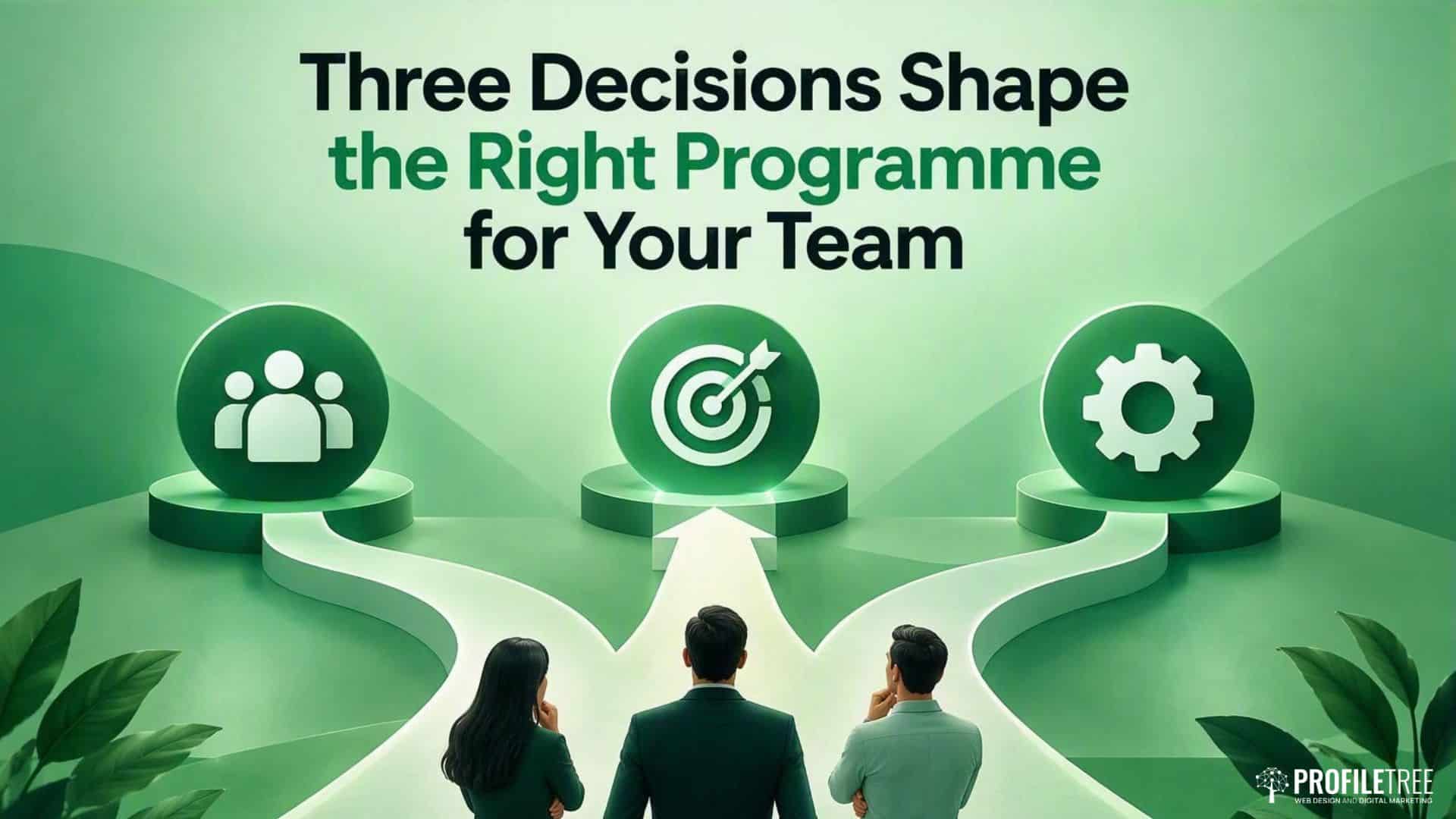
Most buyers start by searching for the best AI course for business and comparing course names. A better starting point is the decision you are making about your own team, because the right format follows from three questions about how your people learn and what they need to change.
Self-Study Suits Individuals More than Teams
You can give staff a self-paced curriculum and trust them to work through it, or bring in a trainer to run sessions. Self-study costs less and fits around the working week, and for one curious employee who wants to understand the basics, it can be enough.
At team level,l the picture changes, because self-paced courses depend on each person finding time, they rarely use examples from your sector, and nobody is on hand when a lesson does not match the way your business works. Instructor-led training costs more upfront but tends to change behaviour faster, because a trainer can answer the question every learner eventually asks: how a technique applies to the work on their own desk. ProfileTree’s comparison of in-house and outsourced AI training for SMEs sets out the cost and management trade-offs in more detail.
Live Delivery Matters More than the Venue
Live online sessions suit teams spread across several offices or working from home, and they remove travel time for businesses outside Belfast. In-person sessions suit teams who learn better with a trainer at the front of the room and colleagues working through the same exercise beside them.
The format that disappoints most often is pre-recorded video with no live element, because there is no one to ask and no one checking that the exercises were done. ProfileTree runs the same content in the room or by video call, so the choice comes down to logistics rather than quality. The guide to workshops and webinars in AI training covers when each one works best.
Business-Specific Learning Pays Back Sooner than Generic Content
A generic course explains what a large language model is and how to write a prompt. Business-specific learning starts from your invoices, your customer emails and your reporting, and teaches your people to handle those particular jobs with AI tools.
For an accountancy practice in Belfast, that might mean drafting client update emails from a standard template; for an estate agency in Cork, it might mean sorting incoming enquiries by urgency before anyone opens them. The closer the training sits to tasks people already do every week, the sooner it earns back its cost.
Once those three questions are answered, the shortlist is usually obvious. A sole trader on a tight budget can reasonably start with a free self-paced course, while a ten-person marketing team that needs to work differently within a quarter is better served by instructor-led sessions built around its own work.
Each Training Format Suits a Different Budget and Goal
AI training for companies falls into five broad formats. None of them is right for every business, and the table below compares them on the factors that decide whether staff actually work differently afterwards.
| Format | Suits | Built around your tasks | Follow-up support | Recommendation |
|---|---|---|---|---|
| Self-paced online courses | Individuals building general AI literacy | No, the examples are generic | Usually forums only | A sensible free or low-cost first step for one person, but not a team programme |
| Vendor certifications | Technical staff who need a credential for one platform | No, tied to a single vendor’s tools | Recertification routes | Choose only when the role requires that credential |
| University and executive programmes | Senior leaders setting AI strategy | Limited, strategic rather than hands-on | Alumni networks | Useful for directors shaping policy, paired with practical training for staff |
| Intensive bootcamps | People moving into technical roles | Limited, project-based | Careers support | Rarely the right fit for an existing SME team |
| Instructor-led workshops built for your team | SME teams that need measurable change in day-to-day work | Yes, using your own documents and tasks | Structured follow-up sessions | The usual recommendation for a team that needs to change how it works |
Free self-paced courses are a reasonable starting point for one person who wants the basics before any budget is committed. Their limit shows when a whole team needs to change, because a course built around a fictional company teaches general principles and cannot show your sales team how to write a follow-up email using your own pricing and tone of voice.
A Useful SME Programme Covers Three Areas of Skill
Whatever format you choose, check the syllabus against three areas. A programme that skips any of them is teaching awareness rather than capability, and staff will struggle to use what they learned once the trainer has gone.
Literacy and Clear Prompting Come First
Staff need to understand what tools such as ChatGPT, Microsoft Copilot, Gemini and Claude can and cannot do, and how to write prompts with enough context to produce usable output the first time. This part should be tool-agnostic. The habit of briefing a tool properly, with the audience, the purpose and an example of good output, matters more than which model the business happens to use this year.
Role-Based Automation Is Where Generic Courses Stop
Good training takes a job your team does every week and shows how a tool can handle part of it, whether that is matching invoices, sorting customer support emails, drafting first versions of marketing copy or summarising long reports. The skill being taught is judgement about which tasks suit automation and which still need a person. When a task is better handled by a tool built for the purpose, ProfileTree’s AI chatbot development service shows how an everyday job such as answering routine customer questions becomes a working system on your website.
“Effective AI training for an SME team is not about teaching people to use a chatbot. It is about looking at the jobs they already do every week and showing them which of those a tool can take off their plate, safely. The teams that get value are the ones who leave a session with two or three automations they can use on Monday morning, not a folder of slides.” Ciaran Connolly, founder of ProfileTree
Shadow AI Is the Risk Most Courses Leave Out
Shadow AI is the unsanctioned use of free consumer tools by staff who paste client information into a public chatbot to save time. Many free and personal plans allow the provider to use conversations to improve its models unless the user changes a setting, whereas business and enterprise plans generally exclude customer data from training by default.
The terms differ by provider and change often, so check the plan your staff actually use. Training that ignores this leaves a data protection gap, and it works best alongside a written AI policy for your business that names the approved tools and what may be entered into them.
Ask Any Provider These Questions Before You Book

Clear criteria make providers easier to compare than course names do. Put the following questions to anyone you are considering, and treat vague answers as a warning sign.
- Ask whether the sessions will use your own documents, emails and processes, or a standard case study used for every client.
- Ask who delivers the training, what they have built with AI tools themselves, and whether the same person runs every session.
- Ask how data protection is handled during exercises, including which tools participants will use and whether any client information is needed.
- Ask what happens after the sessions finish, such as follow-up calls, written guides or a review of how the team is using the tools a month later.
- Ask how the provider will measure whether the training worked, and which figures you will see at the end.
Measurement is the question buyers most often skip. Hours saved on a named task, the number of staff using an approved tool each week and fewer errors in routine documents can all be tracked, and ProfileTree’s guide to measuring AI training effectiveness explains how to record a baseline before the first session so the comparison afterwards means something.
Public Funding Can Reduce the Cost in All Three Jurisdictions
Cost is the most common reason teams put training off, yet public support exists on both sides of the border and in Great Britain. Eligibility rules and amounts change, so confirm the current terms with the relevant body before you build a budget around them.
In Northern Ireland, the Artificial Intelligence Collaboration Centre (AICC), led by Ulster University in partnership with Queen’s University Belfast and supported by Invest NI and the Department for the Economy, offers fully funded consultancy, education and training to help businesses adopt AI. Invest NI also provides wider support for digitalisation, and NI Business Info lists the current AI support routes in one place.
In the Republic of Ireland, most SMEs start with their Local Enterprise Office. The free Digital for Business assessment reviews digital and AI readiness, and the Grow Digital Voucher, worth up to €5,000 in matched funding, can cover AI tools, software and implementation, with training among the eligible costs. Skillnet Ireland’s Upskill SME Training Grant lets eligible SMEs reclaim salary costs linked to staff training in AI skills. The Department of Enterprise, Tourism and Employment keeps a summary of AI and digital supports for Irish businesses.
In England, Skills Bootcamps allow employers to put existing staff through subsidised training, with small and medium-sized employers contributing 10 per cent of the cost, and some local areas run bootcamps in digital skills and AI for business. Scotland and Wales operate their own schemes, so businesses there should check with the business support service in their nation.
Training Is the Practical Way to Meet AI Governance Duties
Businesses in Northern Ireland and Ireland sit closer to EU regulation than most UK guidance acknowledges. Article 4 of the EU AI Act has required providers and deployers of AI systems to take measures supporting the AI literacy of their staff since 2 February 2025, and a business that simply uses an AI tool at work counts as a deployer. The duty applies to organisations established in the EU and can also reach firms outside it when the output of their AI systems is used in the EU.
An amendment in July 2026 removed the requirement for a specific level of literacy but kept the obligation itself, and national authorities began supervising it in August 2026. The European Commission’s guidance on AI skills and literacy sets out what it expects, and its published questions and answers advise organisations to keep a record of the training they provide.
UK GDPR applies whenever personal data goes into an AI tool, so data protection belongs in every syllabus whether or not the EU Act applies to you. Structured training, a plain-English usage policy and a record of who has been trained give an owner something concrete to point to if a client, insurer or regulator asks how staff use AI. Teams in and around the city can see how ProfileTree delivers this on its AI training Belfast page.
Scope a Programme around Your Team’s Work
For most SMEs, the sensible sequence is a short literacy session to build confidence, followed by workshops on the two or three workflows that matter most, with a usage policy agreed before tools go into daily use. ProfileTree structures its digital training programmes in that order, and the guide to running a company-wide AI rollout covers the steps after the first sessions. To discuss a programme for a team in Northern Ireland, Ireland or Great Britain, contact the ProfileTree team with a short note of the tasks you would most like to hand to AI.
FAQs
What Should a Company Look for in an AI Training Programme?
Look for training that uses your own tasks and documents, is delivered live by someone who knows your sector, and includes follow-up after the sessions end. Ask how results will be measured before you book, ideally against a named task such as the time taken to prepare a weekly report.
Is a Free Online AI Course Good Enough for My Business?
A free self-paced course is a good starting point for one person learning the basics, but it is rarely enough for a team that needs to work differently. A sensible approach is to have one or two staff complete a free course first, then use what they learn to decide which workflows deserve tailored training.
How Do You Train Non-technical Staff to Use AI Tools?
Start from tasks staff already do, such as drafting an email or summarising a document, and let them try the tool with a trainer on hand. No coding is needed, and short sessions spread over several weeks usually work better than one long day.
How Much Does AI Training Cost for a Small Business?
ProfileTree’s AI training starts from £350, and the cost of a tailored programme depends on team size and how much of the content is built around your own work. Public funding in Northern Ireland, the Republic of Ireland and England can reduce the net cost, so check what your business qualifies for before you commit.
We Paid for ChatGPT or Copilot Licences, and Hardly Anyone Uses Them. What Kind of Training Fixes That?
Low uptake usually means staff were given a tool without being shown where it fits in their day. Short, role-specific sessions built around two or three weekly tasks, backed by a simple usage policy, tend to turn licences into daily habits.
Is It Safe for Staff to Put Customer Data into ChatGPT or Similar Tools?
It depends on the plan, because many free plans can use conversations to improve the provider’s models, while business plans generally exclude customer data by default. UK GDPR still applies either way, so agree which tools are approved and what staff may enter into them.
Does the EU AI Act Apply to a Business in Northern Ireland or Great Britain?
It can, where a business’s AI systems are placed on the EU market, or their output is used in the EU, which matters for firms selling into the Republic of Ireland or serving EU clients. Training staff and keeping a record of it is a sensible step either way, and legal advice is worth taking if you are unsure.