
Building an AI Learning Path: Skills, Stages and Tools
Table of Contents
Many businesses start AI adoption the wrong way: they buy tools, run a one-day workshop, and expect transformation. It rarely works. The teams that get real results from AI are the ones that treat it like any other professional skill, building knowledge in stages, connecting theory to practice, and giving people time to apply what they’ve learned before moving on.
“The businesses we see succeeding with AI aren’t necessarily the ones with the biggest budgets,” says Ciaran Connolly, founder of ProfileTree. “They’re the ones that invest in helping their people understand what AI can actually do for their specific work. A learning path gives that structure. Without it, most teams end up dabbling rather than genuinely changing how they operate.”
This guide covers everything you need to build an AI learning path that works: how to assess where your team is starting from, what to include at each stage, how to connect training to real workflows, and how to measure whether it’s working.
Why AI Learning Needs a Structured Approach
When teams pick up AI tools without a plan, a few things tend to happen. Some people adopt tools enthusiastically but without context, producing output they can’t properly evaluate. Others avoid AI entirely because they feel behind and don’t know where to start. The result is an uneven spread of capability that creates more inconsistency than it solves.
A structured learning path addresses this directly. It sets a common baseline, creates shared vocabulary across the team, and gives everyone a clear progression from beginner understanding through to confident practical application.
Why AI literacy is now a baseline expectation
Across marketing, operations, finance, and customer service, AI tools are becoming standard parts of the workflow. Teams without AI literacy are already at a disadvantage in speed, output quality, and analytical capacity. According to the World Economic Forum’s 2025 Future of Jobs report, AI and big data skills sit among the top five most sought-after capabilities globally, with demand accelerating sharply.
For SMEs in particular, the argument for structured AI learning is straightforward: you can’t afford the productivity gap that comes from patchy, ad-hoc adoption.
The difference between tools training and genuine AI literacy
Using a specific AI tool is not the same as understanding AI. Teams need both, but in the right order. Genuine AI literacy means understanding what different types of AI can and cannot do, how to evaluate outputs critically, where data quality matters, and what the ethical and legal implications are. Tool-specific training builds on that foundation; it doesn’t replace it.
Assessing Your Team’s Current Skills
Before designing any learning path, map out where the team actually is. A skills gap analysis doesn’t need to be complicated. Start with three questions for each team member or function:
- What AI tools, if any, are you already using in your work?
- What data or analytical tasks currently take you the most time?
- What would you do differently if you had access to better AI tools or more confidence using them?
The answers tell you two things: the starting point for training, and the specific workflow problems the training should be designed to solve.
Categorising skill levels across the team
Once you’ve gathered input, group people roughly into three levels: those with no AI exposure, those with basic tool familiarity, and those already using AI regularly but without a structured understanding. Each group needs a different entry point into the learning path, and trying to run everyone through the same material is one of the most common reasons team training fails.
Identifying role-specific AI needs
A content writer’s AI priorities differ from an operations manager’s. Map AI skill development to specific job functions from the start. Trying to create a single generic curriculum for a whole team tends to produce content that feels irrelevant to most of the people in the room.
Building the Learning Path: Stage by Stage
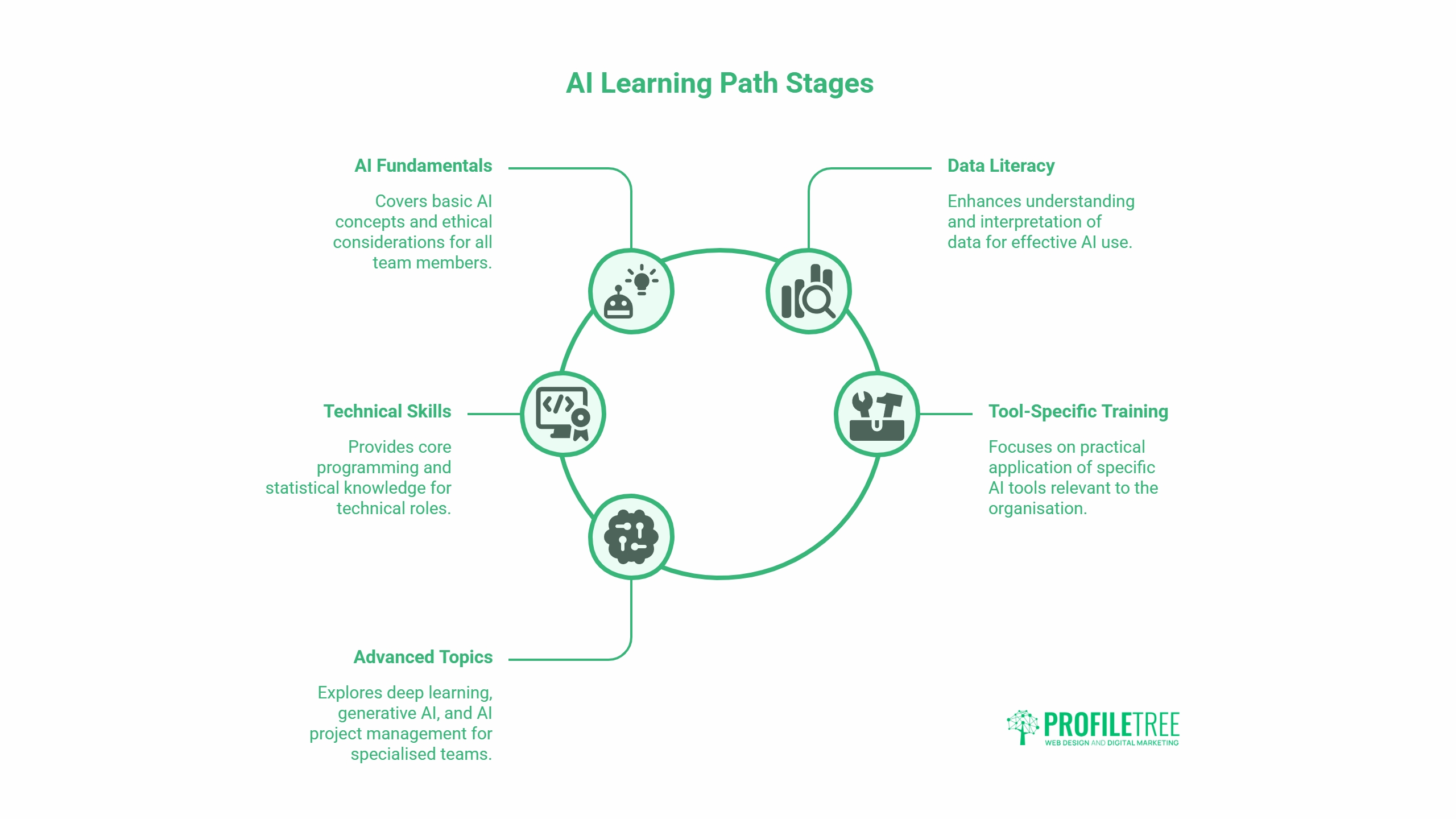
Stage 1: AI fundamentals and literacy
Every team member, regardless of role, should start here. This stage covers:
- What AI is and what the main categories are (machine learning, generative AI, computer vision, natural language processing)
- How AI systems learn from data, and why data quality matters
- The difference between narrow AI (specific tasks) and general AI (still largely theoretical)
- Real examples of AI in business contexts: customer service automation, content generation, data analysis, predictive analytics
- Ethical considerations: bias in AI systems, transparency, data privacy, and responsible use
This stage should take between four and eight hours, depending on the delivery format. It doesn’t require any technical background.
Stage 2: Data literacy and analytical thinking
AI produces outputs that need to be interpreted and evaluated. Without basic data literacy, teams can’t do that effectively. Stage 2 covers:
- Reading and interpreting data: what charts, tables, and statistics actually mean
- Understanding correlation versus causation (a common source of bad AI-informed decisions)
- Working with spreadsheets and basic data tools
- Introduction to SQL for non-technical team members whose work involves data systems
- How to ask better questions of AI tools by understanding what the data behind them represents
Stage 3: Core technical skills for technical roles
For team members working directly on AI implementation, this stage introduces the technical foundations:
- Python programming: the dominant language for AI and data science work, with libraries including NumPy, pandas, and TensorFlow
- Statistics and probability: the mathematical basis for understanding how AI models make predictions
- Linear algebra and calculus at a conceptual level: enough to understand how machine learning models work without needing to build them from scratch
- Introduction to machine learning: supervised learning (classification and regression), unsupervised learning (clustering), and reinforcement learning
Not every team member needs this stage. Focus technical training on the people whose roles involve building, configuring, or closely managing AI systems.
Stage 4: Tool-specific and applied training
This is where the learning path connects directly to your team’s actual work. Stage 4 covers the specific AI tools your organisation uses or plans to use:
- Generative AI platforms for content, copy, and creative work
- AI-assisted analytics and business intelligence tools
- Natural language processing applications for customer service and communications
- Computer vision tools for industries where image analysis is relevant
- Workflow automation tools that use AI to handle routine tasks
Training at this stage should be hands-on. The goal is confident, critical use: knowing how to get good outputs, how to spot poor ones, and how to integrate the tools into existing processes without creating new problems.
Stage 5: Advanced and specialist topics
For teams ready to go deeper, stage 5 covers more advanced territory:
- Deep learning and neural networks: How models with many layers learn complex patterns from large datasets. Relevant to teams working on image recognition, speech processing, or advanced predictive modelling.
- Generative AI in depth: Large language models, how they’re trained, their capabilities and limitations, and how to use them responsibly at scale. Includes prompt engineering as a practical skill.
- AI project management: How to scope, manage, and evaluate AI implementation projects, including how to work with vendors and technical teams if you’re not building in-house.
Practical Applications to Include in Training
NLP is one of the most immediately applicable areas of AI for most businesses. Practical training should cover:
- Using AI to analyse customer feedback and reviews at scale
- Chatbots and virtual assistants: how they work, where they add value, and where they create problems
- AI-assisted writing and editing tools: what they’re good for and where human judgement remains essential
- Sentiment analysis for monitoring brand reputation or customer satisfaction
Computer vision applications
Computer vision training is most relevant for businesses in manufacturing, retail, healthcare, or security. Practical applications include:
- Quality control and defect detection in manufacturing
- Automated image tagging and categorisation for e-commerce
- Document processing and data extraction from scanned files
- Accessibility tools that describe images for visually impaired users
Working with AI APIs and integrations
Most businesses don’t build AI from scratch; they integrate existing AI capabilities into their systems via APIs. Training should include:
- Understanding what an API is and how AI APIs work
- How to evaluate AI tool integrations for security and data privacy
- Connecting AI tools to existing workflows without creating data silos
- When to use off-the-shelf AI products versus custom development
ProfileTree’s AI transformation services support businesses through exactly this process, from identifying the right tools through to implementation and team training.
Integrating AI Into Day-to-Day Workflows
The best place to start is where AI saves time on tasks that are currently manual, repetitive, and low-stakes. For most SMEs, this means things like:
- Drafting first versions of routine communications, reports, or content briefs
- Summarising long documents or research
- Generating initial data analysis and visualisations from spreadsheets
- Automating routine customer enquiries through chatbots or automated responses
These applications are accessible without advanced technical skills and produce visible results quickly, which builds confidence and buy-in for broader adoption.
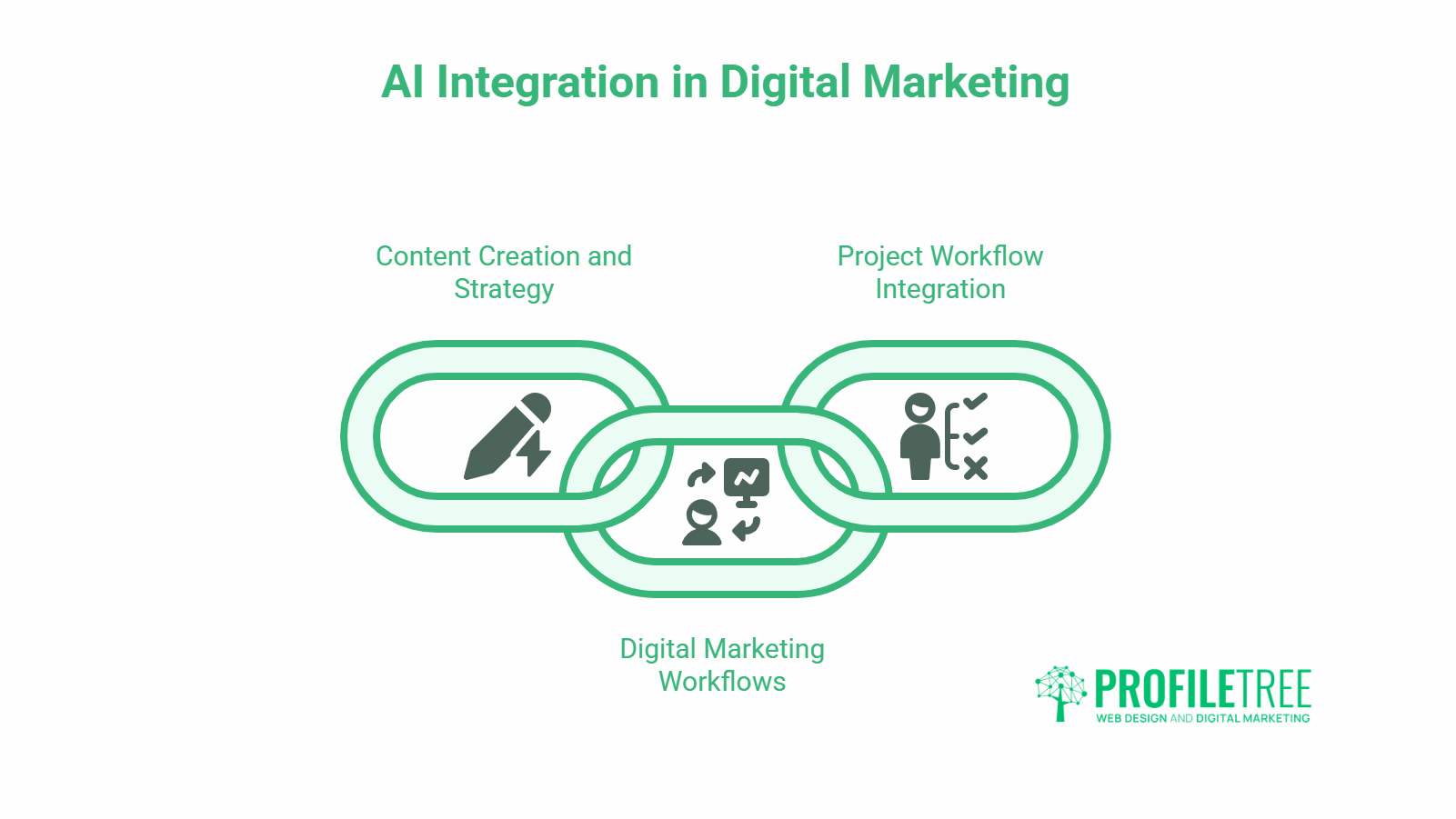
Connecting AI learning to digital marketing workflows
For marketing teams, AI has particularly clear applications. Content research, SEO analysis, social media scheduling, paid campaign optimisation, and customer segmentation all have AI-assisted equivalents that can meaningfully improve output and reduce time spent on lower-value tasks.
ProfileTree’s digital marketing services incorporate AI tools across strategy, execution, and reporting. Teams trained in how to use these tools effectively get significantly more from their marketing investment.
AI in content creation and strategy
AI is changing how content teams plan, produce, and optimise their work. It can accelerate ideation, support keyword research, generate structured drafts for editing, and help teams analyse what’s performing and why. The critical skill isn’t just knowing how to use the tools; it’s knowing where to apply human judgement and where to trust the output.
For businesses developing content strategies or training their teams on AI-assisted content production, ProfileTree’s content marketing services provide both the strategic framework and practical support to make that transition effectively.
Building AI into project workflows
Effective AI integration requires changes to how projects are planned and managed. Teams need to know when to use AI in a workflow, how to review and validate AI output before acting on it, and how to document decisions made with AI assistance. This is a process design question as much as a technology one.
Industry-Specific AI Training Considerations
AI applications in finance include fraud detection, credit risk modelling, automated reporting, and regulatory compliance monitoring. Training for finance teams should emphasise data accuracy, auditability, and the regulatory frameworks that govern AI use in financial services, including FCA guidelines in the UK.
Healthcare and life sciences
In healthcare, AI is used in diagnostic support, patient pathway optimisation, and administrative automation. Teams in this sector need training that places equal weight on AI capability and on the governance frameworks that apply: data protection under UK GDPR, clinical safety standards, and NHS digital policy for AI tools.
Marketing and e-commerce
For marketing and sales teams, AI training should focus on customer data analysis, personalisation at scale, predictive lead scoring, and the tools used for campaign automation. Understanding how AI processes customer data and what consent requirements apply is as important as knowing how to operate the tools themselves.
Research and development
In R&D contexts, AI accelerates literature review, data analysis, experimental design, and hypothesis generation. Teams need training in how to work with AI tools in ways that maintain research integrity and produce results that are reproducible and properly documented.
Conclusion
An AI learning path isn’t a luxury for large organisations with dedicated L&D teams. For SMEs, it’s the practical difference between adopting AI in a way that sticks and running a series of expensive experiments that don’t change how the business actually operates.
The framework is straightforward: assess where your team is, build in stages from fundamentals through to applied skills, connect every stage to real workflow problems, measure outcomes against defined objectives, and treat it as a continuous programme rather than a one-time event.
The businesses seeing the best results from AI right now aren’t necessarily the most technically sophisticated. They’re the ones that have invested in helping their people understand the technology well enough to use it confidently and critically.
FAQs
What is an AI learning path for a team?
An AI learning path is a structured programme that takes team members from basic AI literacy through to confident practical application, in stages that match their existing skills and specific job roles. It typically covers AI fundamentals, data literacy, tool-specific training, and workflow integration, with each stage building on the last.
How long does it take to build AI skills in a team?
Most teams reach a functional level of AI competency across key roles within three to six months of a structured programme. Full integration, where AI tools are used confidently and consistently across workflows, typically takes six to twelve months. The timeline depends on starting skill levels, how much time is allocated to training, and how quickly the team can apply learning in practice.
Do all team members need technical AI training?
No. Most team members need AI literacy, not technical proficiency. Understanding what AI can do, how to evaluate its outputs, and how to use AI-assisted tools effectively is the relevant skill set for the majority of roles. Technical training in programming, machine learning, and model development is only necessary for team members whose work involves building or closely managing AI systems.
What AI tools should be included in team training?
This depends on your industry and workflows. Most SMEs benefit from training on generative AI tools for content and communication, AI-assisted analytics platforms, and any sector-specific tools relevant to their work. Start with the tools that address your highest-volume, most time-consuming tasks first.