
Digital Compliance for SMEs: What It Means and How to Get There
Table of Contents
Digital compliance covers the rules, standards, and practices that govern how your business operates online, from data protection and website accessibility to cybersecurity and GDPR. For SMEs in Scotland and across the UK, getting this right is no longer a back-office concern. It affects your search rankings, your customer trust, and your ability to trade with larger partners who now ask for evidence of compliance before they sign contracts.
This guide breaks down what digital compliance actually requires, where most small businesses fall short, and what a realistic path to improvement looks like.
What Digital Compliance Actually Covers
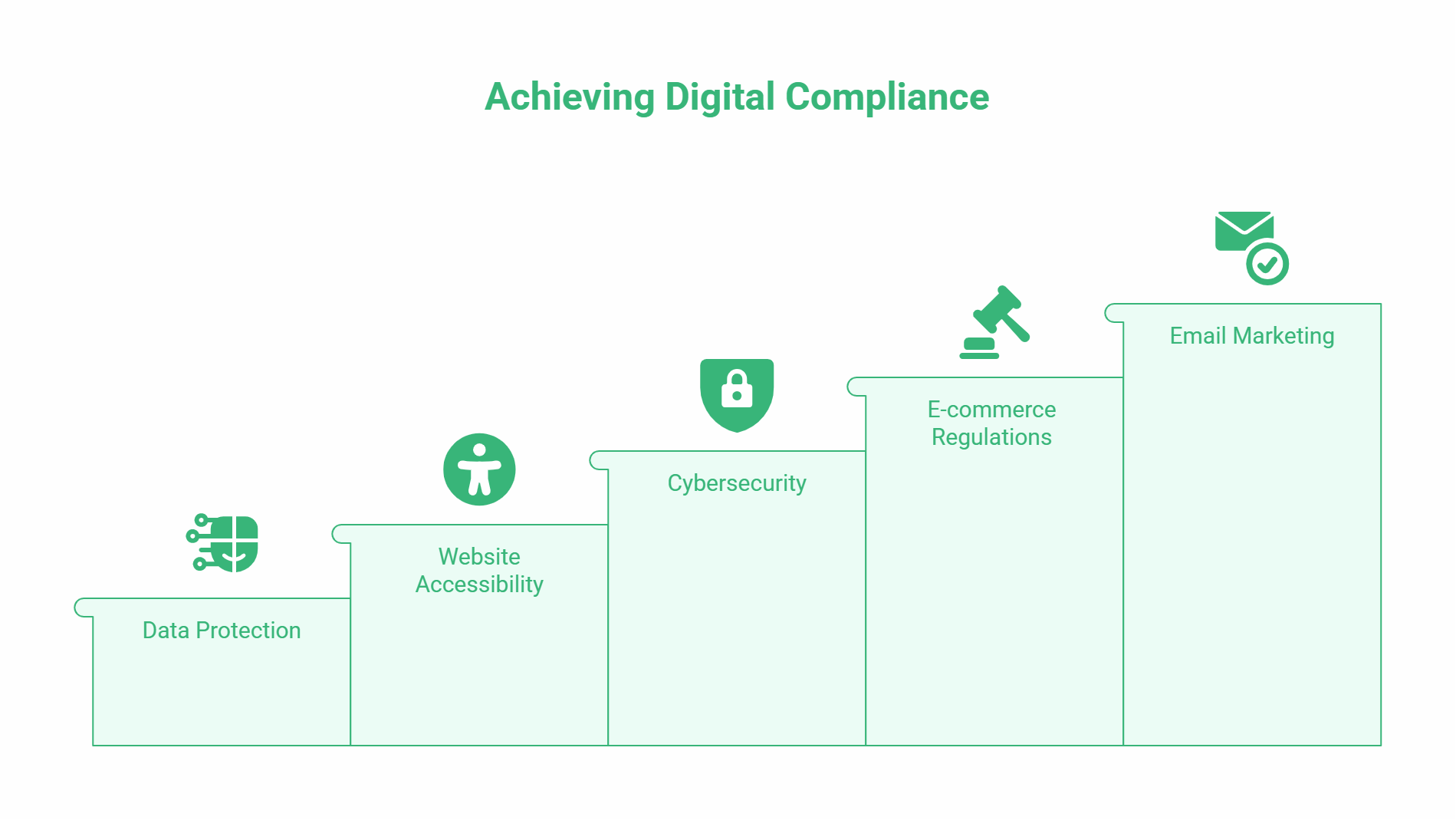
Digital compliance is not a single standard. It’s a collection of legal, technical, and operational requirements that apply to any business with an online presence. For UK and Scottish SMEs, the most relevant areas are:
Data protection (UK GDPR): How you collect, store, and use customer data. This includes your privacy policy, cookie consent banners, and how you handle data subject requests. The UK GDPR has applied since Brexit, and fines for serious breaches can reach £17.5 million or 4% of global turnover.
Website accessibility: The Public Sector Bodies Accessibility Regulations require government websites to meet WCAG 2.1 AA standards. Private sector businesses are not legally required to comply under this regulation, but the Equality Act 2010 does require that your website does not discriminate against disabled users. Accessibility also affects SEO; Google’s Core Web Vitals and page experience signals reward well-structured, readable pages.
Cybersecurity: The National Cyber Security Centre (NCSC) publishes the Cyber Essentials scheme, a government-backed certification that covers five technical controls: firewalls, secure configuration, access control, malware protection, and patch management. Many public sector contracts in Scotland now require Cyber Essentials as a condition of supply.
E-commerce regulations: If you sell online, the Consumer Contracts Regulations and the Electronic Commerce Regulations govern how you present pricing, cancellation rights, and terms of sale.
Email marketing: PECR (Privacy and Electronic Communications Regulations) sets the rules for marketing emails and SMS. Sending marketing communications without a valid legal basis is a breach, regardless of the size of your list.
Most SMEs are not deliberately non-compliant. They’re unaware that the rules exist, or they set things up quickly when they launched and never revisited them.
Why This Matters More Than It Did Three Years Ago
Three shifts have made digital compliance a live commercial issue rather than a theoretical one.
First, enforcement is more visible. The ICO (Information Commissioner’s Office) publishes fines and reprimands publicly. Even small businesses have received monetary penalties for basic GDPR failings, and the reputational damage from a public reprimand often outweighs the fine itself.
Second, your customers check. B2B buyers, procurement teams, and larger retail partners now carry out digital due diligence before signing. A poorly configured cookie banner or an outdated privacy policy is a red flag in a tender process. This is particularly relevant for Scottish construction firms, professional services companies, and anyone supplying to the public sector.
Third, your website’s performance is tied to compliance-related technical standards. Google’s page experience signals, Core Web Vitals, and mobile usability requirements are all areas where compliance and SEO overlap. A site that fails on accessibility or loads slowly on mobile will rank below a better-built competitor, regardless of the quality of your content.
As Ciaran Connolly, founder of ProfileTree, puts it: “Mentorship and structured learning build the confidence employees need to embrace digital tools properly; the business has to create the environment where that’s possible. Compliance isn’t separate from that; it’s part of building something that lasts.”
The Most Common Gaps in Scottish SME Websites
Based on web design and digital marketing work across Northern Ireland, Ireland, and Scotland, these are the issues that come up repeatedly:
Cookie consent that doesn’t actually work. Many SMEs have a cookie banner, but it doesn’t block non-essential cookies before consent is given. Accepted Google Analytics tracking before the user clicks “accept” is a GDPR breach, not a technicality.
Privacy policies copied from templates. Template policies that don’t reflect what the business actually does with data are worse than useless. They create a false sense of compliance while containing inaccurate statements.
No SSL on all pages. HTTPS is a minimum. Any page that still loads over HTTP, including internal pages and older subdirectories, is both a security risk and a ranking signal issue.
Contact forms that don’t state a legal basis for processing. If your contact form collects a name and email address, you need a lawful basis for processing under UK GDPR. Legitimate interest usually applies, but it needs to be stated.
Images without alt text. This affects both accessibility and SEO. It’s one of the quickest wins on most SME sites.
No process for handling data subject requests. If a customer emails asking what data you hold on them, you have 30 days to respond. Most SMEs have no documented process for this.
Building a Digital Compliance Action Plan
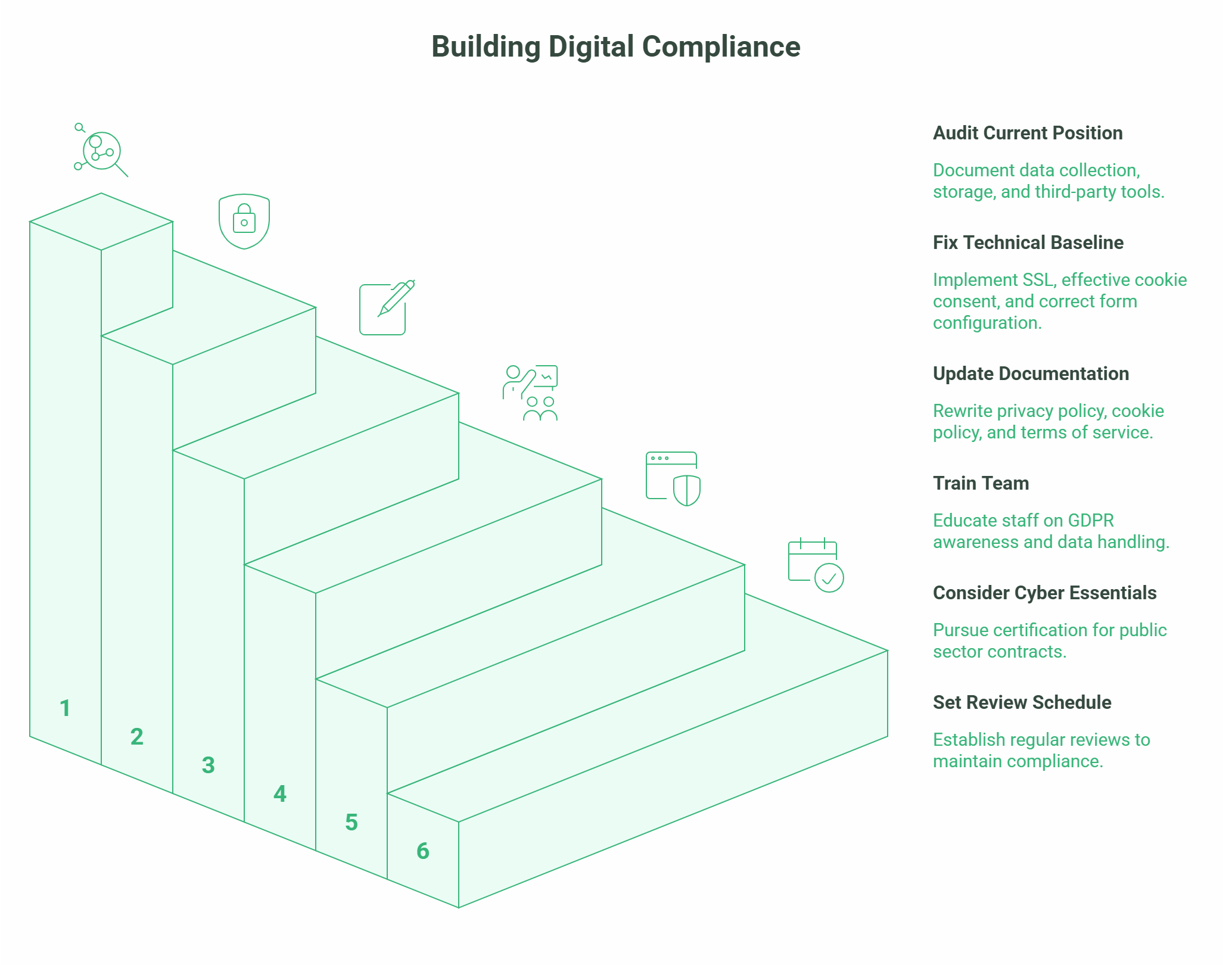
Compliance is easier to manage as a structured project than as a reactive scramble. A practical action plan looks like this.
Step 1: Audit what you have. Before making changes, document your current position. What data do you collect? Where is it stored? What third-party tools (analytics, CRM, email marketing platforms) process customer data on your behalf? Most SMEs discover they have more data flows than they realised.
Step 2: Fix the technical baseline. SSL, cookie consent that actually works, and correct form configuration. These are non-negotiable and most can be addressed quickly if your website is built on a well-supported platform like WordPress.
Step 3: Update your documentation. Privacy policy, cookie policy, and terms of service should reflect what your business actually does. If your website was built three years ago and your service offering has changed, your documentation probably needs rewriting.
Step 4: Train your team. GDPR awareness is not just an IT issue. Anyone who handles customer data, including sales staff, account managers, and customer service teams, needs to understand the basics. The ICO publishes free training resources, and ProfileTree’s digital training programmes through Future Business Academy cover data literacy for non-technical teams.
Step 5: Consider Cyber Essentials. If you’re pursuing any public sector contracts in Scotland, Cyber Essentials certification will become a practical requirement. The certification process also forces a useful audit of your technical controls. The National Cyber Security Centre runs the scheme; certification starts with a self-assessment questionnaire.
Step 6: Set a review schedule. Digital compliance is not a one-off project. Regulations change. Your website changes. Your data processing activities change. A twice-yearly review is a reasonable minimum for most SMEs.
Digital Skills and Compliance: The Training Gap
Many SME compliance failures are skills problems, not attitude problems. Business owners who launched their websites in 2018 or 2019 did so before UK GDPR came into force. They set things up based on what was normal at the time and haven’t had the capacity to revisit it since.
Closing this gap requires both practical training and the right external support. Internal training should cover:
- Basic data protection principles (what constitutes personal data, lawful bases for processing, data subject rights)
- Cybersecurity hygiene (password policies, phishing awareness, software updates)
- Website content standards (accessibility basics, image optimisation, structured data)
For businesses that lack the internal resource to manage this, working with a digital agency that understands both the technical and compliance dimensions is a practical shortcut. ProfileTree works with SMEs across Northern Ireland, Scotland, and the Republic of Ireland on web design, SEO, and digital marketing strategy, with compliance requirements built into the development process rather than bolted on afterwards. Details on how that works in practice are on the web design services page.
The Scottish Government’s DigitalBoost programme also provides funded advisory support for eligible Scottish businesses, including digital health checks and specialist consultancy through Business Gateway.
Digital Compliance and SEO: Where They Overlap
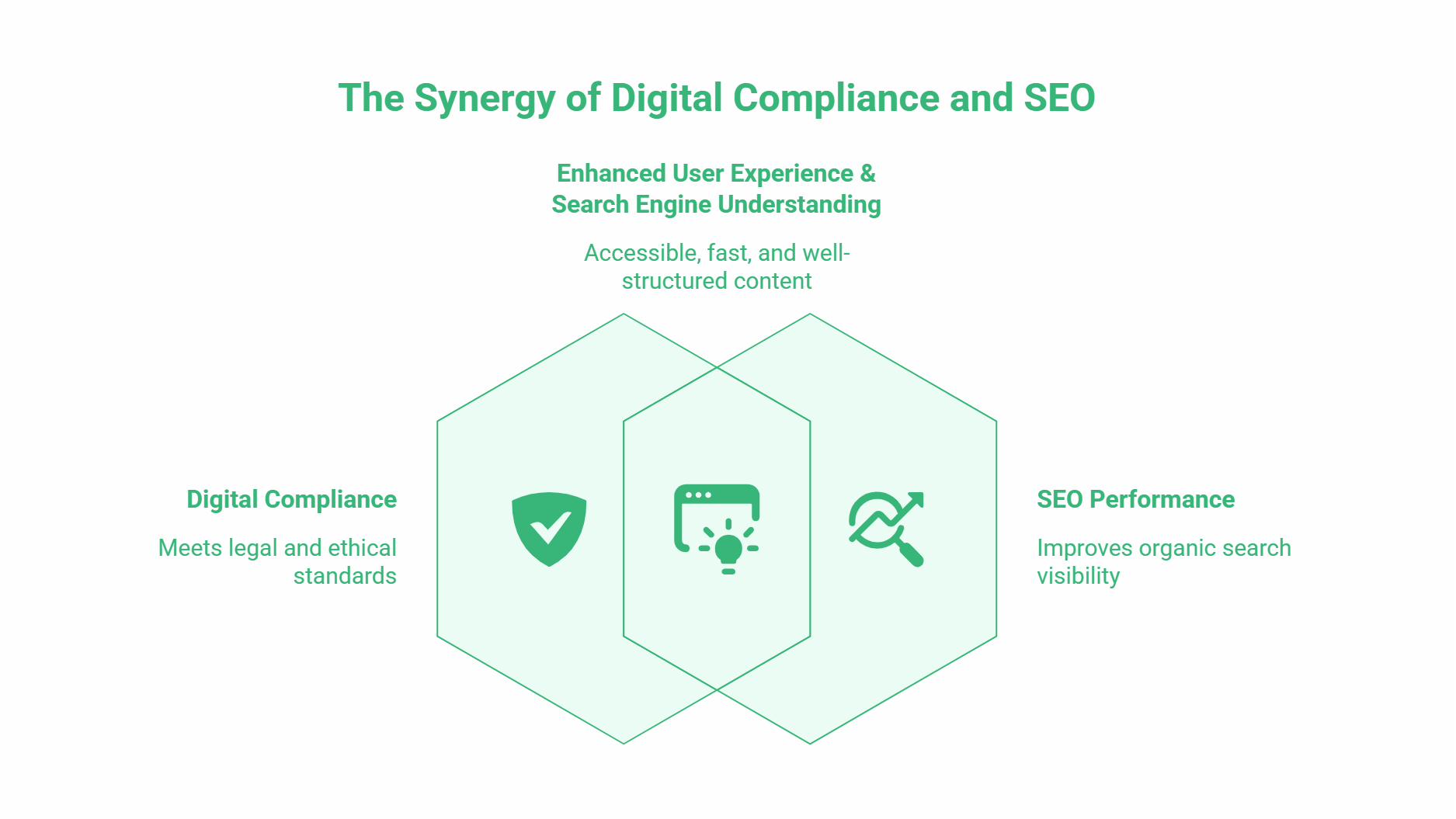
Search engine optimisation and digital compliance share more common ground than most SMEs realise. Several compliance requirements directly improve organic search performance.
HTTPS: Google has used HTTPS as a ranking signal since 2014. Sites without SSL rank below equivalent sites that have it.
Accessibility: Descriptive alt text, logical heading structure, and keyboard navigability all improve both accessibility compliance and how search engines index your content. Google’s crawlers behave more like a screen reader than a visual browser.
Page speed and Core Web Vitals: Many compliance-related technical fixes, such as reducing third-party scripts or optimising images, also improve page load speed. Google’s Core Web Vitals directly affect mobile search rankings.
Structured data: Schema markup, while not strictly a compliance requirement, helps search engines and AI systems understand your content. It’s part of the same discipline of building a site that communicates clearly to both humans and machines.
If your website needs a full audit covering both compliance and SEO performance, an SEO audit is a useful starting point for identifying where the gaps are.
FAQs
Does GDPR apply to very small businesses in Scotland?
Yes. UK GDPR applies to any organisation that processes personal data about UK residents, regardless of business size. There are some lighter obligations for organisations with fewer than 250 employees (such as reduced record-keeping requirements in some cases), but the core principles, including lawful basis, transparency, and data subject rights, apply to all.
What is Cyber Essentials and do I need it?
Cyber Essentials is a UK government-backed certification scheme covering five basic security controls. It’s mandatory for businesses bidding for certain UK government contracts involving sensitive data. For Scottish SMEs supplying to the public sector, it’s increasingly expected. Even without a contractual requirement, the certification process is a useful forcing function for reviewing your security posture.
How do I make my website GDPR-compliant?
Start with a proper cookie consent mechanism that blocks non-essential cookies before consent is given (not just a banner that informs). Then audit your privacy policy to make it accurate and specific to your business. Check that any contact forms or lead capture forms state the lawful basis for processing. Check that any third-party tools you use (analytics, CRM, email platforms) have data processing agreements in place.
What is the ICO and what can it do?
The ICO is the UK’s data protection regulator. It can investigate complaints, issue enforcement notices, and impose fines for serious breaches of UK GDPR. It also publishes extensive free guidance on its website. Most SME compliance questions can be answered by reading the ICO’s small business resources before paying for legal advice.
How often should I update my website’s privacy policy?
Any time your data processing activities change. That means new tools, new marketing channels, new customer data you’re collecting, or changes to how long you retain data. A practical minimum is a review every six months. Date-stamp each version so you can demonstrate when changes were made.