
Sustainable business examples: what UK SMEs can learn
Table of Contents
The sustainable business examples most worth studying come from companies whose commitments can be checked, such as Patagonia, Interface, Ørsted, IKEA, Riverford Organic and Toast Brewing. This guide from ProfileTree, the Belfast digital agency, explains the mechanism behind each one and shows how a UK SME can make green claims that stand up under consumer law.
What makes a business sustainable
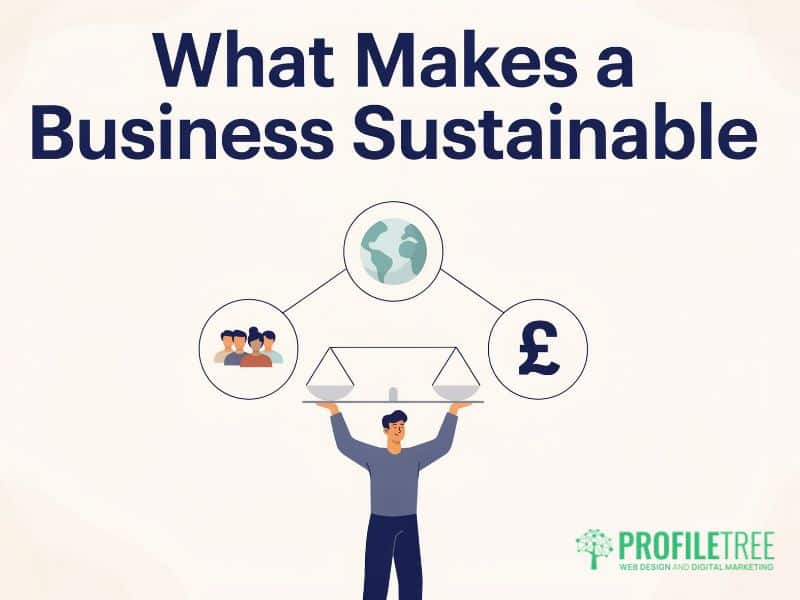
A business is sustainable when it meets its present needs without using up the resources or goodwill it depends on to keep trading. Recognised frameworks judge this on environmental, social and financial performance together, so a company that does badly on one of them does not qualify, however well it scores on the others.
The triple bottom line of people, planet and profit
John Elkington coined the triple bottom line in 1994 as a way of replacing a single financial result with three: environmental impact, social responsibility and financial viability. Most published lists of sustainable companies are measured against it, whether they say so or not.
The framework is useful because it brings trade-offs into the open. A firm that installs solar panels while paying staff below the real living wage has a good story on one measure and a weak record on another. A community business running at a loss will close before it has much impact at all, and the triple bottom line only works when a business reports against all three measures publicly and consistently, without picking the most flattering one for its website.
Sustainable business practices and ESG reporting
ESG (environmental, social and governance) reporting is a measurement and disclosure framework, built mainly so that investors can price risk. The practices themselves are the day-to-day decisions that ESG reporting tries to measure, from energy contracts and supplier choices to pay.
Very few UK SMEs need a formal ESG report. What they do need is a short list of real commitments, evidence that supports each one, and wording that does not overstate what has been achieved. Since 2025, that last point has become a legal question as well as a matter of good marketing.
How sustainable and traditional business models differ
The differences between the two models are easier to see side by side. The table below compares them across the areas where an SME makes most of its everyday decisions.
| Area | Traditional model | Sustainable business model |
|---|---|---|
| Materials | Take, make and dispose | Designed for repair, reuse or recycling |
| Energy | Lowest unit cost | Renewable supply, with efficiency measured and reported |
| Supply chain | Chosen on price | Audited standards, verified claims and longer relationships |
| Workforce | A cost line | Retention, fair pay and sometimes shared ownership |
| Waste | A disposal cost | An input to another process or a source of revenue |
| Claims | Marketing language | Evidenced statements held before publication |
| Time horizon | Quarterly | Multi-year targets with public reporting |
The right-hand column is not automatically more expensive. Energy efficiency work and packaging reduction usually lower operating costs, while the real spending goes on certification, changes to suppliers and the reporting that serious claims need.
Why green claims now carry legal weight in the UK
Since April 2025, the Competition and Markets Authority (CMA) can fine a business directly for misleading consumers, and that includes vague or unsupported environmental claims. For an SME, this turns the sustainability wording on a website from brand polish into a compliance matter.
The Green Claims Code and the CMA’s enforcement powers
The CMA published the Green Claims Code in September 2021. It says claims must be truthful and accurate, clear and unambiguous, and must not omit or hide important information. Comparisons must be fair, claims must consider the full life cycle of the product or service, and every claim must be substantiated.
For several years, the code was hard to enforce, because action required court proceedings. The Digital Markets, Competition and Consumers Act 2024 changed that, giving the CMA power to decide for itself that consumer law has been broken and to impose fines of up to 10% of global turnover. In January 2026, the CMA added guidance on claims made across supply chains, which makes clear that a retailer repeating a supplier’s “eco-friendly” description can share liability for it.
What this means for SME marketing claims
Phrases such as “committed to sustainability” and “environmentally responsible” are claims in the eyes of the regulator, and a claim you cannot evidence is a risk. A statement such as “our packaging uses 40% less material than our previous design, based on our supplier’s weight data” gives a reader something to check and gives the business something to defend. Specific wording is safer, and buyers also find it more persuasive.
The practical change is internal, because each public claim now needs a dated evidence file behind it, prepared before the claim goes live. This is where content marketing for a responsible business differs from ordinary brand copy, since every sentence has to survive a request for evidence. Our guide to green marketing practices works through the six principles claim by claim, and the guide to ethical marketing for SMEs covers the other legal lines that apply to marketing copy.
Independent certification and what B Corp requires since 2025
Independent certification is the strongest support a sustainability claim can have under the Green Claims Code, and B Corp is the scheme most small UK firms look at first. Its rules changed in April 2025, so much of the advice published before then is out of date.
Until then, a company needed at least 80 out of 200 points on the B Impact Assessment, and strength in one area could make up for weakness in another. On 8 April 2025, B Lab published new performance requirements that remove the points system. Every B Corp must now meet requirements across seven Impact Topics: purpose and stakeholder governance; fair work; justice, equity, diversity and inclusion; human rights; climate action; environmental stewardship and circularity; and government affairs and collective action.
| Certification | What it verifies | Best suited to | Effort |
|---|---|---|---|
| B Corp | Social and environmental performance across seven Impact Topics, plus a change to the company’s legal governance | Values-led businesses that want a recognised consumer-facing mark | High |
| ISO 14001 | An environmental management system and the processes behind it | Manufacturers and firms bidding for larger contracts | Medium to high |
| ISO 50001 | An energy management system and how energy performance is improved | Businesses where energy use is the main impact | Medium |
Each of these gives you independent verification held before the claim is made, which is what the Green Claims Code expects. A business that documents the certification process as it goes, including the requirements it found hard, also gains a year of honest material for its website and newsletters.
Sustainable business examples from global companies
The companies below are examined for the mechanism behind their reputation. Each example ends with the principle a smaller firm can take from it.
Patagonia and ownership as the commitment
Patagonia is one of the most cited examples of sustainable business, and the reason is structural. Through its 1% for the Planet commitment, it gives 1% of sales to environmental groups whether or not it makes a profit, and its Worn Wear programme repairs and resells clothing so that customers buy less new stock.
In 2022, founder Yvon Chouinard transferred ownership of the company to a trust and a non-profit organisation set up to direct its profits to climate and nature work. That legal change removes profit extraction as a motive for good, which is a far harder commitment than any policy document. An SME will not restructure its ownership, but it can copy the principle underneath: set one or two targets that outsiders can check, and report against them where customers can see the results.
Interface and a manufacturing turnaround
Interface, the carpet tile manufacturer, launched Mission Zero in 1994 with a goal of zero negative environmental impact by 2020. In November 2019, it announced it had met the goal early, and it moved its focus to Climate Take Back, a mission it had launched in 2016 with the aim of reversing global warming.
Its Net-Works programme, run with the yarn supplier Aquafil and the Zoological Society of London, bought discarded fishing nets from coastal communities and turned them into carpet yarn. The same transaction reduced plastic waste and gave those communities a new source of income. The lesson for an SME is about time, because Mission Zero took 25 years of small, measurable improvements, and a business can start with an energy audit or a packaging change long before it needs a carbon strategy.
Ørsted and a full energy transition
Ørsted, formerly the Danish state-owned DONG Energy, offers one of the clearest records of a company changing its whole business. In 2008, 85% of its heat and power production came from fossil fuels. Over the following years, it stopped building coal plants, sold its oil and gas business, converted its remaining power stations to certified sustainable biomass and built one of the largest offshore wind portfolios in the world, including wind farms that supply the UK grid.
In November 2025, the company reported that renewables made up 99% of its energy generation and that the emissions intensity of its own generation and operations had fallen by 98% against 2006, as set out in Ørsted’s account of its transformation. It now works to a 2040 net zero target validated by the Science Based Targets initiative. What makes Ørsted instructive is the commercial reasoning: its leadership treated the decline of fossil fuels as a risk to future profit, and a strategy built on a clear reading of where a market is heading tends to last longer than one built on values alone.
Unilever and the limits of the commercial case
Unilever reported that in 2018 its 28 Sustainable Living Brands grew 69% faster than the rest of the business and delivered 75% of its growth. The figure still appears in presentations as though it were current, so the date matters, because it describes 2018 and the Sustainable Living Plan ended in 2020.
The figure also rests on a broad definition. Reuters Breakingviews pointed out at the time that a brand qualified when at least 10% of its turnover came from products making progress on social or environmental goals, which grouped very different brands together. The fair reading for an SME is that sustainable practices can support growth, and the evidence for that is real. They do not replace a competitive product, and a business that treats them as a substitute will find that out expensively.
IKEA and sustainability without a price premium
IKEA’s climate strategy rests on an idea worth borrowing, which is that the more sustainable choice should not cost the customer more. Ingka Group, the largest IKEA retailer, matched 94.8% of its electricity use with renewable sources in FY25, through solar panels on its own buildings, wind and solar farms it owns, and energy certificates.
The figure was 96.6% the year before, and the company has said publicly that closing the remaining gap is a priority. The commercial point holds either way. Sustainability credentials sold as a premium put off cost-conscious customers, while the same credentials presented as the sensible default tend to convert.
Allbirds and Beyond Meat and transparency as a selling point
Allbirds and Beyond Meat share one mechanism, which is publishing numbers. Allbirds prints a carbon footprint figure for each product, and Beyond Meat commissions life cycle assessments of its products and releases the results.
Beyond Meat’s 2025 assessment of the fourth-generation Beyond Burger, carried out to ISO standards with a third-party critical review, estimated 88% lower greenhouse gas emissions, 97% less land use and 92% less water than an industry-average US beef patty. The company paid for the study, and readers are entitled to weigh that when they read the figures. A specific number invites scrutiny, and a number that survives scrutiny builds a kind of trust that a general claim to be environmentally responsible cannot earn.
Sustainable business examples from the UK and Ireland
UK and Irish examples are more useful to an SME than American multinationals, because the regulation, the customers and the scale are closer to home. The two firms below built sustainability into their structure, and the smaller firms that follow show what the same approach looks like on a modest budget.
Riverford Organic and employee ownership
Riverford was founded in Devon by Guy Singh-Watson, who started by delivering organic vegetables to local homes. It now delivers around 70,000 veg boxes a week, and in the year to May 2025 its turnover reached a record £117 million.
Singh-Watson moved about three-quarters of the company into an employee ownership trust in 2018 and sold his remaining stake in 2023, making Riverford wholly owned by its staff. Co-owners share profits equally and have a direct say in how the business is run, and the company is also a certified B Corp. Riverford is the clearest UK example of corporate social responsibility built into the ownership of a business, where it cannot be quietly dropped by a future buyer.
Toast Brewing and a circular business model
Toast, founded by food waste campaigner Tristram Stuart, brews beer with surplus bread, which replaces about a quarter of the malted barley in each batch. Its constitution commits all distributable profits, with a minimum of 1% of revenue, to environmental causes, and the company holds B Corp certification.
Toast’s waste stream is its raw material, so the environmental benefit and the commercial model are the same decision. That is a useful test for any circular model. If the sustainable choice could be removed without changing how the business makes money, it is an add-on, and add-ons are the first thing cut when margins tighten.
Smaller firms across the UK and Ireland
Below the level of national brands, the pattern across Northern Ireland, the Republic of Ireland and Great Britain is consistent. Refill shops, repair-led product businesses, professional firms cutting travel and switching to renewable tariffs, and manufacturers reworking packaging with their suppliers all make changes that rarely reach the news.
What these firms do produce is evidence, and evidence is what a procurement team asks for when social value criteria apply to a tender. For many SMEs, that is the point where sustainability work starts to pay for itself, because a documented commitment can help win a contract that an undocumented one cannot.
How sustainable businesses communicate their work online
Every company above communicates its work clearly and consistently online, and for most SMEs this is the weakest part of an otherwise sound effort. Strong practices that nobody can find do not win customers. Strong claims without the practices behind them are greenwashing, which now carries a real financial risk.
A sustainability section on your website
Procurement teams checking a supplier look for its commitments, progress and evidence, and the website is usually the first place they look. A set of pages covering environmental practices, supplier standards, community work and certifications held will do the job for most SMEs, without a formal ESG report.
Structure matters for search as well as credibility. Specific pages built on evidence can rank for the detailed queries buyers use when checking a supplier, which a general “our values” page rarely does. Website design planned around how buyers assess suppliers keeps this material close to the homepage, where a buyer can find it in a couple of clicks.
Content that documents the work
Patagonia’s reputation rests on decades of publishing its own impact data and writing candidly about the difficulty of running a product business sustainably. The SME version is a content programme that reports the work honestly, including the quarters where progress stalled. Content that admits complexity stands out because most brand content is promotional by default, and it earns links and citations from other publishers more readily.
ProfileTree is a Belfast web design and digital marketing agency, founded in 2011 and based at the McSweeney Centre. Its content team writes for businesses across the UK and Ireland that need their environmental work described accurately.
“Every claim on a page should be checkable. If ProfileTree cannot point to where a figure came from, it does not go in, and that rule matters more on a sustainability page than anywhere else on a website. It costs us words and keeps our clients’ trust, and it is the standard our content marketing team in Belfast works to for every client,” says Ciaran Connolly, founder of ProfileTree.
Video as evidence of the work
Interface’s Net-Works programme and Toast’s brewing process are both easier to understand on film than in text. Footage of a supplier visit, a manufacturing change or a community project is harder to dismiss than a written claim, which is why it works as evidence.
The production budget is often smaller than owners expect. A short, well-planned film showing one real process carries the same evidential weight as a corporate campaign, and short video is the format people share most readily on social platforms and other sites embed. ProfileTree’s video marketing service covers planning and distribution alongside filming, with video production starting from £1,200 plus VAT.
Search visibility for sustainability credentials
Searches such as “B Corp certified accountants” or “sustainable packaging supplier UK” come from buyers who have already decided what kind of supplier they want. A search engine optimisation plan built around the certifications you hold, the practices you have adopted and the targets you have set turns those credentials into a source of enquiries. SEO with ProfileTree starts from £500 a month plus VAT, and the pages it relies on are the same evidence pages your buyers and the regulator want to see.
Five steps to build business sustainability in an SME
The examples in this guide follow a common order. Each business found where its real impact sat, committed to something specific, built the evidence, measured honestly and published the result, and the same order works at SME scale.
- Identify your two largest impacts. For a professional services firm, these are usually energy use and purchasing choices, and for a product business they include packaging, logistics and materials.
- Set a time-bound target for each impact. A target to cut office energy consumption by 20% over 18 months can be measured, reported and defended under the Green Claims Code, while a promise to “reduce” or “improve” cannot.
- Build the evidence before you make the claim. Hold the data that supports any public statement first, because a claim published ahead of its evidence is exactly what the Green Claims Code is designed to catch.
- Consider independent verification. Certification takes effort, but it turns your claims into facts checked by a third party, which is the standard the CMA applies.
- Publish the work, including the unfinished parts. A report that shows what has not been achieved yet is more credible than a selective one, and it carries less legal risk.
Make your sustainability work visible with ProfileTree
ProfileTree helps businesses in Northern Ireland and across the UK turn real environmental credentials into content that buyers and search engines can find and trust. If your business has the practices and the evidence but your website does not show them, talk to our content marketing team in Northern Ireland about a programme built around what you can prove. Content work is quoted on request.
FAQs
1. Which UK companies have the most credible sustainability commitments?
The most credible commitments come from companies that publish specific, verifiable data and have changed their structure to protect it. Riverford Organic is wholly employee-owned and a certified B Corp, Toast Brewing has written its profit pledge into its constitution, and Ørsted, which supplies the UK grid, reports a 99% renewable share of its generation. When you compare retailers or manufacturers, look for third-party verification, a stated method behind each figure, and targets with dates attached.
2. Where can I find a list of UK companies leading in sustainable business?
The B Corp directory run by B Lab lists every certified company and can be filtered by country and industry, which makes it the most practical starting point. For larger companies, published sustainability reports and CDP disclosures show how far each company has progressed against its own targets. Treat any list that ranks companies without explaining its method with caution.
3. What is a sustainable business?
A sustainable business operates without depleting the resources it depends on or creating costs for society that outweigh the value it creates. The triple bottom line of people, planet, and profit is the most widely used way of assessing this, and a business has to perform on all three to qualify.
4. What are examples of sustainable business practices?
Common examples include switching to a renewable energy tariff, cutting packaging, buying from audited suppliers, designing products for repair, paying the real living wage, and publishing impact data. Certification such as B Corp or ISO 14001 sits on top of these practices and verifies them, and each company in this guide shows some of them at a different scale.
5. Is sustainability expensive for a small business?
It depends on where you start. Energy efficiency and packaging reduction usually lower running costs, while certification and changing suppliers need real investment of time and money. The sensible order for a small business is to begin with the changes that save money and use the savings, and the evidence they produce, to fund the larger steps.