
Social Media Hacking Statistics: What SMEs Need to Know
Table of Contents
Every week, thousands of individuals and businesses find out their social media accounts have been accessed without their knowledge. Sometimes it is a drained ad budget. Sometimes it is private messages sent to customers. Sometimes the account is locked, and a stranger demands payment to unlock it.
The social media hacking statistics below are sobering: around 70% of Instagram and Facebook users who experience account compromise report being locked out entirely, and 71% say the hacker then impersonated them and contacted their friends or followers. For a business, that means your customers receiving messages from “you” that you never sent.
ProfileTree, a Belfast-based web design and digital marketing agency working with SMEs across Northern Ireland, Ireland and the UK, regularly fields questions from clients whose Facebook or Instagram business accounts have been compromised. Account security sits inside the same conversation as social media marketing for businesses: a campaign built on a hijacked account isn’t a working campaign, whatever the strategy behind it looked like on paper.
Understanding how social media hacking works, what the numbers actually show, and what to do if it affects your business is no longer optional reading. It is the kind of basic digital literacy every business owner in Belfast and across the UK now needs.
Social Media Hacking Statistics: The Current Picture
The social media hacking statistics below draw on the platforms and attack methods most commonly reported by users and businesses. Reading them platform by platform makes the pattern clearer than a single headline figure ever could.
Platform-by-Platform Breakdown
Facebook and Instagram are the most targeted platforms for account compromise, and the gap between them and other networks is significant. Facebook accounts are among the most compromised account types in the United States, with tens of thousands of accounts affected monthly. Instagram ranks second in terms of hacking incidents by volume, driven in part by its influencer and creator economy.
Gmail and Microsoft accounts, despite often holding far more sensitive data, attract far fewer targeted social media hacking attempts. They present a harder technical challenge and less immediate monetisation potential for attackers than a Facebook Business Manager account with an active ad budget attached.
| Platform | Primary Risk Factor | Most Common Attack Method |
|---|---|---|
| Linked ad accounts and payment methods | Phishing and credential stuffing | |
| Influencer monetisation and follower trust | Phishing DMs, session hijacking | |
| B2B access and corporate credentials | Social engineering, spear phishing | |
| TikTok | Creator accounts with large audiences | Account takeover via linked email |
| Snapchat | Young user base with lower security habits | Credential stuffing, phishing |
A question that comes up often is whether Instagram or Facebook themselves have been breached at a platform level. In the vast majority of cases, no. What people are describing when they ask “was Instagram hacked” or “has Instagram been hacked” is almost always an individual account compromise, not a breach of the platform’s own infrastructure.
Key Statistics to Know
The pandemic period saw a dramatic spike in cybercrime, with ransomware attacks increasing by 800% as remote work expanded the attack surface. Data breaches caused by user error account for 94% of incidents, meaning the vast majority of hacking events were preventable. Only 17% of hacking incidents involve malware; the rest stem from human error.
Among the most striking findings is the breakdown of motives. Around 64% of smartphone data breaches are financially motivated. Roughly 49% of hackers report doing it “for fun,” while 78% in surveyed samples cited skill development as a driver. This matters because it means businesses are not exclusively dealing with sophisticated criminal organisations. Many social media hacking attempts come from individuals testing tools, and those tools are increasingly automated and accessible to almost anyone.
The 2026 Picture: Scam Losses Keep Climbing
New Federal Trade Commission data published in April 2026 gives a clearer sense of scale than platform-level hacking figures alone. Reported losses from scams that started on social media reached $2.1 billion in 2025, up from $261 million in 2020, an eightfold increase over five years with no sign of slowing. Nearly 30% of people who reported losing money to any scam in 2025 said it began on social media, more than any other contact method by value, ahead of losses linked to phone calls or general website and app contact.
The FTC notes a large share of this activity runs through the platforms’ own paid advertising systems, not through direct account takeover, which is a different problem to the hacking covered elsewhere in this guide, though the two connect. A hacked business account isn’t just a lost channel; it can become the delivery vehicle for exactly this kind of scam, reaching an audience that already trusts the brand behind it.
Why Instagram and Facebook Attract the Most Attacks
Instagram and Facebook draw the highest volume of this activity because they offer the highest return for the least effort. A compromised Facebook Business account with an active ad budget can be used to run thousands of pounds’ worth of fraudulent advertising within hours. A hacked Instagram account belonging to an influencer or a small brand can be held to ransom, with the attacker demanding payment before restoring access.
Huge user bases mean that even unsophisticated attacks succeed at scale. A phishing campaign sent to 100,000 people will convert a small percentage, and that percentage still represents thousands of compromised accounts. The wealth of personal and financial data stored in these profiles, including linked payment cards and business credentials, makes each successful breach valuable to the attacker.
The Business Cost of Social Media Compromise
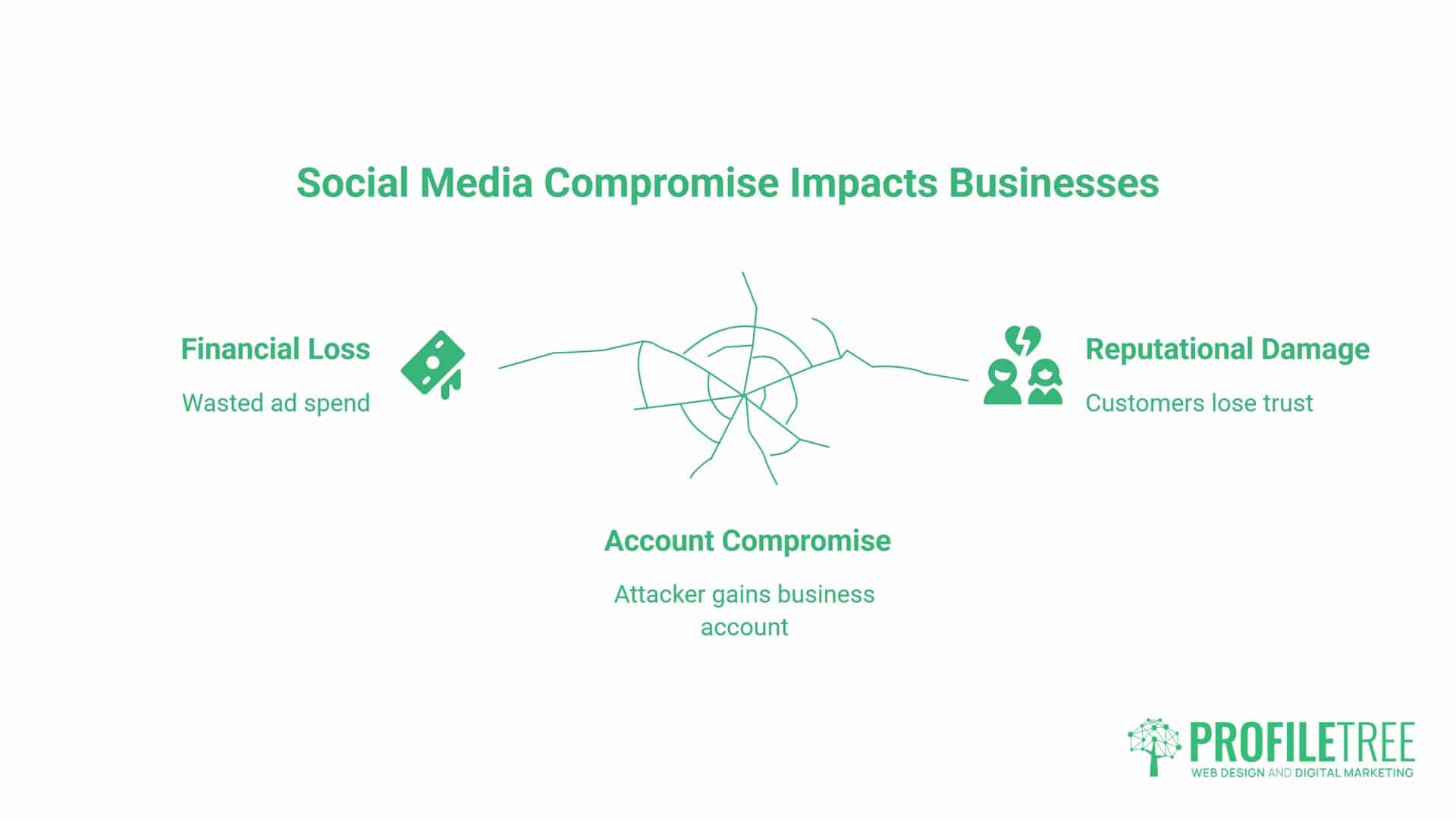
Most social media hacking statistics are written for individuals worried about their own profile. Far fewer address what happens when the account belongs to a business, where the financial and reputational stakes are higher, and the recovery process affects customers, not just the account holder. This is the gap in social media hacking coverage that this section aims to close.
Ad Account Hijacking and Direct Financial Loss
When an attacker gains access to a Facebook or Instagram business account with an active advertising set-up, the first thing they typically do is spend the linked budget as fast as the platform allows. Depending on the daily spend limit and how quickly the compromise is spotted, this can mean anything from a modest waste of ad spend to a genuinely damaging financial hit before the account is recovered and the payment method is removed.
For an SME running its own paid social campaigns, this is precisely why account-level security deserves the same attention as campaign strategy. ProfileTree’s social media marketing services in Belfast include reviewing account access and permissions as part of setting up and managing paid social campaigns for clients, rather than treating security as a separate afterthought.
The Reputational Cost When Customers Lose Trust
Financial loss is often the more visible cost, but reputational damage can outlast it. If an attacker uses a compromised account to message your followers directly, whether with a fake giveaway, a phishing link, or a request for payment, some of those customers will assume the business itself sent it. Trust, once dented this way, takes considerably longer to rebuild than an ad budget takes to replenish.
This is one of the reasons content marketing and community management matter beyond simple posting schedules. A business that has built a consistent, recognisable voice across its channels is in a stronger position to reassure its audience quickly if something goes wrong, because followers already have a clear sense of what genuine communication from that brand looks like. That consistency has a commercial upside too, not just a defensive one. It’s part of how social media marketing increases sales for SMEs: followers who trust a brand’s voice convert more readily than followers who don’t, and a security scare is far easier to weather when that trust already exists.
How Accounts Get Hacked: The Real Mechanics
Behind every social media hacking statistic sits one of a handful of actual techniques. Most fall into one of the categories below, and understanding each one is the first step towards closing it off.
Phishing: AI Has Changed the Game
Traditional phishing was easy to spot. Spelling mistakes, awkward phrasing, implausible urgency. That era is largely over. AI-generated phishing messages now produce fluent, personalised content that mimics the tone of trusted sources. A message that appears to come from Instagram’s support team, warning you that your account will be suspended unless you verify your details within 24 hours, can now be indistinguishable from a genuine platform communication.
The most common phishing attack on Instagram presents as a “copyright infringement notice.” You receive a direct message or email claiming that one of your posts violates intellectual property rules, with a link to “appeal” the decision. That link takes you to a convincing replica of the Instagram login page. You enter your credentials, and the hacker has them within seconds.
Red flags to check before clicking any link: urgent deadlines, generic greetings, suspicious domains (anything other than the official platform URL), and profiles or email addresses that do not quite match the supposed sender.
Session Hijacking: Why Changing Your Password Might Not Be Enough
Session hijacking is the gap that most prevention guides miss, and one of the most searched questions on this topic: can attackers still access an account after the password has been changed? Sometimes, yes.
You can have a strong, unique password and enable two-factor authentication. However, you can still have your account compromised through session hijacking.
When you log into Instagram or Facebook, the platform generates a “session token,” a small piece of data stored in the browser’s cookies that confirms you are already authenticated. Hackers who gain access to this token, typically through malware on your device or an unsecured network, can use it to log in to your account without ever needing your password or 2FA code.
This is why changing your password is not always enough to remove an attacker. You must also revoke all active sessions by logging out of every device simultaneously to guarantee the attacker loses access. It’s a genuinely underserved point in most consumer-facing hacking statistics roundups, which tend to stop at “use a strong password” and leave this specific mechanic unaddressed.
The Psychology of Social Engineering
“Hackers do not break through firewalls anymore; they break through people. They do not need your password if they can convince you to hand over your session token,” says Ciaran Connolly, founder of ProfileTree.
Social engineering attacks work by exploiting psychological triggers that bypass rational thinking:
Urgency creates panic. “Your account will be permanently deleted in 2 hours unless you act now” stops you from pausing to verify the claim.
Authority creates compliance. A message that appears to come from Instagram, your bank, or even a colleague bypasses your scepticism because you have been trained to trust those sources.
Scarcity creates fear of loss. “Only one attempt remaining before your account is locked” mimics real account security warnings convincingly enough to prompt immediate action.
Understanding these triggers does not make you immune, but it does create a pause. When you feel urgency, that is precisely the moment to slow down and verify independently.
Brute Force Attacks and Password Reuse
Accounts with weak or reused passwords remain vulnerable to brute-force attacks, in which automated tools cycle through thousands of password combinations. The practice of using the same password across multiple platforms compounds this risk: a breach at one site exposes credentials that attackers then try systematically across every major platform, a pattern sometimes called credential stuffing.
Platform Risk in Practice: Instagram, Facebook, and Beyond
The platform table earlier in this guide sets out the broad pattern, but a few platforms carry risks specific enough to a business context that they deserve their own attention.
Instagram: The Primary Vector for Brand Impersonation
Because Instagram accounts double as storefronts for many small brands, an attacker who takes one over is not just locking out the owner. They are stepping into a channel that customers already trust, which makes impersonation scams (fake giveaways, fake “verified account” prompts, fake customer service replies) unusually effective until followers realise something is wrong.
Facebook: Ad Accounts Under Attack
Facebook’s tight integration with Meta Business Suite and linked payment methods makes it the platform most closely tied to direct financial loss. Businesses running any paid social activity through Facebook should treat access management there with the same seriousness as banking credentials.
WhatsApp Business: An Emerging Risk for European SMEs
Most hacking statistics roundups focus almost entirely on Instagram and Facebook profiles, but a growing number of UK and Irish SMEs now run sales enquiries, order updates, and client support directly through WhatsApp Business. That channel carries the same social media hacking risks, including session hijacking and phishing, as the other Meta platforms, with the added complication that customer conversations, sometimes containing personal details or order histories, are stored within it. A compromised WhatsApp Business account is not just a lost marketing channel; it can mean an exposed record of customer communications.
Secure Your Social Media Accounts
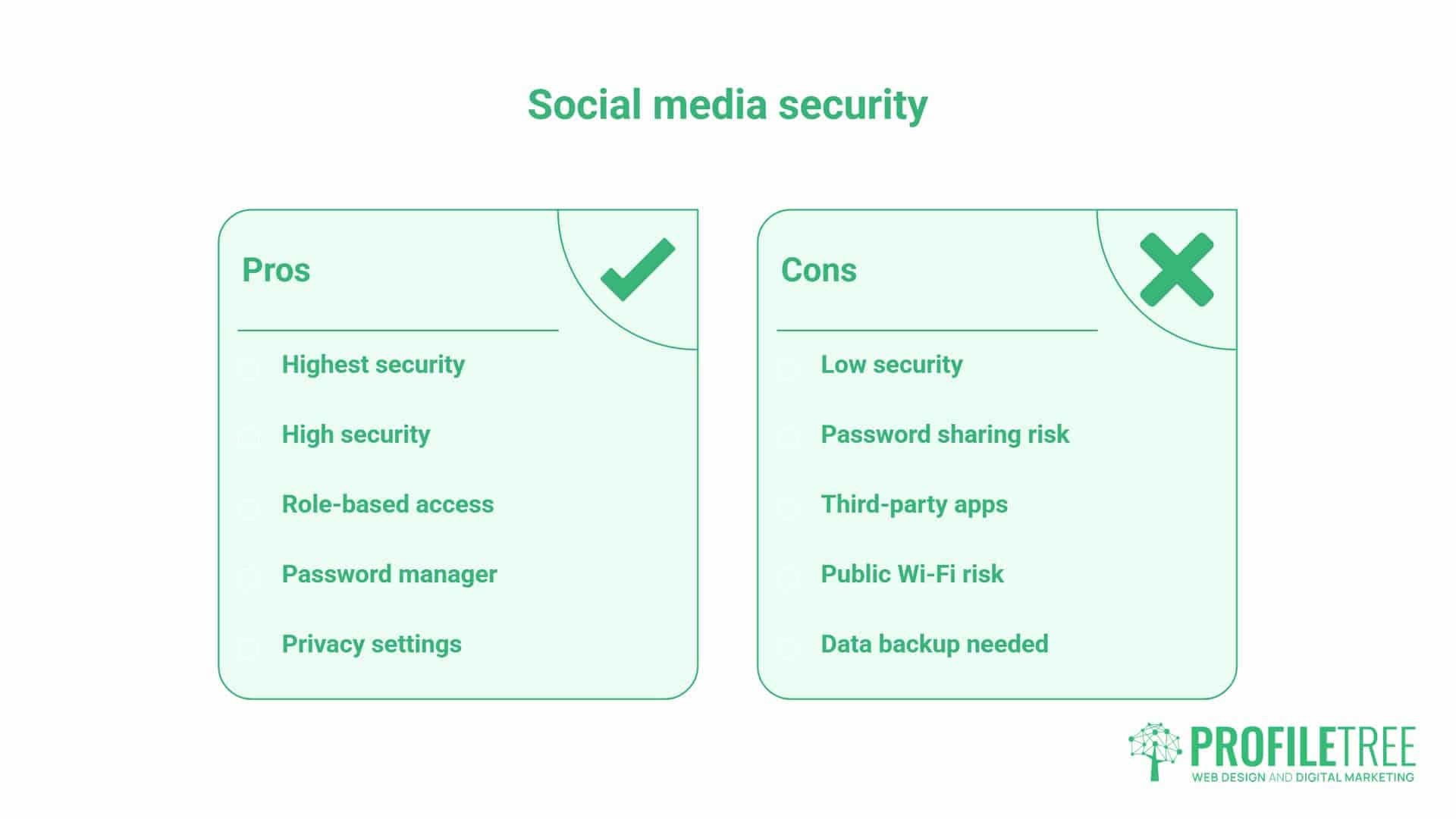
Securing accounts against these threats does not need to be complicated. A handful of consistent habits close off most of the routes attackers rely on, starting with how two-factor authentication is set up.
The 2FA Hierarchy: Not All Methods Are Equal
Two-factor authentication is no longer a nice-to-have. It is the minimum viable protection against most social media hacking attempts. But not all 2FA methods offer the same level of security.
| Method | Security Level | Vulnerability |
|---|---|---|
| Hardware Security Key (e.g., YubiKey) | Highest | Physical theft only |
| Authenticator App (e.g., Google Authenticator) | High | Device compromise |
| Email code | Medium | Email account must also be secure |
| SMS text message | Low | SIM swapping attack |
SMS-based 2FA is now considered outdated. SIM swapping, where an attacker convinces your mobile network to transfer your phone number to a new SIM they control, gives them access to every SMS code you receive. If your 2FA is SMS-only, consider it a temporary measure and migrate to an authenticator app as soon as possible.
Protecting Business and Team Accounts
For businesses that manage social media as a team, the single greatest security risk is password sharing. When five people know the Facebook page password, and one of them leaves the company or has their device compromised, the entire account is at risk.
The correct approach is to use role-based access through Meta Business Suite for Facebook and Instagram accounts. Each team member gets an individual login with the minimum permissions they need, and you can revoke access when they leave without changing any shared passwords.
Use LinkedIn’s Page Admin roles similarly: assign Content Admin or Analyst roles rather than Super Admin, where full access is not required. Getting a team confident on this is as much a training question as a technical one.
Use Strong, Unique Passwords
A password manager removes the friction that drives password reuse. Tools such as Bitwarden, 1Password, or the built-in password managers in iOS and Chrome generate and store unique passwords for every account, so only one master password needs to be remembered.
Everyday Habits That Close the Gaps
Most users never check the third-party applications connected to their social media accounts. Over time, these accumulate: quiz apps, scheduling tools, abandoned projects, and old integrations. Each one is a potential access point, and any of them can be compromised independently.
On Instagram, this sits under Settings > Security > Apps and Websites On Facebook, under Settings > Security and Login > Apps and Websites On LinkedIn, under Settings > Data Privacy > Third-party applications.
Doing this quarterly takes five minutes and closes access points you may have forgotten existed.
Adjust Your Privacy Settings
Social media platforms default to sharing more than you realise. Reducing public visibility of profile details, connections lists, and activity history reduces the information available to attackers scoping out social engineering targets.
Review who can see your friends list on Facebook. On Instagram, consider whether your account should be public or private based on your use case. On LinkedIn, limit the visibility of your connections to protect both yourself and your network.
Avoid Public Wi-Fi for Account Management
Public Wi-Fi networks in cafes, hotels, and airports are unsecured environments where session hijacking is considerably easier to execute, so business accounts are best managed on mobile data or through a VPN when working away from a secured network.
A VPN (Virtual Private Network) encrypts your traffic between your device and the internet, preventing attackers on the same network from intercepting your session tokens or login credentials.
Back Up Your Data
For business accounts, regularly export your data from each platform (Facebook, Instagram, and LinkedIn all offer this in settings). This does not prevent an attack, but it means that if your account is deleted or permanently locked following a breach, you retain your content, follower data, and account history.
What to Do If You Have Been Hacked
Speed matters after any social media hacking incident. The longer an attacker has active access, the more damage they can do. This sequence applies whether the compromised account belongs to an individual or a business.
Step 1: Check Your Email First
Go directly to your email account, not via any link received elsewhere. Look for a notification saying your social media email address or password was changed. Most platforms send these automatically. If you find one, use the “Revert this change” link within the email itself.
Step 2: Change Your Email Password
Your email account is the master key to every other account. If an attacker controls your email, they can reset every password linked to it. So, secure your email before anything else.
Step 3: Attempt Official Account Recovery
Use the platform’s official account recovery process:
Instagram: instagram.com/hacked Facebook: facebook.com/hacked LinkedIn: linkedin.com/help/linkedin
Never use any “account recovery service” promoted in direct messages, comments, or third-party websites. These are almost universally scams. There is a specific “recovery hacker” scam circulating on Instagram where someone claims they can hack your account back for a fee. They take your money and disappear, or they extract further personal information from you. This is a double scam. Stop contact immediately and report them.
Step 4: Revoke All Active Sessions
Once you have regained access, find the active sessions or “where you are logged in” section in your security settings. Log out of all devices simultaneously. This removes the attacker’s session token even if they still have your previous password cached.
Step 5: Enable 2FA and Review Access
Before you consider the incident resolved, enable authenticator app-based 2FA, audit your connected third-party apps, and review your admin access list if it is a business account.
Step 6: Check Sent Messages and Posts
Attackers frequently use compromised accounts to send phishing links to your followers or run unauthorised advertising. If anything was sent without your knowledge, post a clear statement to your audience explaining the breach and warning them not to click any links they received from your account.
UK and Irish Legal Context: Your Rights & Reporting Options
Recovering an account is only half the picture. Both the UK and Ireland treat unauthorised access as a criminal matter, and businesses carry additional regulatory obligations worth understanding before an incident happens, not during one.
Is Social Media Hacking Illegal in the UK and Ireland?
Yes, social media hacking is illegal in both the UK and Ireland. The Computer Misuse Act 1990 makes unauthorised access to any computer system a criminal offence, and social media accounts qualify as computer systems under this legislation. It does not matter whether the attacker knew the password, perhaps from a previous breach, or broke in through technical means.
Accessing an account without the owner’s explicit permission is a criminal act. This applies even within relationships: logging into a partner’s Instagram account without consent, even with a known password, is technically an offence under the Act.
In Ireland, the Criminal Justice (Offences Relating to Information Systems) Act 2017 contains equivalent provisions, making unauthorised access to information systems an offence punishable by up to 5 years’ imprisonment in more serious cases.
When to Contact Authorities
- Report to Action Fraud (actionfraud.police.uk) in England, Wales, and Northern Ireland if:
- Financial theft occurred via your account or linked payment methods. You are being blackmailed or extorted for account access. Business customer data was exposed
- In the Republic of Ireland, reports go to the Garda National Cyber Crime Bureau (garda.ie).
GDPR Obligations for Business Accounts
If your hacked social media account held customer data, collected leads, or was used for retargeting, the breach may carry regulatory consequences beyond reputational damage. Under UK GDPR, UK businesses must notify the Information Commissioner’s Office (ICO) within 72 hours of becoming aware of a personal data breach if it poses a risk to individuals. In Ireland, the equivalent notification goes to the Data Protection Commission.
A hacked WhatsApp Business account or a compromised Facebook Page inbox containing customer phone numbers, email addresses, or order histories can qualify as a personal data breach if that information is exposed. Document everything you know about the breach (when you first noticed it, what access the attacker had, and what data may have been exposed). This documentation supports any regulatory notification and demonstrates that your organisation took the incident seriously.
If your business relies on social media as a core sales or support channel, treating account security as part of your wider digital strategy, rather than an afterthought, is the difference between a minor scare and a genuinely costly week. ProfileTree works with SMEs across Northern Ireland, Ireland and the UK on secure social media management and staff digital training.
Frequently Asked Questions
These are the questions people searching for social media hacking statistics and recovery advice ask most often.
How do Instagram accounts get hacked?
Mainly through phishing fake login pages, reused passwords exposed in other breaches, and session hijacking via malware or unsecured networks.
Can attackers still access my account after I change my password?
Sometimes, yes. If an attacker has already stolen an active session token through malware or an unsecured network, changing the password alone does not automatically end that session. Logging out of all devices, or revoking active sessions in the account’s security settings, is the step that actually closes this gap.
How do hackers bypass two-factor authentication?
Two main ways: SIM swapping, which takes over a phone number to intercept SMS codes, and session hijacking, which steals an active login token so the attacker never needs to authenticate at all.
Which social media platform is hacked the most?
Instagram sees the highest volume of individual account compromise, largely due to its creator and influencer economy, while Facebook accounts for the largest share of business-focused compromises because of its integrated advertising infrastructure.
Is a hacked business social media account a GDPR issue?
It can be. If an attacker gains access to direct messages or contact details containing customers’ personal data, this may constitute a personal data breach, requiring notification to the ICO in the UK or the Data Protection Commission in Ireland within 72 hours of the business becoming aware.
Does changing my password log the hacker out?
Not always. Active sessions must also be revoked in security settings to invalidate any session tokens the attacker holds; otherwise, a stolen token can still grant access after a password change.
Was Instagram or Facebook itself hacked?
Almost always, no. What is usually described this way is an individual account compromise rather than a breach of the platform’s own systems. Genuine platform-wide breaches are rare and are typically confirmed directly by the platform when they happen.
Paid someone to recover a hacked account, and now they want more money?
It is a scam. Stop contact, report the account to the platform, and report any financial loss to Action Fraud in the UK or the Gardaí in Ireland.
What should Belfast businesses do if hacked?
Secure the linked email first, use the platform’s official recovery tools, revoke active sessions, notify customers if messages were sent on the business’s behalf, and check GDPR reporting obligations if customer data may have been exposed.