
SEO Strategy for UK Businesses: A Practical Framework
Table of Contents
Most SEO advice online is written for a US audience chasing national keywords with huge budgets. Northern Ireland and wider UK businesses need something different: a workable SEO strategy built around realistic budgets, local search behaviour, and the handful of pages that actually drive enquiries. Search engine optimisation done well isn’t a one-off project; it’s an ongoing part of how a business gets found.
An SEO strategy is the plan that connects your business goals to the technical, content, and authority work needed to rank. It isn’t a list of tactics you can tick off in an afternoon. A strategy tells you which keywords matter, which pages to build or fix first, and how you’ll know whether any of it is working six months from now. Get the strategy right and the individual tactics, from search engine optimisation basics through to link building, start pulling in the same direction instead of working against each other.
What Is an SEO Strategy?
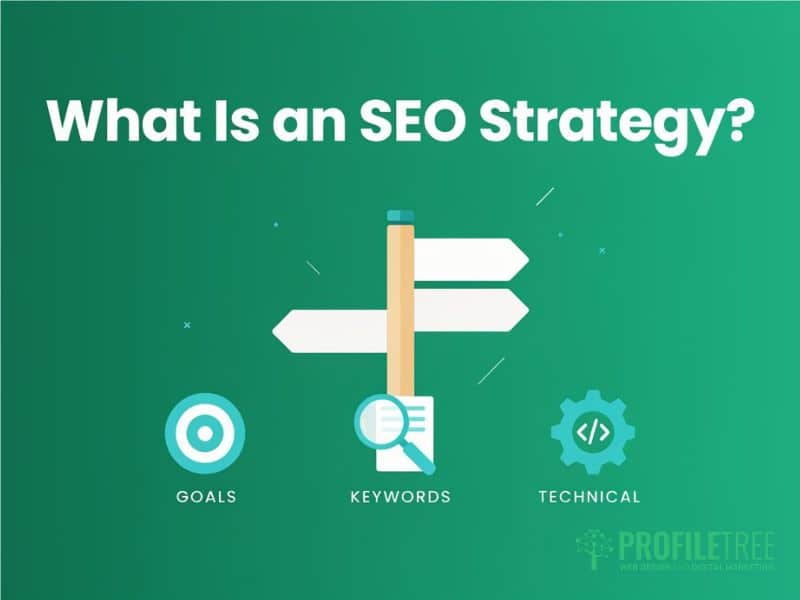
An SEO strategy sets out how your website will earn visibility in search results over the next six to twelve months. It covers three linked questions: who you are trying to reach, what they search for, and what your site needs to become to answer those searches better than the competition currently does.
This differs from an SEO tactic. A tactic is a single action, such as adding alt text to an image, fixing a broken link, or rewriting a meta description. A strategy decides which tactics matter for your business and in what order they should happen. Without a strategy, tactics get applied unevenly across a site, and they rarely add up to the kind of ranking gains a business owner actually notices month to month.
A working SEO strategy typically includes a target keyword and topic map built from real search demand, a technical health baseline covering speed and mobile usability, a content plan tied to business priorities rather than guesswork, and a method for tracking whether rankings translate into enquiries, calls, or sales. Search engine optimisation only works when these four elements move together; miss any one of them and the rest of the plan tends to underperform, however well it’s executed elsewhere.
For an SME with a small marketing team, an SEO strategy also has to be realistic about capacity. A twelve-month plan that assumes weekly publishing and a full technical rebuild isn’t a strategy so much as a wish list. Good strategy work is honest about what a business can actually deliver, and it sequences the highest-impact work first rather than the easiest.
It’s worth being clear about what an SEO strategy isn’t, too. It isn’t a guarantee of a first-page ranking within a fixed timeframe; nobody can promise that, and any agency that does should be treated with caution. It’s also not a substitute for a working website or a viable product; SEO can bring the right people to your site, but it can’t fix a poor customer experience once they arrive. A realistic SEO strategy sets expectations alongside targets, so a business owner knows what success will actually look like and roughly when to expect it.
Why UK Businesses Need a Dedicated SEO Strategy
Search behaviour in the UK isn’t identical to the US, and treating them the same is one of the fastest ways to waste a content budget. UK searchers use British spelling, reference local currency and postcodes, and increasingly search with regional qualifiers such as “Belfast”, “Northern Ireland”, or “Dublin” attached to a service term. An SEO strategy written for a generic English-speaking audience misses all of this nuance, and it shows up quickly in weaker click-through rates once a page does start to rank.
Google’s Helpful Content System now evaluates entire sites rather than single pages, which means a scattered SEO strategy with thin, generic pages can drag down stronger content elsewhere on the same domain. For SMEs across Belfast and Northern Ireland, this makes a coherent, prioritised SEO strategy more valuable than a large volume of loosely related blog posts published without a plan behind them. A handful of well-researched pages that genuinely serve Northern Ireland audiences will usually outperform dozens of generic ones over time.
UK data protection rules also shape how a strategy handles analytics, cookie consent, and lead capture forms. A strategy built without this in mind can end up collecting data it shouldn’t, or missing conversions entirely because a cookie banner blocks tracking before a visitor gives consent. Getting this detail right sits inside the same strategy as keyword targeting; it isn’t a separate legal afterthought that can be dealt with later.
Regional nuance matters at the keyword level too. A search for “web design services” typed from Dublin carries a different commercial context than the same phrase typed in London, and a national SEO strategy that ignores this ends up targeting the wrong pages for the wrong audience. Businesses serving Northern Ireland, the Republic of Ireland, and the wider UK from one site need a strategy that reflects each market rather than treating “UK” as a single homogenous audience. That’s often where a broader digital strategy earns its keep, tying regional SEO decisions back into how the whole business markets itself across each area it serves.
For a business based in Belfast but trading across Northern Ireland and the Republic of Ireland, this usually means separate location-aware content rather than one page trying to serve every region at once. A single “SEO services UK” page can’t realistically speak to a Belfast retailer and a Dublin one in the same terms, so a strategy has to decide early on where dedicated regional pages are worth building and where they aren’t.
The Core Pillars of an Effective SEO Strategy
Every credible SEO strategy rests on four connected pillars. Weakness in one undermines the others, so a strategy has to address all four rather than picking a favourite and hoping the rest sort themselves out. This is where a lot of UK businesses go wrong: they invest heavily in one pillar, usually content, while leaving the technical foundations or the authority-building work almost untouched. Search engine optimisation as a discipline covers all four, and keyword research feeds directly into at least two of them, shaping both the content pillar and the AI search pillar below.
| Pillar | What It Covers | Typical Timeframe |
|---|---|---|
| Technical SEO | Speed, mobile usability, crawlability, Core Web Vitals | Weeks |
| On-page and content | Keyword targeting, structure, and quality of the writing | Ongoing |
| Off-page and authority | Backlinks, brand mentions, reviews | Months to a year |
| AI search optimisation | Structuring content for AI Overviews and chat-based search | Ongoing |
Technical SEO: The Foundation
Technical SEO covers whether search engines can crawl, render, and index your site correctly in the first place. Page speed, mobile responsiveness, clean URL structures, and Core Web Vitals metrics such as Largest Contentful Paint and Cumulative Layout Shift all sit here. An SEO strategy that skips this stage often sees content work underperform simply because the site itself is holding rankings back, no matter how well the pages are written.
On-Page and Content: The Value
This pillar covers keyword targeting, heading structure, internal linking, and the actual quality of the writing behind each page. Content needs to answer the question behind the search, not just mention the keyword a handful of times. An SEO strategy with strong technical foundations but thin, generic content will still struggle to rank for anything competitive, because Google’s ranking systems are built to reward genuine depth over keyword density.
Off-Page and Authority: The Trust
Backlinks, brand mentions, and customer reviews signal to Google that other sites and real people trust your business. This pillar builds more slowly than the other three, and a realistic SEO strategy accounts for that by setting authority-building goals over quarters rather than weeks. For a Northern Ireland business, local press coverage, directory listings, and genuine customer reviews often do more for this pillar than a national link-building campaign ever will. Chasing quick wins here, through low-quality link schemes or paid placements on irrelevant sites, tends to do more harm than good over time.
AI Search Optimisation
AI-generated answers from Google AI Overviews, ChatGPT, and Perplexity now sit above or alongside traditional search results for a growing share of queries. An SEO strategy built only around blue links misses a meaningful and growing source of visibility. Structuring content with clear, self-contained answers near the top of each section, backed by specific data rather than vague claims, makes it easier for AI systems to extract and cite your content directly rather than a competitor’s.
Building Your SEO Strategy Step by Step

Turning the four pillars into a working plan means moving through a set sequence rather than jumping straight to content production. Skipping steps, particularly the research stage, is the most common reason an SEO strategy fails to deliver results that a business can actually feel.
Step 1: Business Goals and KPI Alignment
Start with what the business actually needs: more enquiry form submissions, phone calls, online sales, or brand visibility in a specific region such as Northern Ireland. An SEO strategy without a stated, measurable goal cannot be judged as successful or unsuccessful; it just runs indefinitely, consuming budget without a clear point of accountability.
Step 2: Keyword and Topic Research
Identify the terms your customers actually use, including long-tail phrases with lower search volume but clearer buying intent. Group related keywords into topic clusters rather than treating every keyword as its own separate page. Proper keyword research should draw on real search data wherever it’s available, whether from Google Search Console, Google Keyword Planner, or a paid tool, rather than relying on assumptions about what people search for. Skipping keyword research and writing from instinct alone is one of the quickest ways to end up with content that reads well but never gets found.
Step 3: Competitor Gap Analysis
Look at what is currently ranking for your priority terms and work out what those pages do well, and where they fall short. The goal is not to copy competitors’ line for line, but to identify a genuine gap, whether that is missing local detail, outdated information, a question nobody else has answered properly, or a format (video, a comparison table, a checklist) that the current top results are missing entirely.
Step 4: Content Planning
Plan out which pages need to be built, rewritten, or retired, and in what order. Prioritise commercial pages that support revenue first, then support content that builds topical authority around them. A content plan with twenty pages and no priority order almost always results in the least important five getting written first, simply because they’re the easiest to produce. Businesses tackling this properly often bring in dedicated content marketing support so the writing keeps pace with the plan rather than falling behind it.
Step 5: Technical Health and Core Web Vitals
Run a technical audit alongside the content plan rather than after it. Fixing site speed or mobile usability issues once new content has already gone live wastes the ranking potential of that content in the meantime, so this step should run in parallel with content production, not as a final clean-up job months later.
Measuring SEO Strategy Success
Traffic alone tells you very little. A page can pull in thousands of visitors and generate no enquiries, while a smaller, better-targeted page converts steadily month after month. A properly measured SEO strategy tracks organic enquiries, calls, and revenue attributable to organic search, not just session counts sitting in an analytics dashboard.
Rank tracking still matters, but it should be tied to commercially relevant terms rather than vanity keywords with high search volume and no real buying intent behind them. Reviewing Google Search Console monthly for impressions, clicks, and average position by page reveals where a strategy is gaining ground and where it has stalled, and this kind of page-level review is exactly what flagged the poor performance of this page before its rewrite. Search engine optimisation reporting that stops at rankings and traffic misses the point; the numbers only matter if they connect back to enquiries.
For business owners reporting upward to a director or board, the most useful figure is usually the cost or value of an organic lead compared with paid channels. A strategy that can’t be tied back to this kind of commercial outcome will struggle to hold budget when priorities shift elsewhere in the business, however good the underlying content work has been. This is especially true for smaller UK businesses, where marketing budgets get reviewed more often, and a strategy has to justify itself in commercial terms rather than traffic terms alone.
Seasonal and regional patterns matter here too. A Northern Ireland retailer might see search demand spike around specific local events or trading periods that a UK-wide benchmark wouldn’t capture, so it’s worth reviewing performance data at a regional level rather than relying purely on national averages. Revisiting keyword research every few months, rather than treating it as a one-off exercise, is usually what catches these regional shifts before a competitor does.
Common SEO Strategy Mistakes to Avoid
A handful of mistakes account for most underperforming pages, and they show up again and again across UK businesses of every size. Treating every keyword as equally important is one of them; a small number of commercial terms usually drive the majority of enquiries, and a strategy that spreads effort evenly across hundreds of low-value terms dilutes results rather than concentrating them where they matter.
Publishing content without a clear owner or update schedule is another common failure. Pages go stale, statistics age out, and competitors overtake positions that once felt secure. A strategy needs a review cadence built in from the start, not bolted on once rankings start slipping and traffic has already dropped away.
Ignoring technical debt is a third mistake worth naming directly. New content built on a slow, poorly structured site rarely reaches its potential, regardless of how well it has been written or how thoroughly it has been researched.
Ciaran Connolly, founder of ProfileTree, puts it this way: “The businesses that get the most from their SEO strategy treat it as an ongoing commercial function, not a one-off project. The ones that struggle usually built a plan once, published it, and never came back to check whether it was actually working.”
Working with a specialist team on search engine optimisation can help avoid these mistakes from the outset, particularly where a business lacks the internal capacity to review technical health and content performance on a regular basis. A wider digital strategy that connects SEO to paid search, social, and email activity also tends to outperform SEO run in isolation from everything else a business is doing online.
One client, Adrian Byrne, summed up the value of working through this process properly: “Worked with Nuala on a SEO and digital marketing strategy across several training sessions. Nuala was an excellent mentor, taking the time to walk us through some of the technical elements and giving great direction on how we can improve.”
For businesses that want to build this capability internally rather than outsource it entirely, digital training sessions can bring a marketing team up to speed on the fundamentals covered in this guide, from keyword research through to reading a Search Console report properly.
FAQs
1. How much does a professional SEO strategy cost in the UK?
Costs vary widely depending on scope, from a few hundred pounds a month for a freelancer handling a small site to several thousand for a full agency service covering technical, content, and authority work together. Cheaper options often cover far less ground, so it is worth checking exactly what is included before comparing prices on headline cost alone.
2. What is the difference between an SEO strategy and SEO tactics?
A strategy is the overall plan and set of priorities; tactics are the individual actions carried out within it, such as fixing a broken link or writing a new page. Tactics without a strategy behind them rarely add up to consistent ranking gains over time.
3. Do I need a different strategy for Google and Bing?
Google dominates UK search volume, so most of a strategy should focus there. Bing still carries meaningful volume for some sectors and increasingly feeds AI-powered search tools, so it is worth checking Bing Webmaster Tools data alongside Google Search Console rather than ignoring it entirely.
4. How do I create an SEO strategy for a new website?
Start with technical foundations and a small number of realistic, lower-competition keywords rather than competing immediately for the most searched terms in your industry. Basic keyword research at this stage, even a simple spreadsheet of terms and rough search volumes, is worth more than skipping straight to content. Build topical authority gradually before targeting the more competitive commercial pages further down the line.
5. Can I do SEO myself without an agency?
Yes, with the right tools, time, and a willingness to learn the basics of technical SEO and content planning covered throughout this guide. Growth beyond a certain point usually needs more hands than one person has available, which is where specialist support or in-house training becomes worth the investment for many UK businesses.