The Challenge Energy Sector Businesses Face Online
Energy distributors and utilities occupy an unusual position in the digital space. They serve two distinct audiences — supply customers and distribution customers — whose needs have almost nothing in common. Supply customers want billing information, tariff comparisons, and account access. Distribution customers need connection eligibility checks, operational documents, and regulatory publications. Most energy websites ProfileTree encounters in this sector try to serve both groups from a single platform, and the result is a site that serves neither well.
The specific problems are consistent. Navigation structures become cluttered because they have to accommodate both customer types simultaneously. Self-service fails because the tools that distribution customers need — connection lookups, policy downloads, compliance statements — require a different information architecture to the account-management features supply customers use. Customer support volumes stay high because the website does not answer the questions it should be answering automatically.
Regulated utilities face an additional layer of complexity. The Northern Ireland Utility Regulator requires energy distributors to publish specific operational information and maintain transparency around network activities. A CMS that the client cannot update independently creates a compliance risk: if mandatory documents are not current, the organisation is exposed. Yet many energy sector websites are built on legacy systems that require developer involvement for even basic content changes.
“Regulated businesses in the energy sector need a digital platform that does more than look professional,” says Ciaran Connolly, founder of ProfileTree. “It has to support the operational reality of how they interact with customers and regulators. A connection lookup tool that works reliably, documents that are always current, and a clear separation between different customer journeys — these are functional requirements, not enhancements.”
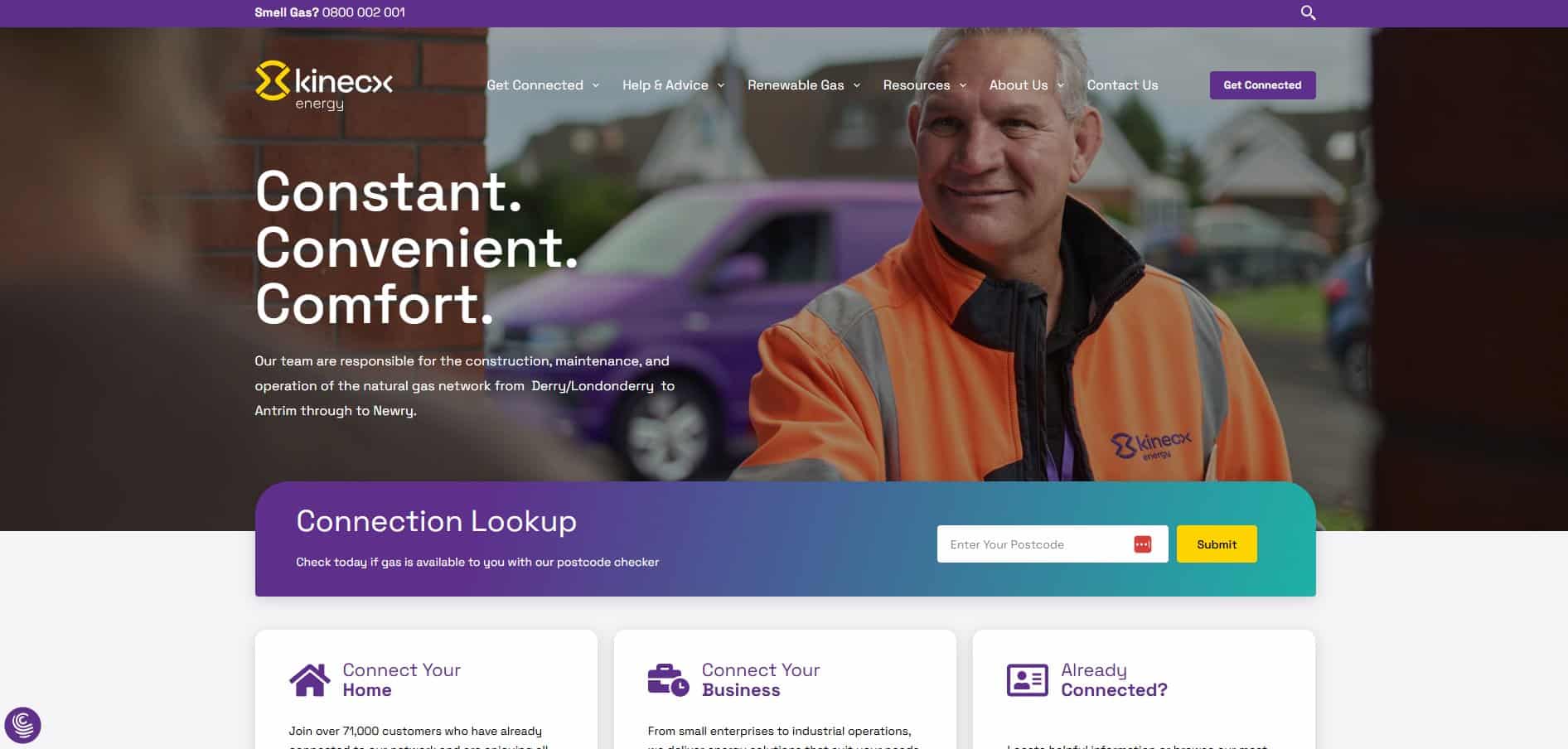
About Kinecx Energy: The Project
Kinecx Energy is the natural gas distribution business established by Firmus Energy Networks, one of Northern Ireland’s leading energy providers. The company is responsible for distributing natural gas to more than 75,000 customers across the Ten Towns network area of Northern Ireland, with over 65 employees managing network operations and customer connections. Its gas network is among the most modern in Europe and operates under the regulatory oversight of the Northern Ireland Utility Regulator.
Before this project, Kinecx operated as part of a combined supply-and-distribution website. As the organisation separated its distribution activities under the new Kinecx brand, it needed a dedicated digital platform that reflected that operational distinction — one that served distribution customers directly, supported regulatory compliance, and could be managed by the internal team without ongoing developer dependency.
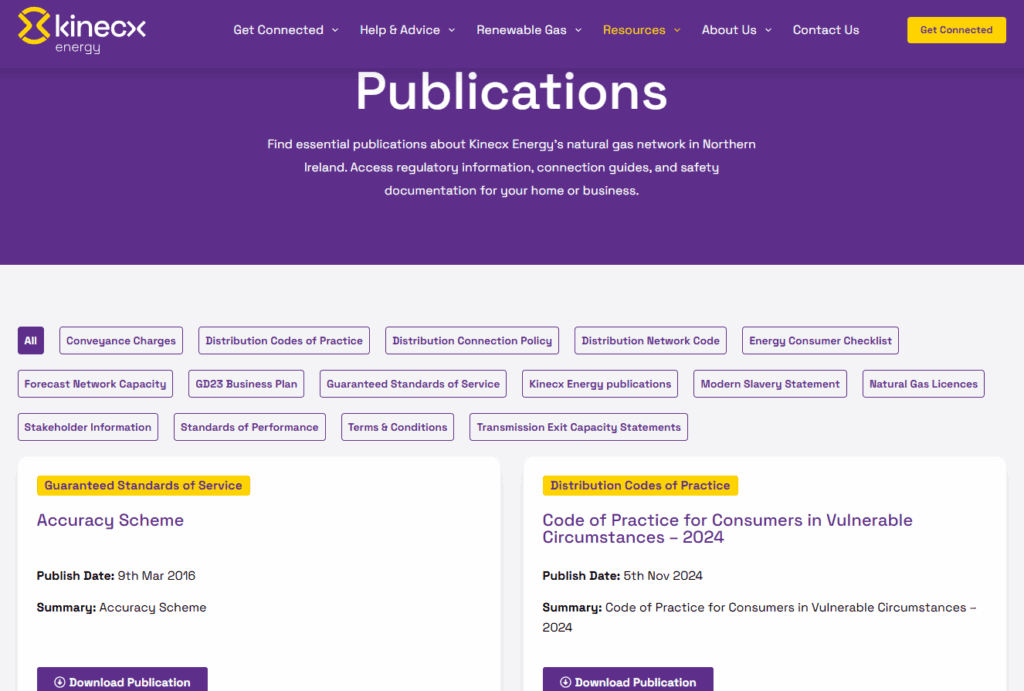
What We Did: The Energy Sector Website Design Approach
Discovery and Information Architecture
The project began with a detailed planning phase to map the distinct journeys of each customer type. Distribution customers arriving at the site fall into two groups: homeowners and businesses checking connection eligibility, and existing network customers or stakeholders looking for operational information and compliance documents. These groups needed separate, clearly signposted pathways within a unified site structure.
ProfileTree organised the site into five primary sections — Home, Connection Services, Help and Advice, Policies and Publications, and a Resources hub — each structured around the tasks users needed to complete rather than the internal divisions of the organisation.
CMS Build and Platform Selection
The client’s existing platform used ExpressionEngine, a system that had become a barrier to independent content management. ProfileTree migrated the platform to a modern CMS chosen for flexibility, editorial control, and scalability. The new system allows the internal team to update content, publish regulatory documents, and manage metadata without developer support — removing the compliance risk that came with the older system.
Gas Connection Lookup Tool
The most technically complex element of the project was the connection eligibility lookup. ProfileTree built a tool that integrates directly with the client’s internal property database, allowing homeowners and businesses to check in real time whether their address falls within the distribution network. This replaced a manual enquiry process, reduced response times for potential customers, and removed routine load from the client’s support team.
Accessibility and SEO Foundations
The site was built to WCAG 2.2 AA standards from concept through to delivery, including keyboard navigation, appropriately specified alt text, and contrast compliance throughout. Technical SEO — structured metadata, page speed optimisation, and schema markup — was integrated into the build rather than added after launch. Analytics tools were configured to provide ongoing visibility into user behaviour, content performance, and traffic sources.
Results
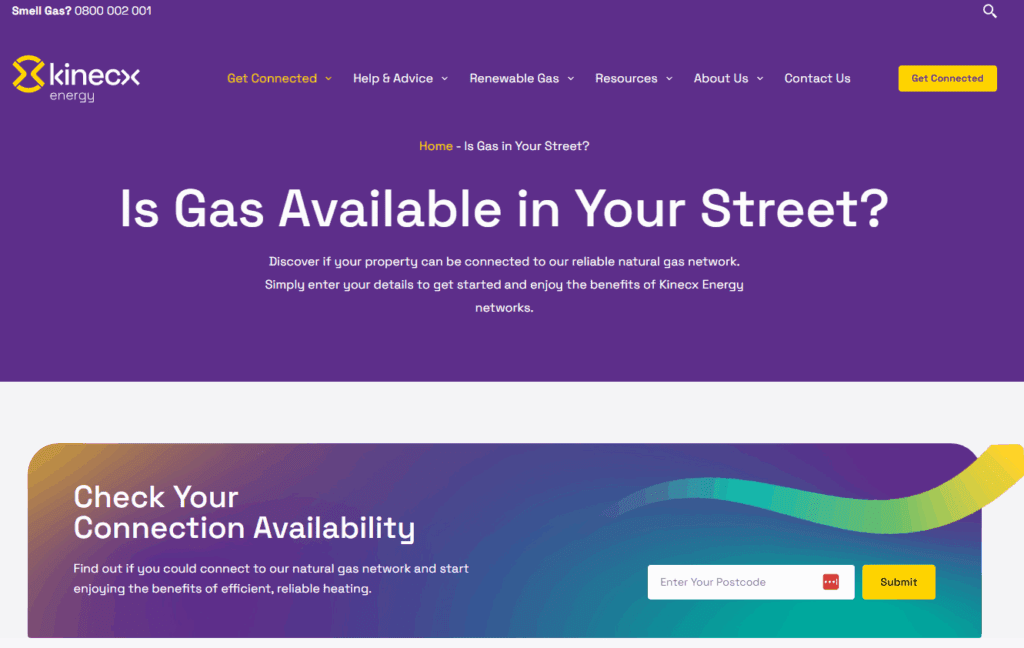
The Kinecx Energy website launched with full WCAG 2.2 AA accessibility compliance and within performance thresholds on both desktop and mobile devices. The connection lookup tool went live integrated directly with the client’s internal database, replacing the previous manual enquiry process. The client’s internal team can now update all site content, publish regulatory documents, and manage SEO metadata independently.
The separation of distribution and supply into distinct digital platforms removed the navigational confusion that had characterised the previous combined site. Danielle Dunbar, Marketing Manager at Kinecx, noted the improvement in user functionality alongside the design quality: “Working with ProfileTree was a great experience. Our new website not only looks great but truly connects with our audience with increased user functionality.”
How ProfileTree Approaches Energy Sector Website Design

Regulated utilities require a different project framework to standard commercial web design briefs. The regulatory dimension is not a footnote — it shapes the information architecture, the CMS requirements, the document management structure, and the content review process. Before any design or development work begins, ProfileTree maps the specific compliance obligations that will affect what the site must publish and how often it must be updated.
The technical build for energy sector clients typically centres on three elements: a CMS that the internal team can operate independently, integrations with operational systems such as connection databases or network management tools, and an information structure that separates distinct customer audiences without fragmenting the site into disconnected sections. Accessibility compliance is a standard part of every energy sector build because regulated utilities are expected to serve all customers, regardless of ability or device.
For energy companies, utilities, and regulated businesses considering a website rebuild or platform migration, our web design services for businesses across Northern Ireland and the UK cover what a structured project looks like from discovery through to launch and ongoing support.
ProfileTree has delivered web design and digital marketing projects for businesses across Belfast and Northern Ireland. As part of our ongoing web design work in Belfast, the Kinecx Energy project reflects the operational complexity that local and regional utilities face when building a digital presence that meets both customer and regulatory expectations.
Frequently Asked Questions
What makes energy sector website design different from standard commercial web design?
Regulated energy businesses have compliance obligations that directly affect how their websites are structured and maintained. Mandatory documents — operational policies, environmental statements, regulatory publications — need to be accessible to the public and kept current. The information architecture must separate different customer types clearly, because supply and distribution customers have completely different needs. CMS selection is also more significant: if staff cannot update the site independently, compliance and customer service both suffer.
What should a utility or energy distributor’s website include?
At minimum: a clear explanation of the services provided and the network area covered, a way for customers to check eligibility or access self-service information, a searchable document hub for regulatory and policy publications, prominent signposting between different customer audiences, and full accessibility compliance. A connection lookup or similar self-service tool is valuable for distributors because it reduces manual enquiry handling and provides faster responses for potential customers.
How does a gas connection lookup tool work on a website?
A connection lookup integrates with the energy company’s internal property or network database, allowing a user to enter their address and receive a real-time result confirming whether their property falls within the distribution network. The technical requirements involve a secure API connection between the website and the underlying database, with appropriate data handling and error management. The user experience needs to be simple enough that customers complete the check without support.
How long does it take to build an energy sector website?
A project of this scale — covering a new CMS build, custom tool integration, a full information architecture redesign, accessibility compliance, and content production — typically runs twelve to sixteen weeks from the initial discovery phase to launch. The variables are the complexity of any system integrations and the content review process, which, for regulated businesses, often requires sign-off on specific language around network operations and compliance obligations.
How does accessibility compliance work for a utility website?
WCAG 2.2 AA is the standard used in this project and the benchmark ProfileTree applies to all public-sector and regulated business builds. Compliance requires keyboard navigation throughout the site, sufficient colour contrast across all text and interface elements, descriptive alt text for images, and layouts that remain usable at different text sizes and on all devices. Regulated utilities are expected to serve all customers, including those with disabilities, and accessibility compliance is part of meeting that obligation.
Can a regulated energy website be maintained without ongoing developer support?
Yes, provided the CMS is chosen and configured with internal team management in mind. The Kinecx project was specifically designed so that the client’s team could publish new documents, update content, manage metadata, and add news items without external developer involvement. Legacy systems like ExpressionEngine often lack this flexibility, which is one of the primary reasons energy businesses move to modern CMS platforms. When staff can maintain the site independently, both compliance and customer service improve.