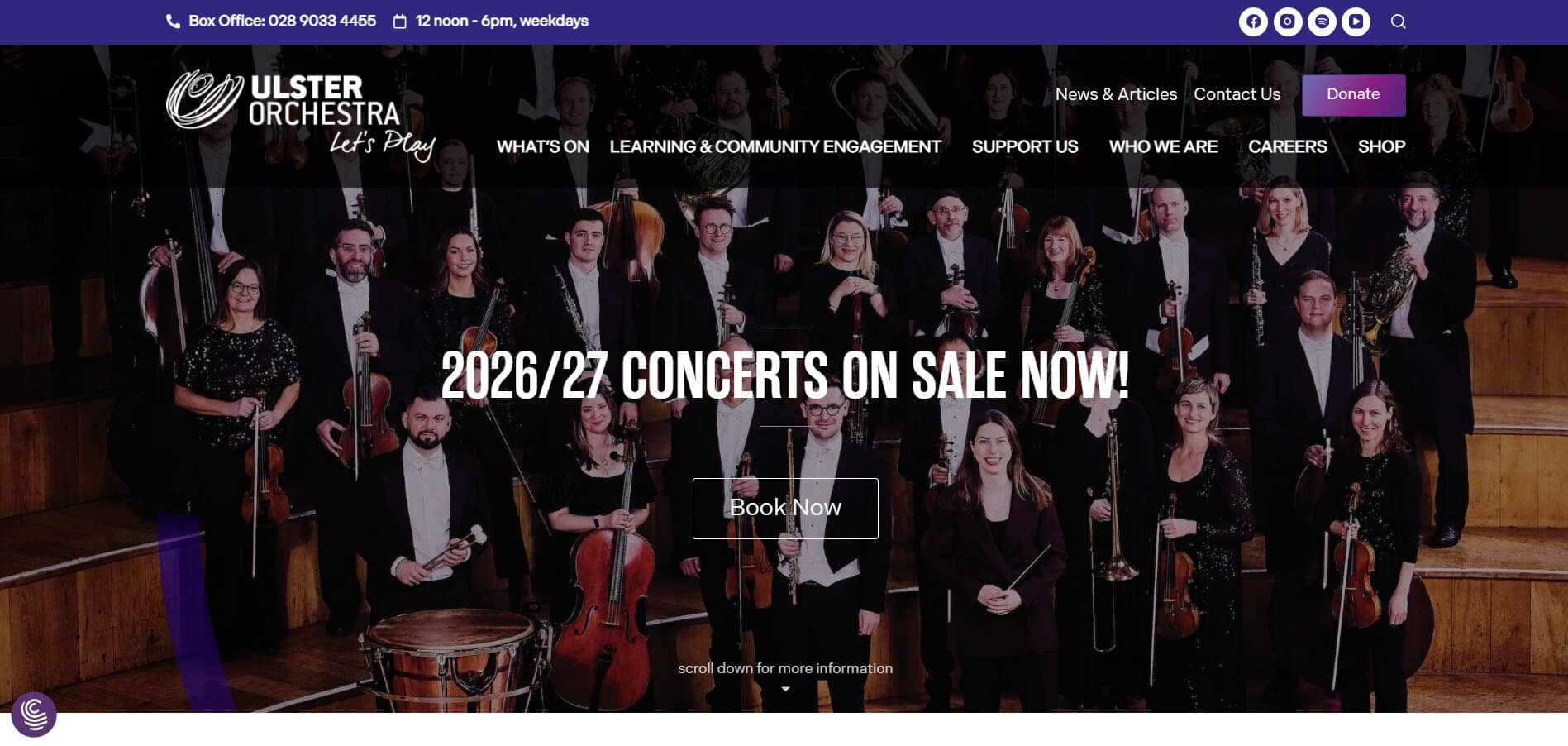
ProfileTree, a web design and digital marketing agency based in Belfast, builds websites for arts organisations, venues and cultural charities across Northern Ireland and the UK. This case study covers two phases of work for the Ulster Orchestra: a new WordPress website in 2025, replacing a complicated and outdated CMS the team could not manage in house, and the rollout of the Society’s 2026 rebrand across the live site rather than through a rebuild. Since launch, the client has also reported a significant rise in enquiries arriving from AI search results.
An orchestra website design is not one thing. It is a rolling concert listing that changes weekly, a learning and community programme with its own audiences and funders, a fundraising operation, a recruitment platform for professional musicians, and the public record of an institution with a history worth telling. Each of those needs different content, different structure, and different people inside the organisation updating it.
That is where legacy content management systems fail arts organisations specifically. When publishing a concert requires developer support, or the CMS is complicated enough that only one person is confident using it, the listings fall behind. A concert that goes on sale on Monday and appears on the site on Thursday has lost three days of selling. Across a full season that compounds into real ticket revenue, and it is entirely a systems problem rather than a marketing one.
Arts audiences also search in two completely different ways. Some search for the organisation by name, or for a specific concert or performer, and those people are already committed and simply need to be able to buy. Others search by category and place: an orchestra in a city, classical music concerts near them, something to do at the weekend. That second group has not heard of the ensemble yet, and reaching them requires the site to rank for terms that have nothing to do with the organisation’s name.
Then there is rebranding. Arts organisations refresh their identity more often than most sectors, and a rebrand is the point at which many of them lose the search performance they have spent years building, because the brand refresh gets treated as a reason to rebuild the website from scratch.
About the Ulster Orchestra: The Project
Founded in 1966, the Ulster Orchestra has been central to musical life in Northern Ireland for six decades, and its full-time musicians form the region’s only professional symphony orchestra. It has had a distinguished line of principal conductors, with Anna Handler taking up the role of chief conductor from autumn 2026. The Orchestra performs at the Ulster Hall and the Waterfront in Belfast alongside a touring programme that reaches venues across Northern Ireland, and it has a longstanding broadcast relationship with BBC Radio 3 and BBC Northern Ireland.
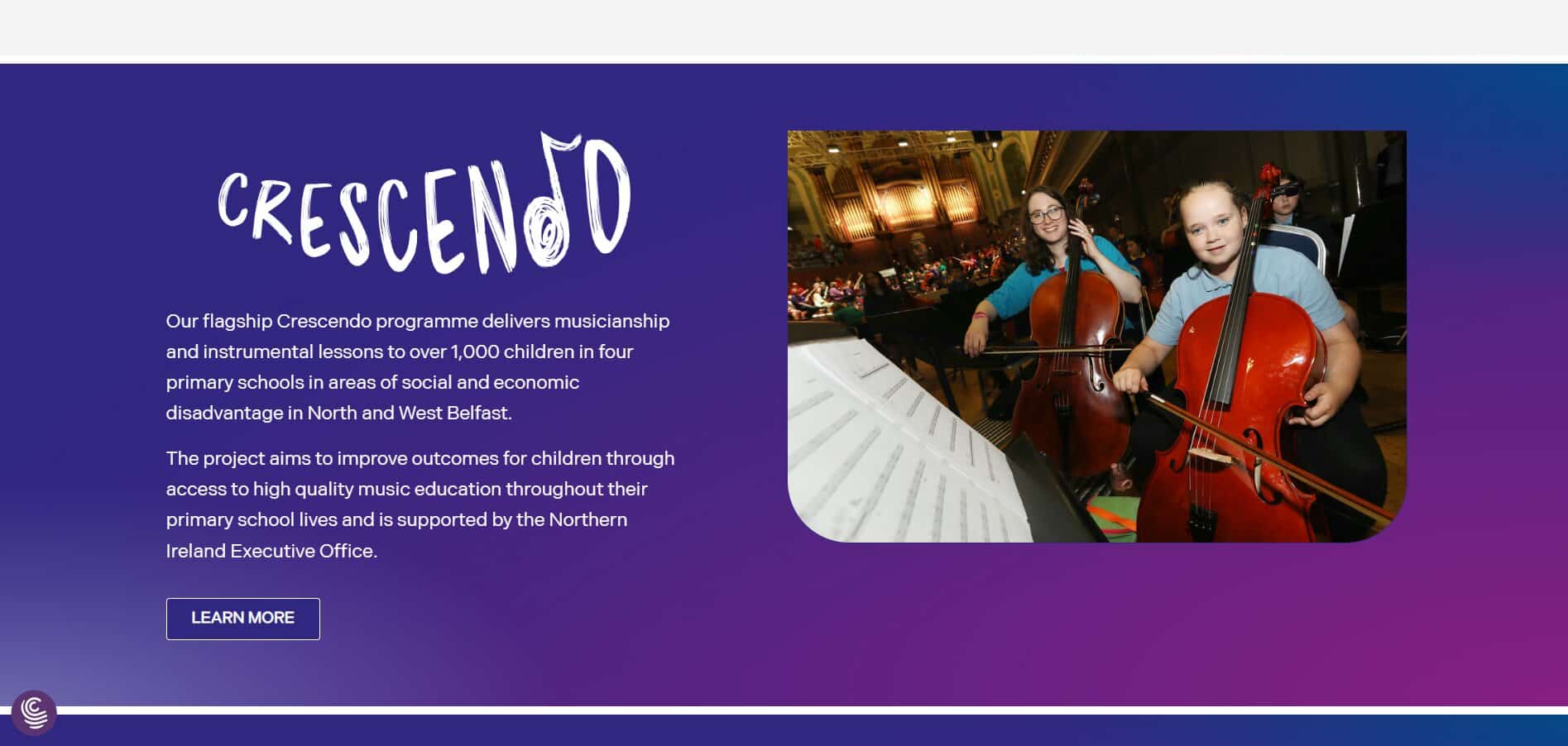
Beyond the concert platform, the organisation runs a substantial learning and community engagement programme. Its flagship Crescendo project delivers musicianship and instrumental lessons to over 1,000 children across four primary schools in areas of social and economic disadvantage in North and West Belfast, supported by the Northern Ireland Executive Office. The Professional Experience Scheme gives emerging players time with a working symphony orchestra. Ulster Orchestra Society Limited is a registered charity based at Townsend Street in Belfast, with principal funding from the Arts Council of Northern Ireland, BBC Radio 3, BBC Northern Ireland and Belfast City Council.
The digital problem was the platform, not the ambition. The previous CMS was complicated and out of date, and it made day to day management difficult for a team that needs to publish concerts, news, vacancies and programme updates continually.
What We Did: Two Phases of Work
Phase One, 2025: A Build the Team Could Run
The measure of success was not how the site looked on launch day but whether the marketing and communications team could run it afterwards.
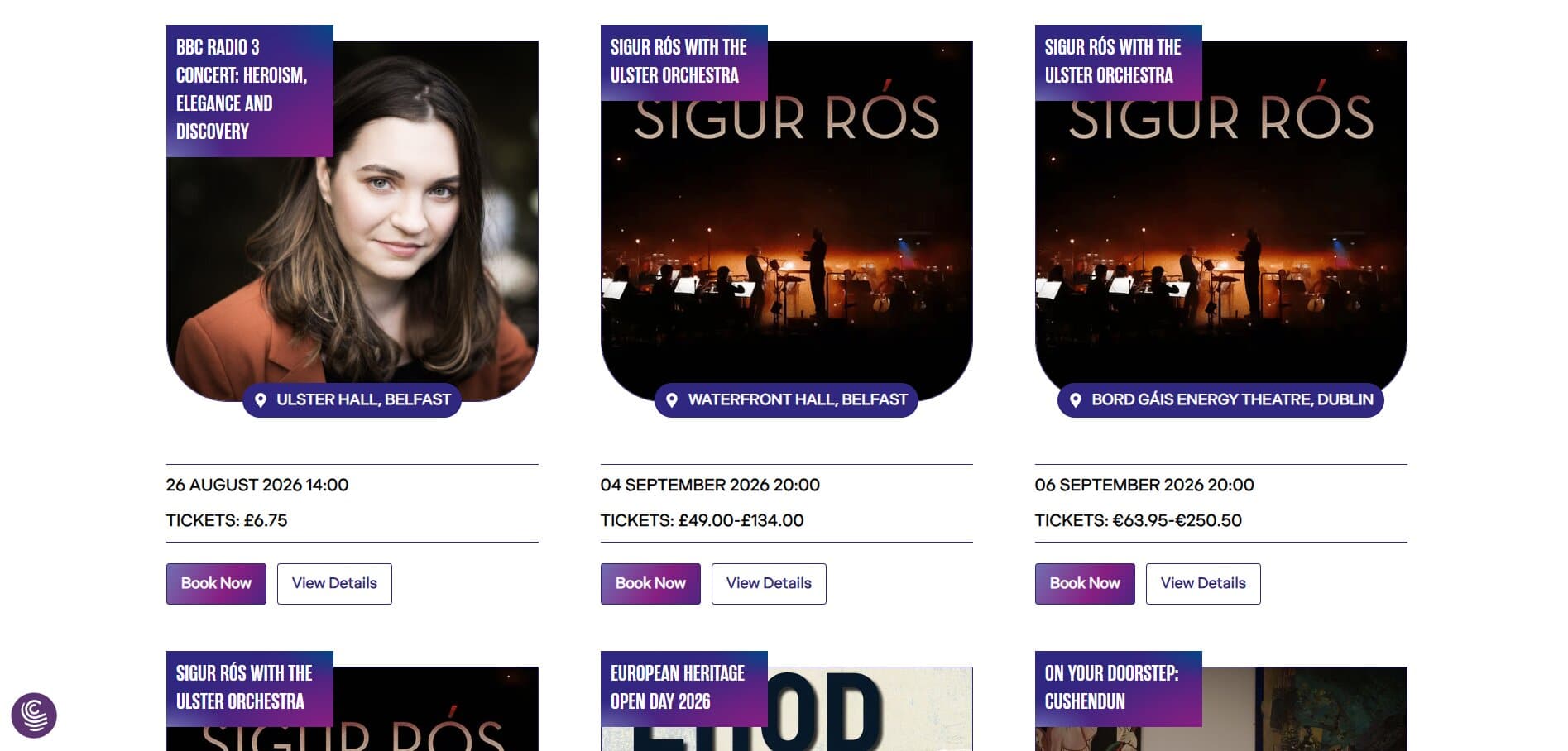
That shaped the structure. What’s On was built as a proper event system rather than a page edited by hand, so a new concert is published once as a record with its date, venue, ticket prices, programme detail and booking link, then appears automatically wherever it needs to appear across the site. Booking routes point out to the relevant box office for each venue, which is how the Orchestra actually sells, so the site had to handle several different ticketing destinations cleanly rather than assuming one.
The rest of the architecture was mapped to the organisation’s real audiences rather than its internal departments. Learning and Community Engagement was given room to explain Crescendo and the wider programme to the schools, families and funders who need to understand it. Support Us was structured for patrons, corporate members, sponsors and legacy giving, each of which is a different conversation. Who We Are covers the history, the artistic team, the players and the BBC relationship, with individual pages for conductors and principals. Careers was built out properly, including vacancies and the Professional Experience Scheme, because recruiting musicians is a genuine function of the website.
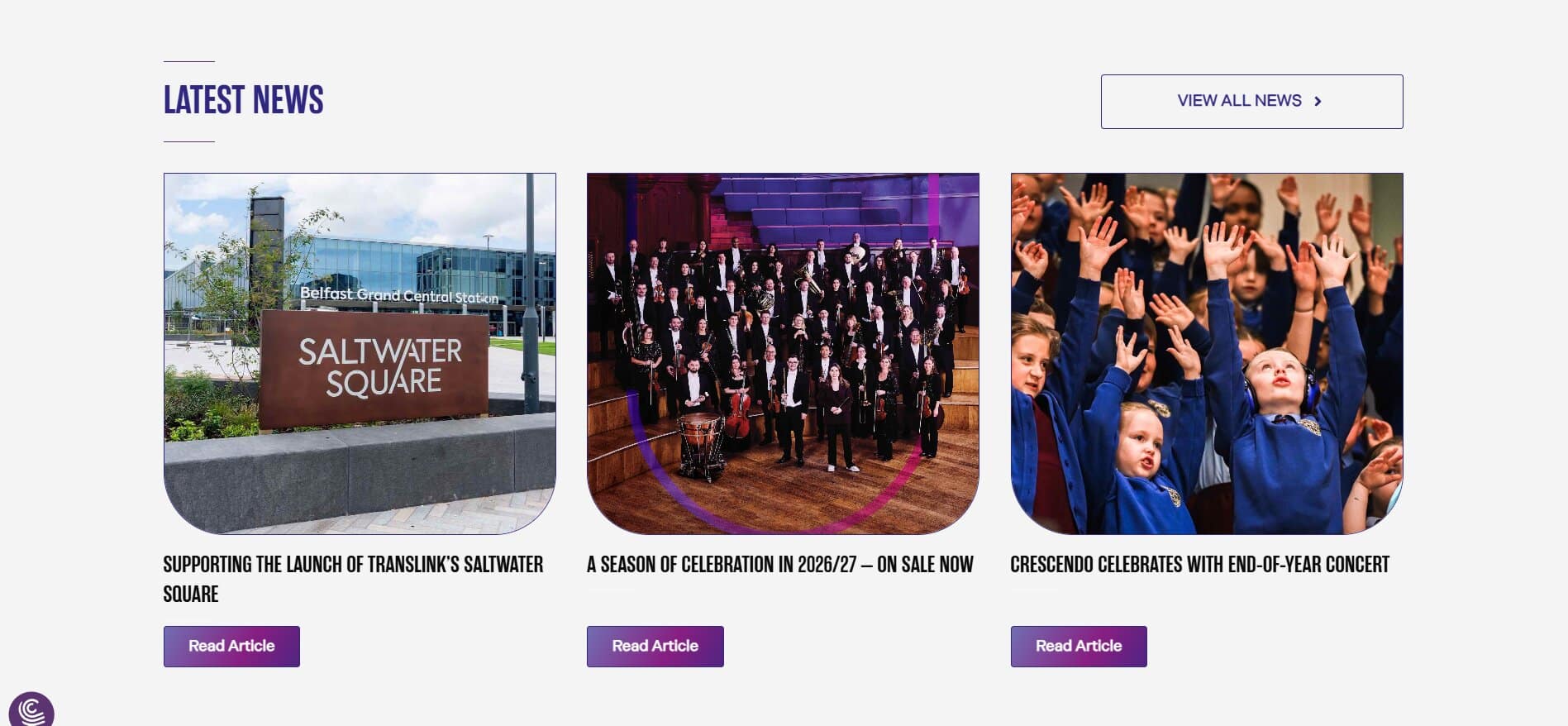
Technical SEO was built in rather than added later: structured event data, clean URL patterns, descriptive metadata and internal linking between concerts, performers and programme pages. Then came the part that mattered most. Training and handover gave the internal team the ability to publish concerts, news, vacancies and page content themselves, and the volume of live, current content the site now carries is the clearest evidence it worked.
Phase Two, 2026: Rolling Out the Rebrand Without Rebuilding
In 2026 the Ulster Orchestra Society completed a rebrand, and this is the part of the project worth paying attention to, because it is where most organisations go wrong.
A new identity is very often used as the trigger for a new website. That means a new build, a new URL structure, a migration, and a period of lost search performance that can take six months or more to recover, all to accommodate a change that is essentially visual.
We did the opposite. The new brand was applied throughout the existing site: the updated colour palette across every template and component, the new typography, and the new graphic language and supporting assets carried consistently through the concert listings, the learning and engagement sections, the fundraising pages, the news archive and the individual event templates. The site changed how it looked. It did not change what Google understood it to be.
The result is that the Orchestra got a fully rebranded digital presence with no migration, no URL changes, no redirect risk, and no interruption to the rankings and visibility the site had built through 2025 and into 2026. That is the case for treating a rebrand as a design system change rather than a website project. It is faster, it costs less, and it protects the asset.
The Result That Is Hardest to Measure and Easiest to Notice
Since the site launched, the Ulster Orchestra team has reported a significant rise in enquiries arriving from AI search results. People are asking assistants such as ChatGPT, Gemini and Perplexity about orchestras, classical concerts in Belfast, music education programmes and what is on this weekend, and they are arriving at the Orchestra having been pointed there by an AI answer rather than a blue link.
That is not an accident, and it is not something a website gets for free. AI answer engines draw overwhelmingly from pages that already rank: industry analysis puts the share of AI Overview citations coming from pages in the top 20 organic results at around 97%, and roughly 44% of citations come from the first 30% of a page. The Ulster Orchestra site satisfies both conditions, which is why it is being cited:
It ranks widely. Hundreds of non branded searches now return the site on the first page or close to it, across the concert programme, the learning work and the organisation itself. That breadth is the entry ticket to AI citation.
Its content is structured, not narrative. Every concert is a record with a date, a venue, a price and a booking link, marked up with event schema. That is precisely the format an AI system can read, verify and repeat when someone asks what is on in Belfast next week.
It answers entity questions directly. Pages covering the players, the artistic team, the history and the BBC relationship exist as distinct, factual, well structured pages, and the players page is one of the strongest performers on the site. When an assistant is asked who conducts the Ulster Orchestra or who plays in it, there is a clean authoritative source to draw from.
It is internally consistent. One canonical set of facts about venues, programmes, contact details and ticketing, maintained by the team in house, rather than contradictory information spread across an ageing site.
One honest caveat worth stating: Search Console does not report AI referrals, so the evidence here is the client’s own account of enquiry sources rather than a figure we can pull from a report. The structural picture supports it, and the measurement approach going forward is to segment referral traffic from the assistant domains in analytics and track it as its own channel.
The wider point for arts organisations is that the work which earns AI visibility is not a separate discipline. Structured event data, pages that answer clear questions, strong organic positions and a team publishing current content are the same things that make a site work for audiences. Doing them properly is what gets you cited.
Results
The picture across both phases is a site performing strongly and improving as it matures.
The concert listings are the engine. What’s On is the strongest-performing section on the site, converting well above the site average and running close to the homepage in total traffic; individual concert pages convert even better. That is the event system built in 2025 doing exactly what it was designed to do.
Category visibility now reaches people who have not heard of the Orchestra. Searches for an orchestra in Belfast, and for classical music and classical concerts in the city, return the Orchestra at or near the top of the first page. Those are the searches that grow an audience rather than serve one that already exists.
Branded search converts at a rate most organisations never see. When people search the Orchestra by name, or for what is on, or for the Professional Experience Scheme, the overwhelming majority of them click through, which is what happens when the page gives them exactly what they came for.
Recruitment and programme pages perform in their own right. The Professional Experience Scheme and the learning pages, including Crescendo, both draw substantial visibility, reaching audiences a concert listing alone would never touch. Event structured data is also earning enhanced results in search rather than plain listings.
Mobile dominates and performs, outranking and outconverting desktop by a wide margin, which is unsurprising for an audience checking what is on from a phone. Reach also extends well beyond Northern Ireland, with meaningful visibility across Britain, Ireland, the United States and Europe, which matters for an orchestra with a broadcast profile and an international artistic roster.
One pattern is worth explaining rather than glossing over. Traffic tracks the concert calendar, easing between seasons in the summer when the new programme is announced, but fewer immediate dates are being searched for, then recovering as the season approaches. Engagement rates were at their strongest late in the period measured. For an arts organisation, this is worth planning around rather than worrying about: the summer gap is the natural window for content that is not date-dependent, such as the history, the artistic team, the learning programmes, and the recruitment pages. Those are also the pages AI systems draw on most readily, since they answer questions rather than announce dates.
“The Ulster Orchestra team publish constantly, and that was the whole point of the 2025 build. When the rebrand came in 2026, the instinct in most organisations would have been to start again. Rolling out the new identity across the existing site gave them a brand-new look without handing back the search visibility they had spent a year building. The AI enquiries they are seeing now are the compounding effect of that decision.” Ciaran Connolly, Founder, ProfileTree
How ProfileTree Approaches Websites for Arts and Cultural Organisations
The first question on any arts project is who inside the organisation will run the site once it launches. Concert listings, seasonal programmes, vacancies and news are published weekly, so a platform that requires developer involvement will fall behind within a month. Everything about the build follows from answering that honestly, including the website development approach and the depth of the handover training.
From there, the sequence is consistent. Build the listings as structured records rather than hand-edited pages, so one entry populates the site and marks itself up for search and AI surfaces. Give the non-concert audiences, learning programmes, funders, patrons and prospective staff sections with real depth, because they generate a substantial share of both traffic and organisational value. Rank for the category terms as well as the organisation’s name, since the category terms are what reach a new audience. And when the brand changes, change the brand, not the website.
For arts organisations, venues, festivals and cultural charities considering a rebuild, a rebrand rollout or a platform migration, our web design services for organisations across Northern Ireland, Ireland and the UK cover the process from strategy and architecture through to launch, training and ongoing support.
Frequently Asked Questions
Will a rebrand mean rebuilding our website and losing our search rankings?
Not if the existing platform is sound. A rebrand is a change to the visual system: colours, typography, graphic assets and imagery. Where the site is built on a flexible CMS with a proper template structure, the new identity can be applied throughout the live site without changing URLs, page structure or content, which means no migration and no ranking risk. That is how the Ulster Orchestra rebrand was rolled out in 2026, and the site’s search performance carried straight through it. Rebuilding is only necessary when the underlying platform is the actual problem, which in this case had already been dealt with in 2025.
What should an orchestra or arts venue website include?
A structured event system rather than hand-built listing pages, so concerts publish once and appear everywhere with the right date, venue, price and booking link. Clear booking routes to whichever box office handles each venue. Sections with real depth for learning and community programmes, since funders and participants both need them. A fundraising area structured by giving type. Pages for the players, conductors and history, which are what people and AI assistants search for by name. And a careers section, because recruitment is a real function of an arts website.
Can an in-house arts marketing team manage a WordPress site day to day?
Yes, and for arts organisations it is close to essential given how often content changes. The Ulster Orchestra team publishes concerts, news, vacancies and programme updates without developer involvement, and the volume of current, indexed content on the site reflects that. The determining factors are how the CMS is configured, whether the templates are flexible enough to handle unusual content, and how thorough the handover training is. Training matters less for showing which buttons to press than for agreeing on which tasks are self-serve and which should come back to the development team.
Why do individual concert pages convert better than the homepage?
Because the intent behind the search is more specific. Someone searching for a named concert, or for what is on in a particular week, wants dates, prices and a way to book, and a page that gives them all three answers the query completely. On this site, the concert pages convert well above the site average. It is a good argument for treating event pages as primary landing pages that deserve proper content, rather than as functional listings generated from a database and left alone.
How do you get an arts organisation cited in AI search results?
Rank in the top 20 first, because that is where the overwhelming majority of AI citations come from. Then make the content extractable: structured event data, factual pages that answer specific questions, clear headings, and the answer near the top of the page rather than buried below scene-setting copy. Keep the information consistent and current, which for an arts organisation means the internal team publishing rather than a site drifting out of date. There is no separate AI channel to optimise for, and no shortcut that bypasses organic performance.
How should we measure traffic coming from AI assistants?
Search Console does not report it, so the practical approach is to segment referral traffic from the assistant domains in analytics and track it as its own channel alongside organic. Enquiry and booking forms should also ask how the person found the organisation, since self-reported data is currently more reliable than referral data for this channel. Measurement here is still immature across the industry, and it is worth being straightforward about that rather than quoting precise figures nobody can verify.
Amazing Cars and Drives started as a low-budget internal experiment and became a car review website with over half a million YouTube views, brand partnerships with Ferrari, Lexus, and Mercedes-Benz, and a measurable shift...
Most companies that come to us with a learning management system requirement have already tried the quick route. They installed a plugin, set up a few courses, and found that it fell apart under...
Business parks and local enterprise agencies occupy an unusual position online. Their work is highly local, deeply community-rooted, and often includes a mix of services (workspaces, funded programmes, conferencing, virtual offices) that don't fit...
Navigate the digital landscape with a marketing strategy. Our team crafts comprehensive plans that resonate with your target audience, drive engagement, and boost conversions.
Elevate your digital proficiency. Our in-depth training sessions equip your business with cutting-edge digital marketing techniques to outperform competitors and thrive online.
Captivate and grow your social following. We create tailored social media strategies that ignite engagement, amplify your brand's online presence, and foster lasting connections.
Harness the power of your mailing list. Our precision-targeted email marketing campaigns are engineered to nurture relationships and drive tangible business outcomes.
Elevate your brand with our content marketing mastery. From thought-provoking blogs to eye-catching infographics, we craft content that captivates, informs, and converts your ideal audience.
Bring your brand's story to life with authenticity. We craft compelling narratives that strike a chord with your audience, forging a powerful emotional bond with your brand.
Empower your business with AI expertise. Our tailored training demystifies AI, equipping your team with the knowledge to leverage its potential for growth and innovation.
Transform customer service with AI chatbots. We develop sophisticated chatbots that elevate user experience, streamline interactions, and deliver unparalleled efficiency.
Transform your reach with AI-driven marketing. Harness data-driven insights for laser-targeted campaigns that captivate, engage, and convert your audience.
Optimise your operations with cutting-edge AI tools. We integrate intelligent solutions that streamline processes, enhance efficiency, and support data-driven decision-making.
Join Our Mailing List
Grow your business with expert web design, AI strategies and digital marketing tips straight to your inbox. Subscribe to our newsletter.