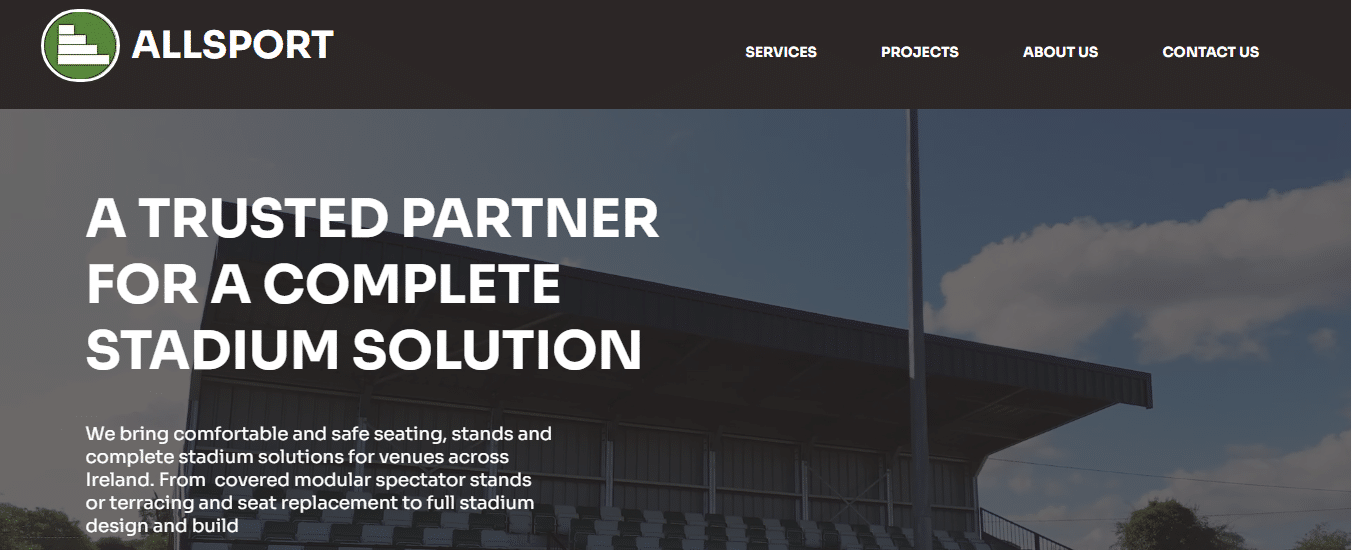
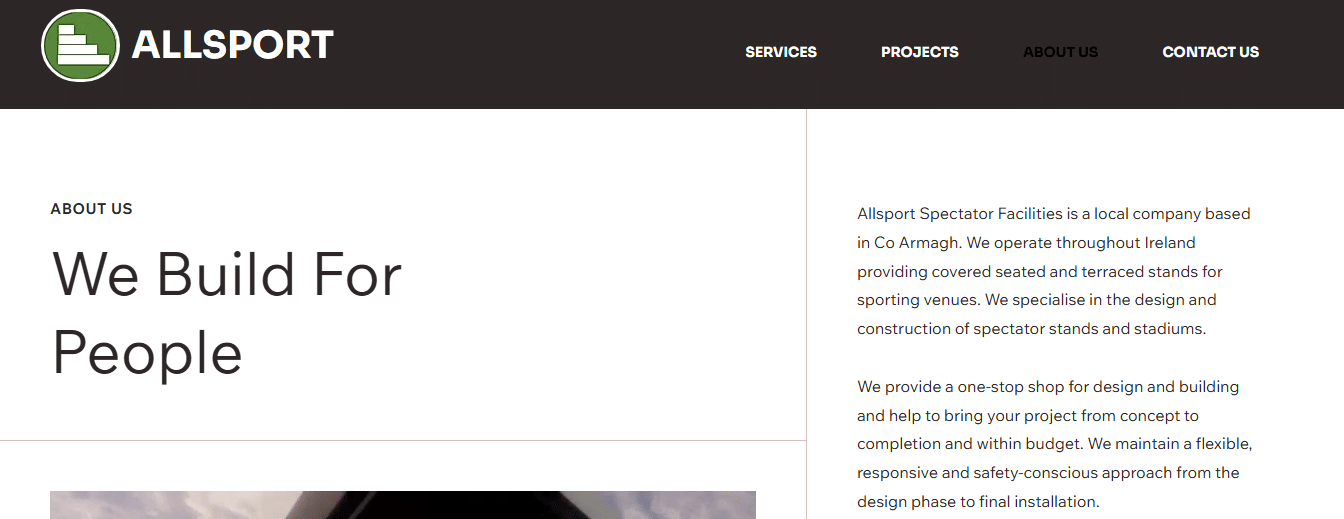
ProfileTree, a Belfast-based web design agency, built a conversion-focused digital platform for Allsport Ltd, a County Armagh stadium construction specialist serving sports clubs across Ireland. The project addressed lead generation, trust-building, and service visibility for a B2B company with 30 years of project experience.
The Challenge Sports Infrastructure Businesses Face Online
Specialist construction companies in Northern Ireland face a specific digital problem: the quality of their work rarely shows up on Google. Allsport Ltd had completed stadium builds, terracing solutions, and spectator stands for GAA clubs and football clubs across Ireland. Their reputation was built on referrals and completed projects. Their website was not doing any of that work for them.
The challenge for companies like Allsport is that their buyers — club committees, venue managers, and sports facility procurement teams — do research online before they pick up the phone. A club treasurer looking at a six-figure stand installation will check three or four suppliers before making contact. If your digital presence does not clearly show what you have built, who you have built it for, and why you are credible, you are not in that conversation.
The pattern we see repeatedly with specialist B2B contractors is that their websites fail on three fronts. First, service visibility: the site does not distinguish between different types of work. A club looking for a 200-seat seated stand and a club looking for basic terracing cannot tell from the homepage which applies to them. Second, project evidence: without a well-organised gallery showing real completed work at recognisable venues, there is nothing to anchor trust. Third, conversion: no clear path for a committee chair to request a consultation or get a preliminary quote.
Construction sector businesses are also increasingly expected to demonstrate digital credibility to funding bodies and grant programmes. For a broader picture of where construction companies stand with digital adoption, see our article on construction industry statistics and digital trends. The gap between the quality of work on the ground and the quality of the digital presence is one of the sector’s most consistent blind spots.
About Allsport Ltd: The Project
Allsport Spectator Facilities operates from County Armagh and delivers modular stadium construction solutions to sports clubs across Ireland. The company specialises in covered seated stands, terraced spectator areas, dugouts, and full stadium builds. With over 30 years of construction experience, their portfolio includes projects for Bohemians FC, Colin Valley FC, and a range of GAA and community clubs. This project is part of ProfileTree’s ongoing web design and digital marketing work across Northern Ireland.
When Allsport came to ProfileTree, their digital presence was not reflecting the scale or quality of their project history. The brief was to build a platform that communicated their full service range, showcased their completed work with proper visual depth, and gave sports clubs a clear path to begin a conversation about their specific requirements.
What We Did: The Web Design Approach
Content Architecture and Site Structure
We started with the information architecture rather than the visual design. The key question was how club decision-makers research stadium construction options — and the answer shaped every structural decision. Committees typically move from understanding what type of solution they need, to evaluating whether a supplier has done similar work, to assessing credibility before making contact.
The navigation structure we built reflects that journey: distinct service pages for seated stands, terracing, dugouts, and full stadium projects; a project gallery organised by client type and capacity; prominent testimonials from named clubs; and multiple contact routes depending on where a visitor is in their decision-making process.
Service Page Development
We created individual pages for each construction type, covering specifications, capacity ranges, compliance information (including Red Guide standards for spectator safety), and installation timelines. Separating these by service type means a club looking for a 50-seat stand can find directly relevant information without wading through content aimed at clubs commissioning a full stadium rebuild.
Each service page was written to answer the questions a committee treasurer or facilities manager would actually ask: what does this cost relative to traditional construction methods, what planning documentation is needed, what does the timeline look like, and what warranty is included. Allsport’s modular approach and 10-year warranty were built into the content as genuine differentiators.
Project Gallery and Social Proof
The project gallery was the most commercially important element of the build. We organised completed projects by client type, venue scale, and construction category, so a GAA club looking for covered terracing can find directly relevant examples rather than browsing a generic portfolio. Each entry includes high-quality photographs, client name, location, and capacity details.
Testimonials from named clubs — including Wolfe Tone GAC and St Peter’s GAA — were integrated across the site rather than siloed on a single testimonials page. For B2B purchases of this scale, social proof from recognisable organisations carries significantly more weight than generic star ratings.
Technical Build and Mobile Performance
The platform was selected to handle extensive image galleries, support video content, and provide Allsport’s team with straightforward content management. Mobile responsiveness was treated as a baseline requirement, not an afterthought — club committee members research options on mobile devices, and the gallery navigation, contact forms, and service pages all needed to work cleanly across screen sizes.
Results
The new website positions Allsport Spectator Facilities as a credible, professional partner for sports infrastructure investment across Ireland. The project gallery functions as a direct sales tool: the team can share specific examples with prospective clients that match their venue type, capacity requirement, and budget. Clubs that previously would not have found Allsport through online research can now discover them through targeted searches.
The combination of dedicated service pages, named testimonials, and structured contact pathways has reduced the qualification burden on the Allsport team. Enquiries arrive with realistic expectations about timelines, construction methods, and costs — because that information is available on the site before anyone picks up the phone. The flexible content management system allows the team to add new projects, update specifications, and publish case studies independently as the business grows.
How ProfileTree Approaches Web Design for B2B Specialist Businesses
Every B2B web design project we take on starts with the same two questions: what does the business want the website to do, and what is currently stopping it from doing that? For specialist contractors and infrastructure businesses, the answer to the second question almost always comes back to the same issues — the service range is not clearly differentiated, the project evidence is not well organised, and there is no obvious path for a qualified buyer to make contact.
Our approach for companies like Allsport focuses on translating operational credibility into digital credibility. The work they have done over 30 years is genuinely impressive. The website needed to make that visible to someone who has never heard of them and is comparing three or four potential suppliers on a Tuesday evening.
For B2B businesses with a complex service range, the structural work — separating services into distinct pages, organising project evidence by client type, building conversion pathways for buyers at different stages — is as important as the visual design. If you work in a specialist sector and your website is not generating enquiries that match the quality of your work, our web design services for specialist and B2B businesses cover the full process from strategy and architecture through to build, SEO, and ongoing support.
Frequently Asked Questions
What should a stadium construction company include on its website to generate enquiries?
The most important elements are clearly separated service pages for each construction type, a project gallery organised by client type and capacity, named testimonials from recognisable clubs or venues, and visible contact pathways that work on mobile. Clubs making significant infrastructure investments want to see that you have done comparable work at a similar scale before they make contact. A pricing or cost framework — even a broad range — also helps qualify enquiries before they come in.
How long does it take for a B2B construction website to generate leads?
For most specialist B2B projects, the new site starts generating qualified enquiries within two to four months of launch, particularly where the business already has some brand recognition through word of mouth or completed projects. For businesses starting with no existing online presence, building organic visibility typically takes six to twelve months. The key factor is whether the site is maintained after launch — adding new projects, updating service pages, and building topical content around relevant industry terms extends reach steadily over time.
Is a Wix or template-built site adequate for a specialist construction company?
For a company at Allsport’s scale, with a complex service range and a high-value B2B buyer, template sites tend to fall short on two counts. First, the service differentiation and project gallery depth that serious buyers expect is difficult to achieve on most template platforms without significant customisation. Second, content management independence matters — the team needs to be able to add new projects and service updates without developer involvement. The right platform depends on the specific business, but the decision should be driven by what the site needs to do, not by upfront cost.
How does web design for sports infrastructure differ from standard business websites?
The primary difference is the buyer journey. Sports clubs and venues making infrastructure decisions involve committees, funding applications, and lengthy approval processes. The website needs to support a longer consideration period: detailed service information that can be shared with multiple stakeholders, project evidence that maps to specific club types and capacities, and content that addresses the practical questions raised during planning and funding processes. It is less about immediate conversion and more about sustained credibility across multiple touchpoints.
Can a specialist construction company manage content updates without developer support?
Yes, if the site is built on the right platform with a modular content system. We build sites that give the business team full control over adding project entries, updating specifications, publishing news, and managing contact forms — without needing to call a developer for routine content changes. This is particularly important for construction companies whose project portfolios grow continuously and whose service descriptions need to reflect current capabilities and compliance standards.
What is the ROI case for professional web design for a stadium construction company?
For a business where a single contract can be worth tens or hundreds of thousands of pounds, a website that generates even one additional qualified enquiry per quarter delivers a strong return. The more specific calculation depends on average contract value, enquiry-to-conversion rate, and how many current enquiries are being lost to competitors with stronger digital presence. The Allsport project was built around making that gap measurable: a site that can be tracked, updated, and optimised as the business grows, rather than a static brochure that ages quietly.
In today’s competitive digital landscape, businesses face an ongoing challenge: standing out online. A well-designed website and engaging content are important, but they are not enough to secure top rankings in search results. To...
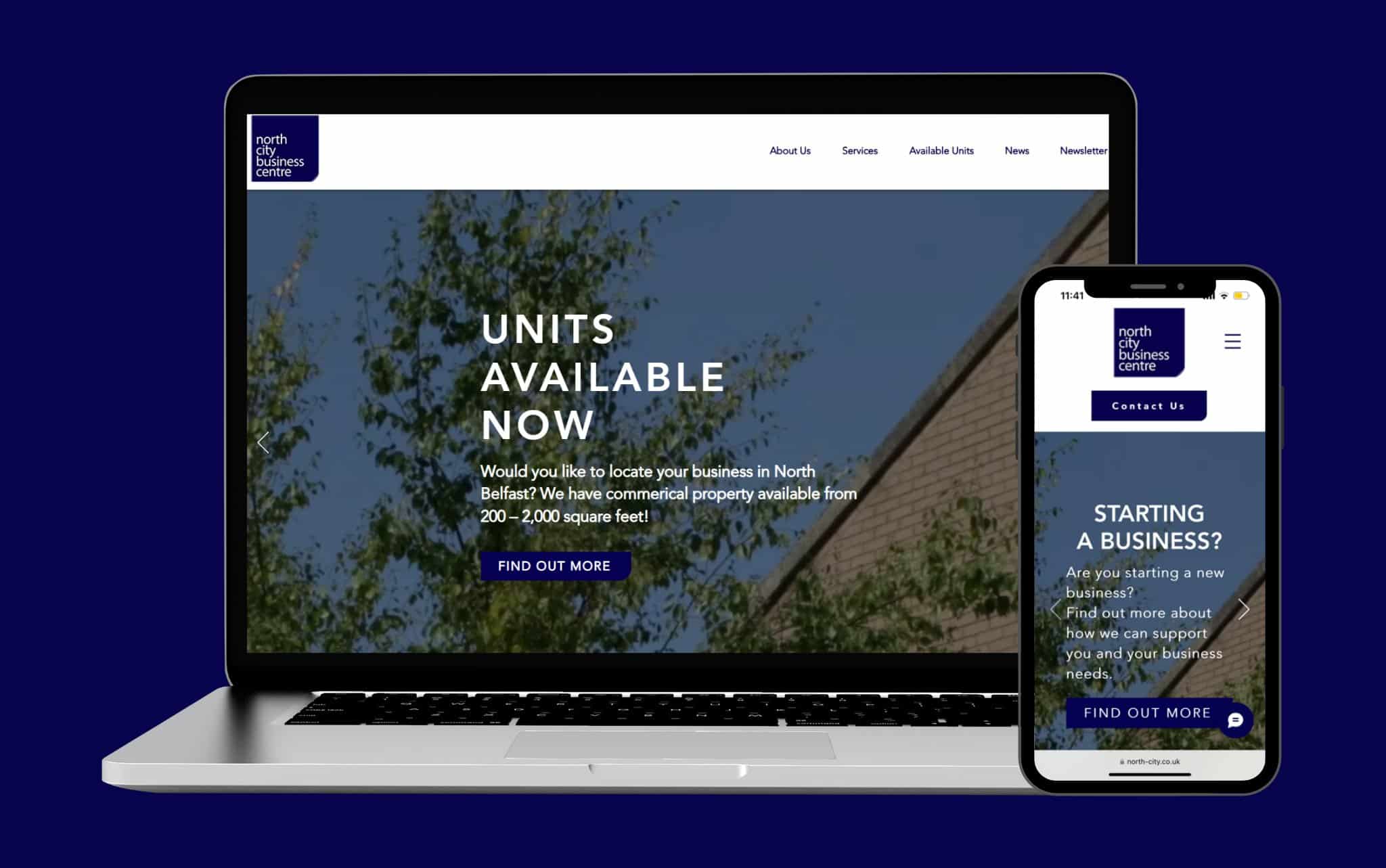
Business parks and local enterprise agencies occupy an unusual position online. Their work is highly local, deeply community-rooted, and often includes a mix of services (workspaces, funded programmes, conferencing, virtual offices) that don't fit...
Navigate the digital landscape with a marketing strategy. Our team crafts comprehensive plans that resonate with your target audience, drive engagement, and boost conversions.
Elevate your digital proficiency. Our in-depth training sessions equip your business with cutting-edge digital marketing techniques to outperform competitors and thrive online.
Captivate and grow your social following. We create tailored social media strategies that ignite engagement, amplify your brand's online presence, and foster lasting connections.
Harness the power of your mailing list. Our precision-targeted email marketing campaigns are engineered to nurture relationships and drive tangible business outcomes.
Elevate your brand with our content marketing mastery. From thought-provoking blogs to eye-catching infographics, we craft content that captivates, informs, and converts your ideal audience.
Bring your brand's story to life with authenticity. We craft compelling narratives that strike a chord with your audience, forging a powerful emotional bond with your brand.
Empower your business with AI expertise. Our tailored training demystifies AI, equipping your team with the knowledge to leverage its potential for growth and innovation.
Transform customer service with AI chatbots. We develop sophisticated chatbots that elevate user experience, streamline interactions, and deliver unparalleled efficiency.
Transform your reach with AI-driven marketing. Harness data-driven insights for laser-targeted campaigns that captivate, engage, and convert your audience.
Optimise your operations with cutting-edge AI tools. We integrate intelligent solutions that streamline processes, enhance efficiency, and support data-driven decision-making.
Join Our Mailing List
Grow your business with expert web design, AI strategies and digital marketing tips straight to your inbox. Subscribe to our newsletter.